eBook - ePub
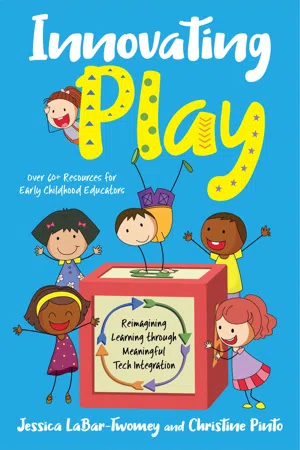
Innovating Play
Reimagining Learning through Meaningful Tech Integration
- English
- ePUB (mobile friendly)
- Available on iOS & Android
eBook - ePub
Innovating Play
Reimagining Learning through Meaningful Tech Integration
About this book
Innovating Play, early childhood educators Jessica LaBar-Twomey and Christine Pinto share the insights that led their kindergarten classes to generative, daily collaborations from opposite ends of the United States. In the process, they offer elementary educators a powerful set of digital tools that transform social-emotional learning. LaBar-Twomey and Pinto guide readers through the process of leveraging classroom technology in order to foster empathy and broaden horizons. With a warm, inviting style, and drawing from the rich examples of their own classrooms, Jessica and Christine offer a treasure trove of actionable, impactful tips that will help you seamlessly connect your students with the world around them.
Trusted by 375,005 students
Access to over 1 million titles for a fair monthly price.
Study more efficiently using our study tools.
Information
Topic
EducationSubtopic
Education GeneralII
Innovating Play in the Curriculum
Morning routines and rituals often focus on establishing safety and security within the learning community. As the day progresses, we develop routines for content areas that are driven by academic expectations and standards. This does not mean that the concepts in the routines need to become dry and detached from connection and meaning.
Reflecting on and reconsidering everyday routines in all areas gives us the opportunity to discover new ways to approach learning with connection.
We recognize that teachers all have different areas of growth and comfort levels, especially in the area of innovating with technology. In an effort to offer different levels of support, this section is dedicated to letting you into the thinking behind our work. It is our hope that by sharing our thinking, we will help each teacher to develop a mindset that inspires even more creative energy in the classroom.
Rather than starting with technology, all of the experiences we are about to share have unfolded from the big-picture ideas that we value as educators. Here are some of the types of questions that we kept in mind as we set out to develop a foundation for broadening literacy, math, and science routines:
- How can we support children in making deeper connections to the experience of reading?
- How do we bridge the worlds of books and digital media?
- How do we safely and thoughtfully simulate the experiences of consuming visual information and text that are out in the world?
- How can we support the development of a mathematical and scientific mindset that expands the natural connections children make to learning in the world?
- How can we use technology to reframe and more actively include learners in the collection and analysis of data?
- Why is it important to collect multiple sets of data? How can we easily include meaningful data from multiple sources in order to compare and contrast, ask questions, and draw conclusions?
- As districts across the country work to implement Next Generation Science Standards (NGSS), how can we use free tools to approach instruction with depth and authenticity?
- How can we use the structure of daily routines to create rich context for literacy, along with mathematical and scientific application of ideas?
- How does perspective shift when we move beyond observing what is in front of us to a larger view of the world?
As the questions driving our decisions became clearer, we created a foundation we could draw upon as we developed the practical facilitation of the experience. We zeroed in on our big ideas for routines across curricular areas, which are as follows:
- Literacy experiences are often built upon a series of connections that can be experienced, captured, documented, and extended through digital tools.
- Digital literacy represents an important element of learning that should be included in the process of developing emergent literacy skills and strategies.
- Digital tools offer multiple ways for children to collect and visualize information.
- Virtual spaces open up opportunities for collaboration between classrooms in order to communicate and analyze multiple sets of data. Using multimedia tools to collect information allows children to create a window into their immediate world that can be shared with others.
- Collaborative collection and sharing of data allow children to interpret on a local and global scale, supporting them in becoming thinkers beyond the walls of the classroom.
Taking time to ask questions and identify the big ideas that can focus your innovation efforts is an empowering approach for educators. It will not only help you to create a meaningful course of action but will constantly keep you and your students focused as you carry out these routines on a daily basis. This mindset is particularly important for routines that will be revisited every day of the school year. It is through the big ideas that we ensure our instruction continues to develop and grow in ways that meet our students’ needs on all levels, support the transfer of learning to the larger world, and create exciting and joyful moments in and beyond our classrooms each and every day.
Applying the Mindset and Lesson Planning
In this section of the book you will see different ways that we use the Innovating Play Cycle to facilitate learning experiences across the curriculum. We will share how we reimagine traditional literacy approaches as we connect with texts, ideas, and each other. We apply the idea of wonder to delve deeper into emergent literacy skills, strategies, and concepts. We take our curiosity beyond the idea of comprehension and pave the way for children to play with books and stories. Through this approach, they develop deeper personal connections to the texts and contribute to collaborative digital creations within and between classrooms. Digital class books, videos, and projects reflect the rich experiences in which the children discover as active participants and creators.
As we develop daily routines and special projects in areas of literacy, math, and science, we constantly return to the Innovating Play Cycle to ground these learning experiences. While we talk you through the application of the process for daily routines such as the days of school or weather collaboration, we also offer examples of specific projects for which a lesson plan framework is provided in the resources section. This lesson plan is meant to guide the planning of focused curricular projects between classes in order to ensure a rich, sta...
Table of contents
- Cover
- Praise for Innovating Play
- Title Page
- Dedication
- Contents
- Introduction
- I. Innovating Play with Routines and Rituals
- II. Innovating Play in the Curriculum
- III. Innovating Play
- IV. Moving Forward
- Acknowledgments
- About the Authors
- More from Dave Burgess Consulting, Inc.
Frequently asked questions
Yes, you can cancel anytime from the Subscription tab in your account settings on the Perlego website. Your subscription will stay active until the end of your current billing period. Learn how to cancel your subscription
No, books cannot be downloaded as external files, such as PDFs, for use outside of Perlego. However, you can download books within the Perlego app for offline reading on mobile or tablet. Learn how to download books offline
Perlego offers two plans: Essential and Complete
- Essential is ideal for learners and professionals who enjoy exploring a wide range of subjects. Access the Essential Library with 800,000+ trusted titles and best-sellers across business, personal growth, and the humanities. Includes unlimited reading time and Standard Read Aloud voice.
- Complete: Perfect for advanced learners and researchers needing full, unrestricted access. Unlock 1.4M+ books across hundreds of subjects, including academic and specialized titles. The Complete Plan also includes advanced features like Premium Read Aloud and Research Assistant.
We are an online textbook subscription service, where you can get access to an entire online library for less than the price of a single book per month. With over 1 million books across 990+ topics, we’ve got you covered! Learn about our mission
Look out for the read-aloud symbol on your next book to see if you can listen to it. The read-aloud tool reads text aloud for you, highlighting the text as it is being read. You can pause it, speed it up and slow it down. Learn more about Read Aloud
Yes! You can use the Perlego app on both iOS and Android devices to read anytime, anywhere — even offline. Perfect for commutes or when you’re on the go.
Please note we cannot support devices running on iOS 13 and Android 7 or earlier. Learn more about using the app
Please note we cannot support devices running on iOS 13 and Android 7 or earlier. Learn more about using the app
Yes, you can access Innovating Play by Christine Pinto,Jessica LaBar-Twomey in PDF and/or ePUB format, as well as other popular books in Education & Education General. We have over one million books available in our catalogue for you to explore.