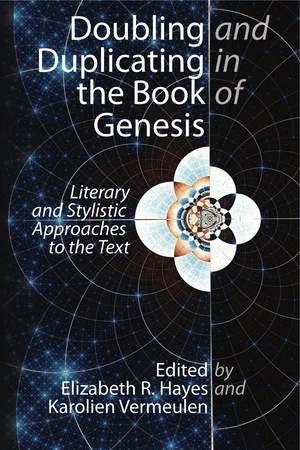
Doubling and Duplicating in the Book of Genesis
Literary and Stylistic Approaches to the Text
- 224 pages
- English
- PDF
- Available on iOS & Android
Doubling and Duplicating in the Book of Genesis
Literary and Stylistic Approaches to the Text
About this book
The style of the Hebrew Bible has long been of significant interest to scholars and exegetes alike. Early Jewish and later Christian commentaries point out the importance of the exact wording in interpreting the text, and many an article has been written on features such as repetition and inclusio. With the rise of literary and narrative criticism in biblical studies, these features have received even more attention. The current book stands in the tradition of Robert Alter in that it focuses on how the text of Genesis is written and phrased. More explicitly, it is interested in why Genesis is formulated the way it is and how this affects the reader in his/her encounter with the text. Doubling and Duplicating is not only concerned with a style-as-analysis frame for interpreters but also with its role as a guide for any audience and its gateway to the ancient mind-set (ideological, ontological, and so on).
All of the contributors to this collected volume focus on the form of the book of Genesis—that is, on its use of language and formulation. Yet, each author does this in his/her own way, depending on the most fitting tool for the specific research question or based on the researcher's methodological background. Thus, the essays represent the various approaches in current literary and stylistic criticism as applied to the biblical corpus. Furthermore, the recurring duality of the features discussed in each of the contributions adds to the overall unity of the volume. This recurrence suggests the presence of a stylistic feature in the book of Genesis, the feature of doubling and duplicating, that surpasses the other features of the individual units or stories. This book offers insights about meaning-making on both the micro- and the macro-text levels.
Frequently asked questions
- Essential is ideal for learners and professionals who enjoy exploring a wide range of subjects. Access the Essential Library with 800,000+ trusted titles and best-sellers across business, personal growth, and the humanities. Includes unlimited reading time and Standard Read Aloud voice.
- Complete: Perfect for advanced learners and researchers needing full, unrestricted access. Unlock 1.4M+ books across hundreds of subjects, including academic and specialized titles. The Complete Plan also includes advanced features like Premium Read Aloud and Research Assistant.
Please note we cannot support devices running on iOS 13 and Android 7 or earlier. Learn more about using the app.
Information
Table of contents
- COVER Front
- Copyright Page
- Table of Contents
- Introduction
- Chapter 1: Doubled Request and Doubled Refusal:The Verb פצר in Biblical Narrative
- Chapter 2: The Expulsion of Ishmael Narrative: Boundaries, Structure, and Meaning
- Chapter 3:The Proof-and-Play of Quoted Speech in the Joseph Story (Genesis 37–50)
- Chapter 4: The Intersection of Orality and Style in Biblical Hebrew Metapragmatic Representations of Dialogue in Genesis 34
- Chapter 5: Alliteration in the Book of Genesis
- Chapter 6: One, Two, or Three . . . ?The Confusion of the Trees in Genesis 2–3 and Its Hermeneutical Background
- Chapter 7: The Art of Blessing and Cursing in Genesis 1–11 Stylistic Patterns andTheir Ideological Motivation
- Chapter 8: Distinguishing Abraham from the “Terahides”:The Ideology of Separation behind Etiology
- Chapter 9: Whose World? Whose Time? A Text World Theory Examination of the Style and Message of Genesis 1:1–2:25
- Chapter 10: Double-Plotting in the Garden: Stylistics of Ambiguity in Genesis 2–3
- Chapter 11: Inclusio in Genesis 28 and 32:Synchronically and Diachronically
- Index