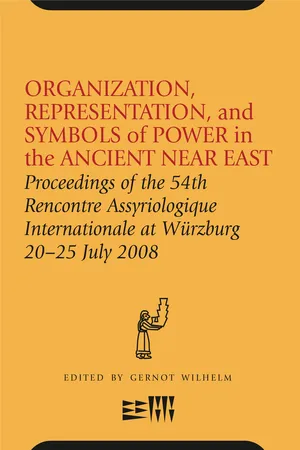
In July, 2008, the International Association for Assyriology met in Würzburg, Germany, for 5 days to deliver and listen to papers on the theme "Organization, Representation, and Symbols of Power in the Ancient Near East." This volume, the proceedings of the conference, contains 70 of the papers read at the 54th annual Rencontre, including most of the papers from two workshop sessions, one on "collective governance" and the other on "the public and the state." As the photo of the participants on the back cover demonstrates, the surroundings and ambience of the host city and university provided a wonderful backdrop for the meetings.
eBook - PDF
Organization, Representation, and Symbols of Power in the Ancient Near East
Proceedings of the 54th Rencontre Assyriologique Internationale at Würzburg 20–25 Jul
- 843 pages
- English
- PDF
- Available on iOS & Android
eBook - PDF
Organization, Representation, and Symbols of Power in the Ancient Near East
Proceedings of the 54th Rencontre Assyriologique Internationale at Würzburg 20–25 Jul
About this book
Information
Table of contents
- COVER Front
- Table of Contents
- Chapter 1: Das Ansehen eines altorientalischen Herrschers bei seinen Untertanen
- Chapter 2: L’exercice du pouvoir par les rois de laI ère Dynastie de Babylone: problèmes de méthode
- Chapter 3: Verwaltungstechnische Aspekteköniglicher Repräsentation: Zwei Urkunden über den Kult der verstorbenen Königeim mit elassyrischen Assur
- Chapter 4: Bild, Macht und Raum imneuassyrischen Reich
- Chapter 5: Die Rolle der Schrift in einer Geschichte der frühen hethitischen Staatsverwaltung
- Chapter 6: Collective Governance and the Role of the Palace in the Bronze Age Middle Euphrates and Beyond
- Chapter 7: Archaeological Evidence for Collective Governance along the Upper Syrian Euphrates during the Late and Middle Bronze Age
- Chapter 8: Textual Evidence for a Palace at Late Bronze Emar
- Chapter 9: Die Rolle der Stadt im spätbronzezeitlichen Emar
- Chapter 10: Les « Frères » en Syrie à l’époque du Bronze récent: Réflexions et hypothèses
- Chapter 11: Organization of Harrâdum, Suhum,18th–17th Centuries b.c., Iraqi Middle Euphrates
- Chapter 12: Ein Konflikt zwischen König und Ältestenversammlung in Ebla
- Chapter 13: The Public and the State in the Ancient Near East
- Chapter 14: From People to Public in the Iron Age Levant
- Chapter 15: Administrators and Administrated in Neo-Assyrian Times
- Chapter 16: The Babylonian Correspondence of the Seleucid and Arsacid Dynasties: New Insights into the Relations between Court and City during the Late Babylonian Period
- Chapter 17; La liste Lú A et la hiérarchie des fonctionnaires sumériens
- Chapter 18: Königslisten als Appellativ-Quellen
- Chapter 19: From King to God: The NAMEŠDA Title in Archaic Ur
- Chapter 20: The Uses of the Cylinder Seal as Clues of Mental Structuring Processes inside Ur III State Machinery
- Chapter 21: EN-Priestess: Pawn or Power Mogul?
- Chapter 22: Die Uruk I-Dynastie—ein Konstrukt der Isin-Zeit?
- Chapter 23: Neue Erkenntnisse zu den königlichen Gemahlinnen der Ur III-Zeit
- Chapter 24: Ĝeštinanna und die Mutter des Šulgi
- Chapter 25: Vom babylonischen Königssiegel und von gesiegelten Steinen
- Chapter 26: Marduk and His Enemies: City Rivalries in Southern Mesopotamia
- Chapter 27: Text im Bild — Bild im Text: Bildmotive als Bedeutungsträger von Machtansprüchen im hellenistischen Mesopotamien
- Chapter 28: The Tablet of Destinies and the Transmission of Power in Enūma eliš
- Chapter 29: Aššur and Enlil in Neo-Assyrian Documents
- Chapter 30: “The Charms of Tyranny”:Conceptions of Power in the “Garden Scene” of Ashurbanipal Reconsidered
- Chapter 31: King’s Direct Control: Neo-Assyrian Qēpu Officials
- Chapter 32: Triumph as an Aspect of the Neo-Assyrian Decorative Program
- Chapter 33: Local Power in the Middle Assyrian Period: The “Kings of the Land of Māri” in the Middle Habur Region
- Chapter 34: Women, Power, and Heterarchy in the Neo-Assyrian Palaces
- Chapter 35: Organising the Interaction between People: a New Look at the Elite Houses of Nuzi
- Chapter 36: Les femmes comme signe de puissance royale: la maison du roi d’Arrapḫa
- Chapter 37: Power Transition and Law: The Case of Emar
- Chapter 38: The Representatives of Power in the Amarna Letters
- Chapter 39: Herrscherrepräsentation und Kult im Bildprogramm des Aḥirom-Sarkophags
- Religion and Politics at the Divine Table:The Cultic Travels of Zimrī-Līm
Trusted by 375,005 students
Access to over 1.5 million titles for a fair monthly price.
Study more efficiently using our study tools.
Frequently asked questions
Yes, you can cancel anytime from the Subscription tab in your account settings on the Perlego website. Your subscription will stay active until the end of your current billing period. Learn how to cancel your subscription
No, books cannot be downloaded as external files, such as PDFs, for use outside of Perlego. However, you can download books within the Perlego app for offline reading on mobile or tablet. Learn how to download books offline
Perlego offers two plans: Essential and Complete
- Essential is ideal for learners and professionals who enjoy exploring a wide range of subjects. Access the Essential Library with 800,000+ trusted titles and best-sellers across business, personal growth, and the humanities. Includes unlimited reading time and Standard Read Aloud voice.
- Complete: Perfect for advanced learners and researchers needing full, unrestricted access. Unlock 1.5M+ books across hundreds of subjects, including academic and specialized titles. The Complete Plan also includes advanced features like Premium Read Aloud and Research Assistant.
We are an online textbook subscription service, where you can get access to an entire online library for less than the price of a single book per month. With over 1.5 million books across 990+ topics, we’ve got you covered! Learn about our mission
Look out for the read-aloud symbol on your next book to see if you can listen to it. The read-aloud tool reads text aloud for you, highlighting the text as it is being read. You can pause it, speed it up and slow it down. Learn more about Read Aloud
Yes! You can use the Perlego app on both iOS and Android devices to read anytime, anywhere — even offline. Perfect for commutes or when you’re on the go.
Please note we cannot support devices running on iOS 13 and Android 7 or earlier. Learn more about using the app
Please note we cannot support devices running on iOS 13 and Android 7 or earlier. Learn more about using the app
Yes, you can access Organization, Representation, and Symbols of Power in the Ancient Near East by Gernot Wilhelm in PDF and/or ePUB format, as well as other popular books in History & Ancient History. We have over 1.5 million books available in our catalogue for you to explore.