In the mid-first millennium B.C., the Eanna temple at Uruk sacrificed a minimum of nine lambs every day in its basic routine of offerings to its gods; in addition to these, special occasions and festivals demanded the sacrifice of as many as 90 lambs in a single day. All told, the Eanna sacrificed about 4,300 lambs per year. There were more than 120 herdsmen connected to the Eanna at any given time, and the temple expected there to be tens of thousands of sheep and goats under their responsibility. These herdsmen delivered male lambs to the Eanna for sacrifice, and the temple had an internal infrastructure for the care, maintenance, and ritual expenditure of these lambs; they also delivered wool, which the Eanna sold mostly in bulk quantities. This book aims to analyze the economic organization of this entire system of sheep and goat maintenance and utilization, to explore the economic and social relationships between the Eanna and its herdsmen, and to integrate the study of the Eanna's animal economy into the developing picture of the Neo-Babylonian temple economy as a whole. Kozuh's careful examination of the bookkeeping records, the management records, and legal documents connected with this substantial enterprise sheds new light on an arcane area of first-millennium Mesopotamian life that will be sure to enlighten our understanding of the daily life, economy, and social structure of this region.
eBook - PDF
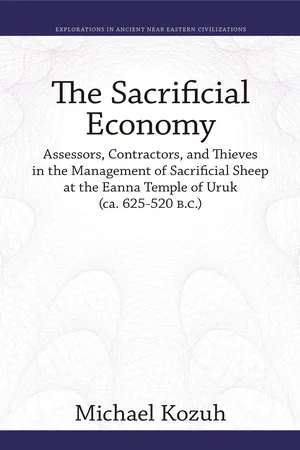
The Sacrificial Economy
Assessors, Contractors, and Thieves in the Management of Sacrificial Sheep at the Eanna Temple of Uruk (ca. 625–520 B.C.)
- 337 pages
- English
- PDF
- Available on iOS & Android
eBook - PDF
The Sacrificial Economy
Assessors, Contractors, and Thieves in the Management of Sacrificial Sheep at the Eanna Temple of Uruk (ca. 625–520 B.C.)
About this book
Information
Table of contents
- COVER Front
- Table of Contents
- Acknowledgments
- Chapter 1: Introduction
- Chapter 2: Sources, Methodology, Prior Literature, and Terminology
- Chapter 3: The Herdsmen and Their Formal Relationship with the Eanna
- Chapter 4: Balances
- Chapter 5: Balances, Incentives, and Restrictions
- Chapter 6: Managing the Herdsmen
- Chapter 7: Entrepreneurial Debt and Systemic Stress
- Chapter 8: The Internal Livestock Management of the Eanna of Uruk
- Chapter 9: The System at Work
- Bibliography
- Index
Trusted by 375,005 students
Access to over 1.5 million titles for a fair monthly price.
Study more efficiently using our study tools.
Frequently asked questions
Yes, you can cancel anytime from the Subscription tab in your account settings on the Perlego website. Your subscription will stay active until the end of your current billing period. Learn how to cancel your subscription
No, books cannot be downloaded as external files, such as PDFs, for use outside of Perlego. However, you can download books within the Perlego app for offline reading on mobile or tablet. Learn how to download books offline
Perlego offers two plans: Essential and Complete
- Essential is ideal for learners and professionals who enjoy exploring a wide range of subjects. Access the Essential Library with 800,000+ trusted titles and best-sellers across business, personal growth, and the humanities. Includes unlimited reading time and Standard Read Aloud voice.
- Complete: Perfect for advanced learners and researchers needing full, unrestricted access. Unlock 1.5M+ books across hundreds of subjects, including academic and specialized titles. The Complete Plan also includes advanced features like Premium Read Aloud and Research Assistant.
We are an online textbook subscription service, where you can get access to an entire online library for less than the price of a single book per month. With over 1.5 million books across 990+ topics, we’ve got you covered! Learn about our mission
Look out for the read-aloud symbol on your next book to see if you can listen to it. The read-aloud tool reads text aloud for you, highlighting the text as it is being read. You can pause it, speed it up and slow it down. Learn more about Read Aloud
Yes! You can use the Perlego app on both iOS and Android devices to read anytime, anywhere — even offline. Perfect for commutes or when you’re on the go.
Please note we cannot support devices running on iOS 13 and Android 7 or earlier. Learn more about using the app
Please note we cannot support devices running on iOS 13 and Android 7 or earlier. Learn more about using the app
Yes, you can access The Sacrificial Economy by Michael Kozuh in PDF and/or ePUB format, as well as other popular books in History & Ancient History. We have over 1.5 million books available in our catalogue for you to explore.