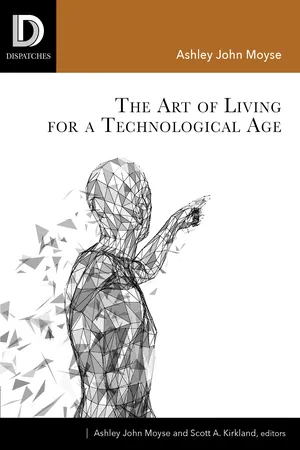
The Art of Living for A Technological Age sketches the crisis of our late modern age, where persons are enamored by the promises of progress and disciplined to form by the power of technology--the ontology of our age. Yet, it also offers a response, attending to those performative activities, educative and transformative social practices that might allow us to live humanly and bear witness to human being (becoming) for a technological age. As such, it is an exemplary example of the goals and outcomes of the Dispatches series, the individual volumes of which draw on diverse theological resources in order to offer urgent responses to contemporary crises. Authors in the series introduce succinct and provocative arguments intended to provoke dialogue and exchange of ideas, while setting in relief the implications of theology for political and moral life.
eBook - ePub
The Art of Living for A Technological Age
- 225 pages
- English
- ePUB (mobile friendly)
- Available on iOS & Android
eBook - ePub
The Art of Living for A Technological Age
About this book
Information
I
Sketching the Crisis
1
The Fate of the Technological World
Writers often begin with a provocative first few sentences. This exercise makes sense for those who wish their readers to continue reading. It is a good technique. It might be an ideal technique to employ when setting out to write on the question and crisis of technology—it has, after all, proven a successful method, so perhaps I would be unwise to do differently.
The publisher, for instance, would surely prefer that this book sells many copies and is read widely.
Perhaps I have failed to execute the provocative introduction. In failing to do so, however, I may have accomplished two things (if readers have continued to read). First, I may have captured attention by other means—speaking of provocation without giving in to the demand to be provocative. Second, I may have thwarted the powers of technique that so often constrain and homogenize human action, making it all the same, including the task of writing, exchanging sparks of creativity for efficiencies of form.
It is possible that I have succumbed to the technique ordered by the mechanics of writing by structuring the introduction of this volume as I have (and this might be why readers continue to read). Perhaps it would be correct to assess my writing as such. For one thing is certain, in addition to both taxation and death: we live amid the ubiquity of technology.
Hans Jonas (1903–1993) refers to technology as the “focal fact” of the present age.[1] Our present age is one in which beliefs in or of God might remain an option, as Charles Taylor has argued in A Secular Age, but encounter with various technologies is not. It is, at very least, an age in which it is disproportionately difficult to remain a Luddite. Technology pervades “almost everything vital to [our] existence—material, mental, and spiritual.”[2] As such, we are a technological civilization. It might be, then, that the ubiquity of technology has formed me so completely to follow particular means that I am no longer free to be creative.
I will leave it to you, the reader, to determine which assessment is correct for the start of this volume. In what follows I aim to lead you through an analysis of our technological age and the power(s) we think we possess—powers we often wonder where and how to deploy, or powers we wonder whether ought to be deployed at all.
We must wrestle with the question of power in our present age. Not only do we think we possess power in various forms, but also we are becoming increasingly aware about how much power is available. One needs only to consider the atomic powers wrought from the theoretical and physical sciences of the last centuries and determined necessary by the industries of energy and of war. We have long thought these powers were harnessed, but, with renewed global-political unrest and dilapidating infrastructure, they threaten once again both ecology and security. Consider too the powers that reify the strata of geology and liberate gaseous energy reserves from the bowels of the earth through hydraulic fracturing, risking the destabilization of faults and contaminating groundwater.
In addition to such powers implemented to harness and release energies and to control natural resources, we have over the last several decades observed increased knowledge and the development of powers to create and to recreate biological life and to remediate the deleterious effects of aging, dysfunction, and disease. We do this through advances emerging from genetic, epigenetic, and genomic research and their complementary biotechnologies and intelligent algorithms. We also face the inevitable human experiment to transplant a viable body from a vegetative donor, attaching it to the head of another person whose body is otherwise terminally ill—a potentiality made possible by advances in chemical, neurological, and medical-surgical sciences. These powers and advances demonstrate the promise and peril of modern scientific and technological progress, both fostering the potential of extreme longevity and revealing the potentiality for dystopic futures.
With such examples one might be able to understand, in our technologically enhanced context, just how much power humanity has amassed and is pursuing. Many more examples could be introduced, ranging from the powers that emerged through the earliest mass-printing presses and steam engines through to the powers of nanotechnologies and brain-chip interfaces. One might also extend the imagination beyond mere machinery, pointing toward techniques incumbent to politics or perhaps writing (as I have suggested above). Regardless of the examples, power is what is most interesting.
Such power is interesting because, as Emmanuel G. Mesthene (1921–1990) suggests, the acquisition of power is what is new in our present age. He says that we are among the first “who can aspire to be free of the tyranny of physical nature” that has haunted humanity from the beginning.[3] Power, in this instance, might concern the capacities to change our physical environment. But power, for Mesthene, offers us more than the capacity to shape landscape and to construct built environments.[4] It includes the aspirations to amend our social and cultural milieu, to change the experiences and expressions of human beings (and being human). Such aspirations to change nature, including human nature, correspond well with what technology was for Mesthene: an organization of knowledge for the purpose of accomplishing practical aims and achievements.
Technology, as such, is fashioned after the modern project, which Rémi Brague suggests is pursued by our decision or desire. A project, in the modern sense, is that which “we decide to undertake, whereas a task is entrusted to us by some higher power: nature in pagan style, or God in biblical style.”[5] Mesthene is suggesting, therefore, by his definition, that technology frees humanity from task obligations in pursuit of the project for our desires. Technology, then, might be considered as the powerto do as intended.
Yet to do as anyone might intend reflects a particular limitation in the human endeavor to pursue new knowledge-as-power. The current digital expressions of our technological age have introduced an intelligent civilization that takes advantage of artificial neural networks and machine-learning algorithms—to manage everything from medical diagnostics to targeted propaganda campaigns. The practical aims and achievements of our technological age, therefore, are increasingly conditioned by the forecasting of outcomes as large swaths of data are collated, processed, and analyzed. The organization of knowledge into patterns of information incumbent to the flow of data is prioritized, while decision-making models that adjust our aims and calculate the feasibility of achievements are valued. As such, intelligent technology might be thought as the organization of information for the prediction and pursuit of practical outcomes and achievements—a slight alteration to Mesthene’s definition above. However, while such power is incumbent in the digital hypostases of our technological civilization, it remains restricted to those algorithms that can manage the massive data load. It is restricted because human beings are not able to process such data through traditional rationality, agency, and technique. Technology, as such, is learning to go “where no human has gone before—and where no human can follow.”[6]
The question remains: Is Mesthene’s definition, or the intelligent analogue, of technology suitable? Put differently, how ought we to understand the essence of technology? It is an important question that must precede questions that aim to evaluate the pursuit of power by particular means or to challenge the promises (or probability) of digital forecasts. This question will allow us to discern the essential nature of technology.
Defining Technology
What is technology? The answer for what might seem a simple question is actually quite difficult to establish. Indeed, a great many have labored to delimit and to define technology. Consider George Parkin Grant (1918–1988), educated (in theology) at Oxford and regarded as one of Canada’s foremost philosophers and public intellectuals. He sought on several occasions to examine the essential nature of technology. His writings on the subject were among the first in my academic formation to illuminate a counternarrative to the hegemony of modern values and progress. His doctoral dissertation, for example, which was a study of Scottish theologian John Oman’s (1860–1939) understanding of nature and supernature, offers a glimpse into Grant’s early thinking on the subject.
For Oman, one’s experience of nature is to be the foundation for understanding nature rightly. But nature refers to the unsullied environment, not yet altered by human activity. Our experience and understanding, our perception, of nature, as nature is in itself, is becoming increasingly difficult to encounter. As Grant assesses, Oman feared that industrialism would deprive us all of “the vision of nature in any terms save that of the tourist resort.”[7] This image of the tourist experience of nature, now sullied, is echoed by Martin Heidegger: “The Rhine is still a river in the landscape, is it not? Perhaps. But how? In no other way than as an object on call for inspection by a tour group ordered there by the vacation industry.”[8]
In the end, nature becomes mere fodder for human usage. Such usage thus reorients one’s perception of nature, demanding that one learns to see it as a mere image of the artifacts of industrial potential and power. As Oman illustrated for Grant: once we have discovered the industrial usage in a solid piece of wood, that is, its potential to be a lever for mechanical advantage, everything else about the wood recedes from view. The only thing we learn to see is its abstracted material and the mechanical properties that make it an ideal object to be used as a lever. The rigidity and strength of the wood occlude our original experience of a grand old oak that stands before us among a legion of mature trees in a virgin forest. Instead, such a tree, among the many measured out and numbered in a cut block, becomes interpreted as mere logs and planks to be hewn down by sawyers and crafted into usable object...
Table of contents
- Cover
- Dispatches: Turning Points in Theology and Global Crises
- Title Page
- Copyright
- Dedication
- Table Of Contents
- Acknowledgments
- Prologue: Encountering the Crisis
- Sketching the Crisis
- Performing the Response
- Afterword by Brent P. Waters
- Select Bibliography
- Select Index
Trusted by 375,005 students
Access to over 1.5 million titles for a fair monthly price.
Study more efficiently using our study tools.
Frequently asked questions
Yes, you can cancel anytime from the Subscription tab in your account settings on the Perlego website. Your subscription will stay active until the end of your current billing period. Learn how to cancel your subscription
No, books cannot be downloaded as external files, such as PDFs, for use outside of Perlego. However, you can download books within the Perlego app for offline reading on mobile or tablet. Learn how to download books offline
Perlego offers two plans: Essential and Complete
- Essential is ideal for learners and professionals who enjoy exploring a wide range of subjects. Access the Essential Library with 800,000+ trusted titles and best-sellers across business, personal growth, and the humanities. Includes unlimited reading time and Standard Read Aloud voice.
- Complete: Perfect for advanced learners and researchers needing full, unrestricted access. Unlock 1.5M+ books across hundreds of subjects, including academic and specialized titles. The Complete Plan also includes advanced features like Premium Read Aloud and Research Assistant.
We are an online textbook subscription service, where you can get access to an entire online library for less than the price of a single book per month. With over 1.5 million books across 990+ topics, we’ve got you covered! Learn about our mission
Look out for the read-aloud symbol on your next book to see if you can listen to it. The read-aloud tool reads text aloud for you, highlighting the text as it is being read. You can pause it, speed it up and slow it down. Learn more about Read Aloud
Yes! You can use the Perlego app on both iOS and Android devices to read anytime, anywhere — even offline. Perfect for commutes or when you’re on the go.
Please note we cannot support devices running on iOS 13 and Android 7 or earlier. Learn more about using the app
Please note we cannot support devices running on iOS 13 and Android 7 or earlier. Learn more about using the app
Yes, you can access The Art of Living for A Technological Age by Ashley John Moyse, Ashley John Moyse,Scott A. Kirkland, Ashley John Moyse, Scott A. Kirkland in PDF and/or ePUB format, as well as other popular books in Computer Science & Social Aspects in Computer Science. We have over 1.5 million books available in our catalogue for you to explore.