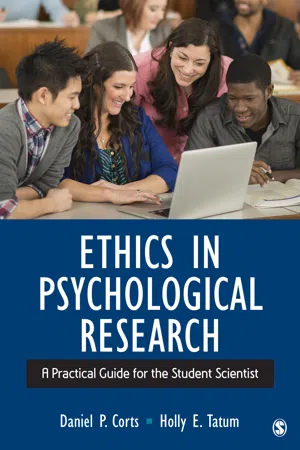
Ethics in Psychological Research is a brief, practical guide for student researchers and their mentors to answer ethical questions and navigate issues of institutional policies and academic freedom. Authors Daniel P. Corts and Holly E. Tatum guide readers in identifying, preventing, mitigating, and resolving ethical issues in research using a unique ethical framework. Each of the standalone chapters provide real-life examples of ethical questions, a description of scholarly work on the matter, and suggestions for how to address similar problems should they arise in the researcher's own work. The book makes for a succinct and easy-to-use reference for any student conducting research in the behavioral sciences.
eBook - ePub
Ethics in Psychological Research
A Practical Guide for the Student Scientist
- 120 pages
- English
- ePUB (mobile friendly)
- Available on iOS & Android
eBook - ePub
Ethics in Psychological Research
A Practical Guide for the Student Scientist
About this book
Information
1 Ethics and Values in Psychological Science
At the end of her junior year, Meghan applied for a summer research grant at her university. To her surprise, the grant was funded. She was provided with a stipend and paired with a faculty mentor who provided her with expertise and equipment. Most of all, she was given free rein to design and conduct her first original experiment. The experience was a great opportunity to include in her medical school applications. Interestingly, Meghan almost did not apply for the grant, despite encouragement from her Brain and Behavior professor who was quite impressed with her term paper on ethnic and gender differences in pain tolerance. “But, it’s not like I can bring people to the lab and make them feel pain,” Meghan had said. “There’s no way that would be ethical.” Her professor agreed, “No, you can’t make them come in, but perhaps you could think of an ethical way to ask for volunteers and guide them through the experiment. Researchers do that all the time. How else do you think we have learned so much about how pain works?”
The scientific method is a profoundly powerful and versatile tool. In the relatively short period of history that it has been taught and practiced, life expectancy has increased, quality of life has improved, and our abilities to achieve new things and travel to new places have increased at a rate that was simply unimaginable a few centuries ago. In fact, the rate of technological advancement today was inconceivable even a few decades ago. The power of science—and what distinguishes it from other systems of thought—comes from its emphasis on objectivity and observation. Theories and hypotheses have scientific merit only to the extent that they generate testable predictions that are verified by data. Science requires us to set aside our personal opinions and assumptions, no matter how much we may want them to be true. Scientific findings can even challenge deeply held moral beliefs. No matter how effective science has been in explaining the world, there are those who interpret this objectivity as being cold and value-free, as if science is incompatible with conscience. That is simply not the case, and this book will demonstrate that science is actually built on and practiced with a set of values.
Values in Science
What are scientific values? It is one thing to say that we, as students of a scientific discipline, value objectivity and observations. We would not have science without those, and that is why education includes courses on research methods, statistics, and laboratory techniques. However, there are other kinds of values in scientific endeavors; the kinds of values we will address in this book relate to concepts such as honesty, responsibility, and respect for the rights and well-being of the people or animals we study. These values are put into action through research ethics, the principles used to define and promote acceptable behavior and discourage unacceptable behavior in scientific work.
As Meghan’s story illustrates, research ethics are often an extension of one’s personal values. Even with limited training, Meghan realizes that she is facing some important ethical decisions. However, with experience comes an appreciation for how complex ethics can be and the fact that they encompass the entire research process. While Meghan considers the physical well-being of her volunteers, a lab group next door might be debating what to do with their data following a conference presentation, and her friend in the computer lab notices that, if he removes two unusual cases from his spreadsheet, he will have statistically significant results. Researchers with different levels of experience, motives, and opportunities may come up with different, even contradictory, answers if they rely solely on their gut feelings. This is why professionals across all scientific disciplines have set aside time to discuss, develop, and teach about ethics.
The purpose of this book is to introduce you to the ethics of research in psychological science. Although the values and principles addressed in this book are drawn from our experiences in psychology, the vast majority of these principles also apply to anyone conducting research—especially in fields like sociology, communications, exercise science, and many other subjects that make people the focus of their studies. Psychology and other disciplines have clinical and practical applications as well. There are ethics specific to psychotherapy, psychological assessments and testing, serving as an expert witness in court, and so on. Those principles are every bit as important as research ethics but are beyond the scope of this book. Our focus is on the responsible conduct of research (RCR), understanding and following the principles, rules, and guidelines for conducting research in an ethical manner (Shamoo & Resnick, 2015). We will introduce you to research ethics through an examination of values rather than specific actions to take or to avoid. With these values as a foundation, each of the subsequent chapters will illustrate how they appear in the research process, the standards for preventing ethical problems, and ways to make ethical decisions as you conduct research yourself.
Values and the Integrity of Research
Most national governments have various agencies that fund scientific research. In the United States, the Department of Health and Human Services houses the Office of Research Integrity (ORI, see Additional Resources at the end of the chapter for more information). ORI establishes regulations and provides oversight of research within any organization or institution that receives research funding from the government. Most colleges and universities, whether public or private, receive some form of federal funds, such as grants for research, training opportunities, or equipment. Therefore, they are obligated to follow the regulations put forth by ORI. For example, you will read in Chapters 4 and 5 that institutions must have committees review and approve research on human subjects. In addition to setting these rules and regulations, ORI investigates allegations of misconduct while also promoting integrity through education on RCR. It seems favorable to emphasize “good citizenship” among researchers (Steneck, 2007), rather than focus on strict warnings and harsh punishments. Therefore, ORI proposes that the responsible conduct of research is best thought of as a commitment to a set of shared values:
- Honesty: conveying information truthfully and honoring commitments
- Accuracy: reporting findings precisely and taking care to avoid errors
- Efficiency: using resources wisely and avoiding waste
- Objectivity: letting the facts speak for themselves and avoiding improper bias (Steneck, 2007, p. 3)
This is not a complete list, but it is a good place to emphasize that scientific values are not simply nice concepts to think about, nor are they just ways for researchers to be polite. These values are necessary for scientific knowledge to progress, as we will see with the value of openness.
Open Science
The concept of openness, related to honesty and accuracy described above, promotes more effective research in a number of ways but largely because it facilitates replication, repeating research methods with different investigators in different locations to test whether the same results are observed. Replication benefits science in several ways, such as identifying Type I errors, which you may have learned about in a statistics course. These type I errors, also called false positives occur when a statistical test produces significant results, but the results are actually due to random error. It is very difficult to detect a Type I error in a single study. However, if research findings can be replicated, it makes Type I errors seem less likely. Finally, replication can be used to detect experimenter effects such as carelessness, a misconception about the use of techniques or methods, and even outright dishonesty. Whatever the reason, research that does not replicate is likely to have less impact.
Despite the importance of replication, historically it has not been practiced in psychology, or in any other fields for that matter. This is largely the product of two connected factors: how scientific journals select what to publish and how university administrators evaluate their faculty. To a large extent, deans and department chairs expect their faculty to publish research frequently to be awarded tenure, get promoted, and earn merit pay. Meanwhile, editors want to publish new, statistically significant findings to elevate the status of their journal. Because editors are not looking for replications of previously published research, faculty have little motivation to spend time on it. In fact, it can cost faculty by occupying time and resources that could be spent trying to produce the new findings editors are seeking. As a consequence, scientific disciplines have not been efficient at weeding out false positives, experimenter effects, and dishonesty.
The concern over replication has led to a recent movement in psychology to openly share data so that other scientists can confirm or replicate the findings. In 2014, the Center for Open Science (COS) was created to promote three core values in science: openness, integrity, and reproducibility (Nosek, 2017, p. 6). Their mission is to change the culture of scientific practices to an open science framework where researchers collaborate on projects by sharing data and other important components of their research—these are covered in much more detail in Chapters 8 and 9. In short, by using larger data sets and including many different samples from multiple settings, scientists can test the strength of the overall effect and the reproducibility of their findings.
It is somewhat ironic that an effort to encourage replication has led to what some call the replication crisis, the concern among a large number of scientists (led by psychologists) that many—perhaps even most—peer-reviewed studies cannot be reproduced by other researchers. This arose from a project initiated by founders of the COS in which dozens of researchers around the world went about replicating 100 published studies in psychology, including both experimental and correlation studies (Open Science Collaboration, 2015). Many were surprised to learn that only 36% of these replication studies reproduced the original results. Naturally, there may be good reasons why so many studies failed to replicate, and it may be that some of the replication studies themselves produced errors. Regardless, openn...
Table of contents
- Cover
- Half Title
- Publisher Note
- Title Page
- Copyright Page
- Brief Contents
- Detailed Contents
- Preface Ethics in Psychological Research: A Practical Guide for the Student Scientist
- Acknowledgments
- About the authors
- 1 Ethics and Values in Psychological Science
- 2 Understanding Freedoms and Responsibilities
- 3 Ethics of Collaboration
- 4 Managing Risks With Human Subjects
- 5 Navigating the IRB Process
- 6 Working With Animal Subjects
- 7 Research Misconduct
- 8 Ethics of Statistical Practices
- 9 Ethical Writing Practices
- Index
Trusted by 375,005 students
Access to over 1.5 million titles for a fair monthly price.
Study more efficiently using our study tools.
Frequently asked questions
Yes, you can cancel anytime from the Subscription tab in your account settings on the Perlego website. Your subscription will stay active until the end of your current billing period. Learn how to cancel your subscription
No, books cannot be downloaded as external files, such as PDFs, for use outside of Perlego. However, you can download books within the Perlego app for offline reading on mobile or tablet. Learn how to download books offline
Perlego offers two plans: Essential and Complete
- Essential is ideal for learners and professionals who enjoy exploring a wide range of subjects. Access the Essential Library with 800,000+ trusted titles and best-sellers across business, personal growth, and the humanities. Includes unlimited reading time and Standard Read Aloud voice.
- Complete: Perfect for advanced learners and researchers needing full, unrestricted access. Unlock 1.5M+ books across hundreds of subjects, including academic and specialized titles. The Complete Plan also includes advanced features like Premium Read Aloud and Research Assistant.
We are an online textbook subscription service, where you can get access to an entire online library for less than the price of a single book per month. With over 1.5 million books across 990+ topics, we’ve got you covered! Learn about our mission
Look out for the read-aloud symbol on your next book to see if you can listen to it. The read-aloud tool reads text aloud for you, highlighting the text as it is being read. You can pause it, speed it up and slow it down. Learn more about Read Aloud
Yes! You can use the Perlego app on both iOS and Android devices to read anytime, anywhere — even offline. Perfect for commutes or when you’re on the go.
Please note we cannot support devices running on iOS 13 and Android 7 or earlier. Learn more about using the app
Please note we cannot support devices running on iOS 13 and Android 7 or earlier. Learn more about using the app
Yes, you can access Ethics in Psychological Research by Daniel P. Corts,Holly E. Tatum in PDF and/or ePUB format, as well as other popular books in Psicologia & Ricerche e metodologie nella psicologia. We have over 1.5 million books available in our catalogue for you to explore.