Smuggling Writing
Strategies That Get Students to Write Every Day, in Every Content Area, Grades 3-12
- 256 pages
- English
- ePUB (mobile friendly)
- Available on iOS & Android
Smuggling Writing
Strategies That Get Students to Write Every Day, in Every Content Area, Grades 3-12
About this book
Is it possible to sneak more writing into your already-jammed curriculum? Yes! With this cache of classroom-tested ideas, you have all you need to make writing-to-learn a daily habit for students that deepens their content understanding and creates learners ready to take on all of the world's information.Ā
Smuggling WritingĀ shows how to integrate writing seamlessly into your lesson plans with 32 written response activities that help students process information and ideas in short, powerful sessions. The authors invigorate time-tested tools like GIST, Herringbone, and Anticipation Guides, and organize them into sections on Vocabulary and Concept Development, Comprehension, Discussion, and Research & Inquiry so you can select and use them to maximum effect.Ā
Here are the success-ensuring how-to's that accompany each strategy:
- A step-by-step process ensures students use the strategy before, during, and after reading/learning so they "own" the strategy and can track their thinking
- Engaging digital applications, including Story Impression with Bubbl.us, Reading Road Map with Prezi, Possible Solutions with Padlet, CLVG with Brain Pop
- Sample lessons showing both traditional and online formats, taking the guess work out of trying these new digital toolsĀ
- Ideas for "smuggling" additional writing opportunities into or after the lessons, ensuring that students' writing skills improve
- Connections to Common Core State Standards
With all the heady talk of what it's going to take for students to read, write, and analyze across multiple sources, it's nice to know that there is a book that shows how big gains will come from "writing small" day by day.Ā
Ā Ā
Frequently asked questions
- Essential is ideal for learners and professionals who enjoy exploring a wide range of subjects. Access the Essential Library with 800,000+ trusted titles and best-sellers across business, personal growth, and the humanities. Includes unlimited reading time and Standard Read Aloud voice.
- Complete: Perfect for advanced learners and researchers needing full, unrestricted access. Unlock 1.4M+ books across hundreds of subjects, including academic and specialized titles. The Complete Plan also includes advanced features like Premium Read Aloud and Research Assistant.
Please note we cannot support devices running on iOS 13 and Android 7 or earlier. Learn more about using the app.
Information
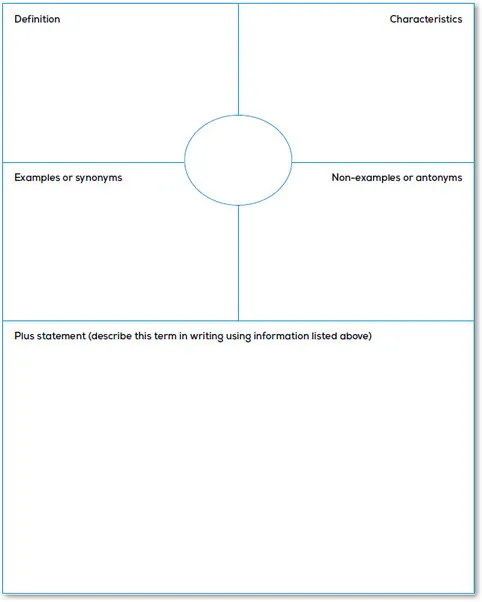
Strategy 1 Frayer Model Plus
Objective
Rationale
Digital Applications
- Inspiration: There are two versions of the Inspiration softwareāInspiration and Kidspiration. Both allow students to easily create concept or bubble maps that can be adapted for use as Frayer maps. The software is available for computers (many schools and districts provide this), but it also has apps for tablet computers.
- SimpleMind+: This is an application available for the iPad that allows students to create concept maps.
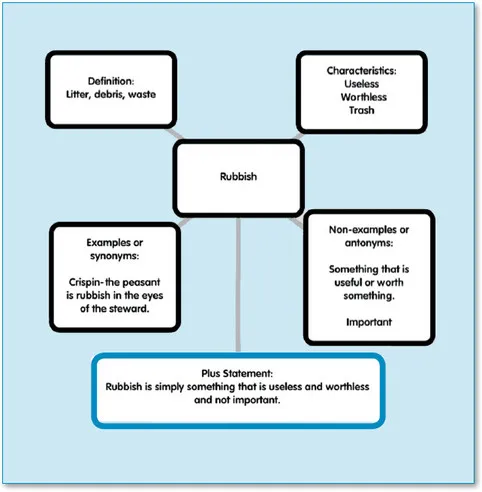
- Popplet (www.popplet.com): Another iPad app that allows users to create bubble maps and concept maps. See Figure 1.2 for an example of using Popplet with the Frayer Model Plus.
Procedures
Teacher Preparation Stage
- ā Step One: The teacher identifies key vocabulary terms from a text, topic, or unit of study. For example, in a social studies class in which students are studying the American Civil War, the teacher might select terms including abolitionist, antebellum, blockade, cash crop, Confederacy, emancipation, Federal, Reconstruction, and secession.Optional: Selection of the vocabulary can be shared with students with some or all of the terms being self-selected by the students or the teacher and students suggesting terms.
- ā Step Two: The teacher decides the best method for sharing the Frayer Model Plus strategyāpaper copies or a digital application such as Popplet or Inspiration. Obviously, this decision depends on availability of computers and digital tablets.
Prereading Stage
- ā Step Three: The teacher introduces the text, topic, or unit of study to students and discusses key vocabulary, or, if the students have identified terms, the teacher leads a brainstorming session and discussion with students to select a set of vocabulary terms.
- ā Step Four: The teacher displays a copy of the Frayer Model Plus and using one of the terms models its use by filling out any information about the term that students know before reading. This might include āit is related toā and āI think it means.āOptional: If using one of the digital applications such as Inspiration, Popplet, or SimpleMind+, the teacher should model how to use this.
Reading Stage
- ā Step Five: Students work independently to read the textbook or other text related to the unit or topic. Students should read the text and make note of key vocabulary terms as they read.Optional: Students can mark the location of key vocabulary terms using sticky notes in their text.
Postreading Stage
- ā Step Six: After students have had sufficient time to read, they can go back to the text and write down what they know about the key terms on the Frayer Model Plus form (paper or digital). The teacher can have students work in pairs or small groups to discuss their entries. This can be done as a whole class as well. It is important to confirm that the definitions, connections, and illustrations lead to a thorough and reasonable understanding of the terms.
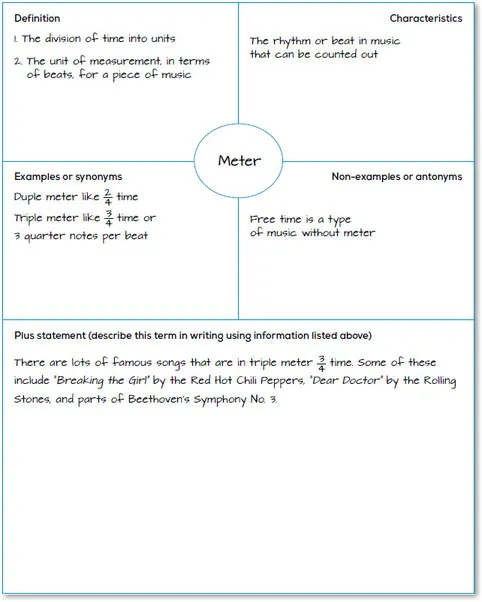
- ā Step Seven: After students create a Frayer chart for a term, they can write out a plus statement that uses what they have learned to describe the term in their own language. The teacher can model this step and also share student examples of plus statements.
- āŖ See Figure 1.3 for an example of a completed Frayer Model Plus chart.
- ā Smuggling Writing: The Plus part of this strategy is the written synthesis step that allows students to summarize and synthesize the content of the selection by referring back to the text sources and using the new vocabulary and concepts in a paragraph. Since this is a practice writing exercise, students can be encouraged to work in pairs to compose a single paragraph between them.
Adaptation
Standards-Based Connections
Examples of Common Core Anchor Standards
- CCSS.ELA-Literacy.CCRA.R.4: Interpret words and phrases as they are used in a text, including determining technical, connotative, and figurative meanings, and analyze how specific word choices shape meaning or tone.
- CCSS.ELA-Literacy.CCRA.W.6: Use technology, including the Internet, to produce and publish writing and to interact and collaborate with others.
- CCSS.ELA-Literacy.CCRA.L.4: Determine or clarify the meaning of unknown and multiple-meaning words and phrases by using context clues, analyzing meaningful word parts, and consulting general and specialized reference materials, as appropriate.
- CCSS.ELA-Literacy.CCRA.L.5: Demonstrate understanding of figurative language, word relationships, and nuances in word meanings.
- CCSS.ELA-Literacy.CCRA.L.6: Acquire and use accurately a range of general academic and domain-specific words and phrases sufficient for reading, writing, speaking, and listening at the college and career readiness level; demonstrate independence in gathering vocabulary knowledge when encountering an unknown term important to comprehension or expression.
References


Strategy 2 Semantic...
Table of contents
- Cover
- Acknowledgements
- Half Title
- Acknowledgements
- Title Page
- Copyright Page
- Contents
- Preface
- Acknowledgments
- About the Authors
- A Matrix for Using This Book
- Publisher Note
- Section I Vocabulary and Concept Development
- Strategy 1 Frayer Model Plus
- Strategy 2 Semantic Feature Analysis Plus
- Strategy 3 Vocabulary Cards
- Strategy 4 Vocabulary-Concept Journals
- Strategy 5 Vocabulary Self-Awareness Chart
- Section II Comprehension
- Strategy 6 ListāGroupāLabelāWrite
- Strategy 7 Book Reviews/Book Trailers
- Strategy 8 Generating Interactions Between Schemata and Text (GIST)
- Strategy 9 Extended Anticipation Guide
- Strategy 10 Possible Sentences
- Strategy 11 Story Impressions
- Strategy 12 Reading Road Map
- Strategy 13 Say Something and Summarize
- Strategy 14 SomebodyāWantedāButāSoāThen
- Strategy 15 Exchange Compare Writing
- Strategy 16 RAFT Writing
- Strategy 17 So What?
- Strategy 18 Found Poetry Summaries
- Strategy 19 Sticky Note Maps
- Strategy 20 Double Entry Journal/Dialectic Response Journal
- Section III Research and Inquiry
- Strategy 21 1ā2ā3 Research
- Strategy 22 Collaborative Listening Viewing Guide (CLVG)
- Strategy 23 Herringbone
- Strategy 24 Inquiry Charts
- Strategy 25 KWL Plus
- Strategy 26 Multiple Source Research Strategy
- Strategy 27 Web Page Evaluation Tools
- Section IV Discussion
- Strategy 28 Discussion Webs
- Strategy 29 Talking Drawings
- Strategy 30 Tea Party
- Strategy 31 ThinkāPairāShareāwrite
- Strategy 32 Ticket to Talk
- Publisher Note