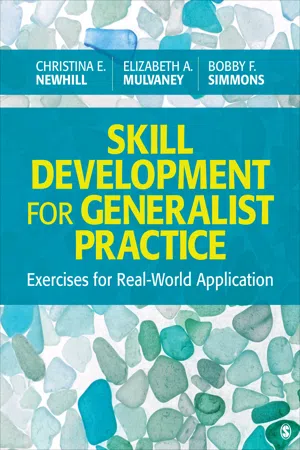
Skill Development for Generalist Practice offers an array of competency-building exercises addressing foundational social work knowledge as well as skills and values across micro, mezzo, and macro levels of practice. Designed to be actively used during class time, exercises embrace the diverse range of clients encountered by social workers in various practice settings and reflect a commitment to serving those who are the most vulnerable, at risk, disadvantaged, and marginalized from society.
eBook - ePub
Skill Development for Generalist Practice
Exercises for Real-World Application
- 248 pages
- English
- ePUB (mobile friendly)
- Available on iOS & Android
eBook - ePub
Skill Development for Generalist Practice
Exercises for Real-World Application
About this book
Information
1 Introductory Exercises
Learning Objectives
- Collectively develop a definition of generalist social work practice (Exercise 1.1).
- Reflect and analyze one’s personal motivation for pursuing a social work career (Exercise 1.2).
- Analyze public perceptions about social work and social workers (Exercise 1.2).
- Identify and discuss some of the important issues facing social workers today (Exercise 1.2).
- Examine the strengths and questions you bring to this class and how they compare and connect with your classmates’ (Exercise 1.3).
Chapter Outline
- Exercise 1.1: Defining Generalist Social Work Practice
- Exercise 1.2: Why Pursue Social Work?
- Exercise 1.3: What Will You Bring to the Class?
The following three exercises are most effectively used as ice breakers during the first session of class, to get you thinking about social work, talking with your classmates, and feeling comfortable participating in class discussion. These exercises ask you to develop a definition of generalist practice, examine why you have chosen to pursue a social work degree and a social work career, and think about what strengths you will bring to the class and what challenges you anticipate.
As you may already know, social workers today work with a wide range of clients in very diverse settings including government agencies, schools, hospitals, mental/behavioral health clinics, children and youth welfare agencies, aging services, business and industry, and private practice. However, what all social workers have in common is a strong commitment to the welfare of those who are poor, oppressed, disenfranchised, and disadvantaged in one way or another.
How do social workers view their work? Most social workers will say that their work can be rewarding, frustrating, satisfying, sometimes discouraging, at times stressful, but, most of all, always challenging. Let us spend some time getting to know each other and begin thinking about what the social work profession is all about.
Exercise 1.1: Defining Generalist Social Work Practice
Put away all papers and information on the class.
- Pick one index card from the deck that is passed around to the class.
- Do not put your name on it.
- Using all you know to date about social work, write a concise definition of generalist practice.
- Return your card to the instructor.
- Receive a card back (it does not matter if it is your own; no one but you will know).
- Report the ideas found on the index card you receive to the instructor, who will record themes/ideas/terms and then moderate creation of a class definition.
Compare the class’s definition to your school’s definition. What is the same? What is different?
Exercise 1.2: Why Pursue Social Work?
Form groups of five or six to address and discuss the following four questions:
- Why have you chosen social work as your career?
- What do you think it means to be a social worker today? What are the pros and cons of working
- as a social worker?
- How do you think the general public perceives the social work profession?
- What are the most pressing issues that the social work profession should address as we move further into the 21st century?
Each group should appoint a spokesperson to take notes. After a half hour of discussion, reconvene with the rest of the class to share the highlights of each group’s discussion.
Exercise 1.3: What Will You Bring to the Class?
Form groups of four to six. One by one, introduce yourself to each member of your group and then briefly interview the classmate to your right for five minutes by asking the following questions:
- What excites and interests you about taking this class?
- What resources, strengths, skills, and experiences do you bring to this class?
- What questions, worries, or concerns do you have about taking this class?
After 10 minutes, the class reconvenes, and then you each briefly introduce the classmate you interviewed, providing at least one answer to each of the following three questions:
- What excites and/or interests your classmate about taking this class?
- What resources, strengths, and experiences does your classmate bring to this class?
- What questions or concerns does your classmate have about taking this class?
After the individual introductions, everyone will try to identify the common themes that have cut across your classmates’ comments and discuss what these themes suggest about social work practice and social work education.
2 The Purpose and Nature of Generalist Social Work Practice
Learning Objectives
- Understand and analyze the purpose, core elements, and major objectives of social work practice.
- Integrate the principles of cultural humility and cultural competence in the purpose and goals of social work practice (Exercise 2.1).
- Compare and contrast the five main social work practice roles, and determine which role you would assume in each of the case vignettes (Exercise 2.1).
- Evaluate the advantages and disadvantages of the ecological systems model.
- Practice analysis of an ecological context and create a representative eco-map (Exercise 2.2).
- Identify which step of the helping process each vignette represents (Exercise 2.3).
Chapter Outline
- Definition of Generalist Social Work Practice
- Social Work: Key Concepts and Definitions
- Core Elements
- Objectives
- Knowledge Base
- Cultural Humility and Cultural Competence
- The Ecological Systems Model
- Criteria for Selecting a Practice Approach
- Five Main Categories of Roles of Social Work Practitioners
- Exercise 2.1: Ways of Helping
- The Eco-Map
- Exercise 2.2: Creating an Eco-Map
- The Generalist Helping Process
- Exercise 2.3: Understanding the Generalist Helping Process
This chapter begins with a concise outline of the roles and responsibilities of social workers and the goals and objectives of social work practice. The generalist helping process is explained. Following this information are three laboratory exercises. The first exercise challenges you to think about different ways to help clients and what social work roles might be assumed for each form of helping, using case vignettes representing micro, mezzo, and macro levels of practice. The second encourages you to create an eco-map to understand ecosystem influences, and the third helps you identify stages of the generalist helping process.
Definition of Generalist Social Work Practice
Social work is the professional activity of helping individuals, groups, and communities enhance their well-being, meet basic human needs, and create societal conditions favorable to these goals, with particular attention to the needs of vulnerable, disenfranchised, and oppressed individuals and groups. These goals are accomplished by social workers pursuing a mission of social and economic justice and pursuing social change targeting poverty, unemployment, discrimination, and other forms of injustice.
The International Federation of Social Workers’ statement of ethical principles (IFSW, 2012) declares that it is the responsibility of social workers to promote social justice in relation to society and their clients by challenging negative discrimination, recognizing diversity, challenging unjust policies and practices, and working in solidarity. This commitment is also reflected in the current National Association of Social Workers Code of Ethics (NASW, 2017a).
Social Work: Key Concepts and Definitions
Core Elements
There are four core elements of the social work profession:
- The purpose and objectives of the profession
- The core values, Code of Ethics, and philosophy of social work practice
- The knowledge base of social work practice
- The practice methods and processes employed
A primary goal of the practice of social work is to enhance clients’ bio-psycho-social-spiritual functioning within the mission of social justice.
Social work’s primary focus is the person and the environment in reciprocal interaction.
Objectives
There are six major objectives of social work practice:
- Help people enhance their competence, exercise their right to self-determination, and increase their problem-solving and coping abilities.
- Help people obtain resources and provide advocacy on their behalf.
- Advocate to make organizations and institutions responsive to people and their needs.
- Facilitate interactions between individuals and others in the environment.
- Act to influence interactions between organizations and institutions.
- Act to influence economic, environmental, and social justice policy efforts.
Knowledge Base
The knowledge base of social work practice includes the following:
- Human behavior in the social environment
- Social welfare policy and services
- Research
- Social work practice methods at the micro, mezzo, and macro levels
- Field placement/practicum
Cultural Humility and Cultural Competence
Cultural humility and cultural competence are essential to social work practice:
- Cultural differences essentially reflect fundamental variations in what people hold to be important and worthwhile and include the thoughts, communication patterns, actions, customs, traditions, beliefs, values, and institutions of a racial, ethnic, religious, or social group.
- Culturally different clients are entitled to competent, professional social work services, as are all the individuals who we serve as social workers.
- As social workers, it is our ethical responsibility to be respectful of cultural differences and not participate in perpetuating the history of gross insensitivity to the cultural differences of our clients.
- Examining cross-cultural issues in social work practice relates to how our profession has conceptualized its involvement with, and commitment to, culturally diverse communities.
- Maintaining cultural competence and cultural humility in practice is an ongoing, always-evolving aspect of social work practice.
- Cultural competence embraces a bio-psycho-social-spiritual model, recognizing that sp...
Table of contents
- Cover
- Half Title
- Acknowledgements
- Publisher Note
- Title Page
- Copyright Page
- Brief Contents
- Contents
- Acknowledgments
- Introduction for Instructors
- Introduction for Students
- 1 Introductory Exercises
- 2 The Purpose and Nature of Generalist Social Work Practice
- 3 Working With Diverse Clients Using Cultural Competence and Humility
- 4 Understanding Values and Ethics
- 5 Communicating: Empathy and Authenticity
- 6 Communicating: Verbal Following/Active Listening Skills
- 7 Multidimensional Client Assessment
- 8 Developing and Negotiating SMART Client Goals and Formulating a Contract
- 9 Understanding Family Functioning
- 10 Working With Groups
- 11 Working With Organizations
- 12 Macro Practice: Community Development and Organizing
- 13 Managing Barriers to Change and the Client–Social Worker Relationship
- 14 Termination, Consolidating Gains, and Follow-Up
- 15 Documentation
- 16 In-Depth Case Analysis Exercises
- 17 Real-World Experiential Exercises
- About the Authors
- References
- Index
Trusted by 375,005 students
Access to over 1.5 million titles for a fair monthly price.
Study more efficiently using our study tools.
Frequently asked questions
Yes, you can cancel anytime from the Subscription tab in your account settings on the Perlego website. Your subscription will stay active until the end of your current billing period. Learn how to cancel your subscription
No, books cannot be downloaded as external files, such as PDFs, for use outside of Perlego. However, you can download books within the Perlego app for offline reading on mobile or tablet. Learn how to download books offline
Perlego offers two plans: Essential and Complete
- Essential is ideal for learners and professionals who enjoy exploring a wide range of subjects. Access the Essential Library with 800,000+ trusted titles and best-sellers across business, personal growth, and the humanities. Includes unlimited reading time and Standard Read Aloud voice.
- Complete: Perfect for advanced learners and researchers needing full, unrestricted access. Unlock 1.5M+ books across hundreds of subjects, including academic and specialized titles. The Complete Plan also includes advanced features like Premium Read Aloud and Research Assistant.
We are an online textbook subscription service, where you can get access to an entire online library for less than the price of a single book per month. With over 1.5 million books across 990+ topics, we’ve got you covered! Learn about our mission
Look out for the read-aloud symbol on your next book to see if you can listen to it. The read-aloud tool reads text aloud for you, highlighting the text as it is being read. You can pause it, speed it up and slow it down. Learn more about Read Aloud
Yes! You can use the Perlego app on both iOS and Android devices to read anytime, anywhere — even offline. Perfect for commutes or when you’re on the go.
Please note we cannot support devices running on iOS 13 and Android 7 or earlier. Learn more about using the app
Please note we cannot support devices running on iOS 13 and Android 7 or earlier. Learn more about using the app
Yes, you can access Skill Development for Generalist Practice by Christina E. Newhill,Elizabeth A. Mulvaney,Bobby F. Simmons in PDF and/or ePUB format, as well as other popular books in Social Sciences & Social Work. We have over 1.5 million books available in our catalogue for you to explore.