- 696 pages
- English
- ePUB (mobile friendly)
- Available on iOS & Android
eBook - ePub
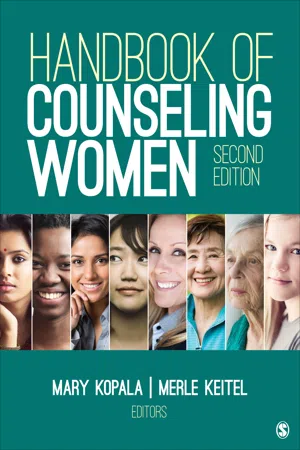
Handbook of Counseling Women
About this book
The Handbook of Counseling Women, edited by Mary Kopala and Merle Keitel, draws together a nationally recognized group of contributing scholars and practitioners to address current theories, research, and issues relevant to the mental and physical well-being of women. Comprehensive and accessible, the Second Edition is organized into three parts covering theoretical, sociocultural, biological, and developmental considerations; assessment, diagnosis, and intervention; and supervision, research, and ethics. The reorganization of this new edition includes more sections and chapters giving special attention to such topics as women and poverty, intimate partner violence, women's career barriers, and considerations for specific ethnic groups.
Information
Part I Women’s Voices: Personal Perspectives on Professional Contributions
1 The Power of Connection: Reflections on Mutual Growth
For as long as I can remember, I have been interested in what makes people tick. I plagued my older sister, from an early age, with questions about the meaning of life. Recently, she sent me a t-shirt with the following message: “Maybe the Hokey Pokey IS what it’s all about.” I grew up in a house filled with books, and prominent among them were volumes of Freud and writings from Karl Menninger. My mother, a dermatologist, believed that many skin disorders were psychological in origin, and she was fascinated with existing theories of psychological development. Her best friend from college was a psychiatrist. When I was in fourth grade, I became a self-appointed deputy to the Ramsey School psychologist, Miss Bryant. I remember going to her office and knocking on the opaque glass door (“nurse’s office,” it said in stark black letters) to report to her that one of my classmates was very unhappy, was being bullied, and I thought she might “need to talk to someone.” Miss Bryant was gracious to her would-be helper.
In adolescence, my interest in psychology deepened when I experienced intense homesickness at a boarding school that was selected to present me with more challenge than the rural high school I attended. I cried and cried, tried and tried to keep a lid on my sadness, but eventually parents and school agreed: Therapy was worth a try. Eventually my longing for home and family ebbed a bit. I was grateful to a kind, young woman psychiatrist who did not shame me for being a cry baby (as teachers in the school had) and who patiently honored my connection with my family. As I look back, I think the message of the power of connection lay deep in my bones and in my heart.
In college, I chose psychology as my major, but counting the bar presses of albino rats and monitoring pigeon pecks was not what I had hoped for. Halfway through my senior year, I decided not to write a thesis and instead decided to explore art, the humanities, and the theater. I wanted to focus on human beings, what gave meaning to people’s lives. My debut on the Sock and Buskin stage in the role of Madam Rosepetal had me delivering four-page monologues; it was a disaster. So much for “Oh, Dad Poor Dad Mama’s Hung You in the Closet and I’m Feeling So Sad.” I was overcome with stage fright, and “wooden” would have been an upgrade. Upon graduating Phi Beta Kappa, magna cum laude from Brown, I moved from Providence to Cambridge, looking for work and planning on studying art at night. I planned to support myself by doing secretarial work. I was undaunted by my lack of secretarial skills; I sent off my vitas and waited for the job offers. None came. By chance my resume was passed to Jerry Kagan at Harvard who was looking for a research assistant. I fit the bill. I happily began observing 4-, 8-, and 13-month-olds with their mothers. We traced the ways they built schema, how impulsive or reflective they were. Jerry was an enthusiastic scientist, and in my second year in his lab, then directing operations there, Jerry persuaded me to return to graduate school in psychology. I happily did and took my place in William James Hall at Harvard in a class of 12 studying for a PhD in clinical psychology. This was a social relations / psychology department that had seen the likes of Timothy Leary, Richard Alpert (aka Ram Dass), B. F. Skinner, Eric Erikson, David McClelland, Robert White, and Talcott Parsons, a parade of truly impressive (mostly well-educated White) men. The times were troubled: The Vietnam war and protests against it were sweeping the country, and the radical students for a democratic society (SDS) groups brought their violent response to the war and the government into our classrooms and campus. All of us were impacted by the chaotic, anxious mood in the country, especially on college campuses. But our mutual concern did not remove lingering social conflicts within our ranks. I was told by one professor and two graduate students that I was “wasting a space” in graduate school that could be occupied by a man who “would actually use this prized education as I undoubtedly would go off, get married, and raise a family.” The other two women in my program dropped out at the end of the first year. I set my jaw, girded myself for battle, and brought determination to the struggle: I would succeed!
I had the model of my mother, who 20 years earlier had been told by the dean of the medical school at the University of Pennsylvania to forget her application to medical school and go back to Wisconsin and find a nice man to marry. He didn’t know my mother! She persevered in following her dream, went to another medical school for 2 years, and then appeared again at Penn; this time they accepted her into their program. She practiced medicine her entire life, including starting some of the first birth control clinics in the country. Her courage and determination undoubtedly contributed to my perseverance. At the end of the first year in graduate school, I received a commendation for outstanding achievement. I knew I was going to make it through the program, but I never felt welcomed or at home there.
The program I was admitted to was in clinical psychology, a track that also wasn’t fully appreciated among researchers and academicians. Harvard wants to educate leaders not service providers. A service field was seen as less legitimate and important than an academic or research field. Years after I got my PhD, I received letters from professors asking if I would consider this academic position at Stanford or that one at Michigan. They were meant to be supportive, but clearly they felt I had made a major mistake in choosing a lesser service specialty. They felt I was indeed wasting my education in working as a clinical psychologist in a psychiatric hospital. Their bias for quantitative research, for “hard science” was part of what I eventually came to question, just as I came to ponder the reality of the “separate self.” My eventual theory building and writing did little to convince my teachers that there were many useful paths to understanding human behavior. I did not fit the mold that was privileged at that time. With support from some like-minded colleagues, I decided to question the mold and possibly contribute to reworking the prevailing models.
To the extent that any of us are marginalized, we often have a different sense of perspective of the dominant models and disciplines. We don’t fit the mold. As a woman in what was still a man’s field (not so much anymore), my presence and the nature of my questions created unease. The seeds of questioning the status quo were sewn at an early age for me; excluded from carpentry class in fourth grade I started a petition to allow girls to take shop. The highly valued safety crossing captains in sixth grade were given to boys only; again, I protested. These efforts at gaining equality for girls found echoes in my response to the graduate school greetings of “You’re wasting space in this program.” At another level, I was troubled by the overvaluation of academia, research, and linear thinking, The SELF. Was there a place in this exalted institution and profession for promoting the care of others and lessening suffering in the world? My early experiences with relatively benign but pervasive sexism contributed to my later passion for questioning the entire paradigm of an overly individualistic, “male” psychology that minimized the importance of context, relationship, and empathy.
Before completing my dissertation, I chose a clinical internship that my professors felt was too traditional and analytic. But an interview with the head of the psychology department at this placement gave me hope and inspiration. I chose a mentor, not a program. Irene Stiver, PhD, director of the psychology department at McLean, a Harvard teaching hospital, was an extremely intelligent person, a thoughtful listener with intensity and warmth. The quality of discussion and of the eye contact in my meeting with her convinced me that this was a place where I could grow and flourish. She provided support, grit, and great wisdom. When several years later I joined her department as a staff member and we became friends as well as colleagues, I knew I had found an important mentor. Two years into my job there, I found a second mentor, Jean Baker Miller, and a collaborative theory building group that was to provide definition and shape to my entire professional career.
Our “Monday night group,” as we came to refer to it, was composed of a group of three psychologists and one psychiatrist (Jean Baker Miller, Irene Stiver, Janet Surrey, and myself). Three of us worked as clinicians and teachers in a Harvard teaching hospital. Initially we met to support one another in male dominated institutions and to examine traditional practices of psychotherapy. We talked and laughed and slowly, almost without our knowing it or setting about to do it, we began to rethink much of traditional psychological theory. Jean Baker Miller had written her ground-breaking book Toward a New Psychology of Women in 1976 (2 years before we began meeting). In that book, Jean had begun to question the psychology of the self, autonomy, and an emphasis on independence at the expense of relationship; she suggested that what had been cast as women’s weaknesses (their investment in relationships, for instance), might be seen as strengths. Our group resonated with these ideas and began to expand on them. We began to present our ideas at national conferences and were greeted with enthusiasm by many women clinicians. The traditional theorists, on the other hand, at first ignored our questioning propositions, then suggested our ideas might be dangerous, and later, they asserted they had discovered these principles of relationship long ago! But people in the field who had long felt that traditional psychology did not accurately represent women’s voices began to read our papers and flock to our conferences. Our group, now called the “self-in-relation” Stone center group (because Jean Baker Miller became the director of the Stone center at Wellesley college in 1981), expanded and refined our thinking. Predominantly clinical in our infancy, we followed Jean’s lead and began to see the relevance for social justice of putting relationship and empathy at the center of human development. To put relationship at the center “changes everything.” Chris Robb, a Pulitzer Prize–winning author, wrote a book about our, Gilligan’s, and Herman’s work called This Changes Everything: The Relational Revolution in Psychology. It heralded the birth of a “relational psychology.” Using our critical analyses of power, proposing new models of human nature, and naming the power of connection, we began to apply our understanding of mutual empathy, courage, and vulnerability to systems as well as to individuals. The burgeoning field of neuroscience with its functional magnetic resonance imaging (MRIs) began to elucidate and demonstrate the many ways our brains are hardwired for empathy, connection, and compassion. Neurobiology validated every principle put forth over 30 years ago in relational-cultural theory (RCT; now so named to honor the centrality of culture and power in psychological/societal development). With this powerful neuroscience database in our hands there is simply no denying the centrality of relationships and interaction in personal and societal well-being. Marginalized for so long as “a group of feminist writers,” with the implication that we were just apologists for our own weaknesses and dependencies, we found ourselves surrounded by fellow travelers, though not necessarily being acknowledged as cofounders of this new relational psychology and this rewriting of psychological theory!
The work has continued to expand. Most importantly, we have examined stratification around race, class, sexual orientation, and other sources of marginalization. We have examined the psychobiology of connection in a way that profoundly honors the importance of belonging, mattering, and participating in the growth of others. Social exclusion and marginalization are seen as major forces in undermining personal and social well-being. This model eschews the bifurcation of self versus other, selfishness versus selflessness. The principle of mutual empathy takes us away from that notion of one-person growth—giving OR receiving. In a mutually empathic relationship, both people grow and flourish. Mutual empathy is at the foundation of mutual respect and at the center of social justice. The work of RCT is still growing, critiquing the destructive forces of stratification, the use of power over others, destructive dehumanization, and inequality.
Our original multigenerational “Monday night” group has changed. Death has claimed both Jean Baker Miller and Irene Stiver, terrible losses for us and for the work. We continue to attempt to represent the voices (rather than A voice) of women. Race, sexual orientation, class, and gender are at the center of our current explorations and group composition. The expansion of social justice remains a guiding principle in our work. We are finding ways to bring to mainstream audiences our thinking on mutuality, empathy, race, and power imbalances and to support our neurobiological predisposition toward connection. We are encouraged by what we see as a growing acceptance of relational thinking and model building by more traditional theorists. We were honored to be considered by the American Psychological Association’s (APA) project on psychotherapy as one of the ten most important theories, and I was pleased to be awarded the “Distinguished Psychologist” award by Division 29 of APA in 2010. We continue to offer JBMTI institutes at the Jean Baker Miller Training Institute, named in honor of the now deceased founding scholar of this thriving relational-cultural model. Over 30,000 participants have attended these institutes. We hold webinars, consult with organizations, support research on the efficacy of RCT, and disseminate our ideas in articles, books, and other media. We have written over 110 Works in Progress, 20 books, numerous chapters, and have been cited in over 7,000 academic articles. Relational-cultural theory has served as the lens for understanding in many different projects, including work with eating disorders; mentoring, the experience of incarcerated women; the challenges of adolescence; working with marginalized groups; countering racism, sexism, and heterosexism; foster care; and parenting, to name just a few.
I personally feel extremely fortunate to have had the opportunity to engage in work that I consider profoundly important and hopeful. I believe that empathy and connection are at the heart of human development and well-being. My deepest wish is that in supporting and honoring the importance of connecting, giving, and receiving, we lessen the suffering of isolation. In order to do this, we need to deconstruct the unattainable expectations that we can function as lone masters of our fate. In its effort to present a more accurate picture of human development, relational-cultural theory challenges some of the most deeply held principles about human nature; understandably there has been resistance to many of these challenges. I could not have done this work alone, without my colleagues. This has been a deeply collaborative enterprise. The focus has been steadfastly on increasing equality, respect, representing marginalized voices, trying to bring about a more empathic and compassionate world. Altering our psychological models can contribute to a shift of expectations and goals. Rather than celebrating self-interest and “go it alone” functioning, we can begin to acknowledge and feel proud of our interdependence, our need to turn to others to create and thrive. As social creatures, we not only have a need to be loved and sustained by others, but we also have a need to participate in the growth of others … to give, to love. I am grateful to colleagues and friends throughout the world who have greeted this work with a sense of relief and zest that comes with validation and knowing that “I am not alone in my understanding of the world.” I believe that we “listen each other into voice.” Our voice (the way we speak, how clear, strong, intelligent, etc.) is strongly influenced by the kind of listening we are accorded. Really attuned and empathic listening will evoke more clarity and authentic responding—our voice emerges differently depending on context and the responsiveness of the listener. Voice is a dialogic metaphor, but it is literal as well. In sharing our stories, we help bring forth one another’s voices. Isolation silences, connection empowers. We encourage one another’s truths and strengths. I believe that to put relationships, not selves, at the center of human meaning-making and development changes everything. We are shifting the “separate-self” paradigm in psychology, and in so doing, we hope we can contribute to the transformation of our cultu...
Table of contents
- Cover
- Half Title
- Acknowledgements
- Publisher Note
- Title Page
- Copyright Page
- Contents
- Preface
- Acknowledgments
- Part I Women’s Voices: Personal Perspectives on Professional Contributions
- 1 The Power of Connection: Reflections on Mutual Growth
- 2 A Latina’s Voice: Contributions to Psychology
- 3 Diverse Paths: A Life of Contrasts
- 4 On Lifelong Learning About Complexity and Intersectionality
- 5 To Create a Meaningful Career: Combine Personal Interests With Professional Expertise
- 6 Caminante No Hay Camino: The Road Is Built as You Walk
- 7 Professional Contributions of Ruth Fassinger: A Symphony in Four Movements
- Part II Historical, Theoretical, and Sociocultural Considerations of Feminist Counseling and Psychology
- 8 Contemporary Adaptations of Traditional Approaches to Counseling Women
- 9 Relational-Cultural Therapy
- 10 The Evolution of Feminist Psychology: Integrating Feminism and Multiculturalism in Counseling Women
- Part III Issues of Social Injustice
- 11 Violence Against Women: Treatment Considerations
- 12 Counseling Women in Violent Relationships
- 13 Picture a Woman: Counseling Women Living in Poverty
- 14 The Ecology of Women’s Career Barriers: Creating Social Justice Through Systemwide Intervention
- Part IV Developmental Considerations of Counseling Women
- 15 Through the Eye of the Needle: The Emerging Adolescent
- 16 Counseling Women in Emerging Adulthood (18–25)
- 17 Counseling Young Adult Women (26–39)
- 18 Counseling Women at Midlife: A Biopsychosocial Perspective
- 19 Counseling Women Greater Than 65 Years of Age
- Part V Within Group Differences: The Implications for Multicultural Counseling
- 20 Counseling Black Women: Understanding the Effects of Multilevel Invisibility
- 21 Counseling Eastern Asian American Women
- 22 Counseling South Asian American Women
- 23 Counseling Latinas in the United States
- 24 Counseling Issues for Lesbian, Bisexual, Transgender, and Queer Women
- 25 Counseling Jewish Women
- 26 Counseling Muslim Women
- Part VI Counseling Women: Normative Issues
- 27 Effective Strategies for Career Counseling With Women
- 28 Hidden Biases in Counseling Women: Balancing Work and Family Concerns
- 29 Women in Intimate Relationships: Theory, Research, and Implications for Practice
- 30 Counseling Women for Grief and Loss: Theoretical and Clinical Considerations
- 31 Counseling Women Who Are Caregivers
- 32 Counseling Women Affected by Military Service
- 33 Women’s Religion and Spirituality
- Part VII Counseling Women: Mental Health Concerns
- 34 Women and Depressive Disorders
- 35 Treatment of Anxiety Disorders
- 36 Substance Use Disorders in Women
- 37 Counseling Women With Eating Disorders
- Part VIII Counseling Women: Physical Concerns
- 38 Health Counseling: Assessment and Intervention
- 39 Helping Women Negotiate the Cancer Experience
- 40 Women and Heart Disease: Information for Counselors
- 41 Systemic Exertion Intolerance Disease1 (AKA Chronic Fatigue Syndrome), Fibromyalgia, Multiple Sclerosis, and Migraine Headaches: Meeting the Challenge
- 42 Breaking Through the Barriers: Psychoeducation and Interventions for Sexually Transmitted Infections in Women
- 43 Infertility and Recurrent Miscarriage
- Part IX Professional Issues in Counseling
- 44 Empowering Female Supervisees: A Feminist, Multicultural, and Relational Perspective
- 45 Value Choices and Methodological Issues in Counseling Research With Women
- 46 Ethical Intelligence in Feminist Therapy
- Index
- About the Editor
- About the Contributors
Trusted by 375,005 students
Access to over 1.5 million titles for a fair monthly price.
Study more efficiently using our study tools.
Frequently asked questions
Yes, you can cancel anytime from the Subscription tab in your account settings on the Perlego website. Your subscription will stay active until the end of your current billing period. Learn how to cancel your subscription
No, books cannot be downloaded as external files, such as PDFs, for use outside of Perlego. However, you can download books within the Perlego app for offline reading on mobile or tablet. Learn how to download books offline
Perlego offers two plans: Essential and Complete
- Essential is ideal for learners and professionals who enjoy exploring a wide range of subjects. Access the Essential Library with 800,000+ trusted titles and best-sellers across business, personal growth, and the humanities. Includes unlimited reading time and Standard Read Aloud voice.
- Complete: Perfect for advanced learners and researchers needing full, unrestricted access. Unlock 1.5M+ books across hundreds of subjects, including academic and specialized titles. The Complete Plan also includes advanced features like Premium Read Aloud and Research Assistant.
We are an online textbook subscription service, where you can get access to an entire online library for less than the price of a single book per month. With over 1.5 million books across 990+ topics, we’ve got you covered! Learn about our mission
Look out for the read-aloud symbol on your next book to see if you can listen to it. The read-aloud tool reads text aloud for you, highlighting the text as it is being read. You can pause it, speed it up and slow it down. Learn more about Read Aloud
Yes! You can use the Perlego app on both iOS and Android devices to read anytime, anywhere — even offline. Perfect for commutes or when you’re on the go.
Please note we cannot support devices running on iOS 13 and Android 7 or earlier. Learn more about using the app
Please note we cannot support devices running on iOS 13 and Android 7 or earlier. Learn more about using the app
Yes, you can access Handbook of Counseling Women by Mary Kopala,Merle Keitel, Mary Kopala, Merle Keitel in PDF and/or ePUB format, as well as other popular books in Psychology & Education Counseling. We have over 1.5 million books available in our catalogue for you to explore.