- English
- PDF
- Available on iOS & Android
About this book
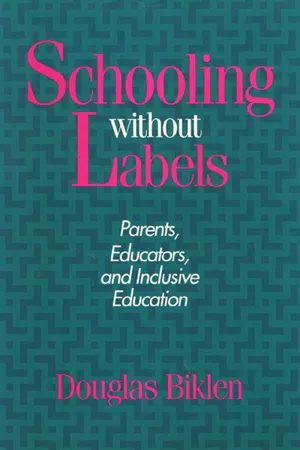
Douglas Biklen closely examines the experiences of six families in which children with disabilities are full participants in family life in order to understand how people who have been labeled disabled might become full participants in the other areas of society as well. He focuses on the contradictions between what some families have achieved, what they want for their children, and what society and its social policies allow. He demonstrates how the principles of inclusion that govern the lives of these families can be extended to education, community life, and other social institutions.
The parents who tell their stories here have actively sought inclusion of their children in regular schools and community settings; several have children with severe or multiple disabilities. In discussing issues such as normalization, acceptance, complete schooling, circles of friends, and community integration, these parents describe the challenge and necessity of their children's "leading regular lives."
In the series Health, Society, and Policy, edited by Sheryl Ruzek and Irving Kenneth Zola.
Frequently asked questions
- Essential is ideal for learners and professionals who enjoy exploring a wide range of subjects. Access the Essential Library with 800,000+ trusted titles and best-sellers across business, personal growth, and the humanities. Includes unlimited reading time and Standard Read Aloud voice.
- Complete: Perfect for advanced learners and researchers needing full, unrestricted access. Unlock 1.4M+ books across hundreds of subjects, including academic and specialized titles. The Complete Plan also includes advanced features like Premium Read Aloud and Research Assistant.
Please note we cannot support devices running on iOS 13 and Android 7 or earlier. Learn more about using the app.
Information
Table of contents
- Contents
- Preface
- I. Achieving Regular Lives
- II. The Inclusion Philosophy
- III. Escape from Client Status
- IV. The Myth of Clinical Judgment
- V. Two Students, One Myth
- VI. A Case of Inclusion: Individual or Schoolwide Change?
- VII. The Inclusive School
- VIII. Epilogue: Equality among Equals
- References
- Index