- English
- PDF
- Available on iOS & Android
About this book
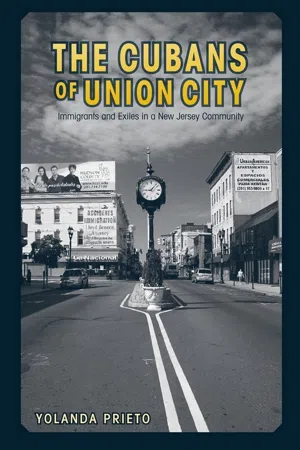
As a result of the conflicts between Cuba and the United States, especially after 1959, Cubans immigrated in great numbers. Most stayed in Miami, but many headed north to Union City, making it second only to Miami in its concentration of Cubans. In The Cubans of Union City, Yolanda Prieto discusses why Cubans were drawn to this particular city and how the local economy and organizations developed. Central aspects of this story are the roles of women, religion, political culture, and the fact of exile itself.
As a member of this community and a participant in many of its activities, Prieto speaks with special authority about its demographic uniqueness. Far from being a snapshot of the community, The Cubans of Union City conveys an ongoing research agenda extending over more than twenty years, from 1959 to the 1980s. As a long-term observer who was also a resident, Prieto offers a unique and insightful view of the dynamics of this community's evolution.
Frequently asked questions
- Essential is ideal for learners and professionals who enjoy exploring a wide range of subjects. Access the Essential Library with 800,000+ trusted titles and best-sellers across business, personal growth, and the humanities. Includes unlimited reading time and Standard Read Aloud voice.
- Complete: Perfect for advanced learners and researchers needing full, unrestricted access. Unlock 1.4M+ books across hundreds of subjects, including academic and specialized titles. The Complete Plan also includes advanced features like Premium Read Aloud and Research Assistant.
Please note we cannot support devices running on iOS 13 and Android 7 or earlier. Learn more about using the app.
Information
Table of contents
- Contents
- Preface
- Acknowledgments
- 1. Introduction
- 2. Cuban Union City: Origins, Development, and Change
- 3. Building Community: Economic Growth and the Rise of Local Organizations
- 4. Women Leave Home for the Factory: Gender, Work, and Family
- 5. Saint Augustine Parish and Cuban Adaptation: Religion and Reconciliation
- 6. Exile, Ethnic Identity, and Political Culture
- 7. Union City Cubans and Community Change: Some Theoretical Considerations
- Abbreviations
- Notes
- Bibliography
- Index