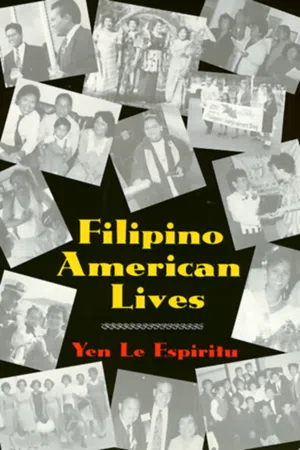
Filipino American Lives
About this book
Filipino Americans are now the second largest group of Asian Americans as well as the second largest immigrant group in the United States. As reflected in this collection, their lives represent the diversity of the immigrant experience and their narratives are a way to understand ethnic identity and Filipino American history.
Men and women, old and young, middle and working class, first and second generation, all openly discuss their changing sense of identity, the effects of generational and cultural differences on their families, and the role of community involvement in their lives. Pre- and post-1965 immigrants share their experiences, from the working students who came before WWII, to the manongs in the field, to the stewards and officers in the U.S. Navy, to the "brain drain" professionals, to the Filipinos born and raised in the United States.
As Yen Le Espiritu writes in the Introduction, "each of the narratives reveals ways in which Filipino American identity has been and continues to be shaped by a colonial history and a white-dominated culture. It is through recognizing how profoundly race has affected their lives that Filipino Americans forge their ethnic identities—identities that challenge stereotypes and undermine practices of cultural domination."
In the series Asian American History and Culture, edited by Sucheng Chan, David Palumbo-Liu, Michael Omi, K. Scott Wong, and Linda Trinh Võ.
Frequently asked questions
- Essential is ideal for learners and professionals who enjoy exploring a wide range of subjects. Access the Essential Library with 800,000+ trusted titles and best-sellers across business, personal growth, and the humanities. Includes unlimited reading time and Standard Read Aloud voice.
- Complete: Perfect for advanced learners and researchers needing full, unrestricted access. Unlock 1.4M+ books across hundreds of subjects, including academic and specialized titles. The Complete Plan also includes advanced features like Premium Read Aloud and Research Assistant.
Please note we cannot support devices running on iOS 13 and Android 7 or earlier. Learn more about using the app.
Information
Table of contents
- Contents
- Preface
- Acknowledgments
- Introduction: Filipino Settlements in the United States
- Chapter 1: "We Have to Show the Americans that We Can Be as Good as Anybody"
- Chapter 2: "I Was Used to the American Way of Life"
- Chapter 3: "Sometimes, I Am Not Sure What It Means to Be an American"
- Chapter 4: "My Dream Is to Be Able to Give Something Back to My Country and My People"
- Chapter 5: "My Experience Is Atypical"
- Chapter 6: "I Sacrificed My Five-Year College Education to Become aSteward"
- Chapter 7: "I Only Finished First Grade"
- Chapter 8: "International Medical Graduates Are Tested Every Stepof the Way"
- Chapter 9: "PASACAT Became My Whole Life"
- Chapter 10: "I Knew that I Wanted to Be a Naval Officer"
- Chapter 11: "I Offended Many Filipinos Because I Was an FOB"
- Chapter 12: " I Could Not Cope with Life"
- Chapter 13: "Everybody Seemed to Be Either White or Black, a Full Race"
- Bibliography
