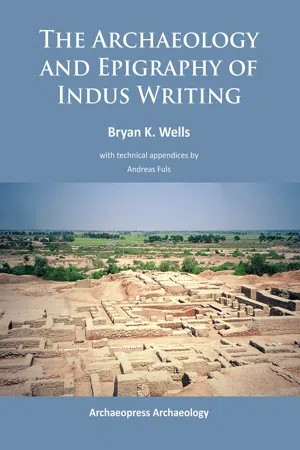
The Archaeology and Epigraphy of Indus Writing is a detailed examination of the Indus script. It presents new analysis based on an expansive text corpus using revolutionary analytical techniques developed specifically for the purpose of deciphering the Indus script. This exploration of Indus writing examines the structure of Indus text at a level of detail that has never been possible before. This advance in analytic techniques is combined with detailed linguistic information to suggest a root language for the Indus script. Further the syntax of the Indus script is demonstrated to match a Dravidian language. In the process of analysis the place name for the ancient Indus site of Dholavira is identified. This leads to the eventual identification of 17 signs with various levels of certainty. These readings lead to the partial definition of the Indus system of affixing. Using innovative analytical techniques Indus signs can be defined functionally as logographic or syllabic. Further, specific sign sequences are identified as verbs or nouns. The volumetric system used at Harappa during the Indus period is demonstrated. This discovery gives us a good idea of the scale and process of Indus exchange. The Indus inscriptions are analyzed with an emphasis on their archaeological contexts. The analysis presented in this book represents a significant advancement in our understanding of Indus writing. Bryan K. Wells is an archaeologist, epigrapher and geographer. He has excavated on the east and west coasts of North America and in Pakistan. Wells has studied ancient writing systems, including the Indus script, since 1990, and holds a PhD. in anthropology from Harvard University.
- 161 pages
- English
- PDF
- Available on iOS & Android
eBook - PDF
The Archaeology and Epigraphy of Indus Writing
About this book
Information
Table of contents
- Cover
- Title Page
- Copyright Page
- Dedication
- Contents
- List of Figures
- List of Tables
- Acknowledgements
- Preface
- Introduction
- Chapter 1
- Figure 1.1 Map of some major archaeological sites discussed in the text.
- The Indus Valley Script
- Figure 1.2 Chronological table showing approximate temporal relationships between the Indus Valley and Mesopotamia.
- Figure 1.3 Various types of intaglio seals: a) Square, b) Rectangular, c) Circular, d) Cylinder.
- Figure 1.4 Examples of seal impressions use as closures. a) K-89, Multiple seal impressions; b) M-0426, multiple impressions with impression of writing on reverse; c) H-1721, single impression; d) H-1725, single impression on jar stopper.
- Figure 1.5 Text on the back of DK12145/M-0426.
- Figure 1.6 Possible pen nib M-2129.
- Figure 1.7 Bas relief (H-1827) and Incised (H-2127) miniature tablets from Harappa, and (M-0534) a Copper tablet from Mohenjo-daro
- Figure 1.8 Inscribed post –firing text (H-2336); Pre-firing seal impressions on ceramic vessel (Pointed-bottom Goblets, H-1082)
- Figure 1.9 Miscellaneous inscribed artifacts from various sites and periods.
- Chapter 2
- Figure 2.1 Flowchart of the method used to define indus graphemes.
- The Indus Sign List
- Figure 2.2 Methods of sign elaboration and construction.
- Figure 2.3 The five largest allographic sets of Indus signs.
- Figure 2.4 Graphemic vs. allographic variations of signs 155, 156 and 158.
- Figure 2.5 Overlapping contexts of signs 155, 156 and 158 with pair frequency given between sign graphs.
- Figure 2.6 An Indus Sign List
- Chapter 3
- Figure 3.1 Continuum of text clasification of Indus texts by sign distribution and clustering.
- Indus Texts
- Patterns of Sign Use and the Syntactic Structure of
- Figure 3.2 Deviation of text types from expected random frequency of occurrences
- Figure 3.3 Elements of the Patterned text M-0393.
- Figure 3.4 Text M-0647 showing “conjunctive” sign 741 and frequency of pairing.
- Figure 3.5 Graphemes based on sign 740 with infixed numbers.
- Figure 3.6 Examples of signs 920/320 in Initial and Terminal clusters
- Figure 3.7 Percentage of ICTM by their positions in txts from right (1) to left (10)
- Figure 3.8 ICTM by one sign initial clusters.
- Figure 3.9 Distribution of sign 1, 2, and 60 in long (6+ signs) Patterned texts
- Figure 3.10 Structural analysis of IC from text M-0355
- Figure 3.11 Segmentation “tree” of text M-0355
- Figure 3.12 Graph showing the solo and IC percentage for 11 common signs found in ICs
- Figure 3.13 Distribution of sign 550 in long Patterned texts
- Figure 3.14 Distribution of sign 817 in long Patterned texts
- FIGURE 3.15 PERCENTAGE OF SET 1 AND 2 ICS PAIRING WITH ICTMS IN LONG PATTERNED TEXTS
- Figure 3.16 The most common ICTM-Constant combinations in ICs.
- Figure 3.17 ICs with sign 220 right-adjacent to ICTMs that employ Semi-variable.
- Figure 3.18 Contexts of sign 368 right adjacent to ICTMs with ∅ case identified from Initial cluster contexts in the last example.
- Figure 3.19 Long ICs with 002 as ICTM. Frequency of collocation given between signs.
- Figure 3.20 Fish signs used in Indus writing.
- Figure 3.21 Sign 220 plus number clusters in medial contexts
- Figure 3.22 The five most common fish sign in the normal order in fish sign clusters (right to left).
- Figure 3.23 Pairing of fish signs in long Patterned texts
- Figure 3.24 Collocations of fish signs with signs 798 and 803
- Figure 3.25 Affixing patters for signs 100-415 Bonded Cluster (BC).
- Figure 3.26 Affixing paradigms for sign 590+ phytomorphic signs as Bonded Clusters
- Figure 3.27 Affixing paradigms for the 033/705 Bonded Cluster. Numbers indicate the frequency of sign pairing.
- Figure 3.28 Contexts of Set 17 signs initial and terminal contexts pairing with sign 350 including a two-line text (bottom).
- Figure 3.29 Well known terminal cluster in strings which could be mistaken for Post Terminals: (a) H-158 (b) H-058 (c) M-120. All three are Multiple Segment texts.
- Figure 3.30 DK.E, E2475 showing the list of three BCs.
- Figure 3.31 Sign 740 solo example from Diamabad (Dmd-1).
- Figure 3.32 Comparison of a Patterned (top) and Complex (bottom) text in terms of sign correlations
- Figure 3.33 Comparison of Pure texts (H98-3491, top) and Hybrid Complex (Nd-1, bottom).
- Figure 3.34 Segmentation trees for H98-3491 and Nd-1.
- Figure 3.35 All of the complete texts using the 920-140 pair.
- Figure 3.36 The Dholavira signboard (photo reversed to maintain reading order).
- Figure 3.37 Text with related structures to the Dholavira signboard.
- Figure 3.38 H-006 with the partially rotated sign 625/850.
- Figure 3.39 The longest Indus text on a single surface (M-0314).
- Chapter 4
- Tablets, Pots and the Volumetric System of Harappa
- Figure 4.1. Possible depiction of a Viiii tree offering on M-0478.
- Figure 4.2. Examples of artifacts bearing V+# texts. Miniature tablets (bas relief: TAB:B; incised: TAB:I) and ceramic vessels.(POT:T:g). Drawings courtesy of Richard Meadow and the HARP project.
- Figure 4.3. Tabulation of tablets with V+# texts found at Harappa, Pakistan by tablet type and number of long strokes (Incised tablets = I, and Bas relief tablets = B).
- Figure 4.4. Miniature tablets with V+# texts by mound at Harappa.
- Figure 4.5 Purana Qila pots in situ after Vats (1940: Vol. II, Plate 23a).
- Figure 4.6. The Purana Qila pots from Harappa with V+# texts and an example from Kalibangan.
- Table 4.1. Measurements of the Purana Qila vessels with radius and volume calculations showing VI ≈ 40.4 liters.
- Table 4.2. Summary of the estimated units of the Harappa volumetric system. Errors are given in litersin liters. Errors never exceeds 2% of the vessels volume.
- Figure 4.7 All non-Harappan examples of V+# texts.
- Chapter 5
- Figure 5.1. Basic Indus Script Stroke Numerals
- Numerals in the Indus Script and their Uses
- Figure 5.2. Economic texts from three ancient writing systems compared to the Indus script demonstrating a common noun + numbe structure.
- Table 5.1. Right-adjacent collocations of Short-Linear Stroke signs (shaded cells have a frequency >4).
- Table 5.2. Right-adjacent collocations of short stacked stroke signs (shaded cells have a frequency >4).
- Figure 5.3. Contexts of signs 031 and 032 with numeric syllabic examples
- Figure 5.4. Inscribed ceramics with matching inscriptions to tablets (from Harappa).
- Table 5.3. Right adjacent collocations of long linear stroke signs (shaded cells have a frequency of five or more).
- Figure 5.5. Associations of “fish” signs and numeral signs.
- Figure 5.6. Numeral signs associated with sign 740. Numbers between sign graphs indicate the frequency of sign pairings.
- Figure 5.7 Examples of sign 900 as a numeral in positional notation
- Figure 5.8. Various Contexts of Sign 055
- Chapter 6
- Proto-Dravidian and the Indus Script
- Table 6.1 The proto-Dravidian number system.
- Figure 6.1 Copper tablet artifacts from Mohenjo-daro with the ‘hare eating grass’ replacement set.
- Figure 6.2. Some examples of sign 820 in various contexts.
- Figure 6.3 Contexts of 740 and 820 using the same bonded cluster.
- Figure 6.4 Positional analysis of sign 820 in Patterned, Long Complex and Short Segment texts texts.
- Figure 6.5. Some examples of 740 and 752 pairing in texts.
- Figure 6.6. Possible reading of M-30.
- Figure 6.7. Bas-relief miniature tablet H-182 with drummer and tiger.
- Figure 6.8. The Dholavira signboard with photo reversed to reflect reading order.
- Figure 6.9. Segmentation tree for the Dholavira Signboard
- Figure 6.10. Other text containing the Dholavira toponym (also see Figure 3.37).
- Figure 6.11. Suggested readings for Dholavira signboard signs.
- Figure 6.12. H-176 with the sign sequence 861+740 reading ‘cow at the city’.
- Figure 6.13. Examples of the various contexts of sign 821.
- Figure 6.14. The distribution of sign 798 in all complete text in which it occurs.
- Figure 6.15. The Mohenjo-daro bangle pot with seal impression and reconstructed bangels for fragments found in the vessel.
- Figure 6.16. The Mohenjo-daro bangle pot text.
- Figure 6.17. Evidence for 575 as a syllable sign.
- Figure 6.18. Various contexts of sign 575.
- Figure 6.19 Possible relationship between signs and images on M-1919.
- Figure 6.20. Proposed values for some Indus signs.
- Figure 6.21 Proto-Dravidian verb case endings and associated signs
- Appendix I
- Automated Segmentation Of Indus Texts
- Figure AI.1 Segmentation of H-026 after Korvink (2006:68)
- Figure AI.2 Segmentation tree using the z-score method (Sinha et al., 2011)
- Figure AI.3 Logarithmic influence of initial sign frequency (given as percentage of total frequency) on the connectivity.
- Table AI.1 Segmentation parameter and their effect on the connectivity between signs.
- Figure AI.4 Example of a) highly structured text, b) less structured text, both 8 signs long.
- Figure AI.5 Step by step process of segmentation and final Multivariate Segmentation tree
- Figure AI.6 Segmentation tree of H-026. Compare segmentation results to figure AI.1
- Figure AI.7 Mean tree index, mean connectivity and its standard deviation for different text classes.
- Figure AI.8 Relationship of mean connectivity to its standard deviation (std) by text class
-  Figure AI.9 Mean tree index and mean connectivity for different artefact types
- Appendix II
- Positional Analysis of Indus Signs
- Table AII.1. Frequency of text lengths in the reduced text corpus of complete inscriptions without duplicates from the same si e or artefact type
- Figure AII.1. Normalization of sign positions for different text lengths. Sign 001 falls between 50-60% (relative position 6), sign 002 falls between 80-100% (relative position 9 or 10), and sign 003 falls between 0-8.3% (relative position 1). Thereby, th
- Figure AII.2. Initial signs 190, 853, and 880.
- Table AII.2. Positional histograms of Initial sign and graphically similar signs.
- Table AII.3. Positional histograms of Terminal marker and graphically similar signs.
- Figure AII.3. Positional histograms of Post-Terminal signs.
- Figure AII.4. Signs with an almost constant positional distribution.
- Figure AII.5. Signs with a constant but with low frequency in the initial position.
- Figure AII.6. Signs with an Early-Medial positional distribution.
- Figure AII.7. Signs 741 and 742 have a Mid-Medial distribution.
- Figure AII.8. Signs with a Late-Medial sign distribution.
- Table AII.4 Comparison of signs and their doubled graphem
- Table AII.5. Comparison of signs and their mirrors.
- Figure AII.9. Histograms of sign 590 for different text classes.
- Figure AII.10. Histogram of sign 550 with two maxima at position 1 and 8 in various text classes.
- Figure AII.11. Positional histogram of signs in the text +740-540-002-820+ (seal M-1088). It is a typical example of a short patterned text with Initial cluster 002-820 and Terminal sign 740.
- Appendix III
- Classifying Undeciphered Writing Systems
- Figure AIII.1: Rank versus number of signs with the same frequency in a double-logarithmic scale for different writing systems. The slope of each linear trend equals the exponent G of each MPL (formula 2).
- Figure AIII.2: Relationship between exponent G of sign frequency curve and mean word length WL (formula 3, 4 and 5) for diffe ent writing systems. The linear functions are based on known writing systems for polysynthetic languages (r² = 0.98), fusional la
- Figure AIII.3: Modified power law (MPL) of Indus signs results in exponent G = -1.347 (R² = 0.991).
- Literature Cited
Trusted by 375,005 students
Access to over 1.5 million titles for a fair monthly price.
Study more efficiently using our study tools.
Frequently asked questions
Yes, you can cancel anytime from the Subscription tab in your account settings on the Perlego website. Your subscription will stay active until the end of your current billing period. Learn how to cancel your subscription
No, books cannot be downloaded as external files, such as PDFs, for use outside of Perlego. However, you can download books within the Perlego app for offline reading on mobile or tablet. Learn how to download books offline
Perlego offers two plans: Essential and Complete
- Essential is ideal for learners and professionals who enjoy exploring a wide range of subjects. Access the Essential Library with 800,000+ trusted titles and best-sellers across business, personal growth, and the humanities. Includes unlimited reading time and Standard Read Aloud voice.
- Complete: Perfect for advanced learners and researchers needing full, unrestricted access. Unlock 1.5M+ books across hundreds of subjects, including academic and specialized titles. The Complete Plan also includes advanced features like Premium Read Aloud and Research Assistant.
We are an online textbook subscription service, where you can get access to an entire online library for less than the price of a single book per month. With over 1.5 million books across 990+ topics, we’ve got you covered! Learn about our mission
Look out for the read-aloud symbol on your next book to see if you can listen to it. The read-aloud tool reads text aloud for you, highlighting the text as it is being read. You can pause it, speed it up and slow it down. Learn more about Read Aloud
Yes! You can use the Perlego app on both iOS and Android devices to read anytime, anywhere — even offline. Perfect for commutes or when you’re on the go.
Please note we cannot support devices running on iOS 13 and Android 7 or earlier. Learn more about using the app
Please note we cannot support devices running on iOS 13 and Android 7 or earlier. Learn more about using the app
Yes, you can access The Archaeology and Epigraphy of Indus Writing by Bryan K. Wells in PDF and/or ePUB format, as well as other popular books in Social Sciences & Archaeology. We have over 1.5 million books available in our catalogue for you to explore.