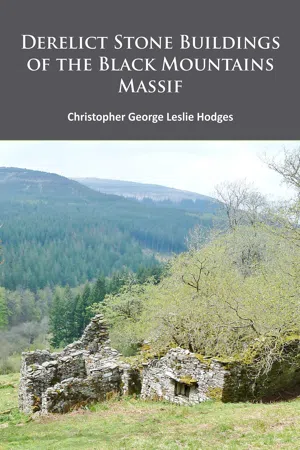
This book is based on several years of author's fieldwork in the valleys of the Black Mountains in South East Wales. Hodges had personal knowledge of the area having worked there in his professional capacity as a drystone waller. The aim of the fieldwork was to locate all the sites of derelict stone buildings within the designated upland study area of approximately 140 square kilometres. Initial research indicated that the area had not been previously surveyed to any great extent and the presence of derelict stone buildings that existed in the valleys was not a characteristic of the surrounding lower terrain. Using a combination of documentary evidence and fieldwork, a total of 549 potential sites were identified comprising houses, barns, other ancillary buildings and sheepfolds; 499 separate structures were located on the ground. Following a specially devised protocol at each site, information regarding masonry, modes of construction and extant features was recorded in both tabular and photographic forms.
- 351 pages
- English
- PDF
- Available on iOS & Android
eBook - PDF
Derelict Stone Buildings of the Black Mountains Massif
About this book
Information
Table of contents
- Cover
- Title Page
- Copyright Page
- Contents
- Acknowledgments
- Fig. P.1: The Black Mountains Massif and its valleys based on the 2005 OS 1:50000 map reproduced by kind permission of the Director General.
- Preface
- Preface
- Fig. P.2. Upper House in the Grwyne Fawr valley: Photographed in the 1960’s but since demolished.
- Fig. P.3: Maps A, B and C showing the areas covered by previous surveys and their relationship with the present study area.
- Chapter 1
- Chapter 1
- Introduction to Study
- Introduction to Study
- Fig. 1.2 Black Mountains: Distribution of recorded sites in the study area based on the 2005 OS 1:50000 map and reproduced by kind permission of the Director General.
- Fig. 1.3 Eastern escarpment: Chimney remnants at Upper Turnant (Lo53)
- Fig. 1.4: Nucleated settlements displayed over broad terrain types © Lowerre (2014).
- Fig. 1.5: Distribution of nucleated settlements in England © Roberts & Wrathmell (2000)
- Fig. 1.6 Eastern escarpment: Banked and hedged track leading to mountain wall.
- Fig. 1.7 Olchon valley – western flank of Cats Back ridge: An access route from the commons to lower farms is identified.
- Chapter 2
- Fig. 2.1.1 Black Mountains’ Region: An aerial view showing the isolation of the Massif from the surrounding terrain. To indicate scale the linear distance between Abergavenny and Crickhowell is five miles. © Google Earth (2013).
- Physical Background of the Study Area
- Fig. 2.1.2: The Black Mountains Massif based on the 2005 OS 1:50000 map and reproduced by kind permission of the Director Gene al.
- Fig. 2.1.3: A view across Llanbedr towards the ‘anonymous valley’ D.
- Fig. 2.1.4: Black Mountains Massif; Satellite view © Google Earth (2012).
- Fig. 2.1.5: Contour map of the Black Mountains.
- Fig. 2.1.6 Hatterall Ridge: The escarpment forms the continuous eastern flank of the Black Mountains. The middle foreground shows part of the Golden Valley. Also visible is the continuous line of the boundary between the lower, historically enclosed lan
- Fig. 2.2.1 Black Mountains: Parochial map based on the 2005 OS 1:50000 map and reproduced by kind permission of the Director General.
- Fig. 2.2.2 Black Mountains: Site distribution map based on the 2005 OS 1:50000 map and reproduced with the kind permission of he Director General.
- Fig. 2.2.3 Black Mountains: Approximate line of the mountain wall based on the 2005 OS 1:50000 map and reproduced with the kind permission of the Director General.
- Fig. 2.2.4: Upper Cwm Bridge UCB and Pontesgob P from the 2005 OS 1:50000 map and reproduced with the kind permission of the Director General.
- Fig. 2.2.5: The area between P and Pont Rhys Powell PRP from the 2005 OS 1:50000 map and reproduced by the kind permission of the Director General.
- Fig. 2.2.6 Black Mountains: Topographical depiction showing the locations of the three bridges and the line of the anonymous valley C-D © Google Maps (2013)
- Fig. 2.2.7: Lower boundary line to the west of Llanbedr from the 2005 OS 1:50000 map and reproduced by kind permission of the Director General.
- Fig. 2.2.8: Southeastern and lower eastern boundary line based on the 2005 OS 1:50000 map and reproduced by kind permission of the Director General.
- Fig. 2.2.9: Eastern boundary-Upper section based on the 2005 OS 1:50000 map and reproduced by kind permission of the Director General.
- Fig. 2.3.1 Geology of the Black Mountains: BGS 1:50000 map Sheet 214 (2004) showing the valleys and ridges for most of the study area. The Lower Cwmyoy area in the southeast was omitted from the published map.
- Fig. 2.3.2 Ffynnon limestone: The external surface appearance of the bed in situ with an approximate depth of 2-3 metres.
- Fig. 2.3.3 Olchon Valley: Limestone (Ff) based on the 2004 BGS 1:50000 map Sheet 214.
- Fig. 2.3.4 Old Red Sandstone: Typical surface appearance.
- Fig. 2.3.5 ORS: Outcrop showing differing bed widths as depth increases.
- Fig. 2.4.1 South Wales: Map showing diurnal rainfall variation © Faulkner and Perry (1974).
- Fig. 2.4.2 South Wales: Distribution map of weather stations © Meteorological Office.
- Fig. 2.4.3: Illustration showing the substantial difference in annual rainfall between the adjoining areas
- Fig. 2.4.4: Temperature variation during the second millennium© Fouquet (2008).
- Fig. 2.4.5: The five year average air temperature in Central England 1650-2000, © Meteorological Office (2006) in Fouquet (2008:70).
- Fig. 2.4.6: Annual insolation in kWh/m2 of South Wales and adjoining areas with legend © European Commission Joint Research Ce tre (2007).
- Fig. 2.5.1: Topographical depiction of the Black Mountains and the surrounding areas © Jansson and Glasser (2008).
- Fig. 2.5.3 Grwyne Fechan: The main lower valley and side valleys as depicted on the 2005 OS 1:50000 map and reproduced by kind permission of the Director General.
- Fig. 2.5.4 Grwyne Fechan: Looking north-eastwards across the valley towards Cwm Henbant.
- Fig. 2.5.5 Grwyne Fechan: Looking northwestwards across the valley towards Cwm Banw.
- Fig. 2.5.6 Grwyne Fechan: Looking down Cwm Banw towards the main valley with Cwm Milaid on the opposite side.
- Fig. 2.5.7 Grwyne Fechan: The smooth-sided glacial shape of Cwm Milaid.
- Fig. 2.5.8 Grwyne Fechan: The upper eastern flank of Pen Cerrig Calch with the Brownstones Formation Brs forming the uppermost section; the remainder is formed by the Senni Formation SB.
- Fig. 2.5.10 Grwyne Fechan: The present day landscape of the eastern slope of the upper section seen from above Cwm Banw.
- Fig. 2.5.9 Grwyne Fechan: The upper valley looking west from the Gader Ridge. Tyle du fawr and Tyle du fach are marked as Tdf and Tdfc respectively.
- Fig. 2.5.11 Grwyne Fawr valley: The NW-SE alignment as depicted by the 2005 OS 1:50000 map and reproduced by kind permission o the Director General.
- Fig. 2.5.13 Grwyne Fawr: Looking NW shows the majority of the valley with its saucer shaped cross-sectional profile above the 50 metre contour; the main path leading along the Ffwddog ridge is in the right foreground.
- Fig. 2.5.14 Grwyne Fawr: Cwm Nant Mair with its characteristic glacial bowl shape. The indicated mountain wall line runs at approximately 365 metres AOD.
- Fig. 2.5.15 Grwyne Fawr: Looking down into Cwm Ddau Nant, one of the less steep and more open dingles with Ffawydden in the top left.
- Fig. 2.5.16 Grwyne Fawr: A site photographed in the 1960’s in the anonymous dingle opposite the Pont Cadwgan carpark at SO26721.
- Fig. 2.5.17 Cefn Coed: A riverside site in the Grwyne Fawr.
- Fig. 2.5.19 Grwyne Fawr: A view of the upper limits of the enclosed area in the valley; at 512 metres AOD the drystone sheepfold (Fg3) forms part of the mountain wall.
- Fig. 2.5.20 Honddu valley: The main valley as depicted by the 2005 OS 1:50000 map and reproduced by kind permission of the Director General; X and Y are viewpoints mentioned in the text.
- Fig. 2.5.21 Honddu valley: Valley entrance and the wide relatively level floor seen from the Ffwddog ridge.
- Fig. 2.5.22 Honddu valley: Typical topography of the valley in the area marked X in Fig. 2.5.20.
- Fig. 2.5.23 Honddu valley: Cwmyoy, the only significant side valley; the name derives from Cwm Iau meaning yoke shaped. The photograph shows the typical glacial cwm bowl shape. In the lower left is the church and directly above is a large landslip.
- Fig. 2.5.24 Honddu valley: View from Y on Fig. 2.5.20 showing the upper Honddu valley looking towards Capel-y-Ffin.
- Fig. 2.5.25 Glyn Bwch and Glyn Fâch: Upper terminal valleys of the main Honddu valley based on the 2005 OS 1:50000 map and rep oduced by kind permission of the Director General. The parochial boundary with Upper Cwmyoy is marked as a red line.
- Fig. 2.5.26 Glyn Bwch: View from Ty Chwarel (Gb10) down into Glyn Bwch and across to the Ffwddog ridge forming the southern flank.
- Fig. 2.5.27 Glyn Fâch: Looking down towards Capel-y Ffin.
- Fig. 2.5.28 Glyn Fâch: The upper reaches and the characteristic glacial form.
- Fig. 2.5.29 Ty’n y Drain (GFc4): A typical site location on the valley floor level ground adjacent to the river.
- Fig. 2.5.30 Olchon valley: Based on the 2005 OS 1:50000 map and reproduced by kind permission of the Director General.
- Fig. 2.6.1 Black Mountains: The primary drainage pattern for the area consists of four main rivers marked A, B, C and D. Based on the 2005 OS 1:50000 map and reproduced by kind permission of the Director General.
- Fig. 2.6.2 Ffwddog ridge: The 1895 OS 1:2500 map shows the prevalence and relationship of springs to four highlighted sites on the ridge, © Historic Digimap.
- Fig. 2.7.2: The key for Fig. 2.7.1 © Stamp (1943).
- Fig. 2.7.3 Black Mountains: Soil map of the study area from the National Soil Survey © Cranfield University (2008).
- Chapter 3
- Chapter 3
- Drystone Walling and Vernacular Architecture
- Drystone Walling and Vernacular Architecture
- Fig. 3.2: A section of wall ‘built from hard slate-like stones… usually bedded in clay but the open joints at the surface help to give an attractive texture to the wall’ Brunskill (1981:83).
- Fig. 3.3 Olchon valley: Boskyns (Lo7), a possible longhouse.
- Fig. 3.4 Grwyne Fawr: 1960’s photograph of Llwyn Celyn in Partrishow.
- Fig. 3.5: Hafod-y-Garreg © Mick Sharp Photography (2002). The only description was - ‘This post-medieval permanent farmstead may have developed from an earlier summer dwelling’ Cadw (2002:9).
- Fig. 3.6: © Cambria Archaeology (2002). The given description of this building was - ‘Many of the peasant cottages of the Welsh countryside fell out of use in the late 19th and early 20th centuries. Their crumbling ruins remain as monuments to the past’
- Fig. 3.7 Troed y rhiw wen: Battered lower gable of the barn.
- Fig. 4.1.1: Ty’n y Pant in the Grwyne Fawr Valley.
- Chapter 4
- Chapter 4
- Fig. 4.1.2 Delyn (LC8): The largest of three buildings at this site in the lower Honddu valley.
- Research Methodology
- Research Methodology
- Fig. 4.1.3: An anonymous site in the Grwyne Fechan valley.
- Fig. 4.1.4 Ty Coch (UC28): A site on the Hatterall ridge above Llanthony.
- Fig. 4.1.5: Frontal view of Cwm Dick (Fg65).
- Fig. 4.1.6 Cwm Dick: The slab floor and a hearth with a pitched stone base exposed during the excavation.
- Fig. 4.1.7: Anonymous drystone site on the Ffwddog side of the lower Honddu valley.
- Fig. 4.1.8 Llanelieu: Four possible sites identified in an enclosed area above the Ffwddog parochial border in the Grwyne Fawr.
- Fig. 4.1.9: The 21st century appearance of the same area as Fig. 4.1.8; © Google Earth (2012).
- Fig. 4.1.10: Glan-dŵr from the 1885 OS 1:2500 map.
- Fig. 4.1.13: Satellite view of Glan-dwr site © Google Earth (2012).
- Fig. 4.1.11: Glan-dŵr on the 1905 OS 1:2500 map.
- Fig. 4.1.12: Glan-dŵr site not shown on the 1920 OS 1:2500 map.
- Fig. 4.1.14 Partrishow: Aerial view of an anonymous rectangular site above the mountain wall.
- Fig. 4.1.15: Anonymous site on the Gader ridge, not recorded on any map. © Google Earth (2012).
- Fig. 4.1.16: Location of the site in Fig. 4.1.15 based on the 1885 OS 1:2500 map.
- Fig. 4.1.17 Daren Farm (Lo25): The triangular-shaped stone in the lower right foreground marks the quoin and line of extant wall remnants.
- Fig. 4.1.18: Sheepfold or field barn (Lo67) adjacent to mountain wall on the eastern escarpment.
- Fig. 4.1.19 Partrishow Hill: A possible unmarked quarry on the eastern side.
- Fig. 4.1.20: The figures show the same section of the Vale of Ewyas above Capel-y-Ffin as depicted on the 2005 OS 1:50000 and :10000 maps respectively and reproduced by kind permission of the Director General.
- Fig. 4.1.21: Site depiction on the OS 1920 1:2500 map.
- Fig. 4.1.22: The arrow indicates the OS map depictions of the drystone building in the photograph.
- Fig. 4.1.23: Site as depicted on the 1904 OS 1:2500 map.
- Fig. 4.1.24: Site as depicted on the 2005 OS 1:50000 map and reproduced by kind permission of the Director General.
- Fig. 4.1.25: Ty Chwarel (GB10).
- Fig. 4.1.27 Grwyne Fechan: The site adjoined and was visible from the footpath on the eastern side of the valley above Henbant Fach.
- Fig. 4.1.28: Section of 1885 OS 1:2500 map.
- Fig. 4.1.29: Three sites: A, B and C related to mountain wall in Cwm Milaid.
- Fig. 4.1.31: Quarry site.
- Fig. 4.1.30: Site as depicted on the 2005 OS 1:50000 map and reproduced by kind permission of the Director General.
- Fig. 4.2.1: Masonry at Ty’n yr yn (GFc2).
- Fig. 4.2.2: Inverted version of the same view seen in Fig. 4.2.1.
- Fig. 4.2.3: Isolated stone slab stile below the eastern escarpment.
- Fig. 4.2.4: Anonymous possible site on the eastern escarpment.
- Fig. 4.2.5: Small anonymous site on the eastern escarpment.
- Fig. 4.2.6: Same site as Fig. 4.2.5 with the Olchon valley and Cat’s Back Ridge in the background.
- Fig. 4.2.7 Weild: Internal masonry of barn wall.
- Fig. 4.2.8 Weild: External view of wall seen in Fig. 4.2.7.
- Chapter 5
- Chapter 5
- Site Analysis and Site Types
- Site Analysis and Site Types
- Fig. 5.1.2 Ffawyddog Fawr (Fg35): The large barn photographed in the 1960’s.
- Fig. 5.1.4 Wern-y-Cwm (Lo73): Probably abandoned after WWII.
- Fig. 5.1.5 Weild (LC21): Tree damage to the large barn.
- Fig. 5.1.6 Cwm Milaid: Upper gable end and interior of a downslope drystone building above the mountain wall.
- Fig. 5.1.7 Cwm Milaid: Lower interior of the same building as Fig. 5.1.6.
- Fig. 5.1.9 Olchon valley: Lower side wall of Cornelau (Lo29), a rare riverside site.
- Fig. 5.1.10: Rectangular window with failed stone lintel.
- Fig. 5.1.11: Another window with a failed lintel but showing a more widespread effect.
- Fig. 5.1.12 Pen yr heol Turnant Lo49: Intact timber lintel and failed masonry.
- Fig. 5.1.13: A timber and stone lintel combination.
- Fig. 5.1.14: Failed timber lintel but the indicated mortise shows this piece of timber had been historically recycled and was herefore not solid.
- Fig. 5.1.15: Timber and stone combination lintel.
- Fig. 5.1.16 Graig Llwyd (Lb40): Mortises in a timber lintel in the barn.
- Fig. 5.1.17 Weild (LC22): Worked timber from differing periods. An outbuilding with reused historical oak timber below a more modern roof structure built using planed softwood.
- Fig. 5.1.19 Lower Blaen (Lo19): Missing quoins.
- Fig. 5.1.18 Nant yr ychain fach (GFn31): Missing quoins.
- Fig. 5.2.1 Spiteful Inn (Fg72): Located above the mountain wall with the main trackway along the Ffwddog ridge visible to the right.
- Table 5A: Building alignment totals.
- Fig. 5.2.2 Cwm Dych (Fg65): Frontal view.
- Fig. 5.2.3 Eastern escarpment: Across slope field barn (Lo67).
- Fig. 5.2.4 Eastern escarpment: Possible across slope house site (Lo66).
- Fig. 5.2.5 Pen Tyle (GFn20): Rear view of house.
- Fig. 5.2.6 Pen Tyle: Barn (GFn21).
- Fig. 5.2.7 Glyn Fâch: Parallel barns (GFc8 and 9).
- Fig. 5.2.8 Blaen Olchon (Lo20): Up valley aspect.
- Fig. 5.2.10 Dial Garreg: Upper side wall.
- Fig. 5.2.9 Dial Garreg (Fg48): Facade on the lower side wall.
- Fig. 5.2.11 Black Cock Inn: Upper side wall and location adjacent to path along the Ffwddog ridge.
- Fig. 5.2.12 Black Cock Inn: Detail of the mullion two light window.
- Fig. 5.2.14 Cwmyoy church: Structural effects on the building caused by historical landslides from above are apparent.
- Fig. 5.2.15 Tyle du Fach (GFn14): Dripstones and closed openings on the rear wall.
- Fig. 5.2.16 Pen yr heol Turnant (Lo49): Porch masonry.
- Fig. 5.2.17 Penybont (GFn28): Remnants of lime wash or thin plaster at this site in the Grwyne Fechan.
- Fig. 5.3.1 Dial Garreg: Typical divisions in the upper side wall between the three constituent sections forming the main building; two abutting and one lean-to.
- Fig. 5.3.2 Tir Moelyn (Fg30): Comprising two abutting buildings marked A and B.
- Fig. 5.3.3 Tir Moelyn: Lean-to B lay at 90º to main building A; the vertical joint between the two buildings is indicated.
- Fig. 5.3.4 Type 1A: Anonymous site in the upper Grwyne Fechan.
- Fig. 5.3.5 Type 1B: Castle Farm (Lo44) on the eastern escarpment.
- Fig. 5.3.7 Type 2B: Tyle Du Fawr (GFn16).
- Fig. 5.3.6 Type 2A: The two separate buildings at Troed yr rhiw wen (UC 54/55).
- Fig. 5.3.9 Weild (LC20-23): A satellite view © Google Earth 2012.
- Fig. 5.3.10 Weild: The approach from point X marked on Fig. 5.3.8.
- Fig. 5.3.11 Type 3: Ty Mawr (Pw31-35) satellite view © Google Earth 2012.
- Fig. 5.3.12 Ty Mawr: Depicted as five separate buildings on the OS 1905 1:2500 map; the barn seen in Fig. 5.3.11 is marked as a hatched rectangle.
- Fig. 5.3.13 Pen Tyle (GFn21): A Type 2B site with an atypical site pattern comprising a large downslope barn and a smaller across slope house complex.
- Fig. 5.3.14 Brychen: Side view showing the parallel alignment of the two main buildings.
- Fig. 5.3.15 Brychen: The depiction from the 1904 OS 1:2500 map and the approximate direction of the photograph in Fig. 5.3.14.
- Fig. 5.3.16 Tredommen: A standing farm comprising three downslope buildings in the central Grwyne Fechan valley.
- Fig. 5.3.17 Anonymous linear site on the eastern escarpment.
- Fig. 5.3.18: Penwyrlod (Lo68) on the eastern escarpment.
- Fig. 5.3.19 Weild: Looking down the Honddu valley towards the Ffwddog ridge in the distance.
- Fig. 5.3.20 Ty Canol (Lo50/51): A linear downslope complex and a secondary detached linear complex on the eastern escarpment.
- Fig. 5.3.21 Ty Canol: Depiction from the 1885 OS 1:2500 map.
- Fig. 5.3.22 Upper Pentwyn (Fg59): A small drystone Type 2A site with an indicated barn.
- Fig. 5.3.23 Upper Pentwyn: Rectangular form of the downslope house.
- Fig. 5.3.24 Y Fferm: Two entrance types in the barn.
- Fig. 5.3.25 (Lo37): Field barn on the eastern escarpment.
- Fig. 5.3.26 Trwyn-tal barn (GFc30): Lower side wall and entrances.
- Fig. 5.3.27 Ty Canol (LC32): A barn above Cwmyoy village.
- Fig. 5.3.28 Ty Ysgubor Fach (Lb60): A site in the central Grwyne Fechan.
- Fig. 5.3.29: The distribution of sheepfolds across the study area based on the 2005 OS 1:50000 map and reproduced by kind permission of the Director General.
- Fig. 5.3.30 Grwyne Fawr: A sheepfold (Fg3) at 512 metres AOD in the upper reaches of the valley, marked S on Fig. 5.3.29.
- Fig. 5.3.31 Grwyne Fechan: A built enclosure (GFn7) recorded in the upper reaches of the valley and still depicted on modern OS maps.
- Fig. 5.3.32 (GFn1); An extensive drystone sheepfold.
- Fig. 5.3.33: The structure shown in Fig. 5.3.32 seen from point A.
- Fig. 5.3.34: Depiction on the 1888 OS 1:2500 map of a sheepfold which approximately forty-five years earlier had been named on the Tithe map as the farm Nant y Bedd Isha.
- Fig. 5.3.35: An aerial view of the same site as Fig. 5.3.34, now obscured by trees. This site was one of a small number unide tified on the ground and recorded as NS. © Google Earth (2013).
- Fig. 5.3.36. (UC42): Circular drystone site in the Honddu valley.
- Fig. 5.3.37 Grwyne Fechan: Anonymous drystone structure above the mountain wall in Nant-y-coy.
- Fig. 5.3.38 Cwm Henllan: Two drystone sites within an enclosure above Henllan in the Honddu valley.
- Fig. 5.3.39 Draen Farm (Lo60): Fireplace and feeding rail.
- Fig. 5.3.40 Ty’n y Cwm: Possible pigsty or poultry house (GFn10).
- Fig. 5.3.41. Wern-y-cwm (Lo73): possible toilet.
- Fig. 5.4.1 Berllan Fedw (Fg9): A drystone site with downslope alignment.
- Fig. 5.4.2 Berllan Fedw: Site location indicated on the 1843 Tithe Map.
- Fig. 5.4.3 Berllan Fedw: Depiction on the 1888 OS 1:2500 map.
- Fig. 5.4.4 Berllan Fedw: Site plan (scale bar shows two metres).
- Fig. 5.4.5 Berllan Fedw: Loop window.
- Fig. 5.4.6 Berllan Fedw: Lower entrance - quoins only visible on the left side.
- Fig. 5.4.7 Berllan Fedw: Interior walls.
- Fig. 5.4.8: Berllan Fedw: Access through upper crosswall.
- Fig. 5.4.10 Berllan Fedw: Lower gable end.
- Fig. 5.4.9: Berllan Fedw: Blocked-off area.
- Table 5.4B
- Fig. 5.4.11: Berllan Fedw: Cross-wall butt joined against external wall.
- Fig. 5.4.12 Berllan Fedw: The northern up-valley side wall.
- Site Feature Analysis
- Chapter 6
- Industrial Buildings and Associated Industries
- Chapter 7
- Historical Narrative: General, Regional and Local
- Chapter 8
- Documentary Evidence
- Chapter 9
- Conclusion
- Appendix A Database spreadsheet
- Masonry
- Appendix B
- DSWA – Craft Certification Advanced and Master Craftsman test regulations (2013)
- Appendix C
- Bibliography
- Fig. 5.1.19 Lower Blaen (Lo19): Missing quoins.
- Fig. 5.2.1 Spiteful Inn (Fg72): Located above the mountain wall with the main trackway along the Ffwddog ridge visible to the right.
- Table 5A: Building alignment totals.
- Fig. 5.2.2 Cwm Dych (Fg65): Frontal view.
- Fig. 5.2.3 Eastern escarpment: Across slope field barn (Lo67).
- Fig. 5.2.4 Eastern escarpment: Possible across slope house site (Lo66).
- Fig. 5.2.5 Pen Tyle (GFn20): Rear view of house.
- Fig. 5.2.6 Pen Tyle: Barn (GFn21).
- Fig. 5.2.7 Glyn Fâch: Parallel barns (GFc8 and 9).
- Fig. 5.2.8 Blaen Olchon (Lo20): Up valley aspect.
- Fig. 5.2.9 Dial Garreg (Fg48): Facade on the lower side wall.
- Fig. 5.2.10 Dial Garreg: Upper side wall.
- Fig. 5.2.11 Black Cock Inn: Upper side wall and location adjacent to path along the Ffwddog ridge.
- Fig. 5.2.12 Black Cock Inn: Detail of the mullion two light window.
- Fig. 5.2.14 Cwmyoy church: Structural effects on the building caused by historical landslides from above are apparent.
- Fig. 5.2.13 Black Cock Inn: Doorway with its double wooden lintel and dripstone.
- Fig. 5.2.15 Tyle du Fach (GFn14): Dripstones and closed openings on the rear wall.
- Fig. 5.2.16 Pen yr heol Turnant (Lo49): Porch masonry.
- Fig. 5.2.17 Penybont (GFn28): Remnants of lime wash or thin plaster at this site in the Grwyne Fechan.
- Fig. 5.3.1 Dial Garreg: Typical divisions in the upper side wall between the three constituent sections forming the main building; two abutting and one lean-to.
- Fig. 5.3.2 Tir Moelyn (Fg30): Comprising two abutting buildings marked A and B.
- Fig. 5.3.3 Tir Moelyn: Lean-to B lay at 90º to main building A; the vertical joint between the two buildings is indicated.
- Fig. 5.3.4 Type 1A: Anonymous site in the upper Grwyne Fechan.
- Fig. 5.3.5 Type 1B: Castle Farm (Lo44) on the eastern escarpment.
- Fig. 5.3.6 Type 2A: The two separate buildings at Troed yr rhiw wen (UC 54/55).
- Fig. 5.3.7 Type 2B: Tyle Du Fawr (GFn16).
- Fig. 5.3.9 Weild (LC20-23): A satellite view © Google Earth 2012.
- Fig. 5.3.8 Type 3: Weild comprising four buildings each marked as a hatched rectangle or polygon on the OS 1900 1:2500 map; fo orientation purposes, building A is identified in Figs. 5.3.8 to 5.3.10.
- Fig. 5.3.10 Weild: The approach from point X marked on Fig. 5.3.8.
- Fig. 5.3.11 Type 3: Ty Mawr (Pw31-35) satellite view © Google Earth 2012.
- Fig. 5.3.12 Ty Mawr: Depicted as five separate buildings on the OS 1905 1:2500 map; the barn seen in Fig. 5.3.11 is marked as a hatched rectangle.
- Fig. 5.3.13 Pen Tyle (GFn21): A Type 2B site with an atypical site pattern comprising a large downslope barn and a smaller across slope house complex.
- Fig. 5.3.14 Brychen: Side view showing the parallel alignment of the two main buildings.
- Fig. 5.3.15 Brychen: The depiction from the 1904 OS 1:2500 map and the approximate direction of the photograph in Fig. 5.3.14.
- Fig. 5.3.16 Tredommen: A standing farm comprising three downslope buildings in the central Grwyne Fechan valley.
- Fig. 5.3.17 Anonymous linear site on the eastern escarpment.
- Fig. 5.3.18: Penwyrlod (Lo68) on the eastern escarpment.
- Fig. 5.3.19 Weild: Looking down the Honddu valley towards the Ffwddog ridge in the distance.
- Fig. 5.3.20 Ty Canol (Lo50/51): A linear downslope complex and a secondary detached linear complex on the eastern escarpment.
- Fig. 5.3.21 Ty Canol: Depiction from the 1885 OS 1:2500 map.
- Fig. 5.3.22 Upper Pentwyn (Fg59): A small drystone Type 2A site with an indicated barn.
- Fig. 5.3.23 Upper Pentwyn: Rectangular form of the downslope house.
- Fig. 5.3.24 Y Fferm: Two entrance types in the barn.
- Fig. 5.3.25 (Lo37): Field barn on the eastern escarpment.
- Fig. 5.3.26 Trwyn-tal barn (GFc30): Lower side wall and entrances.
- Fig. 5.3.27 Ty Canol (LC32): A barn above Cwmyoy village.
- Fig. 5.3.28 Ty Ysgubor Fach (Lb60): A site in the central Grwyne Fechan.
- Fig. 5.3.29: The distribution of sheepfolds across the study area based on the 2005 OS 1:50000 map and reproduced by kind permission of the Director General.
- Fig. 5.3.30 Grwyne Fawr: A sheepfold (Fg3) at 512 metres AOD in the upper reaches of the valley, marked S on Fig. 5.3.29.
- Fig. 5.3.31 Grwyne Fechan: A built enclosure (GFn7) recorded in the upper reaches of the valley and still depicted on modern OS maps.
- Fig. 5.3.32 (GFn1); An extensive drystone sheepfold.
- Fig. 5.3.33: The structure shown in Fig. 5.3.32 seen from point A.
- Fig. 5.3.34: Depiction on the 1888 OS 1:2500 map of a sheepfold which approximately forty-five years earlier had been named on the Tithe map as the farm Nant y Bedd Isha.
- Fig. 5.3.35: An aerial view of the same site as Fig. 5.3.34, now obscured by trees. This site was one of a small number unide tified on the ground and recorded as NS. © Google Earth (2013).
- Fig. 5.3.36. (UC42): Circular drystone site in the Honddu valley.
- Fig. 5.3.37 Grwyne Fechan: Anonymous drystone structure above the mountain wall in Nant-y-coy.
- Fig. 5.3.38 Cwm Henllan: Two drystone sites within an enclosure above Henllan in the Honddu valley.
- Fig. 5.3.39 Draen Farm (Lo60): Fireplace and feeding rail.
- Fig. 5.3.40 Ty’n y Cwm: Possible pigsty or poultry house (GFn10).
- Fig. 5.3.41. Wern-y-cwm (Lo73): possible toilet.
- Table 5.4A
- Fig. 5.4.1 Berllan Fedw (Fg9): A drystone site with downslope alignment.
- Fig. 5.4.2 Berllan Fedw: Site location indicated on the 1843 Tithe Map.
- Fig. 5.4.3 Berllan Fedw: Depiction on the 1888 OS 1:2500 map.
- Fig. 5.4.5 Berllan Fedw: Loop window.
- Fig. 5.4.4 Berllan Fedw: Site plan (scale bar shows two metres).
- Fig. 5.4.6 Berllan Fedw: Lower entrance - quoins only visible on the left side.
- Fig. 5.4.7 Berllan Fedw: Interior walls.
- Fig. 5.4.8: Berllan Fedw: Access through upper crosswall.
- Fig. 5.4.9: Berllan Fedw: Blocked-off area.
- Fig. 5.4.10 Berllan Fedw: Lower gable end.
- Table 5.4B
- Fig. 5.4.11: Berllan Fedw: Cross-wall butt joined against external wall.
- Fig. 5.4.12 Berllan Fedw: The northern up-valley side wall.
- Fig. 6.5.7 Anonymous site: Exposed orthostat fireplace in upper gable.
- Fig. 6.5.8: View of site (LB51) in Cwm Milaid © Vaughan et al (2007)
- Fig. 6.5.9: A view of the same across slope site (Lb51); the feature is indicated in the upper wall on the right.
- Fig. 6.5.10: Possible drystone orthostat fire place with adjacent alcove in (Lb 51).
- Fig. 6.5.11 Tyle du fawr (GFn16): Internal flue masonry.
- Fig. 6.5.12 Cwmbanw: The more complex internal flue masonry above the fireplace seen in Fig. 6.5.1.
- Fig. 6.5.13 Fferm: Chimney stack in the 1960s which serviced both a ground floor and a first floor fireplace Fig. 6.5.14.
- Fig. 6.5.14 Fferm: Extant fireplaces and chimney breast.
- Fig. 6.5.15 Black Cock Inn (Fg55): The upper gable position of the single stack in the 1960s.
- Fig. 6.5.16 Waun Rhyd: View of roof and chimney.
- Fig. 6.5.17 Waun Rhyd: Close up view of the stack in Fig. 6.5.16,its style suggests it was drystone.
- Fig. 6.5.18 Ty’r Ewen: External bread oven in Partrishow.
- Fig. 6.5.19: Typical appearance of the internal masonry of bread ovens.
- Fig. 6.5.21 Ffordd-las-isaf: Interior of bread oven shown in Fig. 6.5.20.
- Fig. 6.5.20 Ffordd-las-isaf (GFr4): Bread oven.
- Fig. 6.5.22 Ty’n y drain (GFc4): Overview showing grassed over bread oven in the foreground.
- Fig. 6.5.23 Tyle du fawr (GFn16): Bread oven and dripstone in the lower gable end.
- Fig. 6.5.24 Upper House: Bread oven in standing outhouse.
- Fig. 6.5.26 Graigwen (GFc20): Fireplace and breadoven.
- Fig. 6.5.25 Ty’n y Llwyn: Bread oven in malt house © Redwood & Barnes (1993/4:67).
- Fig. 6.5.27 Graigwen: Site location and fireplace in Fig. 6.5.26.
- Fig. 6.5.28: Anonymous site in Cwm Bysich recorded as a barn (Lb74)
- Fig. 6.5.29: Possible drystone bread oven and fireplace at site in Fig. 6.5.28.
- Fig. 6.5.30 Wern Hir: The main fireplace with a cast-iron range in situ.
- Fig. 6.5.31 Rhyd Las (Lo9): The fireplace, bread oven and cast-iron range.
- Fig. 6.5.32 Wern Hir: Fireplace in upper gable.
- Fig. 6.5.33 Weild (LC20): Possible location of fireplace, chimney and flue.
- Fig. 6.5.34 Tir Doctor (Lb9): Probable site of staircase and associated hearth.
- Fig. 6.5.35 Hard (Lb28): Fireplace and staircase.
- Fig. 6.5.36 The Place (Lo11): Fireplace and chimney built against the lower gable.
- Fig. 6.5.37 Ty’n y Cwm (GFn 8): Fireplace in external kitchen.
- Fig. 6.5.38 Wern Hir: Similar example of this added structure type.
- Fig. 6.6.1 Ty Canol (Lo50): Stairwell A and fireplace B in lower gable.
- Fig. 6.6.2 Wern Hir (Lb71): Fireplace and stairwell.
- Fig. 6.6.3 Tyle du Fawr (GFn16): Fireplace.
- Fig. 6.6.4 Fferm: Lower gable interior.
- Fig. 6.6.5 Fferm (Fg23): Interior of lower gable in the 1960s; the lower main fireplace and a smaller upper floor fireplace a e visible.
- Fig. 6.6.6 Black Cock Inn (Fg55): Side view showing possible scarcement.
- Fig. 6.7.1: Alcove in soil based mortared masonry.
- Fig. 6.7.3 Cwm Dych (Fg65): Opposing alcoves in a fireplace.
- Fig. 6.7.2: Alcove in lime mortared masonry.
- Fig. 6.7.4: Drystone alcove in masonry at an unidentified site.
- Fig. 6.7.5: Alcove A in‘toilet’.
- Fig. 6.7.6 Cefn Coed: Rectangular opening in adjacent drystone field boundary wall.
- Fig. 6.7.7 Ty Mawr: Drystone geese holes.
- Fig. 6.7.8 Ty’n y Pant (Pw29): Bee boles.
- Chapter 7
- Industrial Buildings and Associated Industries
- Fig. 7.1: Distribution of historical mills in the Black Mountains region based on the 2005 OS 1:50000 map and reproduced with he kind permission of the Director General.
- Table 7A List of mills
- Fig. 7.2 Mill-stone recorded at Wern Hir: This stone with its spindle hole measured 760mm by 150mm and probably formed part of an unidentified cider mill in the vicinity.
- Fig. 7.3 John Jeffrey’s Mill: Depiction on the 1904 OS 1:2500 map.
- Fig. 7.4 John Jeffrey’s Mill: Up valley approach to the mill buildings on the Breconshire side.
- Fig. 7.5: Map from the 1759 survey of the Dinas estate (NLW Gwernyfed 61)
- Fig. 7.6 John Jeffrey’s mill: View of the western side buildings looking up river.
- Fig. 7.7 John Jeffrey’s Mill: Buildings on eastern bank looking down river.
- Fig. 7.8 John Jeffrey’s Mill: Channel below buildings seen in Fig. 7.7.
- Fig. 7.9: Possible mill site opposite Pont Cadwgan (GFr12)
- Fig. 7.10 Grwyne Fawr: Distribution of charcoal hearths © Rippin (2013:4).
- Fig. 7.11 Grwyne Fawr: Charcoal heath site © Rippin (2013:16).
- Fig. 7.12 Grwyne Fawr: Possible charcoal burner’s drystone hut surrounded by coppiced woodland.
- Fig. 7.13 Olchon valley: Remains of drystone lime kiln above Blaen Olchon (Lo2).
- Fig. 7.14 Rhyd Las: Conical lime kiln.
- Fig. 7.15 Rhyd Las: Interior view of the fire space indicated in Fig. 7.14.
- Fig. 7.16 Eastern escarpment: 1885 OS 1:2500 map depiction of lime kiln.
- Chapter 8
- Historical Narrative: General, Regional and Local
- Fig. 8.1: Map of all castles known to have been in Wales and the March 1066-1215 © Hogg & King (1963:78).
- Fig. 8.2: Sections of two maps relating to the study area taken from (Forests and Chases of England and Wales circa 1000 to circa 1850) c/o. St John’s College, Oxford at www. info.sjc.ox.ac.uk/forests/ForestMapTiles.html (2012)
- Fig. 8.3: Sites in Llanthony estate in 1799 © Procter (2007)
- Fig. 8.4: Location map of houses with mullion windows from Introduction to Monmouthshire Houses Part 1, © Smith (1994: xxiv)
- Fig. 8.5: Ground plans of Neuadd and Henbant Fach in the lower Grwyne Fechan, © Jones & Smith (1966/7:7)
- Fig. 8.6: Ground plan of Y Coed in the Grwyne Fawr © Jones & Smith (1966/7:24)
- Fig. 8.7: Sites in the Grwyne Fawr as depicted on the 1885 OS 1:2500 map.
- Fig. 8.8: Carved inscription at Ty’n y pant photographed in the 1960s.
- Fig. 8.9: Approximate distribution pattern of sites in or close to the mountain wall based on the 2005 OS 1:50000 map and reproduced by kind permission of the Director General.
- Fig. 8.10: Drystone site in mountain wall above Cwm Banw.
- Fig. 8.11: ‘Ruins’ (Lb1) in Cwm Banw.
- Fig. 8.12: Aerial view of unmarked site (Lln24) on the Gader ridge © Google Earth (2013).
- Fig. 8.13: Approximate location of (Lln24) marked on the 1885 OS 1:2500 map.
- Fig. 8.14: Upper sidewall of (Lln24).
- Fig. 8.15: Possible entrance into (Lln24).
- Fig. 8.16: Drystone site in Nant-y-coy above the mountain wall in the Grwyne Fechan.
- Fig. 8.17: View from above of the site in Fig. 8.16.
- Fig. 8.18: Coed (Lo70): Downslope aspect.
- Fig. 8.19 Coed: First floor room..
- Fig. 8.20: Gable to the rear of Coed.
- Fig. 8.21: Exterior of the upper gable at Coed
- Fig. 8.22: Auburys façade.
- Fig. 8.23: Full site view of Auburys.
- Fig. 8.24: Inventory of William Poiskine’s Estate in Llanveynoe 1669 © National Library of Wales, Aberystwyth.
- Fig. 8.25: Inventory of Charles Herbert of Ty’n y Llwyn © Redwood & Barnes (1993/4:68).
- Chapter 9
- Documentary Evidence
- Fig. 9.1: Extent of named estates within the study area based on the 2005 OS 1:50000 map reproduced by kind permission of the Director General.
- Fig. 9.3: Extent of the parishes of Llanbedr and Partrishow within the Crickhowell estate based on the 2005 OS 1:50000 map and reproduced by kind permission of the Director General.
- Fig. 9.2: Extent of the marcher Lordship of Hay within the study area based on the 2005 OS 1:50000 map reproduced by kind permission of the Director General.
- Fig. 9.4: Extent of the Dinas estate labelled HGFn, HGFr and Lln within the study area based on the 2005 OS 1:50000 map and reproduced by kind permission of the Director General.
- Fig. 9.5: Map of the Dinas estate dated 1759, showing its boundary with Ffwddog © Gwernyfed 61,NLW, Aberystwyth.
- Fig. 9.6: 1759 Dinas estate survey map which includes Mary Hugh’s, see section 5.6 © NLW, Aberystwyth.
- Fig. 9.7: 1759 Map of Cwm Banw showing some sites that may have been abandoned by this date © NLW, Aberystwyth.
- Fig. 9.8: An access point in the mountain wall above Cwm Banw looking towards Neuadd Fawr in the Grwyne Fechan.
- Fig. 9.9 Blaen Nant Mair (Pw13) : Interior.
- Fig. 9.10: 1759 map showing the location of Blaen Nant Mair in Partrishow © NLW, Aberystwyth.
- Fig. 9.11: Blaen Nant Mair as depicted on the 2005 OS 1:50000 map and reproduced by kind permission of the Director General.
- Fig. 9.12: Overall view of site X depicted in Fig. 9.13.
- Fig. 9.13: Site depiction of X based on the 2005 OS 1:50000 map and reproduced by kind permission of the Director General.
- Fig. 9.14: Frontal view of the Type 1A drystone building indicated in Fig. 9.12.
- Fig. 9.15: View showing the fireplace F, an alcove A and the staircase S.
- Fig. 9.16: Graigwen in Glyn Fâch.
- Fig. 9.17: Anonymous site (Lo24) and its enclosure on the eastern escarpment.
- Fig. 9.18: Distribution map of sites above the mountain wall based on the 2005 OS 1:50000 map and reproduced by kind permissio of the Director General.
- Fig. 9.19: Crickhowell estate land within the study area showing four likely areas of encroachment; based on the 2005 OS 1:5000 map and reproduced by kind permission of the Director General.
- Fig. 9.20: Cwm Henbant and Cwm Beusych reproduced from the 2005 OS 1:50000 map by kind permission of the Director General.
- Fig. 9.21: Reproduction of the 1610 petition document © Hatfield House Archive Collection.
- Conclusion
- Appendix A Database spreadsheet
- Appendix B
- Masonry
- Fig. B.1.1: Building stone with potential faces marked A and B.
- Fig. B.1.2: Diagram showing the structure of a drystone wall © DSWA (2012a)
- Fig. B.1.3: Throughstones placed in a drystone wall under construction © DSWA (2012)
- Fig. B.1.5: Diagram showing alternatives to throughstones © Adcock (2007)
- Fig. B.1.4: Throughstone example (see text below).
- Fig. B.1.6: In situ example of incorrect throughstone alternatives.
- Fig. B.1.7: Interior of historical drystone masonry showing various throughstone alternatives as discussed in the narrative.
- Fig. B.1.9: Diagram used to explain the effects of the absence or settling of hearting within a drystone wall © Fry (2009:216).
- Fig. B.1.8 Ty Canol (LC32): Lime mortar residue within failed masonry.
- Fig. B.1.10: Diagrams representing a wall with vertical sides and a battered wall.
- Fig. B.1.11: Stone used to explain tracing.
- Fig. B.1.12: Outward bulge in standing drystone wall.
- Fig. B.1.13: Inward rotation causing wall failure and collapse.
- Fig. B.1.14 Honddu valley: Internal structure of barn masonry.
- Fig. B.1.15 Pen Cae (Lb55): Mortared masonry of the barn with drystone lean-tos.
- Fig. B.1.16 Grwyne Fechan: Sheepfold forming part of the mountain wall.
- Fig. B.1.17 Shâns (Fg56): Drystone site on the Ffwddog ridge.
- Fig. B.2.1 Cefn Coed Ewyas (Fg5): Internal corner in barn.
- Fig. B.3.1 Ty’n y Cwm: Drystone field wall opposite barn (GFn10), repair using river stones.
- Fig. B.3.2 Partrishow: Pile of collected stones on the edge of a recently ploughed field.
- Fig. B.3.3 Honddu valley: Field stones used in a simple structure located above the 300 metre contour.
- Fig. B.3.4 Partrishow: Example of a small quarry and its proximity to an extensive wall system. This site was located in a field with no evidence of buildings in the vicinity.
- Fig. B.3.5 Cwm Milaid: Small linear quarry located three metres above the mountain wall.
- Fig. B.3.6 Grwyne Fechan: View of the central valley below Pen Cerrig Calch showing the typical field boundary types.
- Fig. B.3.7 Cwm Nant Mair, Partrishow: Line of the drystone mountain wall above 365 metres AOD, in the process of being stripped out prior to repair.
- Fig. B.3.8 Pen Rhiw (Pw20): Approach track leading up to the site.
- Fig. B.3.9 Grwyne Fechan: Quarries in the valley as marked on the 2005 OS 1:50000 map and reproduced by kind permission of the Director General.
- Fig. B.3.10 Cwm Banw: One of the later, larger quarries on the upper ridge.
- Fig. B.3.11 Cwm Banw: An earlier shallow quarry close to Fig. B.3.10.
- Fig. B.3.12 Cwm Banw: House site within the mountain wall below Fig. B.3.11.
- Appendix C
- DSWA – Craft Certification Advanced and Master Craftsman test regulations (2013)
- Bibliography
- Acknowledgments
- Preface
- Chapter 1
- Introduction to Study
- Chapter 2
- Physical Background of the Study Area
- Chapter 3
- Drystone Walling and Vernacular Architecture
- Chapter 4
- Research Methodology
- Chapter 5
- Site Analysis and Site Types
- Fig. 9.16: Graigwen in Glyn Fâch.
- Fig. 9.17: Anonymous site (Lo24) and its enclosure on the eastern escarpment.
- Fig. 9.18: Distribution map of sites above the mountain wall based on the 2005 OS 1:50000 map and reproduced by kind permissio of the Director General.
- Fig. 9.19: Crickhowell estate land within the study area showing four likely areas of encroachment; based on the 2005 OS 1:5000 map and reproduced by kind permission of the Director General.
- Fig. 9.20: Cwm Henbant and Cwm Beusych reproduced from the 2005 OS 1:50000 map by kind permission of the Director General.
- Fig. 9.21: Reproduction of the 1610 petition document © Hatfield House Archive Collection.
- Fig. B.1.1: Building stone with potential faces marked A and B.
- Fig. B.1.2: Diagram showing the structure of a drystone wall © DSWA (2012a)
- Fig. B.1.3: Throughstones placed in a drystone wall under construction © DSWA (2012)
- Fig. B.1.5: Diagram showing alternatives to throughstones © Adcock (2007)
- Fig. B.1.4: Throughstone example (see text below).
- Fig. B.1.6: In situ example of incorrect throughstone alternatives.
- Fig. B.1.7: Interior of historical drystone masonry showing various throughstone alternatives as discussed in the narrative.
- Fig. B.1.9: Diagram used to explain the effects of the absence or settling of hearting within a drystone wall © Fry (2009:216).
- Fig. B.1.8 Ty Canol (LC32): Lime mortar residue within failed masonry.
- Fig. B.1.10: Diagrams representing a wall with vertical sides and a battered wall.
- Fig. B.1.11: Stone used to explain tracing.
- Fig. B.1.12: Outward bulge in standing drystone wall.
- Fig. B.1.13: Inward rotation causing wall failure and collapse.
- Fig. B.1.14 Honddu valley: Internal structure of barn masonry.
- Fig. B.1.15 Pen Cae (Lb55): Mortared masonry of the barn with drystone lean-tos.
- Fig. B.1.16 Grwyne Fechan: Sheepfold forming part of the mountain wall.
- Fig. B.1.17 Shâns (Fg56): Drystone site on the Ffwddog ridge.
- Fig. B.2.1 Cefn Coed Ewyas (Fg5): Internal corner in barn.
- Fig. B.2.2 Ty Mawr (Pw32): Internal corner in large barn.
- Fig. B.3.1 Ty’n y Cwm: Drystone field wall opposite barn (GFn10), repair using river stones.
- Fig. B.3.2 Partrishow: Pile of collected stones on the edge of a recently ploughed field.
- Fig. B.3.3 Honddu valley: Field stones used in a simple structure located above the 300 metre contour.
- Fig. B.3.4 Partrishow: Example of a small quarry and its proximity to an extensive wall system. This site was located in a field with no evidence of buildings in the vicinity.
- Fig. B.3.5 Cwm Milaid: Small linear quarry located three metres above the mountain wall.
- Fig. B.3.6 Grwyne Fechan: View of the central valley below Pen Cerrig Calch showing the typical field boundary types.
- Fig. B.3.7 Cwm Nant Mair, Partrishow: Line of the drystone mountain wall above 365 metres AOD, in the process of being stripped out prior to repair.
- Fig. B.3.8 Pen Rhiw (Pw20): Approach track leading up to the site.
- Fig. B.3.9 Grwyne Fechan: Quarries in the valley as marked on the 2005 OS 1:50000 map and reproduced by kind permission of the Director General.
- Fig. B.3.10 Cwm Banw: One of the later, larger quarries on the upper ridge.
- Fig. B.3.11 Cwm Banw: An earlier shallow quarry close to Fig. B.3.10.
- Fig. B.3.12 Cwm Banw: House site within the mountain wall below Fig. B.3.11.
Trusted by 375,005 students
Access to over 1.5 million titles for a fair monthly price.
Study more efficiently using our study tools.
Frequently asked questions
Yes, you can cancel anytime from the Subscription tab in your account settings on the Perlego website. Your subscription will stay active until the end of your current billing period. Learn how to cancel your subscription
No, books cannot be downloaded as external files, such as PDFs, for use outside of Perlego. However, you can download books within the Perlego app for offline reading on mobile or tablet. Learn how to download books offline
Perlego offers two plans: Essential and Complete
- Essential is ideal for learners and professionals who enjoy exploring a wide range of subjects. Access the Essential Library with 800,000+ trusted titles and best-sellers across business, personal growth, and the humanities. Includes unlimited reading time and Standard Read Aloud voice.
- Complete: Perfect for advanced learners and researchers needing full, unrestricted access. Unlock 1.5M+ books across hundreds of subjects, including academic and specialized titles. The Complete Plan also includes advanced features like Premium Read Aloud and Research Assistant.
We are an online textbook subscription service, where you can get access to an entire online library for less than the price of a single book per month. With over 1.5 million books across 990+ topics, we’ve got you covered! Learn about our mission
Look out for the read-aloud symbol on your next book to see if you can listen to it. The read-aloud tool reads text aloud for you, highlighting the text as it is being read. You can pause it, speed it up and slow it down. Learn more about Read Aloud
Yes! You can use the Perlego app on both iOS and Android devices to read anytime, anywhere — even offline. Perfect for commutes or when you’re on the go.
Please note we cannot support devices running on iOS 13 and Android 7 or earlier. Learn more about using the app
Please note we cannot support devices running on iOS 13 and Android 7 or earlier. Learn more about using the app
Yes, you can access Derelict Stone Buildings of the Black Mountains Massif by Christopher George Leslie Hodges in PDF and/or ePUB format, as well as other popular books in Social Sciences & Archaeology. We have over 1.5 million books available in our catalogue for you to explore.