The history of Ancient Egypt has been studied in the region of Southeast Europe since the end of the nineteenth century. In some of the countries this was not the case for various reasons, but mainly because of the undeveloped scholarly capabilities and institutions, insufficient funds for archaeological research in Egypt, and the lack of cooperation with scholars from other countries.
From the 1960s, however, this situation has changed for the better, firstly with the numerous publications of the diffusion of the Ancient Egyptian cults during Graeco-Roman period, and then with publications (articles, catalogues, books) on Ancient Egyptian collections in various museum institutions located in Southeast Europe.
From the early 1990s one can trace the increased production of various scholarly papers in which researchers from Slovenia, Croatia, Serbia, Macedonia, Romania, and Bulgaria not only researched the Egyptian cults in the Roman Empire, but also on the various aspects of history, religion and literature of Ancient Egypt. Their work, however, was mostly unknown to the scholars outside the region primarily because the results were written in the native languages. This book will try to give a review of the history of the studies of Ancient Egypt done in Southeast Europe, and present some of the latest research.
A History of Research Into Ancient Egyptian Culture in Southeast Europe comprises a selection of papers in which scholars from various institutions of the region reviewed the different aspects of past studies and the development of the research of the Ancient Egypt in some countries, along with recent research in the field. We hope that this publication will be useful for all scholars who are unfamiliar with the historiography of this region.
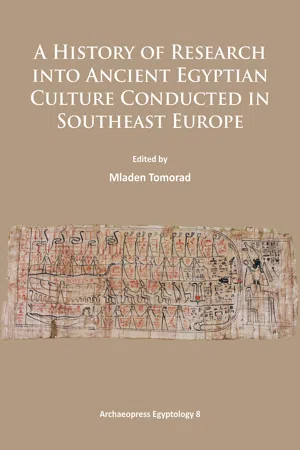
- 289 pages
- English
- PDF
- Available on iOS & Android
eBook - PDF
A History of Research Into Ancient Egyptian Culture in Southeast Europe
About this book
Information
Table of contents
- Cover
- Title Page
- Copyright Page
- Contents
- List of Illustrations
- Preface
- List of contributors
- Chapter I: A History of Research into Ancient Egyptian Culture Conducted in Southeast Europe
- Fig. 1 The Archaeological museum, Zagreb: Zagreb mummy, inv. no. AMZ E-664, c. 1891. The photographic collection of the Archaeological museum in Zagreb.
- Fig. 2 The Archaeological museum, Zagreb: Liber linteus Zagrabiensis, inv. no. AMZ E-665. Photo: F. Beusan, 2004.
- Fig. 3 Franz Koller. The photographic collection of the Archaeological museum in Zagreb.
- Fig. 4 Šime Ljubić. The photographic collection of the Archaeological museum in Zagreb.
- Fig. 5 Gavro Manojlović. The photographic collection of the Miroslav Krleža Institute of Lexicography, Zagreb.
- Fig. 6 Grga Novak. The photographic collection of the Faculty of Philosophy, University of Zagreb.
- Fig. 7 Petar Lisičar. The photographic collection of the Miroslav Krleža Institute of Lexicography, Zagreb.
- Fig. 8 Petar Selem, 2003. Photo by M. Tomorad.
- Fig. 9 Frane Bulić. The photographic collection of the Miroslav Krleža Institute of Lexicography, Zagreb.
- Fig. 10 Manojlović, Gavro. Povijest Starog orijenta, Zagreb 1923.
- Fig. 11 Novak, Grga. Egipat, Zagreb 1967.
- Fig. 12 Uranić, Igor. Stari Egipat: povijest, književnost i umjetnost drevnih Egipćana, Zagreb 2002.
- Fig. 13 Prof. Ignatov and Prof. Lekov in front of Cairo Museum.
- Fig. 14 Students from New Bulgarian University in Luxor Temple.
- Fig. 15 The Courtyard of TT 263. Luxor, West Bank.
- Chapter II: The Ancient Egyptian collections in Southeast Europe
- Fig. 16 Josef Schwegel`s portrait in 1868 by Angeli. Photo by T. Lauko. National Museum of Slovenia.
- Fig. 17a The Archaeological museum, Zagreb: Scarabeus, inv. no. E-004av. Photo M. Tomorad, 2004.
- Fig. 17b The Archaeological museum, Zagreb: Scarabeus, inv. no. E-004av. Photo M. Tomorad, 2004.
- Fig. 18 The Archaeological museum of Istria, Pula: Wedjet-eye amulet, inv. no. AMIP P-30337. Photo M. Tomorad, 2004.
- Fig. 19 The Archaeological museum, Zagreb: Group of shabtis. Photo: F. Beusan.
- Fig. 20 Dubrovnik museums, The Archaeological museum, Dubrovnik: Jewelry, inv. nos. DM 583 and 593. The photographic collectio of the Archaeological museum in Dubrovnik.
- Fig. 21 Dubrovnik museums, The Archaeological museum, Dubrovnik: The group of statuettes of various Egyptian deities. Photo: M. Tomorad, 2003.
- Fig. 22 The Archaeological museum, Zagreb: Egyptian footwear, inv. no. E-191. Photo M. Tomorad, 2004.
- Fig. 23 The Museum of the city, Varaždin: Badari vessel, inv. no. AO 6521. Photo M. Tomorad, 2002.
- Fig. 24 The Museum of the city, Varaždin: Group of canopic vessels. Photo M. Tomorad, 2002.
- Fig. 25 The Archaeological museum, Zagreb: Male head, inv. no. E-213. Photo M. Tomorad, 2004.
- Fig. 26 The Archaeological museum, Zagreb: Isis with Horus, inv. no. E-735. Photo M. Tomorad, 2004.
- Fig. 27 The Archaeological museum, Zagreb: Wooden stele, inv. no. E-568. Photo M. Tomorad, 2004.
- Fig. 28 The Archaeological museum, Zagreb: Papyrus, inv. no. AMZ E-597. Photo M. Tomorad, 2004.
- Fig. 29 The Archaeological museum, Zagreb: The outside coffin of the Kaipamau, inv. no. AMZ E-687. Photo F. Beusan, 2005.
- Fig. 30 Sphinx from the Peristil of the Diocletian palace in Split.
- Fig. 31 Monolite stone block with the protome of Jupiter–Amon. Veliki Brijun. Photo M. Tomorad, 2004.
- Fig. 32 The Archaeological museum, Zagreb: The fragment with the head of Serapis from Petrovci, inv. no. A-164. Photo M. Tomorad, 2004.
- Fig. 33 The Archaeological museum, Zagreb: The statue of Isis from Nin, inv. no. A-34. Photo M. Tomorad, 2004.
- Fig. 34 The Archaeological museum, Zagreb: The Ptolemaic coin with the images of Cleopatra VII and Marcus Antonius, inv. no. AMZ B1921av. Photo M. Tomorad, 2002.
- Fig. 35 The Archaeological museum, Zagreb: The Roman coin with the images of Serapis, inv. no. AMZ C7959rv. Photo M. Tomorad, 002.
- Fig. 36 The Archaeological museum, Zagreb: The pernament exhibition, c. 1920.
- Fig. 37a-d The Archaeological museum, Zagreb: The pernament exhibition, c. 1970's.
- Fig. 38 The Archaeological museum, Zagreb: The pernament exhibition, c. 1990’s.
- Fig. 39 The Archaeological museum, Zagreb: Isis-Fortuna from Lika, inv. no. A-4633. Photo M. Tomorad, 2004.
- Fig. 40 The Archaeological museum, Zagreb: Ptolemy I Soter, inv. no. A3822. Photo M. Tomorad, 2002.
- Fig. 41 The Archaeological museum, Zagreb: Jupiter-Ammon, minted in Alexandria, inv. no. C7945rv. Photo M. Tomorad, 2002.
- Fig. 42 Dubrovnik museums, The Archaeological museum, Dubrovnik: The group of Egyptian artifacts during exhibition in March, 203. Photo M. Tomorad.
- Fig. 43 Dubrovnik museums, The Archaeological museum, Dubrovnik: The mummy in coffin, 2003. Photo M. Tomorad.
- Fig. 44a-b The Archaeological museum of Istria, Pula: Stone monument with sistrum from Savudrija, inv. no. AMIP A-41. Photo M. Tomorad, 2004.
- Fig. 45 The Archaeological museum of Istria, Pula: Sistrum from Nesactium (early 2nd c. B.C.), inv. no. AMIP A-5048. Photo M. Tomorad, 2004.
- Fig. 46 The Archaeological museum, Zadar: Oil lamp with Serapis and Isis, from Nin, inv. no. 375. Photo K. A. Giunio.
- Fig. 47 The Franciscan monastery, Košljun: Shabti, inv. no. AO5279. Photo M. Tomorad 2002.
- Fig. 48 The Museum of the city, Varaždin: Stele of Mery-Mery, reign of Amenhotep III, inv. no. AO 6521. Photo M. Tomorad, 2002.
- Fig. 49 The Archaeological collection, The Museum Mimara, Zagreb: Vessel, Naqada II-Naqada III, inv. no. ATM 230.
- Fig. 50 The Archaeological collection, The Museum Mimara, Zagreb: Bowl, Naqada III-Archaic period, inv. no. ATM 231.
- Fig. 51 The Archaeological collection, The Museum Mimara, Zagreb: Bottle, Naqada II-Archaic period, inv. no. ATM 233.
- Fig. 52 The Archaeological collection, The Museum Mimara, Zagreb: Statuette of a carrier, Middle Kingdom, inv. no. ATM 243.
- Fig. 53 The Archaeological collection, The Museum Mimara, Zagreb: Head of and unknown pharaoh, Middle Kingdom, inv. no. ATM 22 .
- Fig. 54 The Archaeological collection, The Museum Mimara, Zagreb: Statuette of a woman, Middle Kingdom-New Kingdom, inv. no. ATM 244.
- Fig. 55 The Archaeological collection, The Museum Mimara, Zagreb: Upper part of shabti figure, 18th Dynasty, inv. no. ATM 232.
- Fig. 56 The Archaeological collection, The Museum Mimara, Zagreb: Bowl, New Kingdom, inv. no. ATM 234.
- Fig. 57a-b The Archaeological collection, The Museum Mimara, Zagreb: Scarab, New Kingdom, inv. no. ATM 236.
- Fig. 58 The Archaeological collection, The Museum Mimara, Zagreb: Horus, New Kingdom, inv. no. ATM 239.
- Fig. 59 The Archaeological collection, The Museum Mimara, Zagreb: Osiris, New Kingdom, inv. no. ATM 245.
- Fig. 60 The Archaeological collection, The Museum Mimara, Zagreb: Ba-bird, Third Intermediate Period, inv. no. ATM 242.
- Fig. 61 The Archaeological collection, The Museum Mimara, Zagreb: Osiris, Third Intermediate Period, inv. no. ATM 238.
- Fig. 62 The Archaeological collection, The Museum Mimara, Zagreb: Falcon Akhem, Third Intermediate Period, inv. no. ATM 241.
- Fig. 63 The Archaeological collection, The Museum Mimara, Zagreb: Canopic cover with the head of Duamutef, Late period, inv. no. ATM 228.
- Fig. 64 The Archaeological collection, The Museum Mimara, Zagreb: Horus, Late period, inv. no. ATM 237.
- Fig. 65 The Archaeological collection, The Museum Mimara, Zagreb: Unconventional shabti, pregnant naked African woman, New Kingdom to Graeco-Roman period, inv. no. ATM 235.
- Fig. 66 The Archaeological collection, The Museum Mimara, Zagreb: Figure of a woman, Graeco-Roman period, inv. no. ATM 240.
- Fig. 67 The Archaeological collection, The Museum Mimara, Zagreb: Apis amulet, not dated, inv. no. ATM 1376.
- Fig. 68 The Archaeological collection, The Museum Mimara, Zagreb: Hare amulet, not dated, inv. no. ATM 1376a.
- Fig. 69 The Archaeological collection, The Museum Mimara, Zagreb: Hare amulet, not dated, inv. no. ATM 1376b.
- Fig. 70 The Archaeological collection, The Museum Mimara, Zagreb: Anubis amulet, not dated, inv. no. ATM 1376c.
- Fig. 71 The Archaeological collection, The Museum Mimara, Zagreb: Bes amulet, not dated, inv. no. ATM 1376d.
- Fig. 72 The Archaeological collection, The Museum Mimara, Zagreb: Oil lamp on a stand, 6th century A.D., inv. no. ATM 361.
- Fig. 73 The Archaeological collection, The Museum Mimara, Zagreb: Oil lamp on a stand, 6th century A.D., inv. no. ATM 358.
- Fig. 74 The Archaeological collection, The Museum Mimara, Zagreb: Oil lamp on a stand, 7th century A.D., inv. no. ATM 359.
- Fig. 75 The Archaeological collection, The Museum Mimara, Zagreb: Oil lamp, 5th-7th century A.D., inv. no. ATM 357.
- Fig. 76 The Archaeological collection, The Museum Mimara, Zagreb: Stand, 6th century A.D., inv. no. ATM 1719.
- Fig. 77 The Archaeological collection, The Museum Mimara, Zagreb: Oil lamp, 6th century A.D., inv. no. ATM 356.
- Fig. 78 The Archaeological collection, The Museum Mimara, Zagreb: Oil lamp on a stand, 6th century A.D., inv. no. ATM 355.
- Fig. 79 The Archaeological collection, The Museum Mimara, Zagreb: Menasampulla, 6th century A.D., inv. no. ATM 349.
- Fig. 80 The Archaeological collection, The Museum Mimara, Zagreb: Menasampulla, 6th century A.D., inv. no. ATM 351.
- Fig. 81 The Archaeological collection, The Museum Mimara, Zagreb: Relief with two female saints, 5th-6th century A.D., inv. no. ATM 340.
- Fig. 82 The Archaeological collection, The Museum Mimara, Zagreb: Box, 5th-6th century A.D., inv. no. ATM 3582.
- Fig. 83 The Archaeological collection, The Museum Mimara, Zagreb: Fragment of a tunique, 5th-6th century A.D., inv. no. ATM 24.
- Fig. 84 The Glass collection, The Museum Mimara, Zagreb: Small Jug, Egypt, 2nd millennium B.C, inv. no. ATM 1337.
- Fig. 85 The Glass collection, The Museum Mimara, Zagreb: Bead, 15th c. B.C., Egypt, inv. no. ATM 1336.
- Fig. 86 The Glass collection, The Museum Mimara, Zagreb: Balsamarium, 15th c. B.C, Egypt, inv. no. ATM 1334.
- Fig. 87 The Glass collection, The Museum Mimara, Zagreb: Amphoriskos, 14th c. B.C., Egypt, inv. no. ATM 1335.
- Fig. 88 The Glass collection, The Museum Mimara, Zagreb: Alabastron, Egypt, 6th-5th c. B.C., inv. no. ATM 1340.
- Fig. 89 The Glass collection, The Museum Mimara, Zagreb: Alabastron, Egypt, 3rd-4th c. B.C. no. ATM 1343.
- Fig. 90 The Glass collection, The Museum Mimara, Zagreb: Amphoriskos, Greece, 5th/4th c. B.C., inv. no. ATM 1354.
- Fig. 91 The Glass collection, The Museum Mimara, Zagreb: Amphoriskos, Greece, 5th/4th c. B.C., inv. no. ATM 1355.
- Fig. 92 The Glass collection, The Museum Mimara, Zagreb: Oinochoe, Greece, 4th c. B.C., inv. no. ATM 1356.
- Fig. 93 The Glass collection, The Museum Mimara, Zagreb: Small bowl, Alexandria, 1st c. B.C., inv. no. ATM 1352.
- Fig. 94 The Glass collection, The Museum Mimara, Zagreb: Bowl, Alexandria, 1st c. A.D., inv. no. ATM 1350.
- Fig. 95 The Glass collection, The Museum Mimara, Zagreb: Cup, Alexandria, 1st c. A.D., inv. no. ATM 1767.
- Fig. 96 The Archaeological museum, Zagreb: The latest pernament exhibition, 2005. Photo F. Beusan.
- Fig. 97 The Archaeological museum, Zagreb: The latest pernament exhibition, 2005. Photo F. Beusan.
- Fig. 98 The Archaeological museum, Zagreb: The latest pernament exhibition, 2005. Photo F. Beusan.
- Fig. 100 The Archaeological museum, Zagreb: Lower part of scarcophagus of Kaipamau, inv. no. E-687. Photo F. Beusan, 2005.
- Fig. 99 The Archaeological museum, Zagreb: Lower part of scarcophagus with coffin of Kaipamau, inv. no. E-687. Photo F. Beusan, 2005.
- Fig. 101. The Museum of Slavonia, Osijek: Shu amulet, inv. no. MSO-AA-1343.
- Fig. 102. The Museum of Slavonia, Osijek: Pedi-hor-pa-khered votive stele, inv. no. MSO-AA-2590.
- Fig. 103. The Museum of Slavonia, Osijek: Sculpture of Osiris, inv. no. MSO-AA-1340.
- Fig. 104. The Museum of Slavonia, Osijek: Relief plaque, inv. no. MSO-AA-1341.
- Fig. 105. The Museum of Slavonia, Osijek: Scarab amulet, inv. no. MSO-AA-1605.
- Fig. 106. The Museum of Slavonia, Osijek: Scarab amulet, inv. no. MSO-AA-1606.
- Fig. 107. The Museum of Slavonia, Osijek: Dwarf Pataikos amulet, inv. no. MSO-AA-2665.
- Fig. 108. The Museum of Slavonia, Osijek: Bes amulet, inv. no. MSO-AA-2670.
- Fig. 109. The Museum of Slavonia, Osijek: Shabti, inv. no. MSO-AA-6243.
- Fig. 110. The Museum of Slavonia, Osijek: Sculpture of a man, inv. no. MSO-AA-19469.
- Fig. 111. The Museum of Slavonia, Osijek: Sculpture of Osiris, inv. no. MSO-194962.
- Fig. 112. The Museum of Slavonia, Osijek: Scarab amulet, inv. no. MSO-AA-1432.
- Fig. 113. The Museum of Slavonia, Osijek: Scarab amulet, inv. no. MSO-AA-1433.
- Fig. 114. The Museum of Slavonia, Osijek: Scarab amulet, inv. no. MSO-AA-1434.
- Fig. 115. The Museum of Slavonia, Osijek: Thoth amulet, inv. no. MSO-AA-1342.
- Fig. 116. The Museum of Slavonia, Osijek: Hare amulet, inv. no. MSO-AA-1344.
- Fig. 117 Map of the locations in Serbia.
- Chapter III: The current Egyptological research
- Fig. 118. Franc Kavčič, Ptolomey II. Philadelphus, graphite, wash pen and ink drawing, 270 x 190 mm. Akademie der Bildenden Künste Wien, inv. no. 209. Photo: ©Kupferstichkabinett Akademie der Bildenden Künste, Wien.
- Fig. 119. Franc Kavčič, Neshor with the triad of Elephantine, graphite, wash pen and ink drawing, 228 x 313 mm. Akademie der Bildenden Künste Wien, inv. no. 183. Photo: © Kupferstichkabinett Akademie der Bildenden Künste, Wien.
- Fig. 120. Franc Kavčič, The Goddess Isis, graphite, wash pen and ink drawing, 210 x 290 mm. Akademie der Bildenden Künste Wie , inv. no. 188. Photo: © Kupferstichkabinett Akademie der Bildenden Künste, Wien.
- Fig. 121. Franc Kavčič, The Blind harpist from ‘D’Egitto’, graphite, wash pen and ink drawing, 347 x 234 mm Akademie der Bildenden Künste Wien, inv. no. 808. Photo: © Kupferstichkabinett Akademie der Bildenden Künste, Wien.
- Fig. 122. Franc Kavčič, The Blind harpist from ‘D’Egitto’, graphite, wash pen and ink drawing, 350 x 230 mm. Akademie der Bildenden Künste Wien, inv. no. 922. Photo: © Kupferstichkabinett Akademie der Bildenden Künste, Wien.
- Fig. 123. Franc Kavčič, The Blind harpist from ‘D’Egitto’, graphite, wash pen and ink drawing, 247 x 230 mm. Akademie der Bildenden Künste Wien, inv. no. 840. Photo: © Kupferstichkabinett Akademie der Bildenden Künste, Wien.
- Chapter IV: The reseach of the Egyptian cults in Graeco-Roman world
- Table 1. Egyptian and ‘Aegyptiaca’ artifacts discovered in Istria and Illyricum (1st millenium B.C.- early 2nd c. A.D.)
- Fig. 124 The Archaeological museum, Zagreb: Shabti, from Salona, Croatia, inv. no. E-561. Photo M. Tomorad, 2005.
- Fig. 125 The Archaeological museum, Zagreb: Ptolemaic coin, from Gračac, Croatia, inv. no. A3870. Photo M. Tomorad, 2002.
- Fig. 126 The Archaeological museum, Zagreb: Ptolemaic coin, from Gračac, Croatia, inv. no. A3892. Photo M. Tomorad, 2002.
- Fig. 127 The Archaeological museum, Zagreb: Ptolemaic coin, from Gračac, Croatia, inv. no. A9371. Photo M. Tomorad, 2002.
- Fig. 128 The Archaeological museum of Istria, Pula: Sistrum, from Nesactium, Croatia, inv. no. A-5048. Photo M. Tomorad, 2004.
- Fig. 129 The Archaeological museum of Istria, Pula: Neith, from unknown site in Istria, Croatia, inv. no. A-5220. Photo M. Tomorad, 2004.
- Fig. 130 The Archaeological museum of Istria, Pula: Harpocrates amulet, from unknown site in Istria, Croatia, inv. no. A-5221. Photo M. Tomorad, 2004.
- Fig. 131 The Archaeological museum of Istria, Pula: Apis, from unknown site in Istria, Croatia, inv. no. A-5223. Photo M. Tomo ad, 2004.
- Fig. 132 The Archaeological museum of Istria, Pula: Young Egyptian prince or Pharaoh in kneeling position, from unknown site i Istria, Croatia, inv. no. A-5210. Photo M. Tomorad, 2004.
- Fig. 133 The Archaeological museum of Istria, Pula: Osiris, from Bale in Istria, Croatia, inv. no. A-5224. Photo M. Tomorad, 204.
- Fig. 134 The Franciscan monastery, Košljun: Shabti of lady Mehytweskhet, from Krk, Croatia, inv. no. 642. Photo M. Tomorad 201.
- Fig. 135 The Franciscan monastery, Košljun: Pseudoshabti, from Krk, Croatia, inv. no. 641. Photo M. Tomorad 2013.
- Fig. 136 The Franciscan monastery, Košljun: Amulet of the cat, from Krk, Croatia, without inventory number. Photo M. Tomorad 213.
- Fig. 137 The Franciscan monastery, Košljun: Amulet of the cat, from Krk, Croatia, without inventory number. Photo M. Tomorad 213.
- Fig. 138 The Franciscan monastery, Košljun: Amulet of the cat, from Krk, Croatia, without inventory number. Photo M. Tomorad 213.
- Fig. 139 The Franciscan monastery, Košljun: Amulet of the cat, from Krk, Croatia, without inventory number. Photo M. Tomorad 213.
- Fig. 140 The Franciscan monastery, Košljun: Amulet of the cat, from Krk, Croatia, without inventory number. Photo M. Tomorad 213.
- Fig. 141 The Franciscan monastery, Košljun: Scarab, from Krk, Croatia, without inventory number. Photo M. Tomorad 2013.
- Fig. 142 The Franciscan monastery, Košljun: Scarab, from Krk, Croatia, without inventory number. Photo M. Tomorad 2013.
- Fig. 143 The Franciscan monastery, Košljun: Scarab, from Krk, Croatia, without inventory number. Photo M. Tomorad 2013.
- Fig. 144 The Archaeological museum of Istria, Pula: Marble fragment of a head relief depicting the Egyptian goddess Hathor, from Arena in Pula, 1st c. A.D., inv. no. A-8712. Photo M. Tomorad, 2004.
- Fig. 145 The Archaeological museum of Istria, Pula: Isis-Fortuna, from Savudrija, Croatia, inv. no. A-4620. Photo M. Tomorad, 004.
- Fig. 146 Lamp with the representation of Isis and Serapis from Aenona.
- Fig. 147 Lamp with the representation of Harpokrates from Aenona.
- Fig. 148 Bust of Isis from Salona.
- Fig. 149 Bust of Serapis from Salona.
- Fig. 150 Cover of the sarcophagus of Aurelius Satrius and Aurelia Maxima from Salona. Photo T. Seser, Arheološki muzej u Splitu.
- Fig. 151 Left medallion, cover of the sarcophagus of Aurelius Satrius and Aurelia Maxima from Salona. Photo T. Seser, Arheološki muzej u Splitu.
- Fig. 152 Right medallion, cover of the sarcophagus of Aurelius Satrius and Aurelia Maxima from Salona, left medallion represen ing Aurelius Satrius. Photo T. Seser, Arheološki muzej u Splitu.
- Fig. 153 Central meallion with inscription, cover of the sarcophagus of Aurelius Satrius and Aurelia Maxima from Salona, right medallion representing Aurelia Maxima. Photo T. Seser, Arheološki muzej u Splitu.
- Fig.154 Votive altar dedicated to Isis and Serapis, Liber and Libera from Iader, front side. Photo Museo archeologico Maffeiano, Verona, Italy.
- Fig. 155 Votive altar dedicated to Isis and Serapis, Liber and Libera from Iader, left lateral side. Photo Museo archeologico Maffeiano, Verona, Italy.
- Fig. 156 Votive altar dedicated to Isis and Serapis, Liber and Libera from Iader, right lateral side. Photo Museo archeologico Maffeiano, Verona, Italy.
- Fig. 157 Votive altar dedicated to Isis and Serapis, Liber and Libera from Iader, back side. Photo Museo archeologico Maffeiano, Verona, Italy.
- Fig. 158 Marble statue of Isis from Aenona. Photo I. Krajcar, Arheološki muzej u Zagrebu.
- Fig. 159 Bust of Isis from Narona. Photo T. Glučina, Arheološki muzej Narona, Vid.
- Fig. 160 Sphinx of black granite from the 18th Dynasty on the Peristyle of the Diocletian’s palace in Split.
- Fig. 161 Bronze bust of Isis from Gramadište.
- Fig. 162 Bronze figure of Isis Fortuna from Gramadište.
- Fig. 163 Bronze applique of Serapis from Gramadište.
- Fig. 164 Marble sculpture of Isis from Ohrid. Photo M. Tomorad, 2013.
- Fig. 165 Marble sculpture of Isis from Ohrid. Photo M. Tomorad, 2013.
- Fig. 166 Bronze statuette of Harpocrates from Heraclea Lyncestis.
- Fig. 167 Bronze statuette of Isis Fortuna from Prilep.
- Fig. 168 Inscription from Stobi.
- Fig. 169 Marble head of Serapis from Stobi.
- Fig. 170 Reverse of a coin from Stobi.
- Fig. 171 Reverse of a coin from Stobi.
- Chapter V: Bibliographies
Trusted by 375,005 students
Access to over 1.5 million titles for a fair monthly price.
Study more efficiently using our study tools.
Frequently asked questions
Yes, you can cancel anytime from the Subscription tab in your account settings on the Perlego website. Your subscription will stay active until the end of your current billing period. Learn how to cancel your subscription
No, books cannot be downloaded as external files, such as PDFs, for use outside of Perlego. However, you can download books within the Perlego app for offline reading on mobile or tablet. Learn how to download books offline
Perlego offers two plans: Essential and Complete
- Essential is ideal for learners and professionals who enjoy exploring a wide range of subjects. Access the Essential Library with 800,000+ trusted titles and best-sellers across business, personal growth, and the humanities. Includes unlimited reading time and Standard Read Aloud voice.
- Complete: Perfect for advanced learners and researchers needing full, unrestricted access. Unlock 1.5M+ books across hundreds of subjects, including academic and specialized titles. The Complete Plan also includes advanced features like Premium Read Aloud and Research Assistant.
We are an online textbook subscription service, where you can get access to an entire online library for less than the price of a single book per month. With over 1.5 million books across 990+ topics, we’ve got you covered! Learn about our mission
Look out for the read-aloud symbol on your next book to see if you can listen to it. The read-aloud tool reads text aloud for you, highlighting the text as it is being read. You can pause it, speed it up and slow it down. Learn more about Read Aloud
Yes! You can use the Perlego app on both iOS and Android devices to read anytime, anywhere — even offline. Perfect for commutes or when you’re on the go.
Please note we cannot support devices running on iOS 13 and Android 7 or earlier. Learn more about using the app
Please note we cannot support devices running on iOS 13 and Android 7 or earlier. Learn more about using the app
Yes, you can access A History of Research Into Ancient Egyptian Culture in Southeast Europe by Mladen Tomorad in PDF and/or ePUB format, as well as other popular books in Social Sciences & Archaeology. We have over 1.5 million books available in our catalogue for you to explore.