eBook - PDF
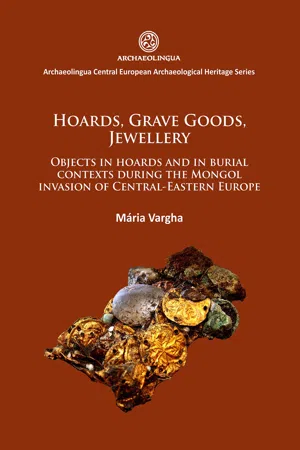
Hoards, grave goods, jewellery
Objects in hoards and in burial contexts during the Mongol invasion of Central-Eastern Europe
- 106 pages
- English
- PDF
- Available on iOS & Android
eBook - PDF
Hoards, grave goods, jewellery
Objects in hoards and in burial contexts during the Mongol invasion of Central-Eastern Europe
About this book
This monograph examines one specific hoard horizon, which is connected to the Mongol invasion of Hungary (1241-42). With this catastrophic event, the historical context is both well-known and much discussed by contemporaries and modern scholars. This opportunity to examine material connected to a sole event, but across a broad spectrum of geographical space and social class, is unique for hoard horizons in Hungary, and, for that matter, in Europe. Though this study focuses on hoards connected to the Mongol invasion, it is also relevant beyond this specific context. The work addresses issues concerning hoard finds and material culture, and examines how finds are related when found in different contexts (a hoard, grave, or settlement feature), thus the questions raised and conclusions reached are important for other medieval hoard finds. By comparing hoards related to a single historical event to a contemporaneous site – containing a village, a church, and a cemetery – assessments can be made regarding how hoards reflect social issues such as stratification, wealth, status, and fashion.
Information
Table of contents
- List of Figures
- Introduction
- CHAPTER ONE
- Jewellery of the High Middle Ages: Problems with research
- Fig. 1. An example for the romantic display of the material culture of the conquering Hungarians.
- Fig. 2. Academic display of the most representative Conquest period finds.
- Fig. 3. Typical finds of the uppermost layer of commoners identified in field cemeteries.
- Fig. 4. Typical finds of field cemeteries of the commoners I. Rings, earrings, pearls, pendants, buttons.
- Fig. 5. Typical finds of field cemeteries of the commoners II: Majs-Udvari rétek. Lock rings, earrings, pearls, buttons.
- Fig. 6. Typical finds of field cemeteries of the commoners II: Majs-Udvari rétek. Pendants and mounts.
- Fig. 7. A typical field cemetery, Majs-Udvari rétek, and a method for analysation: coins.
- Fig. 8. Graves of a typical rural churchyard cemetery: Kána
- Fig. 9. Jewellery from the hoard of Pátroha – Butorka dűlő
- Fig. 10. Coins in 12-13th century Hungary. 1: 12th century anonym denars.
- Fig. 11. 13th century Hungarian coins. The imagery of the coins is influenced by Friesach-type denarius
- Fig. 12. The distribution of hoards connected to the Mongol invasion of Hungary by Csaba Tóth
- Fig. 13. The hoard of Tyukod-Bagolyvár. Jewellery and precious metal pieces.
- Fig. 14. An early example for a precise documentation of a churchyard cemetery by István Méri at Kide, in 1942.
- Fig. 15. Documentation of the superpositions of the graves at the cemetery of Kide.
- Fig. 16. Typical remains of the destruction of the Mongol invasion. 1-2: People hid in an oven of a sunken house, Sz. Wilhelm, ‘Szank’, pp. 101. Pic. 5. Cegléd. 3: Disturbed remains of people sought refuge in a house which was burnt down
- CHAPTER TWO
- Typochronology of the Finds
- Fig. 17. The phases of the cemetery of Kána.
- Fig. 18. Chronological order of the 10th-11th century finds of the Bjelo-Brdo culture. Giesler, ‘Untersuchungen zur Chronologie’, Table 53.
- Fig. 19. The common position of lock rings, examples from the cemetery of Kána. Graves 838, 1013, 1038.
- Fig. 20. Lock ring types of Kána village. 1: K/1037, 2: K/337, 3: K/633, 4: K/1977, 5: K/177, 6: K/2966, 7: K/2794, 8: K/2973, 9: K/2612.
- Fig. 21. The occurrence of lock rings in graves, hoards and settlement features
- Fig. 22. The common position of rings, examples from the cemetery of Kána. Graves 601, 861, 427, 947.
- Fig. 23. Ring types of the period. 1-8: Kána, 1: K/1794, 2: K/1777, 3: K/2778, 4: K/1821, 5: K/1732, 6: K/2600, 7: K/2100, 8: K/1976, 9: Tyukod-Bagolyvár, typical ring types of hoards – seal rings and rings with inset stones, Jakab and Balázs, Elrejtett k
- Fig. 24. Occurrence of finger rings in graves, hoards and settlement features.
- Fig. 25. Circular brooches. 1-2: Kána, K/ 14 and K/462, 3: Krásno, 4: Skalka nad Váhom, 5: Balota puszta, 6: Ducové, 7: Nitra-Dražovce
- Fig 26. Bird-shaped brooches. 1: Kána, 2: Lympne, 3: Greetwell, 4: Aslacton, 5: Leicester, 6: Lüneburg
- Fig. 27. Rhombus-shaped brooches. 1: Kána, 2: Mezőcsát, 3: Esztergom-Szentkirály
- Fig. 28. Pin from Kána, K/2667
- Fig. 29. Button types of Kána. 1: K/458, 2: K/2292, 3: K/456, 4: K/1170.1, 5: K/1170.2, 6: K/357
- Fig. 30. The common position of buckles, examples from the cemetery of Kána. Graves 44, 903.
- Fig. 31. Belt buckles. 1-7 Kána, 1: K/731, 2: K/1170, 3: K/2392, 4: K/2789, 5: K/1731, 6: K/143, 7: K/465, 8: Héhalom, 9: Ecseg-Vároldal
- Fig. 32. Round, iron buckles. 1-2: Kána, K/1783, K/182, 3: Ducové, 4: Krásno
- Fig. 33. Belt buckles decorated with flower applications. 1: Kána, K/94, 2: Nitra-Dražovce, 3: Egisheim
- Fig. 34. The hoard of Esztergom-Szentkirályi földek.
- Fig. 35. The occurrence of buckles in graves, hoards and settlement features
- Fig. 36. Mounts from Kána. 1: K/312, 2: K/467, 3: K/2523
- Fig. 37. An example for the use of pectoral crosses as part of a necklace in the 10-11th centuries, from Majs.
- Fig. 38. Pectoral cross from Kána, K/1725
- Fig. 39. The comparative chronology of the artefacts.
- CHAPTER THREE
- The Material Culture of Hoards: A Socio-Economic Interpretation
- Fig. 40. Laszlovszky, ‘Social Stratification’, pp. 59-60.
- Fig. 41. Laszlovszky, ‘Social Stratification’, pp. 61-62.
- Fig. 42. Map of Medieval Clay Pots Found with Coins.
- Fig. 43. Jewellery from the Nyáregyháza-Pusztapótharaszt Hoard.
- Fig. 44. Gold S-ended Lock Rings.
- Fig. 45. An Example for Late Medieval Treasure: The Kelebia Hoard.
- Fig. 46. Golden Headpiece Found in a Burnt Down House at Szank.
- Fig. 47. The Karcag Hoard.
- Fig. 48. Golden Drop Headpiece from Tyukod-Bagolyvár.
- Fig. 49. An Example for the Characteristic Jewellery of Smaller Hoards: Zalaszentgrót.
- Fig. 50. An Example for the Different Composition of Iron Depots. 1: Nyáregyháza-Pusztapótharaszt,
- Fig. 52. Ashlar Framed and Simple Earth Graves from Kána Village. Graves 43, 373, 268, 84.
- Fig. 53. A Characteristic House Type for the Arpadian Age. 1: Reconstruction of a House in Kardosút.
- Fig. 54. Typical Arpadian Age Settlement Structures I. The Layout of the Sites Vecsés 67 and 98, with Chronologically Distinguished Features.
- Fig. 55. Typical Arpadian Age Settlement Structures II. The Layout of the Sites Üllő 1 and 2, with Chronologically Distinguished Features. Rácz, ‘Az Árpád-kori települési formák’, p. 180.
- Fig. 56. Reconstruction of a Typical Village Scene, Based on the Excavations at Tiszaeszlár-Bashalom.
- Bibliography
- Conclusion
- Cover
- Title Page
- Copyright Page
- Contents
Trusted by 375,005 students
Access to over 1.5 million titles for a fair monthly price.
Study more efficiently using our study tools.
Frequently asked questions
Yes, you can cancel anytime from the Subscription tab in your account settings on the Perlego website. Your subscription will stay active until the end of your current billing period. Learn how to cancel your subscription
No, books cannot be downloaded as external files, such as PDFs, for use outside of Perlego. However, you can download books within the Perlego app for offline reading on mobile or tablet. Learn how to download books offline
Perlego offers two plans: Essential and Complete
- Essential is ideal for learners and professionals who enjoy exploring a wide range of subjects. Access the Essential Library with 800,000+ trusted titles and best-sellers across business, personal growth, and the humanities. Includes unlimited reading time and Standard Read Aloud voice.
- Complete: Perfect for advanced learners and researchers needing full, unrestricted access. Unlock 1.5M+ books across hundreds of subjects, including academic and specialized titles. The Complete Plan also includes advanced features like Premium Read Aloud and Research Assistant.
We are an online textbook subscription service, where you can get access to an entire online library for less than the price of a single book per month. With over 1.5 million books across 990+ topics, we’ve got you covered! Learn about our mission
Look out for the read-aloud symbol on your next book to see if you can listen to it. The read-aloud tool reads text aloud for you, highlighting the text as it is being read. You can pause it, speed it up and slow it down. Learn more about Read Aloud
Yes! You can use the Perlego app on both iOS and Android devices to read anytime, anywhere — even offline. Perfect for commutes or when you’re on the go.
Please note we cannot support devices running on iOS 13 and Android 7 or earlier. Learn more about using the app
Please note we cannot support devices running on iOS 13 and Android 7 or earlier. Learn more about using the app
Yes, you can access Hoards, grave goods, jewellery by Mária Vargha in PDF and/or ePUB format, as well as other popular books in Social Sciences & Archaeology. We have over 1.5 million books available in our catalogue for you to explore.