The present volume reunites most of the papers that were presented at the second meeting of the Homines, Funera, Astra Symposium on Funerary Anthropology that took place at '1 Decembrie 1918' University, Alba Iulia, between 23rd and 26th September 2012. The theme of the volume is Life beyond Death in Ancient Times. The intention was to create a forum for discussing Prehistoric, Roman and Migration Period burial practices from Central and South-Eastern Europe, focusing on elements that might suggest belief in afterlife. The interdisciplinary character of the volume is provided by the varied approaches to the archaeology by the contributors, resulting in exploring the subject from multiple perspectives: archaeological, anthropological, geological, architectural, landscape, and epigraphic. Seven studies are dedicated to prehistoric burial practices, discussing discoveries dating from the Palaeolithic (one study), Neolithic and Copper Age (four studies), and Bronze Age (one study). A study focusing on methodology proposes a non-invasive method of analysis for burial mounds, with examples from the Bronze and Iron Ages. Two studies focusing on the Roman Period and another on the Migration Period complete our vision of funerary archaeology for this part of Europe. The editor's wish to express their joy that the editorial project, which started with the publication of the first HFA volume (R. Kog?lniceanu, R.-G. Curc?, M. Gligor and S. Stratton (eds.), Homines, Funera, Astra. Proceedings of the International Symposium on Funerary Anthropology, 5-8 June 2011, '1 Decembrie 1918' University, Alba Iulia, Romania. Oxford, Archaeopress, BAR International Series 2410), is followed by the present book. The basis for the series dedicated to burial archaeology with the intention to be a useful, modern, interdisciplinary instrument, is thus laid.
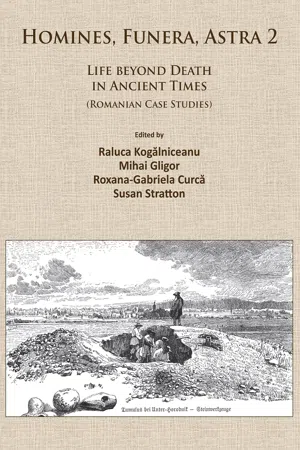
eBook - PDF
Homines, Funera, Astra 2
Life Beyond Death in Ancient Times (Romanian Case Studies)
- 138 pages
- English
- PDF
- Available on iOS & Android
eBook - PDF
Homines, Funera, Astra 2
Life Beyond Death in Ancient Times (Romanian Case Studies)
About this book
Information
Table of contents
- Cover
- Title Page
- Copyright Page
- Contents
- Foreword
- List of contributors
- Les communautés humaines et leur environnement
- Les communautés humaines et leur environnement
- Valentin-Codrin Chirica
- Vasile Chirica
- Vivre et mourir dans le Paléolithique de l’Europe.
- Vivre et mourir dans le Paléolithique de l’Europe.
- Figure 1. Mitoc – Malu Galben (Roumanie) : lithostratigraphie, archéologie, dates 14C et paléoenvironnement
- Figure 2. Cosăuţi (Moldova) : lithostratigraphie, archéologie, dates 14C et paléoenvironnement
- Figure 3. Molodova V (Ukraine): lithostratigraphie, archéologie, dates 14C et paléoenvironnement
- Figure 4. La séquence de l’espace est-carpatique (±55.000-10.000 BP) (d’après Haesaerts et al. 2003, fig. 8).
- Figure 5. La séquence de l’espace est-carpatique (±33.000-10.000 BP)
- Figure 6. Principales séquences pour la Basse Autriche, la Moravie, la Slovaquie occidentale et le sud de la Pologne:
- _GoBack
- Figure 1. Map of Romania with the location of Sălaj County.
- Figure 2. The location of Porț in the Sălaj County territory.
- Neolithic cremation graves and grave goods from Porţ – Corău (Sălaj County, Romania)
- Neolithic cremation graves and grave goods from Porţ – Corău (Sălaj County, Romania)
- Sanda Băcueţ Crişan
- Figure 3. The site from Porț – Corău.
- Figure 4. Porț – Corău. Cremation grave no. 1/2012 (C10).
- Figure 5. Porț – Corău. The locations of the cremation and inhumation graves. ● - cremation graves; ■ - inhumation graves.
- Figure 6. Porț – Corău. Cremation grave no. 5/2012 (C135).
- Disposal of the dead
- Disposal of the dead
- Kirsty McLeod
- Mihai Gligor
- Uncommon mortuary practices from Alba Iulia – Lumea Nouă 2003 excavation
- Uncommon mortuary practices from Alba Iulia – Lumea Nouă 2003 excavation
- Figure 1. Human remains from Trench II/2003, □C, Pit G1. a) ▼0,65-0,75m; b) ▼0,90-0,95m; c) ▼1,10-1,15m; d) ▼1,20-1,30m. Legend: black = stone; red = adobe; yellow = bone.
- Figure 2. 14C AMS calibrated date (calBC) from pit G1/2003 using OxCal v4.2.4.
- Figure 4. a) Modelled date (BC) from pit G1/2003 using OxCal v4.2.4 - Start; b) Modelled date (BC) from pit G1/2003 using OxCal v4.2.4 – End.
- Table 1. Sex determination of the frontal bone
- Table 2. Sex determination using the femoral head
- Table 3. Sex determination using bicondylar width
- Table 4. Sex determination using humeral head
- Table 5. Adult age estimation using teeth attrition
- Table 6. Subadult age estimation using dental development
- Table 7. Estimated age categories of the individuals in the 2003 collection.
- Table 8. Estimated age and sex of six adults within the sample.
- Table 9. Estimated stature from four right femurs
- Figure 5. Possible healed rib fracture.
- Figure 6. Twisting of this left humerus possibly indicates a healed fracture.
- Figure 7. Cranium with depression fracture (up).
- Figure 8. Cranium with depression fracture (up). Internal bevelling (down).
- Internal bevelling (down)
- Figure 10. Cranium with two depression fractures (up). Internal bevelling (down).
- Figure 11. Sacralization of the 5th lumbar and 1st sacral vertebrae.
- Figure 9. Cranium with depression fracture to the occipital bone.
- Figure 12. Curvature and sacralization of the 5th lumbar and 1st sacral vertebrae.
- Figure 14. Eburnation and joint surface pitting on a right and left patella.
- Figure 15. Spinal osteophytosis.
- Figure 16. Periostitis on a tibia fragment.
- Figure 18. Periostitis on a fibula.
- Figure 19. Cribra orbitalia on two eye orbit fragments.
- Figure 21. Cut marks along the shaft of an adult femur.
- Figure 22. Cut marks on the shaft of a subadult femur.
- Figure 23. Cut marks along the shaft of a subadult ulna.
- Figure 24. Traces of burning on a subadult mandible.
- Figure 25. Traces of burning on a cranial fragment.
- Figure 26. Traces of burning on a cranial frontal fragment.
- Figure 27. Traces of burning on a proximal femur fragment.
- RANGE!B6
- RANGE!C6
- RANGE!B7
- RANGE!C7
- RANGE!B8
- RANGE!C8
- RANGE!B9
- RANGE!C9
- RANGE!B10
- RANGE!C10
- RANGE!B11
- RANGE!C11
- Constantin Haită
- Figure 1. Map of Romania with the location of the cemetery.
- Polished stone tools as grave goods in the Hamangia cemetery from Cernavodă – Columbia D
- Polished stone tools as grave goods in the Hamangia cemetery from Cernavodă – Columbia D
- Raluca Kogălniceanu
- Typological and contextual analysis
- Typological and contextual analysis
- _GoBack
- Figure 2. Scattered distribution function of the two parameters considered
- Figure 3. Length of the analyzed tools
- Figure 4. Chisels.
- Figure 5. Profiles of axes.
- Figure 6. Maximum thickness of axes and adzes from Cernavodă – Columbia D.
- Figure 10. Length of axes from Cernavodă – Columbia D.
- Figure 7. Butt types for axes.
- Figure 8. Distribution of axes as indicated by the relation between the considered parameters
- Figure 9. Shapes of axes.
- Figure 11. Size of the axes.
- Figure 12. Profiles of adzes.
- Figure 13. Butts of adzes.
- Figure 14. Distribution of adzes as indicated by the relation between the considered parameters
- Figure 15. Shapes of adzes.
- Figure 16. Length of adzes from Cernavodă – Columbia D.
- Figure 18. Dummies. a) unfinished tool (F 110), b) pebble imitating an axe (F 108), c) pebble resembling an adze (F 75).
- Figure 19. Adze made of limestone (F 21).
- Figure 21. Axe made of magmatic rocks (microdiorite) (F 70).
- Figure 22. Axe made of magmatic/metamorphic rock (gneiss) (F 18).
- Figure 23. Chisel made of greeschist (F 13).
- Figure 24. Quartzitic pebble imitating an axe (F 76).
- Figure 25. Use-wear traces near the blade.
- Figure 26. Chips on the blade.
- Figure 27. Reshaping of the active part (F 11).
- Figure 28. Line of the blade.
- Figure 29. Asymmetrical blade line of an axe (F 184).
- Figure 30. Cernavodă – Columbia D. Internal organization of the site (Berciu et al. 1961, fig. 1, modified).
- Figure 31. The distribution of all reported polished stone tools for each part of the Cernavodă – Columbia D cemetery.
- Figure 32. The distribution of the analyzed and classified polished stone tools for each part of the Cernavodă – Columbia D cemetery.
- Figure 33. The proportion of flat and bulged polished stone tools for each part of the Cernavodă – Columbia D cemetery.
- Figure 34. The occurence of petrographic types for each part of the Cernavodă – Columbia D cemetery.
- Figure 35. Placing of the polished stone tool near the upper right side of the body
- Fig. 38. Placing of the tool in the chest area
- Figure 36. Placing of the tool in the area of the right shoulder
- Figure 37. Placing of the tool around the head
- Figure 40. Placing of the tool left of the body
- Figure 41. Sex and age of the deceased from the graves containing polished stone tools.
- Cătălin Lazăr
- Figure 1. The location of Sultana – Malu Roşu cemetery.
- Mădălina Voicu
- The distortion of archaeological realities through objects: a case study
- The distortion of archaeological realities through objects: a case study
- Figure 2. The general plan of the Sultana – Malu Roşu cemetery (2006-2012).
- Figure 3. The flat polished stone axe from grave 1.
- Table 1. The lithic artefacts from Sultana – Malu Roşu cemetery.
- Table 2. The location of the lithic artefacts in relation to the body of the dead.
- Figure 4. The long flint blade found in grave 11.
- Figure 5. The grave 6 and the pot placed near skull.
- Table 3. The typology and dimensions of beads from Sultana – Malu Roșu cemetery.
- Figure 6. The Spondylus beads found in grave 13.
- Figure 7. The malachite beads found in grave 1.
- Table 4. The location of the adornments in relation to the body of the dead.
- Table 5. The adornments from Sultana – Malu Roşu cemetery: showing type, quantity and raw material.
- _GoBack
- Table 6. The funerary offerings from Sultana – Malu Roşu cemetery.
- Figure 8. Sultana – Malu Roşu cemetery – grave goods and funerary offerings distribution (n = 67).
- Figure 9. Sultana – Malu Roşu cemetery – grave inclusions distribution (n = 67).
- Table 7. The grave intrusion types from Sultana – Malu Roşu cemetery.
- Figure 10. Sultana – Malu Roşu cemetery – grave good type distribution (n = 18).
- Figure 11. Sultana – Malu Roşu cemetery – grave goods distribution from quantitative perspective (n = 18).
- Bogdan Petru Niculică
- Dumitru Boghian
- Figure 1. Funerary discoveries mentioned in the index.
- Funerary constructions characteristic to the Komariv (Middle Bronze Age) communities of the Suceava Plateau
- Funerary constructions characteristic to the Komariv (Middle Bronze Age) communities of the Suceava Plateau
- Figure 2. The number of funerary discoveries considered for the study, for each archaeological site (total number of discoveries: 62).
- Table 1. The characteristics of the funerary constructions from the Suceava Plateau.
- Table 2. The characteristics of the cists and pseudo-cists - stone funerary constructions.
- Figure 3. Adâncata – Imaş, T2. The stone construction and the rectangular ditch. Details (after Niculică 2006).
- Figure 4. Adâncata – Imaş, T2. The circular ring in the southeastern corner of the mound (after Niculică 2006).
- Figure 5. The orientation of stone funerary constructions of the Komariv culture from the Suceava Plateau.
- Figure 6. Adâncata - Imaş, T5. The circular ditch.
- Figure 7. Suceava - Câmpul Şanţurilor.
- Figure 8. Costâna - Imaş, T1. Details
- _GoBack
- Table 3. Stone constructions employed in the areas of manifestations of Bronze Age civilizations.
- Alexandru S. Morintz
- Identifying disturbances in the case of burial mounds. Case studies
- Identifying disturbances in the case of burial mounds. Case studies
- Figure 1. Rectangular grid.
- Figure 2. Spider-web grid.
- Figure 3. Satellite image with the area of the T3 burial mound.
- Figure 4. The area of the T3 burial mound on a map at scale 1:25.000
- Figure 5. A mound from the same area as T3, presenting recent traces of looting.
- Figure 6. T3 burial mound before excavation.
- Figure 7. T3 burial mound: the map with contour lines.
- Figure 8. T3 burial mound: three-dimensional model.
- Figure 10. Piece of wood used at Complex 1.
- Figure 11. Complex 1, sequence 1 of stones.
- Figure 12. Complex 1, sequence 5 of stones.
- Figure 9. T3 burial mound: identified complexes.
- Figure 13. Metal object discovered in Complex 1, sequence 4 of stones.
- Figure 14. Tin component of an agricultural machine discovered in Complex 1, sequence 1 of stones.
- Figure 15. Bârseşti – Lacul Dumbrăvii, the landscape in 2013.
- Figure 16. Bârseşti – Lacul Dumbrăvii, 2013 survey; interval between contour lines of 0.5 m.
- Figure 17. Bârseşti – Lacul Dumbrăvii, 2013 survey; interval between contour lines of 0.1 m.
- Figure 18. Bârseşti – Lacul Dumbrăvii, three-dimensional model with the altitude scale increased four times.
- A few notes on the emergence and distribution of variously shaped ditched enclosures in the Sarmatian environment, with or without graves inside
- A few notes on the emergence and distribution of variously shaped ditched enclosures in the Sarmatian environment, with or without graves inside
- Vitalie Bârcă
- Figure 1. Circular, square, rectangular and trapezoidal ditch enclosures
- Figure 2. Square ditch enclosures at Bădragii Noi
- Figure 3. Plan of the cemetery at Kholmskoe
- Figure 4. Ditched enclosures of various shapes in the cemetery at Vasilevka
- Figure 5. Rectangular and circular ditch enclosures.
- Figure 6. Trapezoidal and circular ditch enclosures.
- Figure 7. Variously shaped ditched enclosures in the barrow cemetery at Zhuravka
- Figure 8. Ditched enclosures in the Sarmatian environment of the Pannonian Plain.
- A few remarks on CIL VI 3419 (= IDRE 27)
- Récit de vie behind funerary texts
- Violeta-Maria Răileanu
- _GoBack
- An eques romanus and his slave in a new funerary inscription from Troesmis
- An eques romanus and his slave in a new funerary inscription from Troesmis
- Figure 1. Map of Moesia Inferior.
- Lucreţiu Mihailescu-Bîrliba
- Figure 2. The upper (a) and lower (b) portion of the inscription.
Trusted by 375,005 students
Access to over 1.5 million titles for a fair monthly price.
Study more efficiently using our study tools.
Frequently asked questions
Yes, you can cancel anytime from the Subscription tab in your account settings on the Perlego website. Your subscription will stay active until the end of your current billing period. Learn how to cancel your subscription
No, books cannot be downloaded as external files, such as PDFs, for use outside of Perlego. However, you can download books within the Perlego app for offline reading on mobile or tablet. Learn how to download books offline
Perlego offers two plans: Essential and Complete
- Essential is ideal for learners and professionals who enjoy exploring a wide range of subjects. Access the Essential Library with 800,000+ trusted titles and best-sellers across business, personal growth, and the humanities. Includes unlimited reading time and Standard Read Aloud voice.
- Complete: Perfect for advanced learners and researchers needing full, unrestricted access. Unlock 1.5M+ books across hundreds of subjects, including academic and specialized titles. The Complete Plan also includes advanced features like Premium Read Aloud and Research Assistant.
We are an online textbook subscription service, where you can get access to an entire online library for less than the price of a single book per month. With over 1.5 million books across 990+ topics, we’ve got you covered! Learn about our mission
Look out for the read-aloud symbol on your next book to see if you can listen to it. The read-aloud tool reads text aloud for you, highlighting the text as it is being read. You can pause it, speed it up and slow it down. Learn more about Read Aloud
Yes! You can use the Perlego app on both iOS and Android devices to read anytime, anywhere — even offline. Perfect for commutes or when you’re on the go.
Please note we cannot support devices running on iOS 13 and Android 7 or earlier. Learn more about using the app
Please note we cannot support devices running on iOS 13 and Android 7 or earlier. Learn more about using the app
Yes, you can access Homines, Funera, Astra 2 by Raluca Kogălniceanu, Mihai Gligor, Roxana-Gabriela Curcă, Raluca Kogălniceanu,Mihai Gligor,Roxana-Gabriela Curcă, Kogalniceanu Raluca, Mihai Gligor, Roxana-Gabriela Curcă in PDF and/or ePUB format, as well as other popular books in Social Sciences & Archaeology. We have over 1.5 million books available in our catalogue for you to explore.