This book is the result of the processing of the excavation data and of the pottery coming from the stratigraphy underneath the cathedral of Siena. The surveys were conducted between August 2000 and May 2003 by the Department of Archaeology and History of Arts of the University of Siena, with the scientific coordination of Prof. Riccardo Francovich and Prof. Marco Valenti and the collaboration of the Opera del Duomo di Siena.
The ultimate goal is to trace a view of the settlement types and economic framework that has affected the hill of the Cathedral from the Classical age to the late Middle Ages, combining stratigraphic data and the study of materials. The limited planimetric extension of the excavations (often physiological to urban contexts) did not allow an investigation in open area, so the findings have often been compared with those coming from the deposits investigated in the immediate vicinity, both in front and below the Santa Maria della Scala, in order to obtain a more complete and articulated perspective on a diachronic context.
The stratigraphy is developed over a time span ranging from the 7th century BC until the 20th century AD, unearthing a very structured sequence that represents a significant view in understanding the evolutionary dynamics of the urban fabric of Siena: in this regard, it is important to emphasize the fact that the chronological junction on which most attention is focused on is between the Augustian Age and the end of the 14th century, since the survey revealed that the archaeological deposit is better preserved in the time period between the two phases mentioned above and, as a result, the restitution of ceramics has been more complete. The settlement/economic dynamics developed over this extended period in different ways and this is what we are going to analyse: the goal is to develop a dialogue between stratigraphic deposit and material culture, with the aim of understanding the evolution of an urban reality, especially in those phases that led to the crisis of the "classical" city and its consequent transformation and reconfiguration between Late Antiquity and the Early Middle Ages.
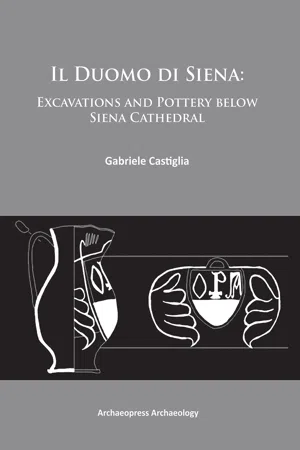
- 171 pages
- English
- PDF
- Available on iOS & Android
eBook - PDF
About this book
Information
Table of contents
- _GoBack
- Foreword
- Premise
- The Excavation
- Pottery from the Excavation
- Conclusions
- Appendix
- Bibliography
- Fig. I: Excavations and surveys in Siena
- Fig. II: Topographic identification of the excavation and the surveyed rooms.
- Fig. 1: GIS elaboration of the rooms investigated during the excavation.
- Fig. 2: Hypothetical topography of Siena during the Roman centuries (PALLECCHI 2006).
- Fig. 3: Topographic position of the well.
- Fig. 4: Well with animal deposits, and (right) a detail of one.
- Fig. 6: Two of the lamps (volute) found inside the well (1st century AD).
- Fig. 5: GIS elaboration of the animal entombents found in primary deposition inside the well (CAUSARANO 2009).
- Fig. 8: The semicircular wall, probably dating to the 4th century AD and its topographic position.
- Fig. 7: The structure with two apses identified below the Santa Maria della Scala (CANTINI 2005).
- Fig. 9: Pottery wares between 5th and 6th centuries AD, with the principal typologies.
- Fig. 10: A burial dating to the 5th century AD.
- Fig. 11: GIS elaboration of the grübenhaus and its topographic position.
- Fig. 12: The grübenhaus during its excavation and its 3D reconstruction.
- Fig. 13: Lamps found inside the grübenhaus (5th-6th century AD).
- Fig. 14: Bronze cloak pin from one of the burials (6th-7h century AD).
- Fig. 15: The two 12th-century siloi.
- Fig. 16: The apse linked to the 12th-century cathedral, attested by documents since 102 AD.
- Fig. 17: GIS elaboration of the documented phases of the cathedral (CAUSARANO 2005).
- Fig. 18: The two identified dump pits.
- Fig. 19: Pottery from the two dump pits. Drawing (below) of a jug with the emblem of the Opera del Duomo.
- Fig. 20: The arrows indicate the two bases serving as foundations
- Fig. 21: Fragments of mosaic found in secondary deposits, dating to 3rd-4th century AD (CHIESA 2012-2013).
- Fig. 22: GIS elaboration of the 15th-century loculi.
- Fig. 23: Detail of a burial inside one of the loculi, with an individual wearing a cape bearing the cross of the Order of the Knights of Malta.
- Fig. 24: Graphic showing the percentage level of residual materials over the centuries (CASTIGLIA 2012).
- Fig. 25:14th-century cooking vessel (olla).
- Fig. 26: 13th/14th-century cooking vessels (ollae).
- Fig. 27: Late 14th/15th century corse ware jug.
- Fig. 28: 15th-century fine ware moneybox.
- Fig. 29: 14th-century fine ware pitcher.
- Fig. 30: Red engobe ware production centres in Tuscany.
- Fig. 31: Circulation of amphorae directed to Siena in Late Antiquity.
- Fig. 32: Lamps ‘a volute’ from inside the votive well (1st century AD).
- Fig. 33: Lamps from the grübenhaus fill (5th-6th century).
- Fig. 34: Maiolica arcaica jugs. The left one bears the Opera del Duomo emblem.
- Fig. 35: Jug in monochrome Maiolica.
- Fig. 36: On the right a Maiolica arcaica sauce boat.
- Fig. 37: Glazed ware cooking pots (14th century AD).
- Fig. 38: Hypothetical plan of the defensive walls in Roman times
- Fig. 39: Table and coarse wares from the ‘Age of Transition’ and the Early Middle Ages.
- Fig. 1a: Interface of the DBMS Carta Archeologica.
- Fig. 2a: Interface of the DBMS Carta Archeologica (Reperti container).
- Fig. 3a: Example of the Tabella quantificazioni (Quantification table).
Trusted by 375,005 students
Access to over 1.5 million titles for a fair monthly price.
Study more efficiently using our study tools.
Frequently asked questions
Yes, you can cancel anytime from the Subscription tab in your account settings on the Perlego website. Your subscription will stay active until the end of your current billing period. Learn how to cancel your subscription
No, books cannot be downloaded as external files, such as PDFs, for use outside of Perlego. However, you can download books within the Perlego app for offline reading on mobile or tablet. Learn how to download books offline
Perlego offers two plans: Essential and Complete
- Essential is ideal for learners and professionals who enjoy exploring a wide range of subjects. Access the Essential Library with 800,000+ trusted titles and best-sellers across business, personal growth, and the humanities. Includes unlimited reading time and Standard Read Aloud voice.
- Complete: Perfect for advanced learners and researchers needing full, unrestricted access. Unlock 1.5M+ books across hundreds of subjects, including academic and specialized titles. The Complete Plan also includes advanced features like Premium Read Aloud and Research Assistant.
We are an online textbook subscription service, where you can get access to an entire online library for less than the price of a single book per month. With over 1.5 million books across 990+ topics, we’ve got you covered! Learn about our mission
Look out for the read-aloud symbol on your next book to see if you can listen to it. The read-aloud tool reads text aloud for you, highlighting the text as it is being read. You can pause it, speed it up and slow it down. Learn more about Read Aloud
Yes! You can use the Perlego app on both iOS and Android devices to read anytime, anywhere — even offline. Perfect for commutes or when you’re on the go.
Please note we cannot support devices running on iOS 13 and Android 7 or earlier. Learn more about using the app
Please note we cannot support devices running on iOS 13 and Android 7 or earlier. Learn more about using the app
Yes, you can access Il Duomo di Siena by Gabriele Castiglia in PDF and/or ePUB format, as well as other popular books in Social Sciences & Archaeology. We have over 1.5 million books available in our catalogue for you to explore.