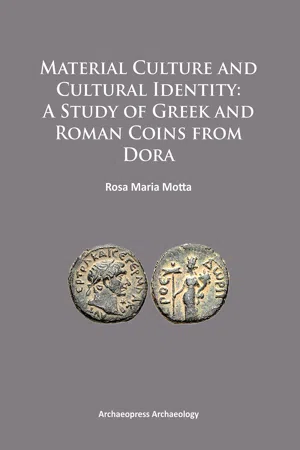
The ancient harbor town of Dor/Dora in modern Israel has a history that spanned from the Bronze Age until the Late Roman Era. The story of its peoples can be assembled from a variety of historical and archaeological sources derived from the nearly thirty years of research at Tel Dor — the archaeological site of the ancient city. Each primary source offers a certain kind of information with its own perspective. In the attempt to understand the city during its Graeco-Roman years — a time when Dora reached its largest physical extent and gained enough importance to mint its own coins, numismatic sources provide key information. With their politically, socio-culturally and territorially specific iconography, Dora's coins indeed reveal that the city was self-aware of itself as a continuous culture, beginning with its Phoenician origins and continuing into its Roman present.
eBook - PDF
Material Culture and Cultural Identity: A Study of Greek and Roman Coins from Dora
- 117 pages
- English
- PDF
- Available on iOS & Android
eBook - PDF
Material Culture and Cultural Identity: A Study of Greek and Roman Coins from Dora
About this book
Information
Table of contents
- Cover
- Title Page
- Copyright Page
- Preface
- Acknowledgments
- List of Abbreviations
- List of Classical References
- Chapter 1 Tel Dor’s Context
- Fig. 1.1. Map of Northern Israel
- Fig. 1.2. Map of Coastal Plains of Israel
- Fig. 1.3. Kurkar Ridge (Tel Dor digital library)
- Fig. 1.4. Kurkar Stones (photo by C. Majer
- Fig. 1.5 Phoenician Bichrom Vessel from Tel Dor (Area D2
- Fig. 1.6 Assyrian Cylindrical Seal – Tel Dor Photo Archive
- Fig. 1.7. Sherds of Assyrian Style Bowls (Tel Dor Photo Archive)
- Fig. 1.8. Sarcophagus of Eshmunazar II, King of Sidon. Louvre Museum. AO 4806.
- Fig. 1.9. Persian and Hellenistic Dor (Tel Dor Photo Archive)
- Fig. 1. 10. Reconstruction of Eastern Continuous Outer Wall During the Hellenistic Period
- Fig. 1.11. Imported Hellenistic West Slope’ Ware found at Tel Dor
- Fig. 1.12. Opus Vermiculatum of the Mask and Garland Type (Tel Dor Photo Archive)
- Fig. 1.13. Lead Sling Projectile Inscribed in Greek and Phoenician (Tel Dor Photo Archive)
- Fig. 1.14. Aerial View of Roman Dora (Tel Dor Photo Archive)
- Fig. 1.15. Excavations of Roman Areas (Iftah Shalev)
- Fig. 1.16. Roman House with Mosaics (John Berg)
- Fig. 1.17. Persian, Hellenistic and Roman Period Jewelry
- Fig. 1.19. Location of Byzantine Church in Relation to Tel Dor (Google Map)
- Fig. 1. 20. Various Areas Opened at Tel Dor During the course of Excavations (drawing by Sveta Matskevich)
- Fig. 1. 21. Athenian Coin Excavated at Tel Dor (photo by R. Motta)
- Fig. 1.22. Ptolemaic Coin Excavated at Tel Dor (photo by R. Motta)
- Fig. 1.23. Jewish Coins Found at Tel Dor (Stern 2002)
- Fig. 1. 24. Roman Coins Found at Tel Dor (Stern 2002, 184)
- Chapter 2 Material Culture, Coins and Cultural Identity
- Chapter 3 The Mint of Dora
- Table 1: Roman Period Issues
- Table 2: Denominations of Dora’s imperial coins at the Israel Antiquities Authority
- Table 3: Provenance of Dora’s Coins at the Israel Antiquities Authority
- Chapter 4 The Iconography of Dora’s Coins
- Fig. 4.1. Portrait of Augustus. British Museum, Inv. 1812,0615.1
- Fig. 4.2. Vespasian, British Museum, London.
- Fig. 4.3 Titus, British Museum, London.
- Fig. 4.4 Trajan, British Museum. London. 1805,0703.93
- Fig. 4. 5. Hadrian. Musei Capitolini. Rome MC 817
- Fig. 4.6. Antoninus Pius. British Museum. London.
- Fig. 4.7. Septimius Severus. British Museum, London.
- Fig. 4.8. Septimius Clasping Hands With His Son Caracalla, While Tyche Fortuna Presides Over The Scene. Arch Of Septimius Seve us. Leptis Magna.
- Fig. 4.10. Julia Domna, Musei Capitolini, Rome.
- Fig. 4.9. Aureus, 161 CE.
- Fig. 4.11. Julia Domna. Staatliche Antikensammlungen und Glyptothek. Munich.
- Fig. 4.12. Young Geta.
- Fig. 4.13. Young Caracalla
- Fig. 4.14. Young Plautilla
- Fig. 4. 16. Caracalla, New York Metropolitan, New York.
- Fig. 4.15. Caracalla. British Museum, London
- Fig. 4. 17. Tyche of Antioch by Euthychides (Roman copy)
- Fig. 4.18. Tyche with Cornucopia and Rudder.
- Fig. 4. 19. Relief of Tyche of Dura. Photo Courtesy of Yale University Art Gallery. New Haven.
- Fig. 4. 21. Tyche of Tyre. 117-118 CE. BMC 344.
- Fig. 4.20. Tyche of Arados, 152 BCE. BMC 97
- Fig. 4.22. Tyche of Tripolis. 22-21 BCE. BMC 206.
- Fig. 4.23. Tyche of Byblos. 1st c. BCE. BMC 12
- Fig. 4.24. Tyche of Ashkelon. 76-77 CE. Rosenberg 30
- Fig. 4.25. Tyche of Antioch ad Orontem, 127-8 CE. BMC 105
- Fig. 4.26. Tyche of Sidon, 78-7 BCE. Lindgren 2324.
- Fig. 4.27. Tyche of Caesarea, 248 CE.
- Fig. 4.28. Tyche of Ashkelon, 138-161 CE, RPC 6384
- Fig. 4.29. Tyche of Tiberias, 177-192 CE, RPC 6313
- Fig. 4.30. Tyche of Gaza. 197 CE. Mionnet 169
- Fig. 4.31. Tyche of Marcianopolis 197 CE Moushmov 394
- Fig. 4.32. Tyche of Aelia Capitolina, 161-169 CE. RPC 6413.
- Fig. 4.33. Tyche of Berytus, 161-169 CE. RPC 6756
- Fig. 4.34. Zeus/Jupiter
- Fig. 4.35. Zeus/Ammon.
- Fig. 4. 40. Zeus Strategos, Amastris (Bithynia, 101 CE).
- Fig. 4.36. Zeus/Jupiter
- Fig. 4.37. Poseidon, LIMC No. 42, p.357
- Fig. 4.38 Poseidon, LIMC No. 50
- Fig. 4.39. Poseidon, LIMC No. 54
- Fig. 4.41. Zeus Strategos, Amastris (Bithynia, 101 CE) RPC 4897
- Fig. 4.42. Silver Stater from Metapontum (550 BCE).
- Fig. 4.43. Triobol from Serdaioi (520 BCE). BMC 395.
- Chapter 5 Epigraphic Analysis of Dora’s Coins
- Chapter 6 Drawing Some Conclusions
- Fig. 6.1. ΙΟΥΔΑΙΑΣ ΕΑΛWΚΥΙΑΣ from Caesarea (81AD),
- Bibliography
- Coin Catalogue
- Coin Plates
- Plate 1
- Plate 2
- Plate 3
- Plate 4
Trusted by 375,005 students
Access to over 1.5 million titles for a fair monthly price.
Study more efficiently using our study tools.
Frequently asked questions
Yes, you can cancel anytime from the Subscription tab in your account settings on the Perlego website. Your subscription will stay active until the end of your current billing period. Learn how to cancel your subscription
No, books cannot be downloaded as external files, such as PDFs, for use outside of Perlego. However, you can download books within the Perlego app for offline reading on mobile or tablet. Learn how to download books offline
Perlego offers two plans: Essential and Complete
- Essential is ideal for learners and professionals who enjoy exploring a wide range of subjects. Access the Essential Library with 800,000+ trusted titles and best-sellers across business, personal growth, and the humanities. Includes unlimited reading time and Standard Read Aloud voice.
- Complete: Perfect for advanced learners and researchers needing full, unrestricted access. Unlock 1.5M+ books across hundreds of subjects, including academic and specialized titles. The Complete Plan also includes advanced features like Premium Read Aloud and Research Assistant.
We are an online textbook subscription service, where you can get access to an entire online library for less than the price of a single book per month. With over 1.5 million books across 990+ topics, we’ve got you covered! Learn about our mission
Look out for the read-aloud symbol on your next book to see if you can listen to it. The read-aloud tool reads text aloud for you, highlighting the text as it is being read. You can pause it, speed it up and slow it down. Learn more about Read Aloud
Yes! You can use the Perlego app on both iOS and Android devices to read anytime, anywhere — even offline. Perfect for commutes or when you’re on the go.
Please note we cannot support devices running on iOS 13 and Android 7 or earlier. Learn more about using the app
Please note we cannot support devices running on iOS 13 and Android 7 or earlier. Learn more about using the app
Yes, you can access Material Culture and Cultural Identity: A Study of Greek and Roman Coins from Dora by Rosa Maria Motta in PDF and/or ePUB format, as well as other popular books in Social Sciences & Archaeology. We have over 1.5 million books available in our catalogue for you to explore.