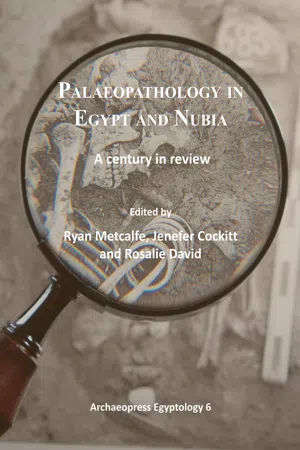
eBook - PDF
Palaeopathology in Egypt and Nubia
A century in review
- 184 pages
- English
- PDF
- Available on iOS & Android
eBook - PDF
Palaeopathology in Egypt and Nubia
A century in review
About this book
The study of human remains from ancient Egypt and Nubia has captured the imagination of many people for generations, giving rise to the discipline of palaeopathology and fostering bioarchaeological research. This book contains 16 papers that cover material presented at a workshop entitled 'Palaeopathology in Egypt and Nubia: A Century in Review,' held at the Natural History Museum, London (August 29–30, 2012), which formed part of a three-year research project, 'Sir Grafton Elliot Smith: Palaeopathology and the Archaeological Survey of Nubia.' The papers explore the subject of palaeopathology from its beginnings in the early 1900s through to current research themes and the impact of technological development in the field. Revealing the diverse range of methods used to study human remains in these regions, the book gives readers an insight into the fascinating work carried out over the last century, and suggests some possible future directions for the field.
Information
Table of contents
- Book cover
- Title page
- Copyright page
- Dedication
- Preface
- Acknowledgements
- Contents
- Whose body? The human remains from the 1908-1909 season of the Archaeological Survey of Nubia
- Table 1: The provenanced bones from the ASN
- Table 2: Skulls from the Archaeological Survey of Nubia
- Table 3: The surviving human remains from the Nubian Pathological Collection
- Table 4: The provenanced bones from the ASN
- Figure 1: An example of a surviving ASN tomb card from cemetery 87, grave 84.
- Figure 2: Top – The top of two skulls from 74/514 and 76/83 ; Bottom – The faces of two skulls from 87/90 and 87/131
- Figure 3: Photograph B763 excavated skeleton in grave
- An interesting example of a condylar fracture from Ancient Nubia suggesting the possibility of early surgical intervention
- Figure 1: Condylar head showing extensive destruction of the normal anatomy
- Figure 2: View looking directly into the Glenoid fossa
- Figure 3 Hypertrophic bone of mandibular.
- Figure 4: Demonstrating a sharp incision
- Figure 5 A and B: Alicona surface laser scan
- Figure 6: 3D reformation of Micro CT
- Figure 7: Anterior view of skull with mandible articulated.
- Figure 8: Occlusal surface of molar teeth demonstrating even occlusal wear
- Dental infections in Ancient Nubia
- Figure 1: Skull NU363 displays a periapical cyst
- Fig. 2 Occlusal view of skull NU363
- Figure 3: Multiple pathological bony cavities are evident in skull NU131.
- Figure 4: Skull NU322 displays a cyst associated with the second maxillary premolar.
- Figure 5: A cyst measuring 9 x 20 mm
- Figure 6: Periapical lesion above the roots of the first molar in skull NU616.
- Figure 7: Diagram representing the maxillary air sinus.
- Figure 8: Skull NU737 is from one of the individuals excavated from the ‘Executioner’s Trench’.
- Figure 9: Palatal view of the cyst in skull NU737
- A case of severe ankylosis of temporomandibular joint from New Kingdom necropolis (Saqqara, Egypt)
- Figure 1: Fragments of the skull of a 16-17 years old individual
- Figure 2: Mandible of a 16-17 years old individual from the north chapel of tomb
- Figure 3: Porous and rough bottom of the left mandibular fossa
- Figure 4: View to the left temporomandibular joint with ankylosis.
- Figure 5: The affected right temporomandibular joint.
- Figure 6: X-ray photograph of affected temporomandibular joint
- Occlusal macrowear, antemortem tooth loss, and temporomandibular joint arthritis at Predynastic Naqada
- Table 1: The Naqada skeletal sample of adults available for examination of the teeth
- Table 2: Patterns of occlusal macrowear at Naqada (tooth count).
- Table 3: Tooth count and individual count patterns of antemortem tooth loss
- Table 4: The age, sex, and cemetery distributions of TMJ lesions at Naqada
- Figure 1: Resorption on the right articular eminence
- Figure 2: Extensive resorption and marginal lipping
- Figure 3: Pronounced remodelling of the right glenoid fossa
- Figure 4: Proliferation of bone within the left glenoid fossa.
- How to make a mummy: A late hieratic guide from Abusir
- Table 1: Summary of late hieratic inscriptions from the embalmer’s cache
- Table 2: Substances sorted by days of the mummification process.
- Table 3: Comparison of the evidence of texts from Shaft S1 of the tomb of Menekhibnekau
- Microstructural analysis of a Predynastic iron meteorite bead
- Figure 1: Tomb card of tomb 67 Gerzeh cemetrery
- Figure 2: Iron beads found in Gerzeh cemetery tomb 67,
- Figure 3: The Gerzeh bead analysed in this study shown as it is today,
- Figure 4: Secondary electron SEM image of hydrated iron oxide growth structures
- Figure 5: Secondary electron SEM image of one end of the bead showing exposed fibres
- Figure 6: Image of Gerzeh bead CT model oxide layers
- Figure 7: Gibeon, a coarse octahedrite iron meteorite,
- Figure 8: Optical image of the prehistoric Egyptian Gerzeh bead
- Imaging and analysis of skeletal morphology: New tools and techniques
- Figure 1: Standard human cranial landmarks and measurements.
- Figure 2: A. Digital callipers, used for measuring 3D distances between landmark points
- Figure 3: A. d’Arcy Thompson’s drawing of a transformation grid
- Figure 4: Three different types of modern 3D digitisers.
- Figure 5: Steps in sampling surface morphology using the eigensurface procedure
- Table 1: A small sample of mixed male and female crania
- Figure 6: Theory behind use of pixel coordinate brightness/colour values
- Figure 7: Principal component ordination of the specimen images shown in Table 1. Prior to analysis the images were downsampled to a 60 x 40 pixel grid, size-standardised, converted to greyscale and image-histogram normalised in order to reduce the effect
- Mummies on rails
- Figure 1: The MEPR main record list screen
- Mummy website and database
- Figure 1: The main screen used for searching the database.
- Figure 2: An example search result.
- Figure 3: An example of the range of data available for a single slide.
Trusted by 375,005 students
Access to over 1.5 million titles for a fair monthly price.
Study more efficiently using our study tools.
Frequently asked questions
Yes, you can cancel anytime from the Subscription tab in your account settings on the Perlego website. Your subscription will stay active until the end of your current billing period. Learn how to cancel your subscription
No, books cannot be downloaded as external files, such as PDFs, for use outside of Perlego. However, you can download books within the Perlego app for offline reading on mobile or tablet. Learn how to download books offline
Perlego offers two plans: Essential and Complete
- Essential is ideal for learners and professionals who enjoy exploring a wide range of subjects. Access the Essential Library with 800,000+ trusted titles and best-sellers across business, personal growth, and the humanities. Includes unlimited reading time and Standard Read Aloud voice.
- Complete: Perfect for advanced learners and researchers needing full, unrestricted access. Unlock 1.5M+ books across hundreds of subjects, including academic and specialized titles. The Complete Plan also includes advanced features like Premium Read Aloud and Research Assistant.
We are an online textbook subscription service, where you can get access to an entire online library for less than the price of a single book per month. With over 1.5 million books across 990+ topics, we’ve got you covered! Learn about our mission
Look out for the read-aloud symbol on your next book to see if you can listen to it. The read-aloud tool reads text aloud for you, highlighting the text as it is being read. You can pause it, speed it up and slow it down. Learn more about Read Aloud
Yes! You can use the Perlego app on both iOS and Android devices to read anytime, anywhere — even offline. Perfect for commutes or when you’re on the go.
Please note we cannot support devices running on iOS 13 and Android 7 or earlier. Learn more about using the app
Please note we cannot support devices running on iOS 13 and Android 7 or earlier. Learn more about using the app
Yes, you can access Palaeopathology in Egypt and Nubia by Ryan Metcalfe, Jenefer Metcalfe, Rosalie David, Ryan Metcalfe,Jenefer Metcalfe,Rosalie David, Ryan Metcalfe, Jenefer Cockitt, Rosalie David in PDF and/or ePUB format, as well as other popular books in Social Sciences & Archaeology. We have over 1.5 million books available in our catalogue for you to explore.