eBook - PDF
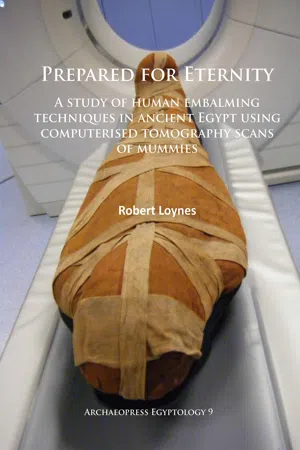
Prepared for Eternity
A study of human embalming techniques in ancient Egypt using computerised tomography scans of mummies
- 275 pages
- English
- PDF
- Available on iOS & Android
eBook - PDF
Prepared for Eternity
A study of human embalming techniques in ancient Egypt using computerised tomography scans of mummies
About this book
This publication brings together personal analyses of sixty CT scans of ancient Egyptian human mummies collected from many museums throughout the UK and continental Europe. The effect is that of performing 'virtual autopsies' ('virtopsies') allowing techniques of mummification to be examined. The historical age of the mummies ranges from the Middle Kingdom to the Roman Period. Several new observations are made regarding the preparation of mummies and confirmation of previously described themes is tempered by the observation of variations probably indicating individual workshop practices. The work presents a springboard for further detailed research on the subject. About the Author: Robert Loynes is an Orthopaedic Surgeon who, after retirement, carried out the research described in this publication and was subsequently awarded a PhD in Egyptology. His lifelong interest in Egyptology and a lifetime career using medical images fired his passion for the subject of mummy research specifically using CT scans as a tool.
Information
Table of contents
- Cover
- Title Page
- Copyright Page
- List of Figures
- List of Tables
- Acknowledgements
- Chronology
- Terminology
- Chapter One
- Introduction
- Fig. 1.1 The Body Planes.
- Chapter Two
- Methods
- Table 2.1 Current locations, origins and era of mummies
- Table 2.2 Grouping of current locations
- Fig. 2.1 External appearance of Graeco-Roman Mummy – BMAG
- Fig. 2.2 3D reconstruction of skull showing the teeth in Graeco-Roman mummy
- Fig. 2.3 Axial view of male genitalia in Graeco-Roman mummy
- Fig. 2.4 Coronal view of skull - cribriform plate perforation
- Fig. 2.5 Sagittal view of skull showing brain remnants in posterior fossa
- Fig. 2.6 Axial view of skull showing ocular remnants
- Fig. 2.8 Sagittal view of skull base showing foreign body.
- Fig. 2.9 Coronal view of skull base showing multiple foreign bodies
- Fig. 2.10 Axial view of skull base showing multiple foreign bodies
- Fig. 2.11 Axial view of mid thoracic region - costo-vertebral dislocation
- Fig. 2.12 Axial view of mid thoracic region - costo-vertebral dislocation
- Fig. 2.13 Axial view of thorax showing asymmetry with anterior padding on left
- Fig. 2.14 Coronal view of thorax showing chest asymmetry with anterior padding on left
- Fig. 2.15 Axial view of thorax showing thoracic contents
- Fig. 2.16 Axial view of abdomen - left flank incision
- Fig. 2.17 Axial view of pelvis - sacro-iliac joint disruption
- Fig. 2.18 Coronal view of pelvis - pubic symphysis disruption
- Fig. 2.19 Coronal view of pelvis - bilateral hip dislocation
- Fig. 2.20 Coronal view of pelvis - bilateral hip dislocation
- Fig. 2.21 Axial view of pelvis - incision anterior to left hip
- Fig. 2.22 Axial view of pelvis - incision anterior to right hip
- Fig. 2.23 Axial view demonstrating detail of right wrist
- Fig. 2.24 Coronal view illustrating detail of anterior wrappings
- Fig. 2.25 Coronal view illustrating terracotta studs
- Fig. 2.26 Murphy’s skid
- Fig. 2.27 Possible method of dislocation. Stage 1
- Fig. 2.28 Possible method of dislocation. Stage2
- Chapter Three
- Results – General
- Fig. 3.1 Axial view of skull showing resin levels
- Fig. 3.2 Axial view at level of mandible showing ear ring
- Fig. 3.3 Axial view showing thoracic packing
- Fig. 3.4 Axial view - symmetry of thoracic wall and exterior packing.
- Fig. 3.5 Coronal view of thorax - possible canopic packages
- Fig. 3.6 Axial view of pelvis - ischial tuberosity epiphyses.
- Fig. 3.7 Axial view of skull demonstrating perforation of the cribriform plate
- Fig. 3.8 Axial view of skull showing brain material in posterior cranial cavity.
- Fig. 3.10 Axial view of the abdomen showing packing.
- Fig. 3.11 Axial view of pelvis and contents.
- Fig. 3.9 Axial view of thorax showing the mediastinum.
- Fig. 3.12 Axial view of thorax - radio-opaque objects anteriorly.
- Table 3.1a Distribution in time
- Table 3.1b Distribution in time
- Table 3.2 Distribution in time
- Table 3.3 Distribution by location
- Chapter Four
- Fig. 4.1 Diagram of skull – the foramina in base of skull
- Fig. 4.2 Diagram of inferior surface of the brain - the cranial nerves
- Results – The Head
- Fig. 4.3 Sagittal view of skull - excerebration in Middle Kingdom Mummy XXVIII
- Fig. 4.4 Coronal view of a ‘false mummy’.
- Fig. 4.5 Coronal view of skull illustrating cribriform plate perforation
- Fig. 4.6 Sagittal view of skull - brain remnants in posterior fossa
- Table 4.1 Mummies with ethmoid perforation only.
- Fig. 4.7 Axial view of skull illustrating limited damage to nasal structures
- Fig. 4.8 Axial view of skull showing perforation of the cribriform plate
- Fig. 4.9 Axial view of skull - brain material in posterior cranial cavity.
- Fig. 4.10 Axial view of skull - retained meninges and empty cranial cavity.
- Fig. 4.11 Sagittal view of skull - limited perforation of ethmoid and cribriform plate.
- Fig. 4.12 Axial view of skull illustrating excerebration and loose linen packing.
- Fig. 4.13 Sagittal view of skull - excerebration and loose packing.
- Fig. 4.14 Sagittal view of skull showing excerebration
- Fig. 4.15 Sagittal view of skull - excerebration and packing.
- Fig. 4.16 Axial view of skull - perforation of cribriform plate.
- Fig. 4.17 3D reconstruction showing perforation of cribriform plate from the intra- cranial surface.
- Fig. 4.18 Coronal view of skull - perforation of cribriform plate.
- Fig. 4.19 Sagittal view of skull - excerebration and packing
- Fig. 4.20 Coronal view of skull - resin in maxillary sinuses.
- Fig. 4.21 Sagittal view of skull - cribriform plate perforation.
- Fig. 4.22 Sagittal view of skull showing the large defect in the cribriform plate.
- Fig. 4.23 Axial view of skull - perforation of cribriform plate and resin in the posterior cranial fossa.
- Fig. 4.24 Sagittal view of skull - perforation of cribriform plate and resin in the posterior cranial fossa.
- Fig. 4.25 Sagittal view of skull - cribriform plate perforation, packing and atlanto-occipital disruption.
- Fig. 4.26 Sagittal views of skull showing bone and tooth within intra-cranial packing.
- Fig. 4.27 Axial view of skull - debris in posterior cranial fossa.
- Fig. 4.28 Axial view of skull - perforation of the cribriform plate.
- Fig. 4.29 Axial view of skull - trans-nasal excerebration.
- Fig. 4.30 Coronal view of skull - trans-nasal excerebration.
- Fig. 4.31 Axial view of skull showing meningeal remnants.
- Fig. 4.32 Sagittal view of skull demonstrating linen in nose and cranial cavity.
- Fig. 4.33 Axial view of skull - excerebration via right nostril.
- Fig. 4.34 Axial view of skull - resin with contained air.
- Fig. 4.35 Axial view of skull - excerebration and packing.
- Fig. 4.36 Sagittal view of skull demonstrating trans-nasal excerebration.
- Fig. 4.37 Small coronal section of skull showing cribriform plate perforation.
- Fig. 4.38 Axial view of skull showing cribriform plate perforation.
- Fig. 4.39 Sagittal view of skull showing empty cranial cavity.
- Fig. 4.40 Axial view of skull illustrating trans-nasal excerebration.
- Fig. 4.41 Coronal view of skull - perforation of cribriform plate.
- Fig. 4.42 Sagittal view of skull - cracked resin in posterior cranial fossa.
- Fig. 4.43 Sagittal view of skull - perforation of ethmoid with intact sphenoid.
- Fig. 4.44 Coronal view of skull showing limited perforation of cribriform plate.
- Fig. 4.45 Sagittal view of skull - posterior ethmoid perforation and resin levels.
- Fig. 4.46 Axial view of skull - meninges and resin levels.
- Fig. 4.47 Sagittal view of skull - nasal tampons.
- Fig. 4.48 Axial view of skull - nasal tampons and resin ‘levels’.
- Fig. 4.49 Sagittal view of skull showing excerebration route via ethmoid air sinuses.
- Fig. 4.50 Sagittal view of skull - excerebration route and resin.
- Fig. 4.51 Sagittal view of skull demonstrating cribriform plate perforation.
- Fig. 4.52 Coronal view of skull showing cribriform plate perforation.
- Fig. 4.53 Sagittal view of skull - fragment of cribriform plate in posterior cranial fossa.
- Fig. 4.54 Coronal view of skull - ethmoid perforation.
- Fig. 4.55 Sagittal view of skull - ethmoid perforation.
- Fig. 4.56 Sagittal view of skull - meninges and brain tissue.
- Fig. 4.57 Sagittal view of skull - cribriform perforation, resin and nasal tampon.
- Fig. 4.58 Axial view of skull - ethmoid sinus and cribriform plate perforation.
- Fig. 4.59 Axial view of skull - resin levels
- Table 4.2 Mummies with ethmoid and sphenoid perforation
- Fig. 4.60 Sagittal view of skull - excerebration and resin
- Fig. 4.61 Axial view of skull showing route of excerebration
- Fig. 4.62 Sagittal view of skull - excerebration and resin
- Fig. 4.63 Axial view of skull demonstrating resin
- Fig. 4.64 Sagittal view of skull demonstrating two materials in resin packing
- Fig. 4.65 Sagittal view of skull showing nasal tampon, ethmoid perforation and resin
- Fig. 4.66 Sagittal view of skull showing movement of the resin
- Fig. 4.67 Coronal view of skull - ethmoid perforation
- Fig. 4.68 Coronal view of skull - nasal tampon
- Fig. 4.69 Axial view of skull - ethmoid perforation
- Fig. 4.70 Sagittal view of skull - cribriform plate perforation
- Fig. 4.71 Coronal view of skull - cribriform plate perforation
- Fig. 4.72 Sagittal view of skull demonstrating the excerebration route
- Fig. 4.73 Coronal view of skull demonstrating the excerebration route
- Fig. 4.74 Coronal view of skull demonstrating the excerebration route
- Fig. 4.75 Sagittal view of skull - excerebration route and resin.
- Fig. 4.76 Axial view of skull - debris in posterior cranial fossa
- Fig. 4.77 Axial view of skull - sphenoid perforation
- Fig. 4.78 Sagittal view of skull - sphenoid perforation
- Fig. 4.79 Axial view of skull - sphenoid perforation
- Fig. 4.80 Sagittal view of skull - sphenoid perforation and linen packing
- Fig. 4.81 Axial view of skull demonstrating linen packing
- Fig. 4.82 Sagittal view of skull - foreign material in posterior cranial fossa
- Fig. 4.83 Sagittal view of skull - route of cranial perforation
- Fig. 4.84 Coronal view of skull - route of cranial perforation
- Fig. 4.85 Sagittal view of skull showing the excerebration route
- Fig. 4.86 Coronal view of skull - excerebration route in one plane
- Fig. 4.87 Coronal view of skull - excerebration route in second parallel plane
- Fig. 4.88 Coronal view of skull - excerebration route in third parallel plane
- Fig. 4.89 Axial view of skull - excerebration route
- Fig. 4.90 Sagittal view of skull - trans-nasal/orbital route of excerebration
- Fig. 4.91 Coronal view of skull - trans-nasal/orbital route
- Fig. 4.92 Axial view of skull - trans-nasal/orbital route
- Fig. 4.93 Axial view of skull - granular material
- Fig. 4.94 Axial view of skull - teeth in granular material
- Fig. 4.95 Axial view of skull base - enlarged foramen magnum
- Fig. 4.96 Axial view inferior to base of skull - anteriorly displaced atlas
- Fig. 4.100 Axial view close to skull base showing foramen magnum and atlas alignment
- Fig. 4.97 Sagittal view of skull demonstrating trans-foraminal route
- Fig. 4.98 Axial view of skull showing cervical spine displacement
- Fig. 4.99 Axial view close to skull base showing foramen magnum alignment
- Fig. 4.101 Coronal view of skull demonstrating meninges
- Fig. 4.102 Coronal view of cervical spine showing misalignment
- Fig. 4.103 Sagittal view of skull showing a possible trans-foraminal route
- Fig. 4.104 Sagittal view of skull in a mummy where the trans-basal route was used with an intact cribriform plate and a small amount of cerebral tissue in the posterior cranial fossa
- Fig. 4.105 Coronal view of skull showing the trans-basal route with an intact cribriform plate
- Fig. 4.106 Sagittal view of skull - trans-basal route
- Fig. 4.107 Axial view of skull - trans-basal route
- Fig. 4.108 Sagittal view of skull - foreign material in posterior fossa
- Fig. 4.109 Sagittal view of skull - trans-orbital route
- Fig. 4.110 Coronal view of skull showing distorted eyes in trans-orbital route
- Fig. 4.111 Coronal view of skull - intact cribriform plate
- Fig. 4.112 Sagittal view of skull - cerebral material in posterior cranial cavity
- Fig. 4.113 Sagittal view of skull with intact cribriform plate and retained brain.
- Fig. 4.114 Sagittal view of skull with intact cribriform plate and retained brain
- Fig. 4.115 Sagittal view of skull with intact cribriform plate and retained brain
- Fig. 4.116 Sagittal view of skull with intact cribriform plate and retained brain
- Fig. 4.117 Sagittal view of skull with intact cribriform plate
- Fig. 4.118 Sagittal view of skull with brain in posterior cranial fossa
- Fig. 4.119 Sagittal view of skull with eye replaced by resin-soaked linen
- Table 4.3 Treatment of eyes by removal
- Fig. 4.120 Axial view of skull - linen rolls in orbits and eye plates anteriorly
- Fig. 4.121 Coronal view of skull with linen rolls in orbits
- Table 4.4 Treatment of eyes by desiccation only
- Table 4.5 Treatment of eyes by desiccation and enhancement by use of plates/linen
- Fig. 4.122 Axial view of skull - desiccation of left eye and loss of right eye.
- Fig. 4.123 Axial view of skull - remnants of the globes and muscles, but empty globes
- Fig. 4.124 Axial view of skull with large remaining cavity in eyeball in Mummy XLV
- Fig. 4.125 Axial view of skull. Small anterior compartment – Red arrow. Large remnant of solid eye – Blue arrow in Mummy I
- Fig. 4.126 Sagittal view of orbit - linen packing within the globe of the eye
- Fig. 4.127 Coronal view of skull - eyes tightly packed with linen
- Table 4.6 Eyes opened and packed – some with the use of eye plates (‘false eyes’)
- Fig. 4.128 Sagittal view of orbit demonstrating outer layer of the eye (sclera and cornea)
- Fig. 4.129 External appearance of the damaged left eye
- Fig. 4.130 Coronal view of skull - loosely packed eyes
- Fig. 4.131 Sagittal view of orbit with small amount of packing through anterior wall of globe
- Fig. 4.132 Coronal view of skull showing both packed eyes
- Fig. 4.133 Sagittal view of skull - linen packing of right eye
- Fig. 4.134 Sagittal view of skull - resin soaked linen packing of left eye
- Fig. 4.135 Axial view of skull - eyes packed from anterior incisions
- Fig. 4.136 Sagittal view of orbit -eyes packed from anterior incisions
- Fig. 4.137 Axial view of skull - tight packing of linen into globes
- Fig. 4.138 Coronal view of orbits showing tight packing of linen into globes
- Fig. 4.139 Axial view of skull - packed eyes. More resin in the linen on the right than the left
- Fig. 4.140 Axial view of skull showing packed eyes and eye plate over right eye
- Fig. 4.141 Sagittal view of orbit - packed eye with eye plate
- Fig. 4.142 3D reconstruction showing eye plates
- Fig. 4.143 3D reconstruction showing eye plates
- Fig. 4.144 Axial view of orbits showing detail of the embalming process of the eyes
- Fig. 4.145 Sagittal view of orbits showing detail of the embalming process of the eyes
- Fig. 4.146 Eye plates in 3D image
- Fig. 4.147 Axial view of skull - eye plates – arrows
- Fig. 4.148 Axial view of skull - eye plates and packed eyes
- Fig. 4.149 Coronal view of skull demonstrating packed eyes
- Fig. 4.150 3D reconstruction showing eye plates
- Fig. 4.151 Sagittal view of orbits - embalming method for eyes
- Fig. 4.152 Sagittal view of skull showing empty mouth with desiccated tongue
- Table 4.7 Mummies with empty mouths
- Table 4.8 Mouth packing with linen only
- Fig. 4.153 Sagittal view of pharynx - loose linen packing within the mouth.
- Fig. 4.154 Sagittal view of the skull - loose linen packing within the mouth.
- Fig. 4.155 Sagittal view of skull - loose linen packing within the mouth.
- Fig. 4.156 Sagittal view of skull - tight linen packing within the mouth in Mummy XXXI
- Fig. 4.157 Coronal view of skull - tight linen packing within the mouth in Mummy XXXI. Also shown is the linen within the cheeks.
- Fig. 4.158 Sagittal view of skull - tight linen packing in the mouth – Mummy XLV
- Fig. 4.159 Sagittal view of skull showing the use of resin and linen in the mouth
- Fig. 4.160 Axial view of skull demonstrating the use of both linen and ‘granular’ material
- Fig. 4.161 Sagittal view of skull - use of both linen and ‘granular’ material
- Fig. 4.162 Sagittal view of pharynx - packing in mouth and neck
- Fig. 4.163 Sagittal view of pharynx – excess amorphous material in the mouth causing the teeth to be forced apart.
- Table 4.10 Treatment of the mouth - resin only
- Table 4.9 Granular material in the mouth
- Fig. 4.164 Sagittal view of skull - resin in the mouth and packing in the neck
- Fig. 4.165 Axial view at level of mandible - resin packing within the mouth
- Fig. 4.166 Coronal view of skull - metal plate over the tongue (possibly Gold)
- Fig. 4.168 3D reconstruction of metal plate lying over tongue
- Fig. 4.167 Sagittal view of skull - metal plate over the tongue (possibly Gold)
- Chapter Five
- Results – The Trunk
- Table 5.1 Mummies with an abdominal incision
- Fig. 5.1 Axial view of thorax showing costo-vertebral dislocation
- Fig. 5.2 Axial view of thorax showing costo-vertebral dislocation
- Fig. 5.3 Axial view of thorax - asymmetry with anterior padding on left
- Fig. 5.4 Coronal view of thorax - asymmetry with anterior padding on left
- Fig. 5.5 Axial view of thorax showing chest contents
- Fig. 5.6 Axial view of lower abdomen - left flank incision
- Fig. 5.10 Coronal view of thorax showing remnants of pleura and mediastinum
- Fig. 5.7 Axial view of lower thorax - perforation in posterior wall.
- Fig. 5.8 Sagittal view of lower thorax - perforation in posterior wall.
- Fig. 5.9 Sagittal view of lower thorax – plug of material in perforation
- Fig. 5.11 Axial view of lower abdomen - material hanging free from abdominal incision
- Fig. 5.12 Sagittal view of abdomen - material in abdominal incision
- Fig. 5.13 Axial view of thorax - fluid levels in ‘resin’
- Fig. 5.14 Coronal view of thorax - heart in mediastinum
- Fig. 5.15 Axial view of thorax - heart in mediastinum
- Fig. 5.16 Axial view of lower abdomen showing contents
- Fig. 5.17 Axial view of thorax showing packing
- Fig. 5.18 Axial view of thorax demonstrating asymmetrical chest wall and exterior packing.
- Fig. 5.19 Coronal view of thorax - probable canopic packages
- Fig. 5.20 Axial view of thorax including the mediastinum.
- Fig. 5.21 Axial view of abdomen.
- Fig. 5.22 Axial view of pelvis showing contents.
- Fig. 5.23 Axial view of right shoulder - fractured acromion
- Fig. 5.24 Axial view of right shoulder - scapular fractures
- Fig. 5.25 Axial view of thorax showing viscera
- Fig. 5.26 Axial view of pelvic organs
- Fig. 5.27 Axial view of pelvis showing tubular structures and diastasis of symphysis pubis
- Fig. 5.28 Sagittal view of trunk – compressed anterior thoracic wall
- Fig. 5.29 Axial view of thorax - position of sternum
- Fig. 5.30 Axial view of right lower thorax - organ containing vascular structures
- Fig. 5.31 Axial view of lower thorax - tubular structures within resin
- Fig. 5.32 Axial view of pelvis - constraining structures within pelvis
- Fig. 5.33 Axial view of thorax - intra-thoracic viscera and ‘loose’ sternum
- Fig. 5.34 Coronal view of trunk- remnants of diaphragm
- Fig. 5.35 Sagittal view of abdomen showing intact abdominal wall
- Fig. 5.36 Sagittal view of abdomen showing incision
- Fig. 5.37 Sagittal view of thorax - mediastinum and diaphragm
- Fig. 5.38 Sagittal view of trunk - canopic package
- Fig. 5.39 Coronal view of trunk - canopic package
- Fig. 5.41 Axial view of lower thorax - position of packages - original image
- Fig. 5.42 Coronal view of thorax – mediastinum
- Fig. 5.43 3D reconstruction showing fractured left ribs
- Fig. 5.44 Coronal view of abdomen - pack in abdominal incision
- Fig. 5.45 Axial view inferior to pelvis - double structure of phallus
- Fig. 5.46 More distal axial view inferior to pelvis – single structure of phallus
- Fig. 5.47 Axial view of thorax
- Fig. 5.48 Coronal view of torso
- Fig. 5.49 Coronal view of upper thorax- rolls of material on the right
- Fig. 5.50 Sagittal view of thorax - Sibson’s fascia
- Fig. 5.51 Axial view of thorax showing two layers of material
- Fig. 5.52 Axial view of abdomen - extent of abdominal incision
- Fig. 5.53 Sagittal view of pelvis showing structures
- Fig. 5.54 Sagittal view of lower abdomen - fractured iliac crest
- Fig. 5.55 Sagittal view showing thoracic structures
- Fig. 5.56 Axial view lower thorax - mediastinum and posterior defect
- Fig. 5.57 Coronal view thorax - great vessels, mediastinum and diaphragm
- Fig. 5.58 Axial view of lower abdomen - abdominal incision
- Fig. 5.59 Sagittal view of pelvis showing femoral head biopsy
- Fig. 5.60 Coronal view of pelvis showing femoral head biopsy
- Fig. 5.61 3D reconstruction - right fractured ribs – posterior view
- Fig. 5.62 Sagittal view of trunk - returned viscera
- Fig. 5.63 Coronal view of trunk - linen in abdominal incision
- Fig. 5.64 Sagittal view of lower abdomen - visceral package
- Fig. 5.65 Sagittal view of pelvis - perineal plug, resin and linen in abdomen
- Fig. 5.66 Coronal view of trunk - canopic packages
- Fig. 5.67 Coronal view of abdomen - solid organ – possibly liver
- Fig. 5.68 Sagittal view of trunk - granular material and resin
- Fig. 5.69 Coronal view of abdomen –left flank incision
- Fig. 5.70 3D reconstruction showing disruption of rib cage – anterior aspect
- Fig. 5.71 3D reconstruction showing disruption of rib cage – posterior aspect
- Fig. 5.72 Coronal view of trunk - false breast in wrappings
- Fig. 5.73 Coronal view of trunk - canopic packages
- Fig. 5.74 Axial view of abdomen - left flank incision
- Fig. 5.75 Sagittal view of pelvis - destroyed, featureless perineum
- Fig. 5.76 Axial view of pelvis - disorganised sacro-iliac joints
- Fig. 5.77 Coronal view of pelvis - dislocated symphysis pubis
- Fig. 5.78 Axial view of pelvis - fractured inferior pubic ramus
- Fig. 5.79 Axial view of pelvis - acetabular fractures
- Fig. 5.80 Coronal view of thorax - empty apart from linen packs
- Fig. 5.81 Coronal view of trunk - canopic packages in abdomen
- Fig. 5.82 Sagittal view of lower abdomen - material in lower pelvis
- Fig. 5.83 Axial view of thorax - mediastinum, heart and resin
- Fig. 5.84 Axial view of lower thorax with returned viscera
- Fig. 5.85 3D reconstruction of object possibly Wadjet eye
- Fig. 5.86 Axial view lower abdomen – left flank incision and packing
- Fig. 5.87 3D reconstruction at level of pelvis showing possible amulet
- Fig. 5.88 3D reconstruction at level of pelvis showing possible amulet
- Fig. 5.89 Coronal view of pelvis showing female shape of the pelvis
- Fig. 5.90 Axial view of thorax showing contents
- Fig. 5.91 3D reconstruction of heart scarab
- Fig. 5.92 Axial view showing abdominal incision and amulet
- Fig. 5.93 3D reconstruction of sistrum shaped amulet
- Fig. 5.94 Coronal view of pelvis - canopic package
- Fig. 5.95 Sagittal view of pelvis - perineum and false phallus
- Fig. 5.96 3D reconstruction of false phallus and amulet
- Fig. 5.97 Axial view of thorax and mediastinum
- Fig. 5.98 Axial view of abdominal incision
- Fig. 5.100 Axial view of abdominal incision and canopic packages
- Fig. 5.101 Axial view of pelvis – pubic symphysis
- Fig. 5.102 Sagittal view of pelvis - left femoral head
- Fig. 5.103 Sagittal view of pelvis - right femoral head
- Fig. 5.104 Coronal view of pelvis - external genitalia and left femoral head
- Fig. 5.99 Axial view of thorax - mediastinum and resin
- Fig. 5.105 Axial view of thorax - dislocated costo-vertebral joints
- Fig. 5.106 Axial view of thorax - intact costo-vertebral joints
- Fig. 5.107 3D reconstruction of compressed rib cage
- Fig. 5.108 3D reconstruction of compressed rib cage
- Fig. 5.109 Axial view of compressed thorax
- Fig. 5.110 Axial view of lower abdomen showing folds in abdominal wall
- Fig. 5.111 Axial view of pelvis - dislocated sacro-iliac joints (SIJ)
- Fig. 5.112 Axial view of pelvis - dislocated symphysis pubis
- Fig. 5.113 Sagittal view of pelvis - perineal structures
- Fig. 5.114 Axial view of thorax - anterior thoracic wall damage
- Fig. 5.115 Coronal view of trunk showing position of carpus
- Fig. 5.116 Sagittal view of trunk showing position of carpus
- Fig. 5.117 Axial view of lower thorax - canopic packages
- Fig. 5.118 Sagittal view of trunk showing posterior penetration of resin
- Fig. 5.119 Axial view of lower abdomen showing left flank incision
- Fig. 5.120 Axial view of lower abdomen showing damage to anterior abdominal wall
- Fig. 5.121 Coronal view of thorax – position of left 2nd rib
- Fig. 5.122 Sagittal view of thorax - left 6th rib fracture
- Fig. 5.123 Sagittal view of thorax- fractured right ribs
- Fig. 5.124 Coronal view of trunk - contents of torso
- Fig. 5.125 Axial view of lower abdomen – left flank incision
- Fig. 5.126 Coronal view of pelvis - fractured right iliac bone
- Fig. 5.127 Sagittal view of perineum
- Fig. 5.128 Coronal view of trunk - fragments of ribs and sternum
- Fig. 5.129 Axial view of thorax - rib fragments and resin casts
- Fig. 5.130 Coronal view of thorax - vertebrae and resin casts
- Fig. 5.131 Coronal view of thorax – indentations in the resin cast
- Fig. 5.132 Axial view lower abdomen - shape of linen from abdominal incision
- Fig. 5.133 Axial view of pelvis - dislocated SIJs
- Fig. 5.134 Coronal view of pelvis - dislocated symphysis pubis
- Fig. 5.135 Coronal view of pelvis and lower abdomen - canopic packages
- Fig. 5.136 Coronal view of thorax - left 1st rib lying free
- Fig. 5.137 Coronal view of sternum lying free within the thorax
- Fig. 5.138 Axial view showing material within the thorax
- Fig. 5.139 Coronal view of superior mediastinum
- Fig. 5.140 Axial view of superior mediasinum
- Fig. 5.141 Axial view of abdominal incision
- Fig. 5.142 Sagittal view of trunk showing compressed abdomen
- Fig. 5.143 Axial view of pelvis - subluxed right SIJ
- Fig. 5.144 Axial view of thorax -remnants of viscera
- Fig. 5.145 Coronal view of thorax showing diaphragms
- Fig. 5.146 Axial view showing abdominal incision
- Fig. 5.147 Coronal view of abdominal incision
- Fig. 5.148 Coronal view showing material within abdomen
- Fig. 5.149 Axial view showing material within abdomen
- Fig. 5.150 Axial view of lower abdomen - viscera
- Fig. 5.151 Sagittal view showing an organ within pelvis - possibly uterus
- Fig. 5.152 Coronal view of trunk - fractured right ribs
- Fig. 5.153 Coronal view of trunk - canopic packages
- Fig. 5.154 Sagittal view of thorax - facetted objects – probably gallstones
- Fig. 5.155 Coronal view of thorax - facetted objects – probably gallstones
- Fig. 5.156 Axial view showing abdominal incision and incision plate
- Fig. 5.157 Axial view of abdomen demonstrating material on posterior wall
- Fig. 5.158 Axial view of pelvis - left hip joint articular cartilage
- Fig. 5.159 Sagittal view showing pelvic contents and plate over perineum
- Fig. 5.160 Axial view showing abdominal incision and contents
- Fig. 5.161 Axial view of pelvis - acetabular fractures
- Fig. 5.162 Axial view of pelvis - fractured inferior pubic rami
- Fig. 5.163 Axial view of thorax - mediastinum and canopic packages
- Fig. 5.164 Axial view showing abdominal incision
- Fig. 5.165 Axial view of pelvis - disrupted left SIJ
- Fig. 5.166 Axial view of pelvis - disrupted pubic symphysis
- Fig. 5.167 Axial view inferior to pelvis - cross section of phallus
- Fig. 5.168 Axial view of thorax - mediastinum
- Fig. 5.169 Axial view of thorax - mediastinum and great vessels
- Fig. 5.170 Axial view of thorax demonstrating diaphragm
- Fig. 5.171 Axial view of lower thorax - probable canopic packages
- Fig. 5.172 Coronal view of thorax - canopic packages and ‘cuboid’ structure
- Fig. 5.173 Axial view of lower thorax - biopsy site in right rib posteriorly
- Fig. 5.174 Sagittal view of pelvis - linen pack in perineum
- Fig. 5.175 Coronal view of pelvis showing hip joints
- Fig. 5.176 Coronal view of thorax - comparison of 1st ribs
- Fig. 5.177 Sagittal view of thorax - posterior position of sternum
- Fig. 5.178 Axial view of thorax - tissues and material on posterior wall
- Fig. 5.179 Axial view - viscera and material in abdomen
- Fig. 5.180 Coronal view of pelvis - disruption of symphysis pubis
- Fig. 5.181 Coronal view of thorax - outline of right lung and dilated heart
- Fig. 5.182 Sagittal view of thorax - defect in diaphragm
- Fig. 5.183 Axial view showing viscera within the abdominal cavity
- Fig. 5.184 Axial view of lower abdomen - lower abdominal wall defect (incision)
- Fig. 5.185 Axial view of lower abdomen - lower abdominal wall defect (incision)
- Fig. 5.186 Axial view of lower abdomen - lower abdominal wall defect (incision)
- Fig. 5.187 3D reconstruction - lower abdominal wall defects
- Fig. 5.188 Sagittal view of pelvis - perineal structures
- Fig. 5.189 Axial view showing thoracic shape and packing
- Fig. 5.190 Axial view of lower abdomen showing incision
- Fig. 5.191 Axial view of thorax - mediastinum and lungs
- Fig. 5.192 Coronal view of trunk - remnants of diaphragm
- Fig. 5.193 Axial view of thorax demonstrating shape of rib cage
- Fig. 5.194 Axial view showing abdominal wall incision
- Fig. 5.195 Axial view - viscera on posterior pelvic wall
- Fig. 5.196 Axial view of thorax - mediastinum
- Fig. 5.197 Axial view of lower thorax - canopic packages
- Fig. 5.198 Coronal view of trunk - canopic packages in abdomen
- Fig. 5.199 Axial view of abdomen - metal plate covering incision
- Fig. 5.200 3D reconstruction of incision plate
- Fig. 5.201 Sagittal view of pelvis - canopic package at brim of pelvis
- Fig. 5.202 Sagittal view of pelvis - perineal structures and material in pelvis
- Fig. 5.203 Axial view showing loose packing in thorax
- Fig. 5.204 Axial view of thorax - resin over anterior surface of vertebrae
- Fig. 5.205 Coronal view of trunk - fragmented resin
- Fig. 5.206 Axial view showing abdominal incision
- Fig. 5.207 Coronal view of abdomen - canopic packages
- Fig. 5.208 Sagittal view of pelvis - fragments of resin in pelvis
- Fig. 5.209 Sagittal and coronal views of pelvis - perineal floor
- Fig. 5.210 Axial view of thorax demonstrating shape and contents
- Fig. 5.211 Axial view showing abdominal incision
- Fig. 5.212 Coronal view of abdomen - canopic packages
- Fig. 5.213 Coronal view of pelvis - canopic package within the pelvis
- Fig. 5.214 Sagittal view of pelvis - coccyx and pelvic floor
- Fig. 5.215 Sagittal view of pelvis - symphysis pubis and false phallus
- Fig. 5.216 3D reconstruction demonstrating false phallus
- Fig. 5.217 Oblique axial view of pelvis - false phallus
- Fig. 5.218 Oblique sagittal view of pelvis - false phallus
- Fig. 5.219 Axial view of upper thorax - costo-vertebral dislocation and rib fracture
- Fig. 5.220 Coronal view of trunk - mediastinal structures and Ibis
- Fig. 5.221 Axial view showing structures in thorax
- Fig. 5.222 Coronal view - granular material within pelvis.
- Fig. 5.223 Axial view of abdomen - Ibis
- Fig. 5.224 Sagittal view of abdomen - Ibis
- Fig. 5.225 Axial view of pelvis - acetabular fractures
- Fig. 5.226 Axial view of upper thorax - great vessels
- Fig. 5.227 Axial view of thorax - heart and right lung
- Fig. 5.228 Axial view of lower thorax - remains of diaphragm
- Fig. 5.229 Axial view of lower abdomen - tissues in paraspinal gutters
- Fig. 5.230 Axial view of pelvis - healed fracture of right pubic ramus
- Fig. 5.231 Axial view of pelvis - pack in upper perineum
- Fig. 5.232 Axial view of pelvis - pack in lower perineum
- Fig. 5.233 Axial view of thorax - imbricated ribs
- Fig. 5.234 Sagittal view of trunk - antero-posteriorly compressed thorax
- Fig. 5.235 Coronal view of trunk - asymmetry of thorax
- Fig. 5.236 Axial view of thorax - tissue on posterior wall
- Fig. 5.237 Axial view of pelvis - sacro-iliac joint (SIJ) disruption
- Fig. 5.238 Axial view of pelvis - dislocation of symphysis pubis
- Fig. 5.239 Axial view of pelvis - superior pubic ramus fracture
- Fig. 5.240 Axial view of pelvis - inferior pubic ramus fracture
- Fig. 5.241 Axial view of pelvis - ischial fracture
- Fig. 5.242 Sagittal view of pelvis - perineal pad
- Table 5.2 Mummies with no incision and no evisceration
- Fig. 5.243 Axial view of thorax - viscera in thoracic cavity
- Fig. 5.244 Sagittal view of thorax - depressed and distorted sternum
- Fig. 5.245 Sagittal view of abdomen - extruded lumbar vertebae
- Fig. 5.246 Axial view of pelvis - bladder and rectum
- Fig. 5.247 Axial view - thoracic wall compression and thoracic visceral contents
- Fig. 5.248 Coronal view of abdomen - atlas within abdominal wrappings
- Fig. 5.249 Coronal view of trunk - spinal curvature - scoliosis
- Fig. 5.250 Coronal view of trunk - disrupted ribs
- Fig. 5.251 Axial view of thorax - viscera in thoracic cavity
- Fig. 5.252 Axial view of pelvis - metal plate over genitalia
- Fig. 5.253 Coronal view of trunk - metal plate over genitalia
- Fig. 5.254 Axial view of thorax - costo-vertebral joints
- Fig. 5.255 Axial view of thorax - viscera overlying thoracic vertebral body
- Fig. 5.256 Axial view of abdomen - viscera in abdomen
- Fig. 5.257 Sagittal view of trunk - compression of abdominal wall against the spine
- Fig. 5.258 Sagittal view showing viscera within pelvic cavity
- Fig. 5.259 Coronal view showing intra-thoracic structures
- Fig. 5.260 Axial view of abdomen - compression of abdomen and contained structures
- Fig. 5.261 Coronal view of trunk - liver and calcified node
- Fig. 5.262 Coronal view of pelvis - hip joints
- Fig. 5.263 Sagittal view showing pelvic viscera
- Fig. 4.265 Sagittal view showing intra-thoracic contents
- Fig. 5.264 Axial view demonstrating intra-thoracic contents
- Fig. 5.266 Axial view of lower abdomen - viscera on posterior abdominal wall
- Fig. 5.267 Axial view of pelvis - slight disruption of the bony pelvis
- Fig. 5.268 Coronal view of hip joints
- Fig. 5.269 Sagittal view of pelvic contents
- Fig. 5.270 Axial view of thorax - slight asymmetry of thoracic wall
- Fig. 5.271 Axial view of thorax - mediastinum
- Fig. 5.272 Axial view showing abdominal compression and viscera
- Fig. 5.273 Axial view of sacro-iliac joints
- Fig. 5.274 Sagittal view of thorax showing compression
- Fig. 5.275 Coronal view of disrupted ribs and spine
- Fig. 5.276 Axial view of compressed thorax and contents
- Fig. 5.277 Axial view of compressed abdomen and contained viscera
- Fig. 5.278 Axial and sagittal views of pack in rectum
- Fig. 5.279 Axial view showing asymmetry of rib cage
- Fig. 5.280 Axial view of thorax - costo-vertebral joints
- Fig. 5.281 Axial view of thorax - mediastinum – great vessels
- Fig. 5.282 Sagittal view of thorax - mediastinum - heart Fig. 5.283 Coronal view of thorax - mediastinum - heart
- Fig. 5.284 Coronal view of trunk and axial view of thorax - diaphragm and liver
- Fig. 5.285 Axial view of pelvis - disrupted SIJ
- Fig. 5.286 Coronal view of pelvis - disrupted symphysis pubis and fractured acetabulum
- Fig. 5.287 Coronal view of congruous hip joints
- Fig. 5.288 Axial view of thorax - sternum lying against vertebral bodies
- Fig. 5.289 Axial view of thorax - viscera lying over vertebral bodies
- Fig. 5.290 Axial view of thorax - costo-vertebral dislocation
- Fig. 5.291 Axial view of thorax - crowded ribs
- Fig. 5.292 The anatomy of the thorax and mediastinum.
- Table 5.3 Evidence of the presence of part of the diaphragm
- Table 5.4 Thoracic evisceration complete, with the addition of packing.
- Table 5.5 Presence of lung and other tissues and packing material
- Table 5.6 Retention of the heart, great vessels and lungs
- Fig. 5.293 Coronal view of trunk - liver and canopic packages
- Fig. 5.294 Axial view of lower abdomen - residual visceral tissue
- Table 5.7 Mummies with an abdominal incision and some evidence of evisceration
- Table 5.8 Mummies with retained viscera despite some evisceration
- Fig. 5.295 Axial view of abdomen - residual visceral tissue
- Fig. 5.296 Coronal view of trunk - viscera returned after desiccation
- Fig. 5.297 Coronal view of trunk - returned viscera (red circle) and a canopic package (black circle)
- Table 5.9 Viscera returned to the body cavity after initial removal
- Fig. 5.298 Axial view of abdomen - canopic packages and retained viscera
- Fig. 5.299 Coronal view of trunk - loose viscera and canopic package
- Table 5.10 Pelvic contents after evisceration.
- Fig. 5.300 Sagittal view of trunk - canopic packages in a mummy with only a perineal approach
- Fig. 5.301 Coronal view of trunk - canopic package – True or False?
- Table 5.11 Presence of canopic packages
- Fig. 5.302 Coronal view of trunk - canopic package – True or False?
- Table 5.12 Mummies with foreign material inserted into the body cavity
- Fig. 5.303 Axial view of abdomen - an example of total filling of the body cavity with ‘material’ (‘clay/mud’)
- Fig. 5.304 Axial view of abdomen - an example of a large amount of filling material
- Fig. 5.305 Axial view of thorax - an example of a small amount of ‘material’ (‘Resin’)
- Table 5.13 Foreign materials in the body cavity
- Table 5.14 Material used in packing the body cavity
- Table 5.15 Distribution of amounts of material
- Chapter Six
- Fig. 6.1 Axial view of cervical region - subcutaneous packing
- Fig. 6.2 Sagittal view of cervical region - granular packing (Mummy XXXIII)
- Results - Treatment of the skin, subcutaneous tissues and position of the arms
- Table 6.1 Mummies where resin is used to ‘anoint’ the skin.
- Table 6.2 The use of subcutaneous packing
- Fig. 6.3 Sagittal view of cervical region - linen packing (Mummy VIII)
- Fig. 6.4 3D reconstruction showing arms flexed and across chest
- Fig. 6.5 Arms extended and lateral to the thighs
- Fig. 6.6 Arms extended and over upper thighs/hips
- Table 6.3 Position of arms
- Table 6.4 Hand posture in mummies with flexed arms
- Chapter Seven
- Results related to Demographics and Palaeopathology
- Table 7.1 Age at Death
- Table 7.2 Age distribution
- Table 7.3 Age distribution of this cohort
- Table 7.4 Age at death distribution of US males 2002
- Table 7.5 Age at death model for the Roman Period
- Table 7.6 Sex distribution in cohort analysed
- Table 7.7 Causes of death in 2011 in UK – Men – Primary soft tissue cancers in red
- Table 7.8 Causes of death in 2011 in UK – Men
- Table 7.10 Causes of death in 2011 in UK – Women
- Table 7.9 Causes of death in 2011 in UK –Women – Primary soft tissue cancers in red
- Fig. 7.1 Sagittal view of trunk - collapse of the first lumbar vertebra
- Fig. 7.2 Sagittal view of abdomen - fourth lumbar vertebra pathology
- Fig. 7.3 Coronal view of fourth lumbar vertebra pathology
- Fig. 7.4 Sagittal view of fourth lumbar vertebra pathology
- Fig. 7.5 Sagittal view of thoraco-lumbar junction - collapsed vertebrae
- Fig. 7.6 3D reconstruction of facial fractures
- Fig. 7.7 3D reconstruction of fractured right occiput
- Fig. 7.8 3D reconstruction of fractured left angle of mandible and left humeral neck
- Fig. 7.9 Sagittal view of infected cervical spine.
- Table 7.11 Distribution of observed probable causes of death
- Table 7.12 Non-Fatal pathologies
- Chapter Eight
- Discussion of mummification techniques related to era, geographic location and age at death
- Table 8.1 Distribution of mummies by era
- Fig. 8.1 Axial view of rope and reeds at one end of the mat ‘coffin’
- Table 8.2 Numbers in each era
- Table 8.3 Numbers in each era
- Table 8.5 Mummification techniques used in the head
- Table 8.6 Mummification techniques used in the trunk
- Table 8.7 Mummies from Dynasty 25
- Table 8.10 Mummies from the Third Intermediate Period
- Table 8.11 Mummification techniques used in the head in Third Intermediate Period
- Table 8.8 Mummification techniques used in the head
- Table 8.9 Mummification techniques used in the trunk
- Table 8.12 Mummification techniques used in the trunk in Third Intermediate Period
- Table 8.13 Mummies from Dynasty 26
- Table 8.14 Mummification techniques used in the head in Dynasty 26
- Table 8.15 Mummification techniques used in the trunk in Dynasty 26
- Table 8.16 Contents of mediastinum
- Table 8.17 Mummies from the Ptolemaic Period
- Table 8.18 Mummification techniques used in the Ptolemaic period
- Table 8.19 Mummification techniques used in the trunk in the Ptolemaic Period
- Table 8.20 Contents of mediastinum
- Table 8.21 Mummies from the Roman Period
- Table 8.22 Mummies from the Roman Period grouped by location of origin
- Table 8.23 Mummification techniques used in the head in the Roman Period
- Table 8.24 Mummification techniques used in the trunk in the Roman Period
- Fig. 8.2 The nasal profile of Mummy LI – Khary compared with Ramesses II
- Fig. 8.3 Location of places of origin of mummies
- Table 8.26 Mummies from Fayum and Hawara
- Table 8.28 Mummies from Thebes
- Table 8.29 Theban mummies from Dynasty 20 to 24
- Table 8.30 Mummification techniques used in the head in Dynasty 20 to 24
- Table 8.31 Mummification techniques used in the trunk in Dynasty 20 to 24
- Table 8.32 Theban mummies from Dynasty 25
- Table 8.33 Mummification techniques used in the head in Dynasty 25
- Table 8.34 Mummification techniques used in the trunk in Dynasty 25
- Table 8.35 Mummification techniques used in the head of Mummy XVII
- Table 8.36 Mummification techniques used in the trunk of Mummy XVII
- Table 8.38 Mummification techniques used in the head in Theban Dynasty 26
- Table 8.40 Theban mummies from the Roman Period
- Table 8.41 Mummification techniques used in the head in Roman Period Thebes
- Table 8.42 Mummification techniques used in the trunk in Roman Period Thebes
- Table 8.43 Mummification techniques used in the head
- Table 8.44 Mummification techniques used in the trunk
- Table 8.45 Mummies sorted by age at death
- Table 8.46 Children in order of age
- Table 8.47 Children in order of era
- Table 8.48 Treatment of the head in children in order of age.
- Table 8.49 Treatment of the head in children grouped by era. Medium grey=Ptolemaic; Dark grey=Roman
- Table 8.50 Treatment of the trunk in children in order of age.
- Table 8.51 Treatment of the trunk in children grouped by era.
- Table 8.52 Mummies within the Young Adult group – aged 18 to 29 years.
- Table 8.53 Mummies within the Middle Age group – 30 to 60 years
- Table 8.54 Mummies within the Elderly group - 60 years plus.
- Table 8.55 Treatment of the head in Young Adults.
- Table 8.56 Treatment of the head in Middle Age.
- Table 8.57 Treatment of the head in the Elderly
- Table 8.58 Treatment of the trunk in Young Adults.
- Table 8.59 Treatment of the trunk in Middle Age.
- Table 8.60 Treatment of the trunk in the Elderly.
- Chapter Nine
- Discussion of specific mummification techniques
- Table 9.1 Mummies with ethmoid sinus perforation only grouped by era
- Table 9.2 Mummies with ethmoid sinus perforation only grouped by location
- Table 9.3 Mummies with ethmoid and sphenoid sinus perforation by era
- Table 9.4 Mummies with ethmoid and sphenoid sinus perforation by location
- Table 9.5 Mummies with exclusively sphenoid perforation.
- Table 9.6 Mummies with a trans-nasal orbital route for excerebration
- Table 9.7 Effect of excerebration route on efficiency of excerebration
- Table 9.8 Mummies with no excerebration
- 9.4.2 Trans-orbital route
- 9.5 Treament of the eyes
- Fig. 9.1 Sagittal view of skull - line drawn in the mid line from upper front teeth to posterior edge of hard palate
- Fig. 9.2 Sagittal view of skull - parallel line to that in Fig. 9.1, shown on CT ‘slice’ showing trans-basal perforation
- Fig. 9.3 Sagittal view of skull - mouth packing
- Table 9.10 All mummies with desiccated eyes
- Table 9.11 Mummies with eye desiccation alone by era
- Table 9.12 Mummies with packed globes – in order of era
- Table 9.9 Distribution of treatment of the eyes (as discussed in Chapter 4 – 4.1)
- 9.6 Use of the perineal route for evisceration
- Table 9.14 Mummies with use of the perineal route for evisceration
- 9.7 Techniques used in the Roman Period
- Fig. 9.4 Sagittal view of the perineum with arrow showing the very straight linen ‘membrane’.
- Fig. 9.5 Coronal view of the perineum showing the linen wrappings.
- Table 9.15 Mummies from the Roman Period and their locations
- Fig. 9.6 The costo-vertebral joints seen on a CT scan (axial) of the mid-thorax
- Table 9.16 Roman mummies with damage to the chest wall and its detail.
- Table 9.17 Mummies of the Roman Period without chest compression
- Table 9.18 Chest injury in Non-Roman mummies
- Table 9.19 Pelvic injury with compression of the chest and abdomen
- 9.8 Stiffeners within the wrappings and mummies.
- Fig. 9.7 Axial view of thorax - double board used for support
- Fig. 9.8 Coronal view of trunk - dowels in re-used wooden planks
- Table 9.20 Sex, age and location of mummies with chest and abdominal compression
- Table 9.21 Stiffeners in mummies
- Fig. 9.10 Coronal and axial views showing two pericules used in Mummy LII
- Fig. 9.11 Axial view of pelvis - cross-section of ‘reeds’ anterior to the abdomen
- Fig. 9.12 Sagittal view of ‘reeds’ anterior to the abdomen
- Fig. 9.14 Axial view of stick anterior to and supporting cervical spine
- Fig. 9.15 Coronal view of metal rod through skull into thoracic spine
- 9.9 The effect of foreign rule in various eras
- Fig. 9.16 Axial view of point of trepanation in skull, used for rod insertion
- Fig. 9.17 Sagittal view of cervical region - metal rod and point of separation of the head from the torso
- 9.10 Practicalities from a surgeon’s aspect
- Chapter Ten
- Chapter Ten
- Conclusions
- Conclusions
- Table 10.1 Structure perforated during Trans-nasal Excerebration
- Table 10.2 Structure perforated during Trans-nasal Excerebration.
- Table 10.3 Vertical ‘strike’ c.f. Horizontal ‘strike’
- Table 10.4 Vertical ‘strike’ c.f. Horizontal ‘strike’
- Table 10.5 Change in percentage of vertical c.f. horizontal ‘strike’
- Table 10.6 Frequency of Eye Plate usage
- Table 10.7 Revised frequency of Eye Plate usage
- Table 10.8 Evisceration routes.
- Table 10.9 Evisceration routes.
- Table 10.10 Evisceration routes as percentages of each cohort.
- Table 10.11 Evisceration routes as percentages of each era.
- Table 10.12 Evisceration routes as percentages of each era.
- Table 10.13 Incidence of chest compression.
- Table 10.14 Incidence of chest compression.
- Bibliography
- Bibliography
- Appendix I
- Museums and other institutions contacted
Trusted by 375,005 students
Access to over 1.5 million titles for a fair monthly price.
Study more efficiently using our study tools.
Frequently asked questions
Yes, you can cancel anytime from the Subscription tab in your account settings on the Perlego website. Your subscription will stay active until the end of your current billing period. Learn how to cancel your subscription
No, books cannot be downloaded as external files, such as PDFs, for use outside of Perlego. However, you can download books within the Perlego app for offline reading on mobile or tablet. Learn how to download books offline
Perlego offers two plans: Essential and Complete
- Essential is ideal for learners and professionals who enjoy exploring a wide range of subjects. Access the Essential Library with 800,000+ trusted titles and best-sellers across business, personal growth, and the humanities. Includes unlimited reading time and Standard Read Aloud voice.
- Complete: Perfect for advanced learners and researchers needing full, unrestricted access. Unlock 1.5M+ books across hundreds of subjects, including academic and specialized titles. The Complete Plan also includes advanced features like Premium Read Aloud and Research Assistant.
We are an online textbook subscription service, where you can get access to an entire online library for less than the price of a single book per month. With over 1.5 million books across 990+ topics, we’ve got you covered! Learn about our mission
Look out for the read-aloud symbol on your next book to see if you can listen to it. The read-aloud tool reads text aloud for you, highlighting the text as it is being read. You can pause it, speed it up and slow it down. Learn more about Read Aloud
Yes! You can use the Perlego app on both iOS and Android devices to read anytime, anywhere — even offline. Perfect for commutes or when you’re on the go.
Please note we cannot support devices running on iOS 13 and Android 7 or earlier. Learn more about using the app
Please note we cannot support devices running on iOS 13 and Android 7 or earlier. Learn more about using the app
Yes, you can access Prepared for Eternity by Robert Loynes in PDF and/or ePUB format, as well as other popular books in Social Sciences & Archaeology. We have over 1.5 million books available in our catalogue for you to explore.