- 175 pages
- English
- PDF
- Available on iOS & Android
eBook - PDF
About this book
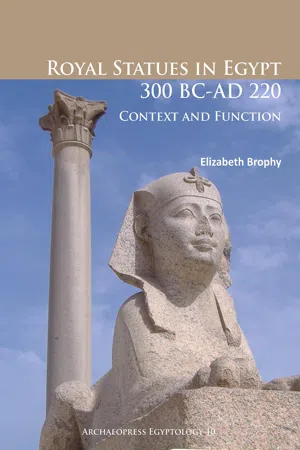
The aim of this book is to approach Ptolemaic and Imperial royal sculpture in Egypt dating between 300 BC and AD 220 (the reigns of Ptolemy I and Caracalla) from a contextual point of view. To collect together the statuary items (recognised as statues, statue heads and fragments, and inscribed bases and plinths) that are identifiably royal and have a secure archaeological context, that is a secure find spot or a recoverable provenance, within Egypt. This material was used, alongside other types of evidence such as textual sources and numismatic material, to consider the distribution, style, placement, and functions of the royal statues, and to answer the primary questions: where were these statues located? What was the relationship between statue, especially statue style, and placement? And what changes can be identified between Ptolemaic and Imperial royal sculpture? From analysis of the sculptural evidence, this book was able to create a catalogue of 103 entries composed of 157 statuary items, and use this to identify the different styles of royal statues that existed in Ptolemaic and Imperial Egypt and the primary spaces for the placement of such imagery, namely religious and urban space. The results, based on the available evidence, was the identification of a division between sculptural style and context regarding the royal statues, with Egyptian-style material being placed in Egyptian contexts, Greek-style material in Greek, and Imperial-style statues associated with classical contexts. The functions of the statues appear to have also typically been closely related to statue style and placement. Many of the statues were often directly associated with their location, meaning they were an intrinsic part of the function and appearance of the context they occupied, as well as acting as representations of the monarchs. Primarily, the royal statues acted as a way to establish and maintain communication between different groups in Egypt.
Information
Table of contents
- Cover
- Title page
- Copyright page
- Acknowledgements
- Contents
- List of Maps and Figures
- Map 1. Egypt (All sites labelled with black dots provide evidence of royal sculpture) (Image: Author)
- Chapter 1
- Chapter 1
- Introduction
- Introduction
- Chapter 2
- Chapter 2
- Textual Sources
- Textual Sources
- Map 2: Find spots of the Priestly Decrees throughout Egypt (Image: Author)
- Figure 1. The Mendes Decree (Meulenaere 1965, pl 1; © Brooklyn Museum)
- Figure 2. a and b;The Raphia Decree; Mit Raphina Stele with detail of the relief; Ptolemy IV on horseback with spear and Arsinoe III behind. (Hölbl 2001, 163; © Egyptian Museum, Cairo)
- Figure 3 Rosetta Stone, British Museum (Digital Image, British Museum, AN00016456_004; © Trustees of the British Museum)
- Figure 4. Philae Decrees on Birthhouse (© Author - digitally combined image)
- Figure 5. The Pithom Stele: left scene Ptolemy II (on left) offering to a king (probably Ptolemy I; middle scene Ptolemy II offering to the gods Tum, Hathor, and Arsinoe; right scene faces the opposite direction, Ptolemy II (far right) offering Ma’at o t
- Figure 6. Procession of priests carrying shrines, on the staircase to the roof at Dendera (© Author)
- Figure 7. Plan of Temple of Horus at Edfu (Kurth 2004, inner cover © D. Kurth)
- Chapter 3
- Chapter 3
- Cult Statues
- Cult Statues
- Figure 8. Falcon Headed Deity (Miho Museum 1997, no.5, © Miho Museum)
- Figure 10. Ptolemy VIII and his wives receive royal status, interior wall relief, Kom Ombo (© Author)
- Figure 9. Offerings to Ptolemy II and Arsinoe II by Ptolemy III; Gate of Euergetes, Karnak (© Author)
- Figure 11. Stele showing Tanite triad with Ptolemy IV and Arsinoe III, from Tanis (Digital Image, British Museum, AN00144204_001; © Trustees of the British Museum)
- Figure 12.a (left). Statue of an Aphrodite from Athribis (Myśliwiec 1988, pl 35 - TA III.15.85; © Polish Centre of Mediterranean Archaeology, University of Warsaw)
- Figure 12.b (below). Head of a female (goddess) from Athribis (Myśliwiec and Herbich 1988, pl 37 – TA III3485; © Polish Centre of Mediterranean Archaeology, University of Warsaw)
- Figure 13. Temple of Augustus at Philae (© Author)
- Figure 14. Temple of Serapis, Luxor (© Author)
- Categories and Contexts
- Categories and Contexts
- Chapter 4
- Chapter 4
- Figure 15. Ram-headed sphinxes lining the dromos of Karnak (© Author)
- Figure 16. Layout of Temple of Amun at Tanis
- Figure 17. Sphinxes and colossi defining the dromos and entrance of the Temple of Luxor (Photo: Author)
- Figure 18. House structures of Karanis (© Author)
- Chapter 5
- Chapter 5
- Environment of Royal statues and Egyptian Statues with Greek Features
- Environment of Royal statues and Egyptian Statues with Greek Features
- Figure 19. Zeus wearing Atef Crown
- Figure 20. a and b Standing Male from Tebtunis (Rondot 2004, no.108 to 111, 277; Archives Anti © Department of Cultural Heritage, University of Padua Inv. No. 184, Photogr. No. 012 and 013)
- Figure 21. Standing statue feet in situ, from Tebtunis (Rondot 2004, no.106, 276; Archives Anti© Department of Cultural Heritage, University of Padua Inv. No. 186, Photogr. No. 001)
- Chapter 6
- Chapter 6
- Functions of Royal Statues
- Functions of Royal Statues
- Alexandria
- Alexandria
- Chapter 7
- Chapter 7
- Map 3. Layout of Alexandria (Bagnall and Rathbone 2004, fig 2.1.1; © Judith McKenzie)
- Figure 22. Plan of the Serapeum, Ptolemaic period
- Figure 23. Ancient and Modern Coastline of Alexandria with relevant areas labelled (Goddio and Bernand 2004, 89; Map Franck Goddio © Franck Goddio/IEASM)
- Figure 24. Two coins of Commemorative Arches from c. AD 81-138
- Chapter 8
- Chapter 8
- Outside Egypt
- Outside Egypt
- Chapter 9
- Chapter 9
- Conclusion
- Conclusion
- Table 1: The distribution of the different categories of royal statue throughout the regions of Egypt.
- Abbreviations
- Abbreviations
- Bibliography
- Bibliography
- Catalogue
- Introduction
Trusted by 375,005 students
Access to over 1.5 million titles for a fair monthly price.
Study more efficiently using our study tools.
Frequently asked questions
Yes, you can cancel anytime from the Subscription tab in your account settings on the Perlego website. Your subscription will stay active until the end of your current billing period. Learn how to cancel your subscription
No, books cannot be downloaded as external files, such as PDFs, for use outside of Perlego. However, you can download books within the Perlego app for offline reading on mobile or tablet. Learn how to download books offline
Perlego offers two plans: Essential and Complete
- Essential is ideal for learners and professionals who enjoy exploring a wide range of subjects. Access the Essential Library with 800,000+ trusted titles and best-sellers across business, personal growth, and the humanities. Includes unlimited reading time and Standard Read Aloud voice.
- Complete: Perfect for advanced learners and researchers needing full, unrestricted access. Unlock 1.5M+ books across hundreds of subjects, including academic and specialized titles. The Complete Plan also includes advanced features like Premium Read Aloud and Research Assistant.
We are an online textbook subscription service, where you can get access to an entire online library for less than the price of a single book per month. With over 1.5 million books across 990+ topics, we’ve got you covered! Learn about our mission
Look out for the read-aloud symbol on your next book to see if you can listen to it. The read-aloud tool reads text aloud for you, highlighting the text as it is being read. You can pause it, speed it up and slow it down. Learn more about Read Aloud
Yes! You can use the Perlego app on both iOS and Android devices to read anytime, anywhere — even offline. Perfect for commutes or when you’re on the go.
Please note we cannot support devices running on iOS 13 and Android 7 or earlier. Learn more about using the app
Please note we cannot support devices running on iOS 13 and Android 7 or earlier. Learn more about using the app
Yes, you can access Royal Statues in Egypt 300 BC-AD 220 by Elizabeth Brophy in PDF and/or ePUB format, as well as other popular books in Social Sciences & Archaeology. We have over 1.5 million books available in our catalogue for you to explore.