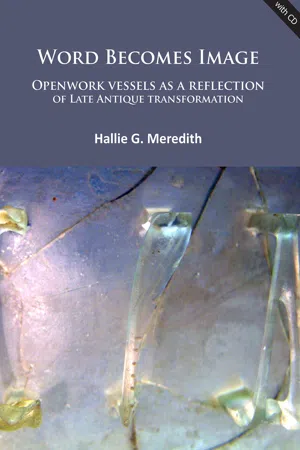
Transformationpresents a diachronic investigation providing a rich case study as well as an approach tracing the contours of a category of Roman material culture defined by the Roman period technique of openwork carving. As the first comprehensive assemblage of openwork vessels from Classical to late Antiquity, this work offers primary evidence documenting a key example of the fundamental shift from naturalism to abstraction in which inscriptions are transformed and word becomes image. A glass blower herself, Hallie Meredith poses questions about process, tactility and reception providing a clear picture of the original contexts of production and reception demonstrated by the Roman technique of openwork carving. In an in-depth analysis of the corpus as a whole, typologies (old and new), imagery, geometric patterning and inscriptions as the major divisions among openwork decorative elements, basic design principles are identified, non openwork carving and its relation to openwork decoration are discussed, as are the function, handling, display, movement and provenance of openwork vessels throughout the Roman Empire. Art historians and archaeologists working on the transition from Classical to late Antiquity, as well as scholars focusing on these and later periods of study, can fruitfully apply this approach to visual culture. This work shows how openwork vessels are a reflection of a wide-reaching Roman cultural aesthetic.
eBook - PDF
Word Becomes Image: Openwork vessels as a reflection of Late Antique transformation
- 301 pages
- English
- PDF
- Available on iOS & Android
eBook - PDF
Word Becomes Image: Openwork vessels as a reflection of Late Antique transformation
About this book
Information
Table of contents
- Cover
- Title page
- Copyright page
- Dedication
- Contents
- Text Figure A: Diagram of Glass Openwork Vessel
- Text Figure B: Total Number of Openwork Vessels
- Text Figure C: Table of Openwork Vessel Materials
- Text Figure D: Reconstruction of Plan, Section and Roman Glass Making Furnace (Primary Production) from Bet Eli’Ezer, Israel
- Text Figure E: An Overview of the Fabrication of Raw Glass in Primary Production
- Text Figure F: An Overview of the Hot-Working Stage of Secondary Glass Production
- Text Figure G: An Overview of the Cold-Working Stage of Tertiary Production
- Text Figure H: Diocletian’s Edict of Maximum Prices (16.1-4) on Glass
- Text Figure I.1-I.2: Table of Glass Colours
- Text Figure J: Openwork Metal Casing Sequence of Production
- Text Figure K: Plan of Excavated Carving Workshop, House D in the Centre Surrounding an Interior Courtyard, Street R4, Kom el-Dikka, Egypt
- Text Figure L: Traditional Interpretation of the Stages of Glass Openwork Carving
- Text Figure M.1-M.2: Non-Traditional Interpretation of the Stages of Glass Openwork Production
- Text Figure N: Openwork Glass Casing Sequence of Production
- Text Figure O: Marble Sarcophagus of Junius Bassus (the Younger), Rome, AD 359
- Text Figure P: Basket- Capital from St. Polyeuktos, Constantinople. Height 0.59metres
- Text Figure Q: Missorium of Theodosius, Stamped Weight: 50 roman pounds (16.128 kilograms), current weight: 15.35 kilograms, diameter: 740mm. The Inscription States: ‘D(OMINUS) N(OSTER) THEODOSIVS PERPET(UUS) AVG(USTUS) OB DIEM FELICISSIMVM X’ (Our Lord T
- Text Figure R: Glass Bust, Three-Quarters View, 21mm
- Text Figure S.1-S.3: Glass Bust
- Text Figure T.1-T.2: Gold-Glass Vessel
- Text Figure U: Table of Openwork Imagery
- Text Figure V: Early Fourth Century AD Mosaic with a Representation of the Lycurgus Myth, Saint Romain-en-Gaul
- Text Figure W: Apse of a Villa triclinium, Fourth Century AD Mosaic with a Representation of the Lycurgus Myth, Villa Romana del Casale, Piazza Armerina, Sicily
- Text Figure X: Table of Base Decoration on Vessels with Geometric Patterning
- Text Figure Y.1-Y.2: Wooden Tripod to Hold Conical Glass Vessels, Excavated from Karanis, Egypt
- Text Figures Z.1-Z.2: Table of Openwork Inscriptions
- Text Figure AA: The Distribution of Inscribed Openwork Vessels in the Late Roman Empire
- Text Figure BB: Table of Structures in which Openwork Vessels have been Found
- Text Figure CC: Carved Glass Fish Appliqué
- Text Figure DD: The Distribution of Openwork Vessels in the Late Roman Empire
- Text Figure EE: Provenanced Glass Openwork Vessels
- Text Figure FF: Table of Openwork Vessel Dates
- Text Figure GG: Table of Openwork Functions
- Illustration Credits
- List of Text Figures
- Acknowledgements
- Introduction
- I. Crafting the Value of Glass
- II. Openwork Vessels: A Roman Category
- III. Inscribing Openwork Vessels with Meaning
- Illustration Credits
- List of Text Figures
- Acknowledgements
- Introduction
- I. Crafting the Value of Glass
- II. Openwork Vessels: A Roman Category
- III. Inscribing Openwork Vessels with Meaning
- Conclusion
- Bibliography
- Appendix: Contemporaneous, Regionally Distributed
- Inscribed Glassware
- Glossary1
- Catalogue
- I. Ancient Authors and Texts
- II. Index
Trusted by 375,005 students
Access to over 1.5 million titles for a fair monthly price.
Study more efficiently using our study tools.
Frequently asked questions
Yes, you can cancel anytime from the Subscription tab in your account settings on the Perlego website. Your subscription will stay active until the end of your current billing period. Learn how to cancel your subscription
No, books cannot be downloaded as external files, such as PDFs, for use outside of Perlego. However, you can download books within the Perlego app for offline reading on mobile or tablet. Learn how to download books offline
We are an online textbook subscription service, where you can get access to an entire online library for less than the price of a single book per month. With over 1.5 million books across 990+ topics, we’ve got you covered! Learn about our mission
Look out for the read-aloud symbol on your next book to see if you can listen to it. The read-aloud tool reads text aloud for you, highlighting the text as it is being read. You can pause it, speed it up and slow it down. Learn more about Read Aloud
Yes! You can use the Perlego app on both iOS and Android devices to read anytime, anywhere — even offline. Perfect for commutes or when you’re on the go.
Please note we cannot support devices running on iOS 13 and Android 7 or earlier. Learn more about using the app
Please note we cannot support devices running on iOS 13 and Android 7 or earlier. Learn more about using the app
Yes, you can access Word Becomes Image: Openwork vessels as a reflection of Late Antique transformation by Hallie G. Meredith in PDF and/or ePUB format, as well as other popular books in Social Sciences & Archaeology. We have over 1.5 million books available in our catalogue for you to explore.