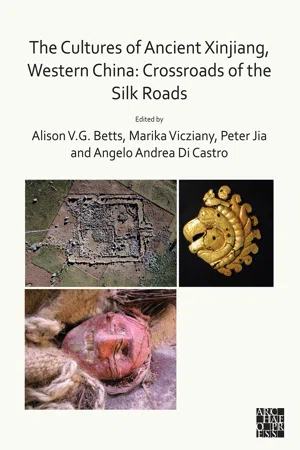
The Cultures of Ancient Xinjiang, Western China: Crossroads of the Silk Roads unveils the ancient secrets of Xinjiang, western China, one of the least known but culturally rich and complex regions located at the heart of Asia. Historically, Xinjiang has been the geographic hub of the Silk Roads, serving international links between cultures to the west, east, north and south. Trade, artefacts, foods, technologies, ideas, beliefs, animals and people have traversed the glacier covered mountain and desert boundaries. Perhaps best known for the Taklamakan desert, whose name translates in the Uyghur language as 'You can go in, you will never come out', here the region is portrayed as the centre of an ancient Bronze Age culture, revealed in the form of the famous Tarim Mummies and their grave goods. Three authoritative chapters by Chinese archaeologists appear here for the first time in English, giving international audiences direct access to the latest research ranging from the central-eastern Xiaohe region to the western valleys of the Bortala and Yili Rivers. Other contributions by European, Australian and Chinese archaeologists address the many complexities of the cultural exchanges that ranged from Mongolia, through to Kashgar, South Asia, Central Asia and finally Europe in pre-modern times.
eBook - PDF
The Cultures of Ancient Xinjiang, Western China: Crossroads of the Silk Roads
- 218 pages
- English
- PDF
- Available on iOS & Android
eBook - PDF
The Cultures of Ancient Xinjiang, Western China: Crossroads of the Silk Roads
About this book
Information
Subtopic
ArchaeologyIndex
HistoryTable of contents
- Cover
- Title Page
- Copyright page
- Contents Page
- List of Figures
- Contributors
- Preface
- Ancient Xinjiang at the International Crossroads
- Ancient Xinjiang at the International Crossroads
- Chapter 1
- Chapter 1
- Figure 1. Diagram showing some of the key archaeological sites and locations referred to in this chapter.
- Marika Vicziany
- Alison Betts
- Chapter 2
- Chapter 2
- Figure 1. Diagram showing the key Xinjiang sites discussed in this chapter.
- Xinjiang in Prehistory
- Xinjiang in Prehistory
- Figure 2a and b. View of the pre-Bronze Age site of Goukou in the north-eastern Tianshan; stone tools from Goukou (photo Bet s).
- Figure 3. Qiemu’erqieke stone stela, Xinjiang Altai (photo Betts).
- Figure 4. Ceramic vessels from the Adunqiaolu cemetery, Bortala Valley (photo Doumani Dupuy).
- Figure 5. Deer Stone Khirigsuur Complex, Xinjiang Altai (photo Betts).
- Figure 6. Chawuhugou cemetery, painted jugs (photo Xinjiang Uygur Autonomous Region International Cultural Exchange Association).
- Chapter 3
- Chapter 3
- The Xiaohe (Small River) Cemetery1 and the Xiaohe Culture
- The Xiaohe (Small River) Cemetery1 and the Xiaohe Culture
- Yidilisi Abuduresule, Li Wenying, Hu Xingjun
- Figure 1. Diagram showing the distribution of the Xiaohe Culture in Xinjiang.
- Figure 2. Diagram showing the location of the Xiaohe Culture Cemeteries, Regions A and B.
- Figure 3. Cemetery 09LE50 located on the top of a yardang (photo Xinjiang Institute of Archaeology).
- Figure 4. Detail of Cemetery 09LE50 (photo Xinjiang Institute of Archaeology).
- Figure 5. Plan of Cemetery 09LE4 showing the location of the graves (illustration Xinjiang Institute of Archaeology).
- Figure 6. Cemetery 09LE4: General view looking south (photo Xinjiang Institute of Archaeology).
- Figure 7. Cemetery 09LE4: Burials 3-15, looking west (photo Xinjiang Institute of Archaeology).
- Figure 10. Cemetery 09LE8: Burial 1 (photo Xinjiang Institute of Archaeology).
- Figure 8. Cemetery 09LE4: Burial 1, looking south-west (photo Xinjiang Institute of Archaeology).
- Figure 9. View of Cemetery 09LE8 on top of the yardang (photo Xinjiang Institute of Archaeology).
- Figure 11. Cemetery 09LE8: Mummified body. Burial 1 (photo Xinjiang Institute of Archaeology).
- Figure 12. Cemetery 09LE8: Burial 2 (photo Xinjiang Institute of Archaeology).
- Figure 13. Artefacts collected from Kongque River Delta Cemetery Burial 36 (after Bergman 1939: Pl. 26).
- Figure 14. Mummified body found at Kongque River Delta Cemetery Burial 36 (after Bergman 1936: 136, Fig. 32).
- Figure 15. Basket collected from Kongque River Delta Cemetery 37 (after Bergman 1939: Pl. 25.5).
- Figure 17. Female mummy found at Tiebanhe Cemetery 2 (photo Xinjiang Institute of Archaeology).
- Figure 18. General view of the Gumuguo Cemetery (photo Xinjiang Institute of Archaeology).
- Figure 20. Excavated burials at the Gumuguo Cemetery (photo Xinjiang Institute of Archaeology).
- Figure 21. Evidence of looting at the Gumuguo Cemetery (photo Xinjiang Institute of Archaeology).
- Figure 22. A timber enclosed burial chamber at LT Cemetery (photo Xinjiang Institute of Archaeology).
- Figure 23. Plan showing the location of graves at Xianshuiquan Cemetery No 10 (illustration Xinjiang Institute of Archaeology).
- Figure 24. View of Xianshuiquan Cemetery No 10 (photo Xinjiang Institute of Archaeology).
- Figure 25. Timbers found at Xianshuiquan Cemetery No 10 (photo Xinjiang Institute of Archaeology).
- Figure 26. Carved timber found at Xianshuiquan Cemetery No 10 (photo Xinjiang Institute of Archaeology).
- Figure 28. The Xiaohe Cemetery before the excavations of 2002-2005 (photo Xinjiang Institute of Archaeology).
- Figure 30. The northern section of the Xiaohe Cemetery before excavation (photo Xinjiang Institute of Archaeology).
- Figure 31. A general view of the Xiaohe Cemetery before excavation showing the middle wall dividing the northern and southern sections (photo Xinjiang Institute of Archaeology).
- Figure 32. Plan of Xiaohe mound before excavation (illustration Xinjiang Institute of Archaeology).
- Figure 33. Xiaohe Cemetery: timber coffins (photo Xinjiang Institute of Archaeology).
- Figure 35. Xiaohe Cemetery: details of the timber poles (photo Xinjiang Institute of Archaeology).
- Figure 36. Xiaohe Cemetery: Burial 75. Coffin with clay shell covering surrounded by poles (photo Xinjiang Institute of Archaeology).
- Figure 37. Xiaohe Cemetery: Burial 75. Detail of the clay shell covering of the coffin (photo Xinjiang Institute of Archaeology).
- Figure 38. Xiaohe Cemetery: The horns of cattle (Bos taurus) from Burial 13 (photo Xinjiang Institute of Archaeology).
- Figure 39. Xiaohe Cemetery: Plan of burials and timber poles in layers 1-3 (illustration Xinjiang Institute of Archaeology).⤀
- Figure 41. Xiaohe Cemetery: Southern section. Burials in layers 4 and 5 (photo Xinjiang Institute of Archaeology).
- Figure 42. Survey route for the Northern Cemetery (illustration Xinjiang Institute of Archaeology).
- Figure 43. Coffins in Northern Cemetery (photo Xinjiang Institute of Archaeology).
- Figure 44. Coffin in the Northern Cemetery (photo Xinjiang Institute of Archaeology).
- Figure 45. Rescue work in the Northern Cemetery (photo Xinjiang Institute of Archaeology).
- Figure 46. Textile found in the Northern Cemetery (photo Xinjiang Institute of Archaeology).
- Figure 47. Female symbol on wooden pole in the Northern Cemetery (photo Xinjiang Institute of Archaeology).
- Figure 48. Basket found in the Northern cemetery (photo Xinjiang Institute of Archaeology).
- Figure 50. Xiaohe Cemetery: Burial 13 covered in cattle hide (photo Xinjiang Institute of Archaeology).
- Figure 51. Xiaohe Cemetery: Burial 13. Female body (photo Xinjiang Institute of Archaeology).
- Figure 52. Xiaohe Cemetery: Pole with female symbol (photo Xinjiang Institute of Archaeology).
- Figure 55. Xiaohe Cemetery: hafted stone axe (photo Xinjiang Institute of Archaeology).
- Figure 56. Xiaohe Cemetery: Burials 24 and 28. Wooden arrows with feathered fletching (photo Xinjiang Institute of Archaeology).
- Figure 57. Xiaohe Cemetery: Wooden arrow with bone tip (photo Xinjiang Institute of Archaeology).
- Figure 58. Xiaohe Cemetery: stone mace head (photo Xinjiang Institute of Archaeology).
- Figure 59. Xiaohe Cemetery: bronze arrowhead (photo Xinjiang Institute of Archaeology).
- Figure 60. Xiaohe Cemetery: Burial 13. Slivers cut from animal ears (photo Xinjiang Institute of Archaeology).
- Figure 61. Xiaohe Cemetery: Burial 75. Basket in a wooden bucket (photo Xinjiang Institute of Archaeology).
- Figure 62. Xiaohe Cemetery: Woven basket (photo Xinjiang Institute of Archaeology).
- Figure 63. Xiaohe Cemetery: Wooden bucket (photo Xinjiang Institute of Archaeology).
- Figure 64. Xiaohe Cemetery: Horn and leather container (photo Xinjiang Institute of Archaeology).
- Figure 65. Xiaohe Cemetery: Burial 13. Leather bag (photo Xinjiang Institute of Archaeology).
- Figure 66. Xiaohe Cemetery: Burial 13. String and bead bracelet (photo Xinjiang Institute of Archaeology).
- Figure 67. Xiaohe Cemetery: String and bead necklace (photo Xinjiang Institute of Archaeology).
- Figure 68. Xiaohe Cemetery: Golden earring on a bronze mirror (photo Xinjiang Institute of Archaeology).
- Figure 70. Xiaohe Cemetery: Burial 13. Leather boots (photo Xinjiang Institute of Archaeology).
- Figure 72. Xiaohe Cemetery: Phallic symbol in wood and string (photo Xinjiang Institute of Archaeology).
- Figure 73. Xiaohe Cemetery: Burial 24. Basket and twigs on top of coffin (photo Xinjiang Institute of Archaeology).
- Figure 75. Xiaohe Cemetery: Burial 11. Woven textile with tassels (photo Xinjiang Institute of Archaeology).
- Figure 76. Xiaohe Cemetery: Burial 11. Woven textile (photo Xinjiang Institute of Archaeology).
- Figure 77. Xiaohe Cemetery: Burial 13. Woven and embroidered textile (photo Xinjiang Institute of Archaeology).
- Figure 78. Xiaohe Cemetery: Burial 13. Human face carved from wood (photo Xinjiang Institute of Archaeology).
- Figure 79. Xiaohe Cemetery: Painted wooden face (photo Xinjiang Institute of Archaeology).
- Figure 81. Xiaohe Cemetery: Wooden figurine with clothing and earrings (photo Xinjiang Institute of Archaeology).
- Figure 82. Xiaohe Cemetery: Wooden sticks carved with human faces and string decoration (photo Xinjiang Institute of Archaeology).
- Figure 83. Table showing radiocarbon dates from the Xiaohe Cemetery: Southern Section (Xinjiang Institute of Archaeology).
- Figure 84. Table showing radiocarbon dates from the Xiaohe Cemetery: Northern section (Xinjiang Institute of Archaeology).
- Chapter 4
- Chapter 4
- Cong Dexin
- Figure 1. Diagram showing the Bortala River area and adjacent regions.
- Tianshan as a Bridge: New Studies of Bronze Age Archaeology in the Western Tianshan, Xinjiang, China
- Tianshan as a Bridge: New Studies of Bronze Age Archaeology in the Western Tianshan, Xinjiang, China
- Figure 2. General view of the site of Turigen (photo Chinese Academy of Social Sciences).
- Figure 3. View of the site of Huertuoleha from above (photo Chinese Academy of Social Sciences).
- Figure 4. Table showing radiocarbon (AMS 14C) dates for the Adunqiaolu site (Chinese Academy of Social Sciences).
- Figure 5. Adunqiaolu: House Site F1 (photo Chinese Academy of Social Sciences).
- Figure 6. Adunqiaolu: Pottery sherds found inside House F1 (photo Chinese Academy of Social Sciences).
- Figure 7. Adunqiaolu: House plan of F1, F2 and F3 (illustration Chinese Academy of Social Sciences).
- Figure 8a and b. A stone cist burial at the Adunqiaolu Cemetery (photo and illustration Chinese Academy of Social Sciences).
- Figure 10. Adunqiaolu: The northern region of the cemetery (SM4 top centre) (photo Chinese Academy of Social Sciences).
- Figure 11. Adunqiaolu: Burial SM4 from above (photo Chinese Academy of Social Sciences).
- Figure 9. Adunqiaolu: Stone enclosure of burial SM9 (photo Chinese Academy of Social Sciences).
- Figure 12. Adunqiaolu: Burial SM4-1 (photo Chinese Academy of Social Sciences).
- Figure 13. Adunqiaolu: Earring found in burial SM4-1 (photo Chinese Academy of Social Sciences).
- Figure 14. Adunqiaolu: Pottery vessel found in burial SM4-1 (photo Chinese Academy of Social Sciences).
- Figure 15. Adunqiaolu: Stone enclosure burial of SM50-1 and SM50-2 (photo Chinese Academy of Social Sciences).
- A Report on Archaeological Findings in the Upper Yili Valley
- A Report on Archaeological Findings in the Upper Yili Valley
- Chapter 5
- Chapter 5
- Liu Xuetang
- Figure 1. Diagram showing prehistoric sites in the Upper Yili River Valley.
- Figure 3. Qiongkeke: Ceramics from the settlement site (illustration Xuetang).
- Figure 5. Qiongkeke: Burial in cemetery No. 1 (illustration Xuetang).
- Figure 6. Qiongkeke: Ceramics in cemetery No. 1 (illustration Xuetang).
- Figure 7. Qiongkeke: Ceramics in cemetery No. 2 (illustration Xuetang).
- Figure 8. Tangbalesayi: Types of burials (illustration Xuetang).
- Figure 9. Tangbalesayi: Ceramics and personal ornaments from the burials (illustration Xuetang).
- Figure 10. Kukesuhexi: Types of burials (illustration Xuetang).
- Figure 12. Kalasu: Plan of house F1 (illustration Xuetang).
- Figure 14. Kalasu: Ceramics from house F1 (illustration Xuetang).
- Figure 15. Gongliu Shankou: Ceramics from the cemetery (illustration Xuetang).
- Figure 16. Wu’ertangou: Plan and cross-section of stone mound burial (illustration Xuetang).
- Figure 17. Jialegesiha’yinte: Ceramics from the burials (illustration Xuetang).
- Figure 18. Bietebasitao: Ceramics and stone artefacts from the burials (illustration Xuetang).
- Figure 19. Jirentuohai: Ceramic and metal artefacts from the burials (illustration Xuetang).
- Figure 20. Sa’erbulakegou: Ceramics from the burials (illustration Xuetang).
- Figure 21. Tiemulike-goukou: Ceramics from the burials (illustration Xuetang).
- Figure 22. Examples of the animals depicted on the rock art of the Yili Valley (illustration Xuetang).
- Figure 23. Examples of the animals depicted on the rock art of the Yili Valley (illustration Xuetang).
- Chapter 6
- Chapter 6
- N. Boroffka and L. Sverchkov
- Painted pottery of the Late Bronze Age – Early Iron Age in Central Asia: new data from southern Uzbekistan
- Painted pottery of the Late Bronze Age – Early Iron Age in Central Asia: new data from southern Uzbekistan
- Figure 1. Diagram showing the distribution of Central Asia Yaz I type hand-made painted pottery, the location of Bandykhan and other sites mentioned in this chapter.
- Figure 2. Diagram showing the location of Maydatepa in the Bandykhan microregion.
- Figure 3. Excavation view (from the east) of Yaz I architecture in the upper layers of Maydatepa. The round pits in the foreg ound are later (photo Boroffka, DAI Eurasien-Abteilung).
- Figure 5. Partial view of the southern profile at Maydatepa. The brown clay visible at the bottom and to the right is the sterile ground, into which a canal was cut. The canal was filled by blackish and greenish humus layers and re-cut at least twice, as
- Figure 6. Maydatepa: Hand-made Yaz I type pottery (illustration R. Boroffka).
- Figure 7. Maydatepa: Hand-made Yaz I type pottery (illustration R. Boroffka).
- Figure 8. Maydatepa: Wheel-made pottery from Yaz I contexts (illustration R. Boroffka).
- Figure 9. Maydatepa: Various finds from Yaz I contexts. 1 Ocean shell ornaments, 2 abstract anthropomorphous figurines, 3 grooved stone hammer, 4 stone pestle, 5 pedestalled stone mortar, 6 copper-alloy finds, 7 stone casting mould (complete figure a d
- Chapter 7
- Chapter 7
- Figure 1. Diagram showing the Eurasian cultural areas and sites of the Bronze Age discussed in this chapter.
- Henri-Paul Francfort
- Shifting exchange patterns during the Bronze and Iron Ages between China and the West in Eurasia
- Shifting exchange patterns during the Bronze and Iron Ages between China and the West in Eurasia
- Figure 2. Sarazm (Tajikistan): Stone implements of steppic (staff) or ‘oasis’ (with handles) types. Penjikent Museum, ca. 3rd millennium BC (photo Mission Archéologique Française en Asie central – MAFAC).
- Figure 3. Sarazm (Tajikistan): Painted pottery of ‘Balochi’ type. Excavation VII, ca. mid-3rd millennium BC. Tajik-French excavations (photo Mission Archéologique Française en Asie central – MAFAC).
- Figure 4. Diagram showing some of the Eurasian sites of the Iron Age discussed in this chapter.
- Figure 5. Berel (Altay, Kazakhstan): Kurgan No. 11 horse tack ornament in gilded wood in the shape of griffin and mountain sheep with curling mane of Achaemenid inspiration, first quarter of 3rd century BC. Kazakh-French-Italian excavation (photo Mission
- Figure 6. Berel (Altay, Kazakhstan): Kurgan No. 11 horse wooden ornament in the shape of Persepolis griffin, of Achaemenid inspiration, first quarter of 3rd century BC. Kazakh-French-Italian excavation (photo Mission Archéologique Française en Asie ce
- Figure 7. Diagram showing main branches of the Silk Roads and Central Asian archaeological sites discussed in this chapter.
- Figure 8. Gandharan toilet tray with royal wine filtering and drinking ceremony seen frontally (photo Kurita, courtesy Mr and Mrs Hirose, and Ms J. Pons).
- Figure 9. Noin-Ula (Mongolia) tapestry with royal wine filtering and drinking ceremony seen in profile. Note the dragons in the ornamental frieze, first century AD. Mongol-Russian excavation (from N. Polos’mak, Nauka, 2 (38), 2011: 116-117).
- Chapter 8
- Chapter 8
- Marika Vicziany and Angelo Andrea Di Castro1
- The Kashgar Oasis: Reassessing the Historical Record
- The Kashgar Oasis: Reassessing the Historical Record
- Figure 1. Diagram showing the location of the eight main archaeological sites in the Kashgar oasis discussed in this chapter.⤀
- Figure 2. Former location of Pigeon House near Khan-oi, showing concrete sign erected by the Kashgar Municipality for the p otection of this site (photo Gollings).
- Figure 3: Road sign placed near the original location of Kizil Debe Stupa in contemporary Kashgar (photo Di Castro).
- Figure 4. Satellite view of the area of Khan-oi in 2006 (acquired from Quickbird, March 2, 2006).
- Figure 5. Agricultural encroachment on Khan-oi in 2012 (from Google Earth).
- Figure 6 a and b. Satellite images of the site of Topa Tim in 2005 (a) and 2013 (b) showing new road dividing the stupa on the right from the monastery on the left (from Google Earth).
- Figure 8. Satellite image showing the line of karez adjacent to the Mori Tim sacred area (acquired from Quickbird, March 2, 2006).
- Figure 9. One of the 48 karez wells in the vicinity of the sacred area of Mori Tim (photo Di Castro).
- Figure 10. Bulldozers removing part of the old wall of Kashgar in 2005 (photo Vicziany).
- Figure 11. Tomb of Satuq Boghra Khan in Artush with a bronze cooking cauldron dedicated by Yakub Beg in the foreground (the cauldron was used to distribute food to pilgrims (photo Di Castro).
- Figure 12. Exterior of the tomb of Bibi Maryam with the female caretaker (photo Di Castro).
- Figure 13. Interior of the tomb of Bibi Maryam showing the tomb with ritual rods (photo Di Castro).
- Figure 14. Desert Shrine of Ordam Padshah in 1928. This is the grave (mazar) of Ali Arslan Khan (Frank Ludlow Collection, courtesy of the British Library).
- Figure 15. Remains of animal sacrifices outside the tomb of Satuq Boghra Khan (photo Di Castro).
- Figure 16. Exterior of the Tomb of Apa Khoja in Kashgar (photo Gollings).
- Figure 17. Interior of the Tomb of Apa Khoja (photo Gollings).
- Figure 18. Lithograph c. 1890 showing the types of military costumes probably worn by Uyghur military during Yakub Beg’s reign (Vicziany archive).
- Figure 19. Detail of the inscription on the cauldron outside Tomb of Satuq Bogra Khan in Artush dedicated by Yakub Beg (photo Di Castro).
- Angelo Andrea Di Castro, Marika Vicziany and Xuan Zhu
- Chapter 9
- Chapter 9
- The Kashgar Oasis in Buddhist and Pre Buddhist Times: the Archaeological and Environmental Record
- The Kashgar Oasis in Buddhist and Pre Buddhist Times: the Archaeological and Environmental Record
- Figure 1. Diagram showing some of the key archaeological sites discussed in this chapter.
- Figure 2a and b. Aerial view of the site of Yawaluk/Tegurman in 2002 (a) and in 2012 (b) (from Google Earth).
- Figure 4. Mori Tim stupa A on the right and stupa B on the left (photo Di Castro).
- Figure 5. Fragment of a figurative stucco from the debris of the monastic site of Topa Tim (photo Di Castro).
- Figure 6. Tractor marks on the old structures of Khan-oi in 2013 (photo Di Castro).
- Figure 7. Encroachment of irrigation canals on the old structures of Khan-oi in 2013, visible in the middle of the image (photo Di Castro).
- Figure 8. Sand dunes covering up part of the cemetery at Yopurga (photo Gollings).
- Figure 9. Plan of the ruins of Eskishahar surveyed by Pelliot in 1906 (from Hambis 1961).
- Figure 10. Image of the ruins of Eskishahar as it appeared during the Pelliot expedition in 1906 (from Hambis 1961).
- Figure 11. Remains of the walls of Eskishahar in 2013 (photo Di Castro).
- Figure 12. The caves of the Three Immortal Buddhas, on the cliffs above the Chakmak river (photo Gollings).
- Figure 14. Fragments of a Buddhist manuscript discovered in Yawaluk (from Xinjiang Cultural Relics Bureau et al. 1999).
- Figure 15. Water well in old Kashgar in 2014 (photo Di Castro).
- Figure 16. Water logged fields around Topa Tim in 2005, the stupa is hardly visible on the horizon line in the middle of the image (photo Di Castro).
- Figure 17. Ruins of a Buddhist stupa and monastery (Toukguzkaznakh), near the tomb of Mahmud al Kashgari in Upal (photo Di Castro).
- Chapter 10
- Chapter 10
- Figure 1. Diagrammatic representation of the three main isotopes of Carbon. All have 6 protons, making them Carbon, but they have differing numbers of neutrons in the nucleus. Carbon-14 is unstable and decays radioactively (illustration Dodson, Atahan a d
- John Dodson, Pia Atahan and Xiaoqiang Li
- Unravelling Farming and Metallurgy in Ancient China with Nuclear Science
- Unravelling Farming and Metallurgy in Ancient China with Nuclear Science
- Figure 2. General rules of isotopic fractionation: lighter isotopes move/vibrate faster and form weaker chemical bonds; isotope effects are stronger where the relative mass differences are larger (e.g. between 16O, 17O, 18O); and isotope effects reduce at
- Figure 4. Diagram showing Eurasia and Gansu Province with the sites mentioned in the text: (1) Mesopotamia; (2) Fertile Crescent; (3) Yili Valley; (4) Baishantang Copper Mine; (5) Huoshiliang, Gangangwa and Tiao Hu; (6) Dadiwan.
- Figure 5. Photograph showing surface scatter at Huoshiliang site. Inset shows pieces of pottery and occupation deposits visible on the surface (photo Dodson, Atahan and Li).
- Figure 6. Cation profiles in Huoshiliang sediments (Dodson et al. 2009).
- Figure 7. Diagram showing the distribution of early wheat sites with robust AMS radiocarbon dating. Sites with wheat discussed in this paper are represented by the round dots (1-14): 1 Wupaer (Upal), 2 Xiakalangguer, 3 Xintala, 4 Xicaozi, 5 Sidaogu, Hu
- Figure 8. Table showing AMS 14C dates for samples taken from the surface scatters at Huoshiliang and Gangangwa sites (Dodson et al. 2009; Dodson et al. 2011; Atahan et al. 2011).
- Figure 9. Diagram showing plot of δ13C and δ15N data measured from herbivore (A & B) and omnivore and carnivore (B) bone collagen samples from Huoshiliang and Gangangwa sites (Diagram Dodson, Atahan and Li).
- Chapter 11
- Chapter 11
- Early wheat cultivation and plant use in Xinjiang prehistory: new evidence based on starch analysis
- Early wheat cultivation and plant use in Xinjiang prehistory: new evidence based on starch analysis
- Peter Jia and Florence Chau
- Figure 1. Diagram showing sites discussed in this chapter.
- Figure 2. Table showing maximum length (mm) of starch granules in the comparative reference taxa used for this project (Jia and Chau).
- Figure 3. Table showing boxplots of starch granule maximum length of the comparative reference collection data. Numbers of starch granules measured for each sample are in brackets (Jia and Chau).
- Figure 4. Starch granules of Leguminosae family: A: 黄芪 (Astragalus membraneus var mongholicus); B, C: adzuki bean (Phaseolus calcaratus); D, E: haricot bean (Phaseolus vulgaris); G: green pea (Pisum sativum); H: mung bean (Vigna radiate); I: 甘草 (Glychirr
- Figure 5. Gramineae starch: oat, Avena sativa (A and single grain particles found B); barley, Hordeum vulgare (C, D); millet – Panicum miliaceum (E); Sorghum bicolour (F); wheat, Triticum aestivum (G, H, I) (photomicrography by Chau using transmitted br
- Figure 6. Other species of starch plants: A: Chinese lovage (Ligusticum chuanxing); B: Cynomorium (Cynomorium coccineum subso Songarium); C: Korean Pine (Pinus koraienisis); D: buckwheat (Fagopyrum esculentum); E. Altai Hawthorn (Crataegus altaica); F, G,
- Figure 7. Stone and specimen collection site (white square): left from Kalasu site C: 09XJ002; D: 09XJ003; EF: 09XJ003; GH: 0 XJ004; right from Adunqiaolu site XBWAF1-14 (photos Jia and Chinese Academy of Social Sciences).
- Figure 8. Specimens collection and stone tools: upper 1-2, JQLYT1⑧: 2; 3-4, JQLYT1⑨: 2 from Luanzagangzi site; bottom left 09XJ013-2, 3 and right 09XJ014-1, 2 from burial No 38 at Saensayi cemetery (photo Jia).
- Figure 10. Wheat starch recovered from stone mortar (Figure 8 bottom left 09XJ013-2, 3), burial 38 in Saensayi cemetery (photomicrography by Jia using transmitted brightfield microscopes applied with Differential Interference Contrast (DIC)).
- Figure 12. Wheat starch recovered from grinding stone at Kalasu site: A. 09XJ011-2; B. 09XJ010-1; C. starch granules of modern wheat (Trticum aestivum) (photomicrography by Jia: on the left using transmitted brightfield microscopes applied with Differe ti
- Figure 13. Modern reference granules of wheat (Triticum aestivum) (A) and barley (Hordeum vulgare) (B), compared with ancient starch granules found on stone tools (09XJ010-1) (C) believed to be barley starch granules (photomicrography by Jia: on the left
- Figure 14. Modern reference starch granules: left – oats (Avena sativa), right – broomcorn millet (Panicum miliaceum) (photomicrography by Jia: on the left using transmitted brightfield microscopes applied with Differential Interference Contrast (DIC), an
- Figure 15. Starch granules with multilateral/polyhedral shape found at Kalasu site: 1-5, 7-12 from sample 09XJ010-1; 6 from sample 09XJ003-2 (photomicrography by Jia: on the left using transmitted brightfield microscopes applied with Differential Interfer
- Figure 16. Modern reference starch granules – sorghum (Sorghum bicolour). (photomicrography by Jia: on the left using transmitted brightfield microscopes applied with Differential Interference Contrast (DIC) and on the right using darkfield microscopes
- Figure 17. Modern reference starch granules – buckwheat (Fagopyrum esculentum) (photographs by Chau: on the left using transmitted brightfield microscopes applied with Differential Interference Contrast (DIC) and on the right using darkfield microscopes
- Figure 18. (A-E) Ancient starch granules from sample 09XJ 018; F-H); starch granules with prominent lamellae from sample 09XJ 010; starch granules from the reference collection species: (I) haricot bean (Phaseolus vulgaris); (J) mung bean (Vigna radiata);
- Figure 19. Possible suo-yang (Songaria Cynomorium) starch granules found on the stone tools at Kalasu site: ancient starch 1, 3, 4 (09XJ010-1), 2 (09XJ009-2), 5, 6 (modern reference) (photomicrography by Jia: on the left using transmitted brightfield micr
- Figure 20. Starch granules of da-yun (Cistanche deserticola) extracted from modern reference plant (photomicrography by Jia: using transmitted brightfield microscopes applied with Differential Interference Contrast (DIC) except in the case of the one in t
- Figure 21. Da-yun (Cistanche deserticola) Starch granules recovered from samples 11XJ01-03 and 11XJ01-05 collected from a gri ding stone XBWAF1-14 from Adunqiaolu site. The two on the left seem flattened, perhaps due to food processing (photomicrography b
- Figure 22. Ancient da-yun (Cistanche deserticola) starch granules found from stone tools unearthed at Luanzagangzi site (photomicrography by Jia: using transmitted brightfield microscopes applied with Differential Interference Contrast (DIC), and with cr
- Figure 23. Table showing plant starches identified from the archaeological sites mentioned in this chapter (Jia and Chau).
- _GoBack
- Back cover
Trusted by 375,005 students
Access to over 1.5 million titles for a fair monthly price.
Study more efficiently using our study tools.
Frequently asked questions
Yes, you can cancel anytime from the Subscription tab in your account settings on the Perlego website. Your subscription will stay active until the end of your current billing period. Learn how to cancel your subscription
No, books cannot be downloaded as external files, such as PDFs, for use outside of Perlego. However, you can download books within the Perlego app for offline reading on mobile or tablet. Learn how to download books offline
Perlego offers two plans: Essential and Complete
- Essential is ideal for learners and professionals who enjoy exploring a wide range of subjects. Access the Essential Library with 800,000+ trusted titles and best-sellers across business, personal growth, and the humanities. Includes unlimited reading time and Standard Read Aloud voice.
- Complete: Perfect for advanced learners and researchers needing full, unrestricted access. Unlock 1.5M+ books across hundreds of subjects, including academic and specialized titles. The Complete Plan also includes advanced features like Premium Read Aloud and Research Assistant.
We are an online textbook subscription service, where you can get access to an entire online library for less than the price of a single book per month. With over 1.5 million books across 990+ topics, we’ve got you covered! Learn about our mission
Look out for the read-aloud symbol on your next book to see if you can listen to it. The read-aloud tool reads text aloud for you, highlighting the text as it is being read. You can pause it, speed it up and slow it down. Learn more about Read Aloud
Yes! You can use the Perlego app on both iOS and Android devices to read anytime, anywhere — even offline. Perfect for commutes or when you’re on the go.
Please note we cannot support devices running on iOS 13 and Android 7 or earlier. Learn more about using the app
Please note we cannot support devices running on iOS 13 and Android 7 or earlier. Learn more about using the app
Yes, you can access The Cultures of Ancient Xinjiang, Western China: Crossroads of the Silk Roads by Alison Betts, Marika Vicziany, Peter Weiming Jia, Angelo Andrea Di Castro, Alison Betts,Marika Vicziany,Peter Weiming Jia,Angelo Andrea Di Castro in PDF and/or ePUB format, as well as other popular books in History & Archaeology. We have over 1.5 million books available in our catalogue for you to explore.