Why do people participate in genocide? The Complexity of Evil responds to this fundamental question by drawing on political science, sociology, criminology, anthropology, social psychology, and history to develop a model which can explain perpetration across various different cases. Focusing in particular on the Holocaust, the 1994 genocide against the Tutsi in Rwanda, and the Khmer Rouge genocide in Cambodia, The Complexity of Evil model draws on, systematically sorts, and causally orders a wealth of scholarly literature and supplements it with original field research data from interviews with former members of the Khmer Rouge. The model is systematic and abstract, as well as empirically grounded, providing a tool for understanding the micro-foundations of various cases of genocide. Ultimately this model highlights that the motivations for perpetrating genocide are both complex in their diversity and banal in their ordinariness and mundanity.
- English
- ePUB (mobile friendly)
- Available on iOS & Android
eBook - ePub
About this book
Information
Publisher
Rutgers University PressYear
2020Print ISBN
9781978814295
9781978814301
eBook ISBN
9781978814318
CHAPTER 1
The Complexity of Evil
Introducing the Model
THIS CHAPTER INTRODUCES the Complexity of Evil model in broad strokes, thus allowing us to capture the complexity of why people participate, with each individual having their own personal story to tell, but at the same time reducing it to common patterns and comparable dynamics. The chapter lays the groundwork for the rest of the book, providing an overview of the Complexity of Evil model itself and discussing what motivations are and how they impact an individual’s actions, as well as how these motivations are related to the situation and the context this person is in. These discussions are necessary before analyzing in detail the various elements of the model. While most people will have an intuitive understanding of what a motivation is and how it informs individuals’ actions, a more precise specification allows us to relate the various parts of the Complexity of Evil model to each other better.
Participation in genocide occurs as a two-step process. The first step is recruitment into the organization or group perpetrating the genocide, while the second step is the actual participation in the genocide, either through one’s own use of lethal violence against victims or through the performance of some actions in roles leading up to this killing. The first step is a necessary precursor to the second one in most cases, as violence is exerted by the regime itself, its constituent and affiliated organizations, or groups that have been allowed to conduct the violence. However, recruitment can be formal or informal, conscripted or voluntary, and with or without knowledge of the intent of the organization; the time between the two steps can vary strongly. Furthermore, people can also be recruited into nonviolent groups that in due course become violent (see Anderson 2018). For example, in the Holocaust, recruitment into the SS or into a police battalion occurred without knowledge that this would lead to genocidal action, it was a formal process, and individuals spent a significant amount of time in the group before engaging in genocidal actions. In Rwanda, the interahamwe followed a similar process; but for the ordinary killing groups, one was recruited much more informally by friends and almost immediately one was then involved in the genocide, similar to some forms of popular violence in Eastern Europe in the Holocaust. In Cambodia, the process was also formal recruitment without knowing that this would mean participation in the genocide, and considerable time normally passed between recruitment into the Khmer Rouge and one’s participation in the genocidal processes (on Khmer Rouge recruitment, see Williams 2018a). Whether someone is approached to participate both in the group and in the killing is a different question, and social ties and geography can play a role here (Fujii 2009, 138–140; McDoom 2013), as can chance (McDoom 2008, 267). How people then react is interesting to us; while it is interesting to also ask why people do not participate (see Straus 2006, 145, 246),1 it is the motivation for taking this second step, the motivation for actually participating in genocide, that is the focus of the Complexity of Evil model.
The chapter is structured as follows: it will first present an overview of the Complexity of Evil model itself, introducing the various elements and highlighting how together they purport to explain participation in genocide (section 1.1). The rest of the book is then dedicated to looking in depth at these various parts of the model conceptually and empirically. However, before we can dive into this endeavor, a small step back to discuss the conceptual underpinnings and the fundamental assumptions of the model is necessary. First, I briefly discuss the multilevel and dynamic nature of the model (section 1.2), as it is pivotal to understand how the individual perceives his or her context and situation in order to then be able to explain the resulting action. I discuss how subjective meaning is constructed and the influence of the situation and the context on this (section 1.3); thus, it is important to think about which cultural or social frames of reference an individual experiences his or her context and situation through. Next, what actually constitutes a motivation is discussed and an overview given on how motivations work precisely (section 1.4). It is suggested that motivations are mechanisms that mediate between the context and situation an individual is in and his or her needs and desires. Motivations allow individuals to make decisions between various action alternatives, the motivation following various rationales. The final section of this chapter (section 1.5) explores the nature of these motivations’ causality and positions them as INUS conditions. No one motivation is deterministically responsible for participation, but various different ones can come to the fore in certain contexts.
1.1 THE COMPLEXITY OF EVIL: AN OVERVIEW OF THE MODEL
The Complexity of Evil model developed in this book answers the question, Why do individuals participate in genocide? The idea behind the model of perpetrator motivations is to bring together the many strands of research on the micro-dynamics of genocide that have emerged over the past decades and synthesize them to an overarching concept of participation. In this way, the Complexity of Evil model should be able to explain participation of individuals in genocide across multiple different cases, all acting in different contexts. The Complexity of Evil model will merge literatures that hitherto have not communicated sufficiently, or at all in some cases. Much fine work has been done on this research question with a mass of historical studies of the Holocaust and individual participation in it, social-psychological literature on situations and context within which a person is compelled to act against his or her moral framework, and political science, sociology, and anthropology literature on genocide in Rwanda and the Holocaust. Furthermore, the Complexity of Evil model will also import some of the insights from the study of other forms of violence, such as terrorism, riots, or rebellion. By synthesizing these various disciplines, insights from different cases, and insights from other forms of violence, this research aims to be able to construct an interdisciplinary and intercontextual model that can explain motivations for participating in genocide across several or all genocides, as well as for most or all participants in these genocides.
A schematic representation of the Complexity of Evil model on why people participate in genocide can be seen in figure 1.1. In the development of this model, I have differentiated between three levels of factors that have an impact on why people participate. Most importantly and at the center of the investigation in this book are the motivations of the perpetrators. Motivations provide the actual impetus for action, and they are the reason people participate; without this specific motivation (or multiple motivations), this individual would not participate (for a more detailed discussion, see section 1.4). Second, there are facilitative factors, which are not the actual reason why someone participates, but they impact the individual by making participation easier when a motivation is present. A multitude of facilitative factors can be present, but an individual will not participate unless he or she has at least one motivation too. Third, there are contextual conditions, which provide a framework within which genocidal action unfolds and which impact the individual’s understanding of the situation and can make the salience of motivations and facilitative factors vary. These are macro-level conditions that are not specific to an individual and thus have no explanatory power on their own on why a certain person participates and another individual does not, but they are important for understanding how motivations and facilitative factors receive the meaning that they do.
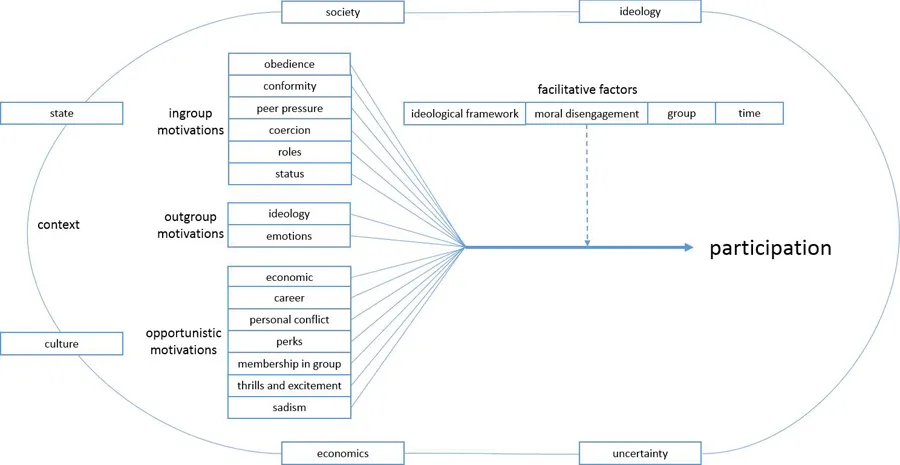
1.1. Schematic representation of the Complexity of Evil model
I will discuss a couple of key concepts in more depth after the model has been introduced, but I mention them now so that the reader has an inkling of the structure of the Complexity of Evil model (see section 1.2 for a deeper discussion of these concepts). I understand the context as the broader environment in which a genocide occurs, and thus it provides the macro-level framework within which the genocide occurs; within this context, I term as the situation the direct environment in which an individual is embedded, the space which he or she actually perceives and with which he or she interacts. To explain people’s motivations for participating, it is pivotal to understand the subjective meaning that these individuals ascribe to the context and the situations they are in: that we can only really understand people when we try to see the world as they see it. Broadly, the context can be located at the macro level, the situation at the meso level, and the individual at the micro level (see Balcells and Justino 2014, 1345). It is the aim of the Complexity of Evil model to bring these levels into interaction with each other in explaining why people participate in genocide.
1.1.1 Motivations
Within this framework for analyzing perpetrator motivations, one can differentiate between three categories of motivations, characterized by the source of the motivation: motivations focused on the ingroup, motivations focused on the outgroup, and opportunistic motivations. This differentiation builds on the concept of ingroups and outgroups as popularized by Henri Tajfel, from whom the scientific community has inherited his social identity theory (Tajfel et al. 1971; Tajfel 1978; Tajfel and Turner 1979; for an overview, see Ellemers and Haslam 2012; see also Dovidio 2013). The basic tenet of social identity theory is that people prefer a positive self-concept to a negative one and that identity is composed of both a personal and a social identity. A social identity is “that part of an individual’s self-concept which derives from his … knowledge of his … membership in a social group (groups) together with the value and emotional significance attached to that membership” (Tajfel 1978, 63; see also Tajfel 1981, 229). People’s sense of self-worth and their self-esteem thus come in part from their social identity—that is, from their group memberships and the evaluation of their ingroups compared with relevant outgroups (Tajfel 1981, 258; see also Schmitt, Branscombe, and Silvia 2000, 1599). In this comparison, individuals focus on the positive distinctiveness for their ingroup, which in turn can result in biased judgments and discriminatory behavior (Tajfel and Turner 1979; see also Cottam et al. 2004, 46).2 Here it is important to emphasize that explicit competition between the groups is not necessary when one uses identities as an explaining factor (Tajfel et al. 1971, 151), contradicting Sherif and Sherif’s (1969) findings of how intergroup conflict can arise from competition over material resources.3 Likewise in Tajfel’s experiments, the groups were split according to absolutely minimal criteria, making the selection nearly arbitrary. Yet, the mere introduction of a dichotomy between an ingroup and an outgroup sufficed in provoking discrimination of the outgroup and favoritism toward the ingroup. Furthermore, the denigration of the outgroup was more important for participants than successes for the ingroup—or put another way, relative gains of the ingroup compared with the outgroup were seen as more important than stronger absolute gains for the ingroup, so participants were prepared to forgo ingroup gains in order to avoid minimal outgroup gains (Tajfel et al. 1971).4
The first category of motivations refers to the ingroup—that is, the group of perpetrators and the social dynamics within it. In an ethnically or racially framed genocide, such as the Holocaust or Rwanda, this would refer to one’s own ethnic group or race, while in Cambodia its definition stops short of the Khmer ethnic group as the ingroup would be constituted only by those deemed loyal to Ângkar. Within this ingroup, the fact that it is a group matters—criminologists acknowledge that of all the factors that influence people in becoming deviant in all sorts of crimes, “the single most important or determinative feature may have been the simple fact that it was committed by a group of individuals acting together” (Warr 2002, 2–3; see also Sémelin 2005a, 241). In this context, different social dynamics within the perpetrator group can impact an individual and motivate him or her to participate in genocide. First, vertical relations between an authority and an individual can motivate people to participate through obedience to an authority’s explicit orders or the desire to conform to the authority’s anticipated desires. Similar dynamics are also apparent with regard to horizontal relations within the group, and individuals can be driven by a desire for conformity with their peers5 in order not to be socially excluded from the group. Further, these peers can also actively apply indirect or direct pressure on the individual to participate. Also, these horizontal and vertical dynamics can be supplemented by the threat or actual use of violence, with this coercion by other members of the group (and the desire to avoid it) providing a strong incentive to participate. Furthermore, taking on a certain role, that of perpetrator, and accepting the values, attitudes, and behavioral norms associated with this role can also provide a motivation for participating in genocide. Finally, the status afforded to someone for participating, the hope of status gain, or the fear of status loss within the ingroup can also motivate some people to participate in genocide.6
The second focus of motivational categories is on the outgroup, which in the genocidal context of this book means the victim group: Jews, Roma, Sinti, homosexuals, and others in the Holocaust, Tutsi in Rwanda, and ethnic minorities and those deemed counterrevolutionary in Cambodia. This group is constructed along specific ideological lines by the perpetrator group. While the individual perpetrator does not necessarily have to share the ideological outlook of the regime under which they live, they will be able to comprehend the ingroup–outgroup division proscribed by the genocidal ideologues. Thus, one should be able to identify who is theoretically a member of the victim group (even if this does not mean, in reality, that one can actually tell which people belong to the group, if no physical differences exist). Not only can the victims be identified, but this outgroup can be the focus of two motivations in the model. The most prominent motivation is a genocidal ideology directed toward the victims. This is the epitome of genocidal motivations given its prominence in media reports and popular discourse, and encompasses rational ideological orientations, ethnic or racial hatred, and any other adherence to a moral framework that stipulates that the eradication of the victim group is desirable and necessary. The second motivation in this category is constituted by various emotions an individual can have toward the victim group, including fear, anger, hatred, resentment, or disgust, which can lead an individual to want to lash out and kill the victims as an emotional reaction to the individual’s situation and perception of the victims.
The third category of motivations is independent of both the ingroup and the outgroup and focuses on opportunistic motivations of the participating individuals. While this does not mean that these motivations are completely decoupled from the social situation in which an individual acts, these motivations are focused on the self of the perpetrator and his or her own self-interest. Most prominently featured among opportunistic motivations are material interests such as the ability to loot or otherwise enrich oneself through participation, the improvement of career prospects, or the chance to settle personal disputes behind the smokescreen of genocidal intent. A further motivation for participating in genocide is sadism, the pleasure that one can gain from the killing of other human beings. The thrill of participating in killing and/or the excitement of committing crimes can also motivate individuals to join genocidal action.
These motivations are discussed in greater depth and incorporate the broad insights of the conceptual and empirical literature, as well as my own fieldwork in Cambodia. Noticeably absent from the Complexity of Evil model are motivations based on emotional development or psychoanalytical explanations (see Baum 2008; Brunner et al. 2011; Hannemann 2011; Pohl 2011; Schelling 2004). The published studies in this field to date fail to present any form of empirical evidence and thus remain as little more than wild stabs in the dark of attempting to explain human behavior in genocidal situations.
1.1.2 Facilitative Factors
These motivations are complemented by what I term facilitative factors, which make participation in genocide easier. Facilitative factors alone would not suffice in making someone participate in...
Table of contents
- Cover
- Series Page
- Title Page
- Copyright
- Dedication
- Contents
- List of Abbreviations
- Introduction
- Vignette I. Chandara: A Fearful Volunteer Enters the Tiger Zone
- Chapter 1. The Complexity of Evil: Introducing the Model
- Vignette II. Sokong: A Coerced Killer with a Conscience
- Chapter 2. Motivations
- Vignette III. Sokphary: A Female Unit Leader with a Sense of Responsibility for Her Subordinates
- Chapter 3. Facilitative Factors
- Vignette IV. Sopheak: An Interrogator Searching to Unearth Enemy Strings
- Chapter 4. Contextual Conditions
- Vignette V. Sokha: A Child Guard the Regime Turned On
- Chapter 5. Diversity, Complexity, Scope: Discussing the Model and Its Empirical Application
- Vignette VI. Ramy: A Garment Worker Participating in the Evacuation of Phnom Penh
- Conclusion
- Appendix: List of Interviewees
- Acknowledgments
- Glossary
- Notes
- References
- Index
- About the Author
Trusted by 375,005 students
Access to over 1.5 million titles for a fair monthly price.
Study more efficiently using our study tools.
Frequently asked questions
Yes, you can cancel anytime from the Subscription tab in your account settings on the Perlego website. Your subscription will stay active until the end of your current billing period. Learn how to cancel your subscription
No, books cannot be downloaded as external files, such as PDFs, for use outside of Perlego. However, you can download books within the Perlego app for offline reading on mobile or tablet. Learn how to download books offline
Perlego offers two plans: Essential and Complete
- Essential is ideal for learners and professionals who enjoy exploring a wide range of subjects. Access the Essential Library with 800,000+ trusted titles and best-sellers across business, personal growth, and the humanities. Includes unlimited reading time and Standard Read Aloud voice.
- Complete: Perfect for advanced learners and researchers needing full, unrestricted access. Unlock 1.5M+ books across hundreds of subjects, including academic and specialized titles. The Complete Plan also includes advanced features like Premium Read Aloud and Research Assistant.
We are an online textbook subscription service, where you can get access to an entire online library for less than the price of a single book per month. With over 1.5 million books across 990+ topics, we’ve got you covered! Learn about our mission
Look out for the read-aloud symbol on your next book to see if you can listen to it. The read-aloud tool reads text aloud for you, highlighting the text as it is being read. You can pause it, speed it up and slow it down. Learn more about Read Aloud
Yes! You can use the Perlego app on both iOS and Android devices to read anytime, anywhere — even offline. Perfect for commutes or when you’re on the go.
Please note we cannot support devices running on iOS 13 and Android 7 or earlier. Learn more about using the app
Please note we cannot support devices running on iOS 13 and Android 7 or earlier. Learn more about using the app
Yes, you can access The Complexity of Evil by Timothy Williams in PDF and/or ePUB format, as well as other popular books in Politics & International Relations & Holocaust History. We have over 1.5 million books available in our catalogue for you to explore.