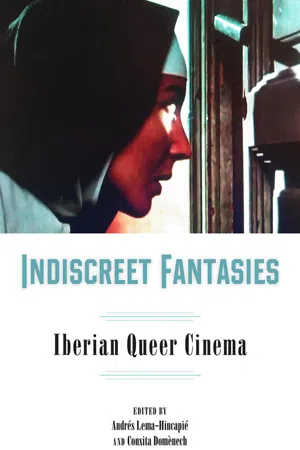
Pedro Almódovar may have helped put queer Iberian cinema on the map, but there are also multitudes of other LGBTQ filmmakers from Catalonia, Portugal, Castile, Galicia, and the Basque Country who have made the Peninsula one of the world's most vital sources for queer film. Together, they have produced a cinema whose expressions of queer desire have challenged the region's conservative religious and family values, while intervening in vital debates about politics, history, and nation. Iberian Queer Cinema is a unique collection that offers in-depth analyses of fifteen different films, each by a different director, produced in the region over the past fifty years, from Narciso Ibáñez Serrador's La residencia ( The House That Screamed, 1970) to João Pedro Rodrigues' O ornitólogo ( The Ornithologist, 2016). Together, they show how queer Iberian cinema has responded to historical traumas ranging from the AIDS crisis to the repressive and homophobic Franco regime. Yet they also explore how these films gesture towards a more fluid understanding of sexuality, gender, and national identity. This book will thus give readers a new appreciation for both the cultural diversity of Iberia and the richness of its moving and thought-provoking queer cinema.Published by Bucknell University Press. Distributed worldwide byRutgers University Press.
- English
- ePUB (mobile friendly)
- Available on iOS & Android
eBook - ePub
About this book
Information
Publisher
Bucknell University PressYear
2020Print ISBN
9781684482467
9781684482474
eBook ISBN
9781684482481
Subtopic
Film & VideoPart I
Into the Realm of Sexual Provocations
1
The Queer Gothic Regime of Narciso Ibáñez Serrador’s La residencia (1969)
ANN DAVIES
Gothic texts have a long and strong association with queer. As William Hughes and Andrew Smith observe: “Gothic has, in a sense, always been queer. The genre, until comparatively recently, has been characteristically perceived in criticism as being poised astride the uneasy cultural boundary that separates the acceptable and familiar from the troubling and different.” They go on to note that “Gothic historically appears to lack the commitment to absolute definitions of identity and substance that arguably characterise … mainstream literatures.”1 Paulina Palmer, for her part, claims that “the spectre and phantom, key signifiers of the uncanny, carry connotations of ‘excess’ since their appearance exceeds the material, and this is another concept that connects the uncanny with ‘queer.’ ”2 Harry Benshoff, writing on queer as a theoretical concept in horror, argues: “Queer can be a narrative moment, or a performance or a stance which negates the oppressive binarisms of the dominant hegemony … both within culture at large, and within texts of horror and fantasy. It is somewhat analogous to the moment of hesitation that demarcates Todorov’s Fantastic, or Freud’s theorization of the Uncanny: queerness disrupts narrative equilibrium and sets in motion a questioning of the status quo, and in many cases within fantastic literature, the nature of reality itself.”3
Now, all narrative deals with the disruption of the status quo that Benshoff posits, and this disruption, whether it be through difficulties over boundaries and demarcation, the denial of binaries, or the possibilities of excess, may result in queerness in the sense of “simply” rendering strange, but it does not automatically entail queer in its more specific connection to sexual preferences, identities, and behaviors. Yet it is this second sense that the critics just mentioned are primarily employing in their definitions of queer Gothic and horror, even as the term “queer” itself proves too slippery to be finally pinned down in this way. Drawing us closer to the specific reasons that horror and Gothic possess such a strong association with queer, Dale Townshend observes that the Gothic—perhaps more than most genres, we might say—offers an explicit challenge to notions of patriarchy on which the status quo appears to rest, by showing patriarchy as corrupt to its core, offering a very particular frisson of fear and pleasure at the disturbance of such a cultural bedrock: “There exists at the limit of law and the paternal metaphor in Gothic writing the phantasm of queer perversion that resists the prohibitive, heteronormalising gestures of the paternal metaphor even as it is defined in relation to them.”4 On the other hand, there may not be a need to dig too deep in order to understand a strong association between queer and the Gothic, given that both have been and to some extent still are treated as entities running contrary to good taste and civilized values. As Hughes and Smith acknowledge, “To condemn Gothic for its perceived ‘bad taste’ is, in essence, to condemn it for acknowledging those very alternatives to monolithic orthodoxy. The endurance of ‘taste’ will always be compromised by the presence of ‘bad taste.’ To be queer in Gothic terms is, in a sense, to know both.”5
Gothic has long had a taint imposed on it arising from its appeal to so-called baser thrills and pleasures, those of sex and violence laced with an ironically comfortable fear, in that a reader or viewer always has the option to retreat to an apparently safer world. Its worrying link to popular culture is made still worse by the “low” emotions it presumes to invoke. It becomes both popular and clandestine in consequence, and its operation at the margins of good taste and good art clearly resonates with the queer identities, behaviors, and preferences that themselves were forced to remain veiled for so long.
A queer Gothic reading of Narciso “Chicho” Ibáñez Serrador’s La residencia (1969) [The House That Screamed] draws on all the conceptualizations of queer Gothic just outlined. La residencia is a Gothic horror film that did remarkably well when it was released in late Francoist Spain and which has done well since. The database of the Spanish government’s Ministerio de Cultura reveals that the film has had nearly 3 million viewers since its release. Only two Spanish horror/fantasy films have outsold it, Alejandro Amenábar’s The Others (2001) and J. A. Bayona’s El orfanato (2007) [The Orphanage]. It is notable, indeed, how many horror and fantasy films, now canonized and/or the object of sustained critical attention, have gained fewer viewers than La residencia (selected figures are presented in table 1.1).
Table 1.1
Viewing figures for selected horror and fantasy films
| Title | Number of Viewers | |
|---|---|---|
| The Others | 6,233,389 | |
| El orfanato [The Orphanage] | 4,419,880 | |
| La residencia | 2,924,805 | |
| El laberinto del fauno [Pan’s Labyrinth] | 1,681,027 | |
| [REC] | 1,426,688 | |
| El día de la bestia [The Day of the Beast] | 1,416,712 | |
| Tesis [Thesis] | 854,735 | |
| El espinazo del diablo [The Devil’s Backbone] | 705,290 | |
| SOURCE: Víctor Matellano, Spanish Horror (Madrid: Ayuntamiento de Talamanca de Jarama, 2009), 110–111. | ||
That La residencia has attracted nearly double the number of viewers as Guillermo del Toro’s El laberinto del fauno (2006) [Pan’s Labyrinth] is particularly noteworthy given that the latter became very much an event film from an internationally known director, as well as the subject of much critical attention from both film critics and academics. The neglect of La residencia is, however, hardly surprising, though Ibáñez Serrador’s cult status in Spain then and now, as mastermind and quirky presenter of the popular TV series Historias para no dormir, suggests that it is not the result of a director’s low profile. The general lack of critical interest in such a successful film, however, merely echoes the critical disdain for the film within Spain as outlined by Antonio Lázaro-Reboll,6 one of the few scholars to pay La residencia any detailed critical attention. Most critics of the time did not find horror artistic enough to warrant critical respect, seeing it as by and large a formulaic vehicle in bad taste, in which Ibáñez Serrador shows no aptitude for the auteurism, the personal vision of the world, that was a crucial attribute for film critics at the time the film was released. For more recent critics who specialize in the horror genre, the place of La residencia in the history of Spanish horror is now assured. For Carlos Aguilar, this film and La noche de Walpurgis (León Klimovsky, 1971) [The Werewolf versus the Vampire Woman] form the two key successes that impelled a new surge in horror filmmaking in the last days of the Francisco Franco dictatorship,7 and La residencia duly features in histories of Spanish horror. More general histories of Spanish cinema do not, however, recognize this. The classic volume on Spanish cinema history by Román Gubern et al. does not mention the film or its director, nor does Vicente J. Benet’s recent historical overview. José María Caparrós Lera namechecks the film in his statistical appendixes but does not treat it as part of his main history. Anglophone equivalents such as Alberto Mira, Núria Triana-Toribio, or Marsha Kinder do not mention the film or director either, even though the latter’s emphasis on violence, sexual repression, and subversion could well have found room for such a film. The reasons for exclusion are not hard to find in the awkward chronological placing of the film at the tail end of the Franco era, when subversion of cultural ideologies emphasized realism and seem far removed from horror formulas; the high valuation given to such filmmakers as Amenábar and Bayona was never a possibility at the time of La residencia’s release, despite Ibáñez Serrador’s use of what were high-quality production values in that era.
Nonetheless, subversive La residencia is, in many ways, despite its critical neglect, and much of this derives from the fact that it deals with motifs and concepts of lesbianism and queerness. Alejandro Melero, in his survey of gay and lesbian representation in Francoist film, notes a significant convergence between the explicit (for the time) representation of the lesbian on the Spanish screen and the surge in popular horror filmmaking of which La residencia formed a crucial part: “The discreet presence of the lesbian in cinema prior to the 70s parallels horror’s lack of popularity as a film genre and confirms the extreme link between lesbianism and horror. To put it another way: in cinema, lesbians ceased to be an exception when, at the end of the 60s, horror ceased to be exceptional as well.”8
We can observe from this that La residencia forms an integral part of alternative cinema histories but not of mainstream ones. As Hughes and Smith commented earlier in regard to queer Gothic, La residencia is condemned as in bad taste precisely because it demonstrates the possibility of alternative cinema histories that nonetheless do not chime with the good-taste canon derived from the political auteurism lauded by the Spanish critics of the time and to some extent enshrined in mainstream histories since.
The plot of La residencia is based around a boarding school for young ladies with a shady or tainted background, presided over by Madame Fourneau (Lilli Palmer): the girls’ school is, as Benshoff notes, a familiar motif of lesbianism,9 which would allow for easy assumptions of the formulaic on the part of skeptical critics. Into this school arrives the ingenue Teresa (Cristina Galbó), accompanied by a middle-aged man who declares himself to be a friend of her mother, a cabaret singer. He is probably her father but may perhaps be her mother’s new lover, eager to be rid of the encumbrance of the daughter. From the very beginning, Teresa observes strange sounds and movements that suggest something mysterious and sinister is going on in the house. Madame Fourneau affects not to notice anything wrong but later accuses her own son Luis (John Moulder Brown) of roaming too freely around the school and risking contamination through encounters with the dubious young women under her charge: she wants him to save himself for a woman just like herself, his mother. She appears to be too late on that score: Luis has already arranged an assignation with another stude...
Table of contents
- Cover
- Series Page
- Title Page
- Copyright
- Dedication
- Contents
- Introduction
- Part I: Into the Realm of Sexual Provocations
- Part II: Queer Intimacy: Within the Household
- Part III: Queering Iberian Politics
- Part IV: Queer Catalonia: Destroying Essential Representations
- Part V: Burning Counterpoints with Religiosity
- Acknowledgments
- Filmography
- Bibliography
- Notes on Contributors
- Index
Trusted by 375,005 students
Access to over 1.5 million titles for a fair monthly price.
Study more efficiently using our study tools.
Frequently asked questions
Yes, you can cancel anytime from the Subscription tab in your account settings on the Perlego website. Your subscription will stay active until the end of your current billing period. Learn how to cancel your subscription
No, books cannot be downloaded as external files, such as PDFs, for use outside of Perlego. However, you can download books within the Perlego app for offline reading on mobile or tablet. Learn how to download books offline
Perlego offers two plans: Essential and Complete
- Essential is ideal for learners and professionals who enjoy exploring a wide range of subjects. Access the Essential Library with 800,000+ trusted titles and best-sellers across business, personal growth, and the humanities. Includes unlimited reading time and Standard Read Aloud voice.
- Complete: Perfect for advanced learners and researchers needing full, unrestricted access. Unlock 1.5M+ books across hundreds of subjects, including academic and specialized titles. The Complete Plan also includes advanced features like Premium Read Aloud and Research Assistant.
We are an online textbook subscription service, where you can get access to an entire online library for less than the price of a single book per month. With over 1.5 million books across 990+ topics, we’ve got you covered! Learn about our mission
Look out for the read-aloud symbol on your next book to see if you can listen to it. The read-aloud tool reads text aloud for you, highlighting the text as it is being read. You can pause it, speed it up and slow it down. Learn more about Read Aloud
Yes! You can use the Perlego app on both iOS and Android devices to read anytime, anywhere — even offline. Perfect for commutes or when you’re on the go.
Please note we cannot support devices running on iOS 13 and Android 7 or earlier. Learn more about using the app
Please note we cannot support devices running on iOS 13 and Android 7 or earlier. Learn more about using the app
Yes, you can access Indiscreet Fantasies by Andrés Lema-Hincapié,Conxita Domènech in PDF and/or ePUB format, as well as other popular books in Media & Performing Arts & Film & Video. We have over 1.5 million books available in our catalogue for you to explore.