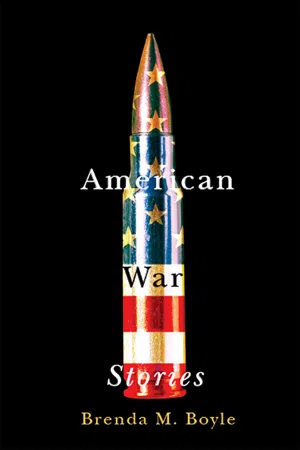
American War Stories asks readers to contemplate what traditionally constitutes a "war story" and how that constitution obscures the normalization of militarism in American culture. The book claims the traditionally narrow scope of "war story," as by a combatant about his wartime experience, compartmentalizes war, casting armed violence as distinct from everyday American life.Broadening "war story" beyond the specific genres of war narratives such as "war films," "war fiction," or "war memoirs," American War Stories exposes how ingrained militarism is in everyday American life, a condition that challenges the very democratic principles the United States is touted as exemplifying.
- English
- ePUB (mobile friendly)
- Available on iOS & Android
eBook - ePub
American War Stories
About this book
Information
Publisher
Rutgers University PressYear
2020Print ISBN
9781978807587
9781978807594
eBook ISBN
9781978807600
Topic
HistoriaSubtopic
Historia militar y marítima1
State of Crisis
Stories of American Exceptionalism, the French, and Masculinities in Vietnam
Why is “1959” on the Wall? I thought the war started in 1965.
The Americans took over from the French.
—Overheard at the Vietnam Veterans Memorial, fall 2017
The question and answer above illustrate a well-worn war story among Americans: the American war in Vietnam began with the commitment of Marine combat units at Da Nang in March 1965. Not only is the period between 1965 and “the French” elided in this story, but so is the American war’s origins.1 Because it did not begin with a declaration of war, its origin is more a process, a series of starts rather than a fixed point in time.2 Yet as Mary L. Dudziak points out in Wartime, distinguishing between the times of war and peace is essential, not only in regard to what service medals can be won and what kind of civil rights can be exercised, but also as war and peace times pertain to law.3 Did the American war begin during World War II, with the Office of Strategic Services (OSS) arming the Viet Minh to counter the Japanese occupying Vietnam? Did it begin immediately after World War II, with the United States’ ambivalence about intervening in France’s war to recolonize Vietnam? Did it begin with the assignment of American military advisors, first in 1950 by President Truman and then in 1961 by President Kennedy? Did it begin after 1950 and the advent of the Cold War, with the United States funding 80 percent of France’s war against the Viet Minh? Did it begin with the bombing of North Vietnam in 1964? Or did it begin in the 1920s as a rescue story, with Hollywood films depicting Vietnamese people as primitive children who needed salvation? The story that the American war began in 1965 prevails, quietening other stories and obscuring the preceding decades of involvement by the United States in Vietnam, as it offers a definitive point in time that absolves—or erases—all potential sins committed previously.4 This erasure relies on the first of the five American core values discussed in this book: exceptionalism. It maintains that the United States is virtuously and uniquely motivated among nations in all of its foreign commitments and hence is immune to the forces of history.5 Consequently, the United States could, with its matchlessly good intents, achieve in Vietnam what no other external nation—China, France, Japan, Cambodia—was able to accomplish. “The Americans took over from the French” denotes the unique competence of the Americans and the predictable incompetence of the French.
In “Making Sense of the French War,” Mark Philip Bradley argues that stories told about the French and American wars in Indochina are more complex than the typical story of the Cold War’s inevitable appearance in Vietnam, of the French duty to combat communism in Vietnam and, flummoxed by the task, being relieved of the burden by the more virtuous and competent United States.6 Instead, Bradley asserts, to tell the stories of this war era in Vietnam, history should extend its scope beyond the relations between French or Americans with Vietnamese to examine the convoluted web of geopolitical relations among Western allies, and it also should use “novel interpretive frameworks” to decipher those relations (19).7 This chapter takes both suggestions seriously, the extension and the novelty, exploring as it does diplomatic relations between the French and the Americans in Vietnam, through 1946 and into 1947, what memoirist Duong Van Mai Elliott calls “the watershed years” (Elliott xiii) and what, in his book’s subtitle, historian Stein Tønnesson terms the French war’s beginnings. This chapter also is guided by Christopher Goscha’s regret about the abundant scholarship on the few years in the late-1950s and early 1960s leading to the 1965 American commitment of combat units in Vietnam, and the comparative dearth on the time leading to the French war (Goscha xi). Specifically, it examines American consular efforts to establish a United States Information Services (USIS) reading room in Saigon during 1946 and 1947, a period of mounting tensions between France and the Democratic Republic of Vietnam (DRV) but more importantly for this chapter, between the two Western allies. According to American archival documents, the reading room—including its physical space, its contents, its staff, and its operating principles—threatened the recolonizing French, as the uncensored availability of books and other reading materials to “Annamites” and Europeans both were perceived by French authorities as censuring them. With analyses of archival documents, both mine and other authors’, this chapter uncovers disputes between the French and Americans founded in contending versions of masculinities, versions that might have impacted French or American influence on Vietnamese people but also might have led the United States to deploy itself as an exception to history and into thinking its exceptionalism could accomplish what the French were unable to do. This gendered and geopolitical “state of crisis” is one of many stories obscured by the story of how “the [exceptional] Americans took over from the [unexceptional] French.”
Some Obscured Stories
THE UNITED STATES DID NOT CONDEMN COLONIALISM
One obscured account is the United States’ ambivalence about supporting France’s recolonization of Vietnam after World War II, despite American principles favoring national sovereignty. Through action and inaction, following World War II the United States was implicated in Vietnam’s quest for independence and complicit in France’s repudiation of that quest. Although the United States supported the self-determination of all nations outlined in the Atlantic Charter of 1941, and sustained Viet Minh resistance to Japanese occupation during World War II, after World War II it did not explicitly advocate Vietnam’s independence. This inaction might have been to assure France of U.S. support as it tried to recover economically and politically from World War II, or it might have been that the United States needed France’s cooperation to build a bulwark in Western Europe—the North Atlantic Treaty Organization (NATO)—against the Soviet Union. Most importantly in this story, the United States did not disapprove of colonialism per se; it only disapproved of how France had conducted its version in Vietnam for nearly a century.8 Belief in American exceptionalism led many American officials to think the United States could perform colonialism well, having demonstrated so in the Philippines.
AMERICAN HUBRIS LED TO THE AMERICAN WAR
Such American hubris may have led the United States, first, to militarily and financially support the French war in Vietnam, and second, to enter into direct conflict a decade after the French withdrew. Two scholars draw this connection and tell this story of American overconfidence. In “Chronicle of a War Foretold: The United States and Vietnam, 1945–1954,” Andrew J. Rotter outlines eight attitudes during the French war that were replicated in the 1965–1973 American war. These include cultural ignorance and racial condescension toward the Vietnamese (284); certainty that Vietnam was a proxy for the communist Soviet Union, and China after 1949 (287); certainty that Asians were interchangeable, so war against Vietnamese would be identical to war against Koreans (295); belief that Vietnamese nationalism was malleable and easily could be overlaid with American liberal capitalism (298); and concern that American credibility was at stake (302). U.S. foreign policy decision-makers, Rotter concludes, “failed to heed the warnings” of the French war when they opted to take the U.S. to war in Vietnam (306). Mark Philip Bradley tells a similar story when he traces American discourses about French Indochina and the Vietnamese in “Slouching toward Bethlehem: Culture, Diplomacy, and the Origins of the Cold War in Vietnam.” Bradley enumerates three discursive eras—the interwar period, World War II, and the Cold War—to investigate the “language and rhetoric by which policy makers framed their choices,” frames learned by Americans from the French (13). In close readings of these temporal discourses, he identifies orientalist tropes in all three: “Annamites” are lazy, primitive liars who only can imitate, not initiate, and as a consequence are susceptible to the influences of bad others, even in terms of nationalism. The Americans, Bradley explains, were certain that all but Americans were bad influences, so it was the obligation of the United States to rescue the Vietnamese, whether by supporting the French war or by direct conflict.
THE UNITED STATES AND FRANCE DISPARAGED VIETNAMESE MASCULINITIES
Other mostly unheard stories intimate the French and American wars were largely motivated or facilitated by gendered views of the Vietnamese. As suggested both by Rotter and Bradley, French and Americans cast the Vietnamese as childlike and the Westerners as rescuing patriarchs who could teach the Vietnamese how to live properly. Frank Proschan outlines how the colonial French found the male and female Vietnamese bodies gender-illegible, producing “colonizing discourses” that warranted the French mastery of people who had not followed (presumably universal) gender presentations. These gender prejudices, Proschan contends, are the “intellectual ground on which the colonial enterprise itself was founded and pursued” (458). Scott Laderman notes in his essay about pre-American-war Hollywood films set in Vietnam that these films cast the childlike, impressionable Vietnamese as exploited by communists and as needing proper “tutelage and instruction,” a depiction “leaving [exceptional] Americans with a solemn obligation to aid in their rescue” (578, 607). Furthermore, both orientalizing French and Americans saw Vietnamese men as unmanly, thereby simultaneously sowing doubt about the abilities of Vietnamese men to be warriors and statesmen, while also normalizing their own Western manliness (Bradley, Imagining 48–49). During the American war, President Johnson was notorious for casting the Viet Cong (VC) and the North Vietnamese Army (NVA) as not manly and the war as a contest for male virility. Rotter cites Johnson’s fear of losing the Vietnam War to “an enemy whom Johnson scorned as sneaky, treacherous, and otherwise effeminate” (302). Jonathan Nashel cites LBJ’s going one step further when he crows in his 1971 memoir, “I didn’t just screw Ho Chi Minh, I cut his pecker off” (141).9
THE AMERICANS THOUGHT THEY WERE MORE PROPER PATRIARCHS
Clearly, both French and Americans were motivated to war by orientalist predilections toward Vietnamese people. However, though both regarded colonialism through a gendered lens, thereby deeming their role in Vietnam as patriarchal, neither trusted the other to perform that fatherly role appropriately. As for the Americans, during World War II President Roosevelt “judged the French to be ‘poor colonizers’ who had ‘badly mismanaged’ Indochina and exploited its people” (Cain 3). As for the French, near the end of their war they sought to negotiate a settlement with the Viet Minh that would “free them from the Chinese without putting them into the hands of the Americans” (Dalloz 169), who had both a “mania for cleanliness” (144) and, according to the Chinese, a puritan strain (Patti 34). This faith in colonialism but refusal of each ally to trust in the other’s version heightened the tension with the Vietnamese and between the two Western allies. What follows is an exploration of the two latter groups vying for dominance, a competition that reveals not only their different geopolitical attitudes but also, and more importantly for this chapter, their variant versions of masculinity.
Gender as a Factor in Foreign Relations
In “Gender Relations, Foreign Relations: The United States and South Asia, 1947–1964,” Andrew Rotter suggests that though gender is not commonly explored in the history of U.S. foreign relations, it ought to be. Gender is, he says, “a transnational process,” and so “nations and the people who constitute them become gendered [by other nations], and this affects the policies that other nations pursue toward them” (521). Gender does not always call attention to itself in such interactions, however, so researchers—in an echo of Cynthia Enloe’s call for reading differently—need to “look for odd things in the documents: stray remarks about personal style or gesture, comments about a people’s alleged ‘emotionalism,’ or ‘effeminacy,’ and even references to the kinds of parties American hosts put on for their … guests.” Rotter continues: “What would seem a collection of marginalia to most diplomatic historians becomes a treasure trove of information demanding thick description to someone interested in culture” (522). Deploying a gender lens as one of Mark Philip Bradley’s “novel interpretive frameworks” enables the detection and parsing of obscured stories about Western engagement in Vietnam, especially those stories revealing, according to Rotter, how “gender inspired imperialism, allowed it to grow, and justified its frequently torturous evolution” (526). While the colonial context in Vietnam already is gendered through orientalizing discourses that clarify colonialism’s masculinist quality, positioning the colonizer as dominant and the colonized as dominated, the particular context in Vietnam requires a more nuanced approach, as at least two Western countries—France and the United States—fought to master the Vietnamese, and in that competition, to determine who would dominate and who would be subordinated. The rest of this chapter tells the story of the two Western masters competing to dominate. Elements of the story include a theoretical undergirding, or “schematic,” the American and French histories of masculinities, and diplomatic relations between the two allies once in Vietnam.
R. W. Connell and J. Messerschmidt’s gender schematic for homosocial groups within patriarchy offers a “novel interpretive framework” for comprehending the “odd things” occurring between American and French diplomats in Vietnam. Unlike other gender theories that distinguish between women and men or focus on women alone, Connell and Messerschmidt’s provides a method to differentiate among men. Starting with the premise that gender is a cultural construct and so is responsive to and reflective of local culture, Connell and Messerschmidt posit that though there is no transcendental signifier, no single masculinity crossing time and culture, nor is masculinity a performance limited to male bodies, masculinity’s enactments in any given culture can be broken into a hierarchy of four modes: hegemonic, subordinate, marginal, and complicit. The hegemonic mode is dominant though culture-specific; because a hegemonic masculinity is deemed dominant in one culture or subculture does not guarantee it will be deemed dominant in another. Second to hegemonic masculinity is subordinate, the mode of masculinity that is actively subordinated by the hegemon. Although less dominant, the subordinate mode mimics and approximates the hegemonic. Given another culture, it might be seen to occupy one of the other three modes. Third in the hierarchy of masculine modes is marginalized. It performs a masculinity that does not approximate the hegemonic mode and so is marginalized both by people in the hegemonic and subordinated modes. Connell and Messerschmidt’s fourth mode, complicit, refers to people who do not perform or value dominance but reap benefits from the hierarchy nonetheless. All of these positions are in relation to one another, shifting across cultures and history. Whomever is in the hegemonic position determines, momentarily anyway, who is in the other categories.
A crucial component of this hierarchical model is that none of these positions are stable or fixed, responsive as they are to culture. Because of this insecurity, the positions require constant maintenance. In Connell and Messerschmidt’s interpretive framework, consequently, rather than crisis being an unusual or isolated condition for masculinity, masculinity is by definition a state of crisis. The compulsion to identify one inexorable form of masculinity within patriarchy, a single script that transcends time and culture, is at the heart of this crisis, as people—mostly men—vie to cement their dominance and thereby gain the perquisite to subordinate and marginalize. In effect, those who occupy the hegemonic position, however temporarily, not only have the power to subordinate and marginalize, but they also have the power to determine, at least provisionally, what is “masculine.” In this story of Vietnam, the French and Americans, already having tacitly agreed via orientalizing to marginalize the Vietnamese, compete in the state of crisis to assume the definer’s hegemonically masculine position. The evidence suggests that the Americans ...
Table of contents
- Cover
- Series Page
- Title Page
- Copyright
- Dedication
- Contents
- Introduction: American War Stories since World War II
- 1. State of Crisis: Stories of American Exceptionalism, the French, and Masculinities in Vietnam
- 2. Staging War: Stories of Collectivity at, by, and through the Vietnam Veterans Memorial
- 3. Lone Wolf Family Man: Stories of Individualism and Collectivism in American Sniper(s) and Lone Survivor(s)
- 4. Military Judgment in a Neoliberal Age: Stories of Egalitarianism and the All-Volunteer Force
- 5. The Soldier’s Creed: Stories of Warrior Patriotism in Visual Culture
- Coda: Prices Paid for the War Stories We Tell
- Acknowledgments
- Notes
- Works Cited
- Index
- About the Author
Trusted by 375,005 students
Access to over 1.5 million titles for a fair monthly price.
Study more efficiently using our study tools.
Frequently asked questions
Yes, you can cancel anytime from the Subscription tab in your account settings on the Perlego website. Your subscription will stay active until the end of your current billing period. Learn how to cancel your subscription
No, books cannot be downloaded as external files, such as PDFs, for use outside of Perlego. However, you can download books within the Perlego app for offline reading on mobile or tablet. Learn how to download books offline
Perlego offers two plans: Essential and Complete
- Essential is ideal for learners and professionals who enjoy exploring a wide range of subjects. Access the Essential Library with 800,000+ trusted titles and best-sellers across business, personal growth, and the humanities. Includes unlimited reading time and Standard Read Aloud voice.
- Complete: Perfect for advanced learners and researchers needing full, unrestricted access. Unlock 1.5M+ books across hundreds of subjects, including academic and specialized titles. The Complete Plan also includes advanced features like Premium Read Aloud and Research Assistant.
We are an online textbook subscription service, where you can get access to an entire online library for less than the price of a single book per month. With over 1.5 million books across 990+ topics, we’ve got you covered! Learn about our mission
Look out for the read-aloud symbol on your next book to see if you can listen to it. The read-aloud tool reads text aloud for you, highlighting the text as it is being read. You can pause it, speed it up and slow it down. Learn more about Read Aloud
Yes! You can use the Perlego app on both iOS and Android devices to read anytime, anywhere — even offline. Perfect for commutes or when you’re on the go.
Please note we cannot support devices running on iOS 13 and Android 7 or earlier. Learn more about using the app
Please note we cannot support devices running on iOS 13 and Android 7 or earlier. Learn more about using the app
Yes, you can access American War Stories by Brenda M. Boyle in PDF and/or ePUB format, as well as other popular books in Historia & Historia militar y marítima. We have over 1.5 million books available in our catalogue for you to explore.