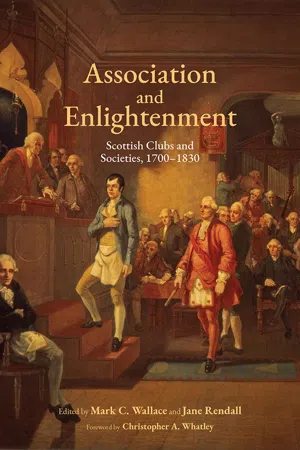
Social clubs as they existed in eighteenth- and early nineteenth-century Scotland were varied: they could be convivial, sporting, or scholarly, or they could be a significant and dynamic social force, committed to improvement and national regeneration as well as to sociability. The essays in this volume—the first full-length study of the subject in fifty years—examine the complex history of clubs and societies in Scotland from 1700 to 1830. Contributors address attitudes toward associations, their meeting-places and rituals, their links with the growth of the professions and with literary culture, and the ways in which they were structured by both class and gender. By widening the context in which clubs and societies are set, this volume offers a new framework for understanding them, bringing together the inheritance of the Scottish past, the unique and cohesive polite culture of the Scottish Enlightenment, and the broader context of associational patterns common to Britain, Ireland, and beyond.
eBook - ePub
Association and Enlightenment
Scottish Clubs and Societies, 1700-1830
- English
- ePUB (mobile friendly)
- Available on iOS & Android
eBook - ePub
About this book
Information
Publisher
Bucknell University PressYear
2020Print ISBN
9781684482665
9781684482672
eBook ISBN
9781684482689
PART I
The Theory and Practice of Associational Life
CHAPTER 1
Politeness, Sociability, and the “Little Platoon”
ASSOCIATIONAL THEORY IN THE SCOTTISH ENLIGHTENMENT
David Allan
It is clear that the Scottish Enlightenment formed an integral part of what Peter Clark has described in the subtitle of his British Clubs and Societies, 1580‒1800 (2000) as “an Associational World.” Indeed, in the wake of Davis D. McElroy’s pathbreaking survey in his PhD dissertation more than sixty-five years ago, followed by the shorter work he later published from it, the importance of clubs and societies in eighteenth-century Scotland now appears beyond dispute.1 The significance of this development, however, was appreciated even at the time. John Ramsay of Ochtertyre, for example, the advocate and Stirlingshire laird who lived through the second half of the century, argued that what he called “literary societies” had actually been one of the period’s most salient features: “Soon after the extinction of the rebellion of 1715, a number of promising young men began to distinguish themselves in science or polite literature. In order to improve themselves and counteract conceit, which is never more apt to spring up than in rich minds unaccustomed to contradiction, societies were instituted wherein at stated times, literary subjects were canvassed with freedom and impartiality: ingenious paradoxes were started and assailed with equal ingenuity.”2 Another articulate witness, the lawyer Henry Cockburn, likewise recalled the extraordinary enthusiasm for membership of extracurricular debating societies that had gripped his fellow Edinburgh undergraduates toward the close of the century—even labeling the entire era, as a consequence, “a discussing age.”3 In just one of those organizations, the Academical Society (1796), Cockburn added wistfully, “There were more essays read, and more speeches delivered, by ambitious lads, in that little shabby place, than in all Scotland.”
The striking cultural phenomenon recalled so fondly by both Ramsay and Cockburn evidently not only was prevalent in eighteenth-century Scotland but also ranged in ostensible focus across the full spectrum of contemporary endeavors, from the unashamedly recreational, like the Nine Tumbler Club at St. Andrews, to the ambitiously educative, such as the Edinburgh students’ Newtonian Club (1778)—to say nothing of prestigious intellectual institutions in the capital, patronized and promoted by the intelligentsia and the social elite, such as the Select Society (1754) and the Philosophical Society (1737).4 It should therefore be no surprise that when radical politics erupted in Scotland in the 1780s, associationalism was again a crucial mechanism for mediating ideological energies. Edmund Burke certainly noticed this development in Reflections upon the Revolution in France (1790), quipping that the French revolutionaries would be heartened by the support they had received from one voluntary institution in particular:
Let them rejoice in the applauses of the club at Dundee, for their wisdom and patriotism in having thus applied the plunder of the citizens to the service of the state. I hear of no address upon this subject from the directors of the Bank of England; though their approbation would be of a little more weight in the scale of credit than that of the club at Dundee. But, to do justice to the club, I believe the gentlemen who compose it to be wiser than they appear; that they will be less liberal of their money than of their addresses; and that they would not give a dog’s-ear of their most rumpled and ragged Scotch paper for twenty of your fairest assignats.5
The target of Burke’s invective was the Whig Club of Dundee, which, founded in 1789 by George Dempster, the local MP, had issued a congratulatory address to the French National Assembly on 4 June 1790.6 Yet this organization was not alone in embodying eager Scottish clubbishness in this most assertively political of forms. By the last two decades of the century there were voluntary membership-based organizations aplenty active in the cause of constitutional change—associational bodies like the numerous corresponding societies, the Association for the Abolition of Patronage and a Repeal of the Test and Corporation Statutes (c. 1791–1792), the Society of the Friends of the People (1792), and eventually, at the revolutionary end of the spectrum, the secretive and insurrectionary Society of United Scotsmen (1797).7
ADDISON AND THE ASSOCIATIONAL IMPERATIVE
Involvement in clubs, then, was impressively broad as well as deep in eighteenth-century Scotland: a rich and diverse “associational world” clearly prospered north of the border. But when had this habit first emerged among the Scots and for what reasons? On this too we have the shrewd testimony of Ramsay of Ochtertyre. As we have already seen, he thought it had probably begun with the “literary societies” that had emerged in the early years after the Union. His analysis, however, went somewhat further, portraying the rise of organized sociability as part of a broader cultural revolution underway after 1707, a process traceable in his view to new intellectual influences entering the country from the south. In particular, Ramsay considered it crucial that “the ‘Tatlers,’ ‘Spectators,’ and ‘Guardians’ made their appearance in the reign of Queen Anne. These periodical papers had a prodigious run all over the three kingdoms, having done more to diffuse true taste than all the writers, sprightly or serious, that had gone before them. Nothing, indeed, could be better calculated to please the fancy, inform the judgment, and mend the hearts of readers of all descriptions.… Those admirable papers prepared the minds of our countrymen for the study of the best English authors, without a competent knowledge of which no man was accounted a polite scholar.”8 In other words, it was the rapid absorption of polite literature, epitomized by Joseph Addison and Richard Steele’s The Spectator in 1711–1712, that had initially been critical. For Addison’s writing more than anything else had promoted the benefits of associationalism in Scotland, popularizing a cultural practice that simultaneously gave vent to eternal human impulses and helped manufacture a new kind of personality—emollient, sociable, rational, tolerant—best suited to existence in a modern society defined increasingly (or so progressive Whigs like Addison earnestly hoped) by its greater political stability, its growing material prosperity, and its expanding individual freedom.
Importantly, Addison’s manifesto for associationalism as a mechanism for achieving modernization both for the individual and for wider society was nested within a coherent Lockean account of human nature as by instinct and aptitude fundamentally social. As the ninth number of The Spectator formulated this classic Addisonian dictum, “Man is said to be a Sociable Animal, and, as an Instance of it, we may observe, that we take all Occasions and Pretences of forming ourselves into those little Nocturnal Assemblies, which are commonly known by the name of Clubs.”9 Addison’s analysis also displayed a keen understanding of how such institutions were suited to a considerable variety of outlooks and personalities, accommodating and even celebrating diversity rather than allowing it to become an impediment to fruitful interpersonal engagement: “Our Modern celebrated Clubs are founded upon Eating and Drinking, which are Points wherein most Men agree, and in which the Learned and Illiterate, the Dull and the Airy, the Philosopher and the Buffoon, can all of them bear a Part. The Kit-Cat itself is said to have taken its Original from a Mutton-Pye. The Beef-Steak and October Clubs, are neither of them averse to Eating and Drinking, if we may form a Judgment of them from their respective Titles.”10 It followed for Addison that the gregarious inclusivity—indeed the boisterous excess—which characterized the internal life of so many clubs and societies also served recognizably ideological purposes. For it forged bonds of amity and mutual understanding that bound people together. It leveled out potential obstacles to peace between disparate individuals which might otherwise have triggered disagreement and provoked open hostility in the community at large. As Addison asserted, “When Men are thus knit together, by Love of Society, not a Spirit of Faction, and don’t meet to censure or annoy those that are absent, but to enjoy one another; When they are thus combined for their own Improvement, or for the Good of others, or at least to relax themselves from the Business of the Day, by an innocent and chearful Conversation, there may be something very useful in these little Institutions and Establishments.”11 According to Addison, then, the reinforcement of people’s inherent sociable tendencies through voluntary participation in social organizations was essential precisely because it held out the promise of successfully narrowing political divisions and creating greater cohesion throughout society.
These were the much broader purposes for associationalism, which, promoted shortly after the turn of the eighteenth century and in the wake of a turbulent hundred years of religious argument and revolutionary upheaval across the British Isles, appeared so utterly beguiling to so many of Addison’s contemporaries. As he later said elsewhere, in the pages of The Freeholder (1715–1716), a publication that reinforced many of the trademark arguments for clubbability first aired in The Spectator, “It would therefore be for the Benefit of every Society, that is disturbed by contending Factions, to encourage such innocent Amusements as may thus disembitter the Minds of Men, and make them mutually rejoice in the same agreeable Satisfactions. When People are accustomed to sit together with Pleasure, it is a Step towards Reconciliation.”12 It was disembitterment—to adapt Addison’s apt neologism—that sociability, cultivated through willing engagement in clubs, seemed best placed to facilitate. This would finally teach people, particularly those Britons most eager to turn their backs on the disagreement and turmoil of the previous century, how to live together in relative tranquility. Ultimately, it would help prevent a repetition of the chronic disturbances that differences of opinion and diversity of belief, when allowed to manifest themselves only in partisanship and intolerance, had so recently engendered.
We do not, of course, need to take Ramsay’s word that Addison’s prescription for pacifying and civilizing modern people in ...
Table of contents
- Cover
- Series Page
- Title Page
- Copyright
- Contents
- Foreword
- Abbreviations
- Introduction
- Part I: The Theory and Practice of Associational Life
- Part II: Professional Men and Their Societies
- Part III: Clubs, Societies, and Literary Culture
- Part IV: Gender and Associational Culture
- Acknowledgments
- Bibliography
- Notes on Contributors
- Index
Trusted by 375,005 students
Access to over 1.5 million titles for a fair monthly price.
Study more efficiently using our study tools.
Frequently asked questions
Yes, you can cancel anytime from the Subscription tab in your account settings on the Perlego website. Your subscription will stay active until the end of your current billing period. Learn how to cancel your subscription
No, books cannot be downloaded as external files, such as PDFs, for use outside of Perlego. However, you can download books within the Perlego app for offline reading on mobile or tablet. Learn how to download books offline
Perlego offers two plans: Essential and Complete
- Essential is ideal for learners and professionals who enjoy exploring a wide range of subjects. Access the Essential Library with 800,000+ trusted titles and best-sellers across business, personal growth, and the humanities. Includes unlimited reading time and Standard Read Aloud voice.
- Complete: Perfect for advanced learners and researchers needing full, unrestricted access. Unlock 1.5M+ books across hundreds of subjects, including academic and specialized titles. The Complete Plan also includes advanced features like Premium Read Aloud and Research Assistant.
We are an online textbook subscription service, where you can get access to an entire online library for less than the price of a single book per month. With over 1.5 million books across 990+ topics, we’ve got you covered! Learn about our mission
Look out for the read-aloud symbol on your next book to see if you can listen to it. The read-aloud tool reads text aloud for you, highlighting the text as it is being read. You can pause it, speed it up and slow it down. Learn more about Read Aloud
Yes! You can use the Perlego app on both iOS and Android devices to read anytime, anywhere — even offline. Perfect for commutes or when you’re on the go.
Please note we cannot support devices running on iOS 13 and Android 7 or earlier. Learn more about using the app
Please note we cannot support devices running on iOS 13 and Android 7 or earlier. Learn more about using the app
Yes, you can access Association and Enlightenment by Mark C. Wallace,Jane Rendall in PDF and/or ePUB format, as well as other popular books in History & Early Modern History. We have over 1.5 million books available in our catalogue for you to explore.