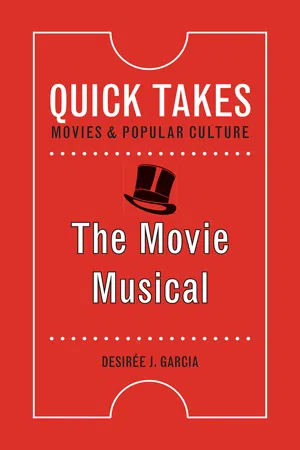
The movie musical is often regarded as a classic Hollywood genre whose heyday was long in the past. In reality, however, musicals remain a vital part of both Hollywood and world cinema, and the genre continues to evolve in fascinating ways.Spotlighting iconic musicals like Singin' in the Rain and La La Land alongside smaller films like La Bamba, Once, and Dancer in the Dark, this book demonstrates the flexibility and durability of the genre, as it takes steps to preserve its relevance for new generations and new cultures. Putting Asian and European movie musicals in conversation with their Hollywood counterparts, it examines how the genre references its own history while mediating between a nostalgic impulse and an embrace of new technologies. It also challenges stereotypes of the musical as merely a form of escapism by examining how many of these films engage with social issues and foreground the experiences of women, immigrants and people of color.This broad-ranging study of the genre helps to explain why the movie musical still gets audiences across the world tapping their feet and singing along.
- English
- ePUB (mobile friendly)
- Available on iOS & Android
eBook - ePub
The Movie Musical
About this book
Information
Publisher
Rutgers University PressYear
2021Print ISBN
9781978803787
9781978803794
eBook ISBN
9781978803800
Subtopic
Film & Video1
The Musical as Archive
There is a moment toward the beginning of La La Land, Damien Chazelle’s 2016 original film musical, when the two main characters explore a Hollywood back lot. Mia (Emma Stone) guides Sebastian (Ryan Gosling) through the space as film crews adjust scenes and props enter in and out of soundstages. It is a dynamic set that shows the functioning of a Hollywood studio. La La Land is a recent iteration of a “back-studio” picture, movies about the process of making movies that, as Steven Cohan says, “demystify the production of entertainment as a condition for remystifying it” (2019a, 2). This particular back-lot sequence at once demonstrates the kinds of activities that go on behind the scenes while reaffirming the movies as magical and glamorous. As the characters walk, Mia expresses her love for classic Hollywood films and her desire to be an actress one day. Seb, too, discusses his passion for jazz and his ambition to open his own club. Theirs is an earnest conversation that the false landscape around them places in harsh relief. As the back-studio picture does so well, La La Land suggests that for all of its artificiality, this genre still has the power to inspire and nurture one’s dreams.
The self-reflexive qualities that are at the heart of the back-studio picture also structure the musical. Indeed, like La La Land, many back-studio pictures are musicals themselves or involve musical numbers (Singin’ in the Rain, Stanley Donen and Gene Kelly, 1952; A Star Is Born, George Cukor, 1954; Hollywood Shuffle, Robert Townsend, 1987; The Artist, Michel Hazanavicius, 2011; Hail, Caesar!, Ethan and Joel Coen, 2016). In the scene just described, Chazelle references the history of musical film at multiple times and on multiple levels. Most directly, the scene is reminiscent of a similar one in Singin’ in the Rain, when Don (Gene Kelly) and Kathy (Debbie Reynolds) walk through the back lot of Monumental Pictures. Like Mia and Sebastian, Don and Kathy are just getting to know each other. The film shows the inner workings of the studio, a series of soundstages and moving props, providing an exploration of the liminal space between reality and fantasy; as such, the scene provides a reflection on how the musical often converges the two realms. As Don sings to Kathy in the “You Are My Lucky Star” number, he employs the studio effects of light, wind, and painted backdrop to help him express his heartfelt emotions.
Like Singin’ in the Rain before it, La La Land is as invested in telling a story about romance as it is in exploring its own relationship to the musical film. In the earlier film, the process of making a musical film becomes the focus of the characters’ energies; in order to save their film in the wake of the sound revolution, they must make a musical that captures the excitement surrounding another (in some ways the first) musical film, The Jazz Singer (Alan Crosland, 1927). In La La Land, the studio back-lot scene reveals how the film is equally indebted to, and in dialogue with, other musical films. For a brief moment, Mia and Seb pause in front of a studio warehouse in which gaffers and grips prepare a scene for shooting. The scene shows the two characters as they gaze at the activity while studio workers pull a large billboard on a dolly behind them. The image is a movie poster for a film called Guy and Madeline, a shortened version of the title of Damien Chazelle’s first narrative feature and film musical, Guy and Madeline on a Park Bench (2009).
The parallels between La La Land and Guy and Madeline on a Park Bench are many. They both place jazz, its performance and its longevity as an art form, at the forefront of the narrative. They explore the themes of romance and the conflicts posed by individual ambition. And the main characters are a male jazz musician (piano in La La Land, trumpet in Guy and Madeline) and a female restaurant worker (a barista in La La Land, a waitress in Guy and Madeline). While the modes of production are at odds—Chazelle’s earlier film started out as a student production while he was enrolled at Harvard University, had a small budget, and aesthetically aligned itself more with independent and avant-garde aesthetics (nonprofessional actors, discontinuous editing, handheld camera, black-and-white film stock), whereas La La Land is a glossy studio production with major Hollywood stars—the similarities between the two films suggest a continuity in Chazelle’s work that he himself acknowledges by inserting Guy and Madeline directly into La La Land’s back-lot scene.
Finally, this particular moment in La La Land points not just to Hollywood musicals of old and the director’s earlier work but to musicals made outside the United States. Chazelle first gives us a reference to Jacques Demy’s Les parapluies de Cherbourg (The Umbrellas of Cherbourg, 1964) toward the beginning of the scene as Mia and Seb start their walk. When Mia directs Seb’s gaze to the building across from her coffee shop, which “Humphrey Bogart and Ingrid Bergman looked out of in Casablanca,” we notice that the first floor of that building is an umbrella (parapluies) shop nearly identical to the one in Demy’s film.
La La Land also gestures toward non-Hollywood musicals with the Guy and Madeline billboard. Despite the film title, the billboard image is not from Chazelle’s first film. Instead, it portrays a close-up of a man and a woman gazing romantically toward each other against a nightscape of stars and framed by orange groves. The image contrasts sharply with the look and feel of Chazelle’s first musical. And it is equally at odds with the musicals of classical Hollywood, which it nonetheless references with the bylines “All Singing! All Dancing!” and “In Technicolor,” phrases historically used by the studios to indicate a film’s status as a musical to movie audiences. Instead, the image is exotic looking due to the graphics (which use an Arabian Nights–style font) and to the depiction of the two central characters, whose dark skin tones differ from those of the La La Land protagonists who stand in front of it. Like the reference to Les parapluies de Cherbourg earlier in the scene, the billboard is an admission that musicals are part of the past and present, made both domestically and throughout the world. Chazelle emphasizes the global reach of musical film with the prominent placement of a large world globe in the scene, the only prop left outside the stage set that the billboard passes.
Making note of the film’s many intra- and intertextual references in just this one scene constitutes the first steps toward a cinematic genealogy that can be mapped through time and space of musical film history. As we see in the back-lot sequence, musicals are dynamic, and they are transnational. They cross-fertilize one another over geographic and national borders. These qualities are not peculiar to La La Land, which is merely a recent example of how the musical continuously self-references in direct and indirect ways. The musical persistently quotes itself, having characters discuss other musical films, characters, and stars, and it recalls entertainment forms associated with earlier eras like jazz, Tin Pan Alley, tap, and ballroom dance. The musical is, in essence, an archive in which a repository of cultural information is held and accessed by successive iterations of the genre. A film like La La Land, in other words, reaches back in order to move forward. It makes a case for itself as a musical by demonstrating, in entertaining fashion, how the qualities of other musicals continue to be relevant today. In this way, the musical’s archival impulse makes possible its regeneration for new audiences.
Expounding on Jane Feuer’s foundational theories regarding the genre’s self-reflexive operation, including its reliance on pastiche and hybridity, the notion of an archive gets at central questions perpetually raised by critics and fans: After all these years, why does the musical continue to be popular? What accounts for its resilience? And how is it able to resonate with shifting audience tastes and attitudes? As the first original musical film to be made by the Hollywood studios in years, La La Land was an enormous success with critics and the public. As I have suggested, however, it is also a nexus of musical-film crosscurrents and intentionally so. La La Land is the vestigial embodiment of these many cinematic references and brings them into the twenty-first century as an otherwise original work.
In assessing the musical’s uniqueness among genres, Barry Keith Grant observes that the musical is the only genre that “consistently violates the otherwise rigid logic of classic narrative cinema. . . . The sudden injection of song and dance into a narrative always announces the work’s own artifice” (2012, 3–4). The disruptive powers of performance, embedded via various formal techniques into the otherwise “closed system” of the film narrative, open up the possibilities for audience engagement with the genre. First and foremost, the inclusion of the audience itself as a character in such films is a structuring feature that renders it deeply self-conscious as a cultural form. But self-reflexivity has also given it a paradoxical place in Hollywood history. While it has always been “the least classical” of Hollywood films, the musical has also been the “quintessential Hollywood product,” as Feuer has pointed out: “all Hollywood films manipulated audience response, but the musical could incorporate that response into the film itself; all Hollywood films sought to be entertaining, but the musical could incorporate a myth of entertainment into its aesthetic discourse” (2002, 38). It is unlike other classical Hollywood genres because of the disruptive power of its song and dance sequences, but those same performative moments provide the space for metacommentary on the musical itself, Hollywood, and entertainment writ large.
In the genre’s evolution inside and outside Hollywood, we can see the many ways in which the musical’s archival impulse serves the needs of the present. While the musical’s themes, style, and tone have shifted over nearly one hundred years of production, its quotation of itself provides continuity in the face of change; historically, the genre has reveled in nostalgia, forming a community out of individuals, integration out of alienation (Feuer 1982; Dyer 2002; Garcia 2014). In creating the sense that musicals are always with us, providing a ritual function of bringing the past into the present, the genre makes an argument for its own endurance.
This chapter examines three ways in which the musical archives itself. First, it reflects on how and where the quotations of other musicals and musical-film stars appear, beginning with examples from the early sound era to the present. Second, the chapter examines the genre’s quotation and reconciliation of older cultural forms with newer ones in order to demonstrate how pastiche and hybridity are central to how the musical perpetuates itself for contemporary audiences. And finally, the chapter explores how the musical uses its self-reflexive moments in order to address present-day problems and concerns.
QUOTATION
To some extent, all genre films rely on quotation of others in the genre. As Christian Metz observes, a genre is an “infinite text” that repeats formulas and engages in repetition (1974, 152). And for genres with great longevity, like the western, such formulas and repetitions extend deep into our historical experience. Certainly, there are moments of profound self-reflexivity in certain genre films, like the quotation of On the Waterfront (Elia Kazan, 1954) in Raging Bull (Martin Scorsese, 1980), of Angels with Dirty Faces (Michael Curtiz, 1938; retitled as “Angels with Filthy Faces”) in Home Alone (Chris Columbus, 1990), and of The Graduate (Mike Nichols, 1967) in 500 Days of Summer (Marc Webb, 2009), to name just a few. But no other genre carries with it the vestiges of its own history like the musical. In a process of “growth through recycling,” the musical makes references to itself as a matter of course and as a matter of survival (Feuer 1982, 93).
For example, one popular touchstone for the movie musical is the iconic song-and-dance team Fred Astaire and Ginger Rogers. As stars of RKO musicals in the 1930s, they combined the performance of ballroom dance with acts of courtship and romantic love (Cohan 2002, 93). And as Edward Gallefant has pointed out, “among the famous star couples of the ’thirties and ’forties, they are the only pair (still) popularly known by their first names” (2002, 6). Their entwined, swirling bodies have reverberated through movie musicals of different eras, in the United States and abroad, as symbols of elegance and desire. And in each subsequent iteration of the duo, the connection between musicals of the past and musicals of the present becomes further solidified.
The first self-reflexive posturing of the Astaire-Rogers team came from Astaire and Rogers themselves. By 1939, they had made eight musicals together and were a household name nearly synonymous with the musical itself. That year, they made their ninth film, The Story of Vernon and Irene Castle, a biopic about the eponymous dancing team from the early twentieth century. This film, their last until ten years later, resurrected the dance and clothing styles that the Castles had made famous decades earlier for 1930s audiences. Significantly, however, in retelling the Castles’ story, Astaire and Rogers also memorialized their own. Their look back onto a moment of cultural origin when a previous couple made dance history cannot help but reference their own accomplishments as a dancing team, who by 1939 had redefined dance onscreen and the musical film itself. Their subsequent film, The Barkleys of Broadway (Charles Walters, 1949), was, in turn, a story of a married couple whose careers in show business, and musical comedy, have been intertwined for years. As Feuer writes, this particular film uses “intertextuality and star iconography” to evoke nostalgia for the dancing couple’s earlier films and performance routines (2002, 37). It also communicated that the Astaire-and-Rogers-type entertainment was still entertaining and that, perhaps more importantly, the musical film was still alive and well. As with Singin’ in the Rain, the musical saves the day; its allure as a form of entertainment woos Ginger Rogers’s character back to the musical stage and back to the arms of her husband (Astaire). In the end, as with all backstage musicals about putting on a show, the “myth of entertainment” is upheld (Feuer 2002, 31). Musical entertainment and the musical itself are the unblemished heroes of such narratives.
But if the entertainment value of the Hollywood musical is indeed a myth, it has enjoyed an impressive afterlife, and it is one that successive generations of filmmakers and audiences have continued to express belief in. If we move beyond the historical moment of classical Hollywood (1930–60) and its industrial mode of production, we see that the Astaire-and-Rogers dancing team continues to be quoted across an array of musicals. Here I would include Federico Fellini’s film Ginger and Fred (1986), in which an aging dancing couple reunite for a nostalgic variety show on Italian television, We Are Proud to Present. Much of the film anticipates the meeting between Amelia, played by Fellini’s wife, the actress Giulietta Masina, and Pippo, played by Marcello Mastroianni. The narrative features a series of interrupted rehearsals and recollections of their glory days and builds toward the ultimate moment on Christmas Eve when Amelia and Pippo perform onstage. With nods to Fellini’s earlier work in which both Masina and Mastroianni starred, the film is laden with intertextual moments. Its allusion to Astaire and Rogers, however, is perhaps the most overt form of quotation of the past. As the story goes, Amelia and Pippo achieved fame by impersonating Astaire and Rogers, and like that dancing team, their act broke up in 1939. For their reunion, they wore the iconic costumes of Astaire and Rogers in Top Hat (Mark Sandrich, 1935), a top hat and tails for Pippo and a plumed and sequined gown for Amelia (Swing Time, George Stevens, 1936). For the couple and the film itself, Astaire and Rogers represent a simpler and happier time. But while Amelia looks forward to reuniting with her old partner, she meets with constant disappointment. Pippo is now forgetful and physically weary. He gets winded while rehearsing, and he often acts inconsiderately toward Amelia, crudely showing interest in other women in front of her. The television show is a garish amalgam of sex, gluttony, and materialism despite the religious overtones of the holiday proper. Pippo rails against the audience who flock like sheep to television programming. Even their anticipated performance is initially disheartening. Pippo becomes disoriented and forgets the steps. Threatening their dance further, a power outage interrupts their routine and forces them to wait on a darkened studio stage until the lights turn back on.
Consistent with backstage musicals of an earlier era, however, the show goes on. The performers overcome the hurdles placed in front of them, and they muster through to give an entertaining performance. As they bow to their audience, Amelia and Pippo smile knowing that they have convinced the audience and themselves that they can still conjure the “Ginger and Fred” of yore. The final scene of the film occurs at a train station where they say good-bye not with words but with the opening part of their act: Pippo makes the sound of an ocean-liner horn about to depart, and Amelia throws her arms up and exclaims his name. Despite the crudeness around them and the difficulties of old age, the quotation of their earlier selves, which are a simulation of the actual Astaire-Rogers dancing team, allows them a space for beauty and romance once again.
Ten years later, the comedian and filmmaker Woody Allen recalled the Astai...
Table of contents
- Cover
- Series Page
- Title Page
- Copyright
- Dedication
- Contents
- Introduction
- 1. The Musical as Archive
- 2. The Musical as Society
- 3. The Musical as Mediation
- Acknowledgments
- Further Reading
- References
- Index
- About the Author
Trusted by 375,005 students
Access to over 1.5 million titles for a fair monthly price.
Study more efficiently using our study tools.
Frequently asked questions
Yes, you can cancel anytime from the Subscription tab in your account settings on the Perlego website. Your subscription will stay active until the end of your current billing period. Learn how to cancel your subscription
No, books cannot be downloaded as external files, such as PDFs, for use outside of Perlego. However, you can download books within the Perlego app for offline reading on mobile or tablet. Learn how to download books offline
Perlego offers two plans: Essential and Complete
- Essential is ideal for learners and professionals who enjoy exploring a wide range of subjects. Access the Essential Library with 800,000+ trusted titles and best-sellers across business, personal growth, and the humanities. Includes unlimited reading time and Standard Read Aloud voice.
- Complete: Perfect for advanced learners and researchers needing full, unrestricted access. Unlock 1.5M+ books across hundreds of subjects, including academic and specialized titles. The Complete Plan also includes advanced features like Premium Read Aloud and Research Assistant.
We are an online textbook subscription service, where you can get access to an entire online library for less than the price of a single book per month. With over 1.5 million books across 990+ topics, we’ve got you covered! Learn about our mission
Look out for the read-aloud symbol on your next book to see if you can listen to it. The read-aloud tool reads text aloud for you, highlighting the text as it is being read. You can pause it, speed it up and slow it down. Learn more about Read Aloud
Yes! You can use the Perlego app on both iOS and Android devices to read anytime, anywhere — even offline. Perfect for commutes or when you’re on the go.
Please note we cannot support devices running on iOS 13 and Android 7 or earlier. Learn more about using the app
Please note we cannot support devices running on iOS 13 and Android 7 or earlier. Learn more about using the app
Yes, you can access The Movie Musical by Desirée J. Garcia in PDF and/or ePUB format, as well as other popular books in Media & Performing Arts & Film & Video. We have over 1.5 million books available in our catalogue for you to explore.