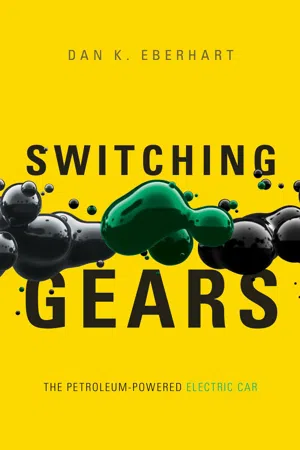
The world is on the precipice of energy innovation. As we strive toward cleaner fuels, some technologies will rise and others will fall. Will the Tesla Roadster and the Nissan Leaf go the way of the 1890s’ Morrison Electric?
The new rock stars of the transportation industry are radical entrepreneurs with visions that may change the landscape of energy as drastically as computers changed the landscape of communication. Electric vehicles (EVs) are steadily gaining acceptance. Countries like Norway, France, India, and China have stated that they will abandon sales and manufacturing of conventional vehicles by 2025–2030 in favor of EVs.
Eberhart’s expert book provides everything we need to know to engage in the debate over EVs versus internal combustion vehicles. He skillfully sorts fact from fiction, puts valuable research at our finger tips, and offers us a glimpse of what the world might look like in 2050 with a potential worldwide population of 9.6 billion people and over 530 million EVs on our roads.
The future has never seemed more like science fiction. We’ve seen hydrogen fuel-cell-powered trains (“hydrail”), autonomous drones, the first prototypes and working models of electric jets, and vertical takeoff and landing (VTOL) vehicles. Uber promised to lift intercity EVs to the sky with its Elevate program, and smaller startups have demonstrated ingenious contraptions for human-powered flight.
Eberhart envisions a successful energy revolution where we learn from our mistakes and solve our puzzles, as we work toward a future that allows us to be conscientious, powerful, and energy-savvy all at the same time. Are EVs really the holy grail of energy solutions—power without fossil fuel? Are EVs here to stay?
- 272 pages
- English
- ePUB (mobile friendly)
- Available on iOS & Android
eBook - ePub
About this book
Information
PART I
THE DEBATE
CARS, CARBONS, AND CLIMATE
CHAPTER 1
CLIMATE CHANGE WARS:
EV VERSUS O&G
It is arguably one of the most memorable scenes in American film history. Howard Beale, fictional TV anchor in the Academy Award–winning movie Network, learns that he’s being let go, just minutes before what turns out to be his final evening broadcast. With cameras rolling, he devolves from unsettled to unhinged. His epic, on-camera meltdown ends with what became a semi-farcical mantra in the late 1970s:
“I’m mad as hell and I’m not going to take this anymore!”
Some 40 years later, not only is that catchphrase still around, but it’s also been adapted to modern times. Whatever anger was brewing in America late last century has percolated into full-blown fury. While Beale railed specifically against inflation, the Russians, and crime in the streets, in today’s politically charged atmosphere, we’re now outraged about nearly everything.
We are an agitated people.
It should surprise no one that the debate over climate change—Is it real? Is it man-made? How bad is it? Who’s to blame?—has turned into a cultural touchstone. If you don’t believe in the idea that climate change is man-made, well, off with your head! The Trump administration’s decision to withdraw from the Paris Agreement further stoked the fire.
From coffee hour at the local doughnut shop to full-chamber debates on the Senate floor, discussions about climate change too often move quickly from polite conversation to full-throated cries: “My side is right and your side is stupid.” We’ve gone from asking, “Why do you think that way?” to “How can you possibly think that way!” This reaction does more than shut down open, honest conversation. It feeds the ire and inspires left-right conflict and science motivated by politics instead of truth.
It wasn’t always this way. Before the term “climate change” had even entered the public consciousness, presidential candidate George H. W. Bush, making a stump speech in Michigan, discussed the importance of treating land, water, and air with care, saying, “These issues know no ideology, no political boundaries. It’s not a liberal or conservative thing we’re talking about.”1
What happened? How did environmental issues become politicized? And is there any way back?
Seeing the World Through Different Lenses
It’s not easy to winnow out exactly how, why, or when climate change became an intractably divisive issue, but it does clearly cut across party lines.
An April 2018 Pew Research study indicated “wide political divides over the effects of climate policy.” That includes how they view one of the key climate quarrels: whether oil and gas have a place in an ostensibly “zero-emission” future. For one thing, Pew found that 66 percent of liberals said policies aimed at reducing climate change are beneficial for the environment, compared with 27 percent of conservatives. On the flip side, conservatives see more risk to the economy: Fifty-seven percent responded that such policies are economically detrimental, while only 14 percent of liberals expressed these opinions.
But before they can agree on that topic, they have to reach détente on the science behind the debate. And that seems unlikely, especially given that “partisanship is a stronger factor in people’s beliefs about climate change than is their level of knowledge and understanding about science.”2
When the Green New Deal (GND), a campaign spearheaded by Democrats to eliminate carbon emissions, hit the congressional floor, the result was expectedly contentious. Senator Ed Markey (D-MA) and Representative Alexandria Ocasio-Cortez (D-NY) introduced a fourteen-page resolution in February 2019 calling for the United States to transition to 100 percent renewable, zero-emission energy sources within ten years. Support—and backlash—followed party lines: Congressional Democrats and liberal environmental groups jumped on the bandwagon, while President Donald Trump and other Republicans deemed it impossible at best. Mark Mills, senior fellow at the Manhattan Institute and a faculty fellow at Northwestern University’s McCormick School of Engineering and Applied Science, went so far as to call the measures “immoral.”3
Clearly, beliefs regarding the impact of fossil fuel emissions—something individual choices can influence through, say, driving habits—are disparate. Here, more than half of liberal Democrats say if more people drive hybrid and electric vehicles, it will make a difference. As for conservative Republicans, less than a quarter think it matters at all.
It doesn’t take a research team to verify that maybe, just maybe, opinions on the value of electric versus gasoline-powered cars have something to do with how the respondent views America’s oil and natural gas industry.
Granted, not every liberal shares fracktivist Bernie Sanders’s vituperative desire to shut down the entire industry. One only has to read the balanced April 11, 2016, New York Times op-ed by Gary Sernovitz, a managing director of Lime Rock Management, to understand how a self-identified liberal can nonetheless appreciate the industry in general and fracking in particular. Sernovitz goes so far as to say that the American shale revolution “advanced causes dear to most liberals’ hearts”4—boosting employment, reducing poverty, keeping billions out of human rights–denying petro states, and reducing toxic greenhouse gases. In fact, because the natural gas unleashed by fracking can produce the same amount of electricity as coal with half the carbon dioxide emitted, coal has been increasingly displaced for use in electricity generation. The United States now leads the world in carbon-emissions reduction.
Even President Obama commended the contributions of domestic oil and gas production during his years in office. In his 2013 State of the Union address, for example, he said, in part, “After years of talking about it, we’re finally poised to control our own energy future. We produce more oil at home than we have in fifteen years. We have doubled the distance our cars will go on a gallon of gas . . . [and] we produce more natural gas than ever before—and nearly everyone’s energy bill is lower because of it. And over the last four years, our emissions of the dangerous carbon pollution that threatens our planet have actually fallen.”4
Still, whether their beliefs are accurate or not, one need only look to the headlines to see that liberals often view the energy industry as backward, resistant to change, and more likely to cause environmental problems. The alternative energy industry? It’s populated by altruists who have Earth’s best interests at heart, they say. Republicans see oil and gas companies as an engine for economic growth and believe that abundant and affordable energy is the key to national security and prosperity.
The fact is the issue isn’t black or white . . . but many shades of green.
Bulls, Beasts, and False Promises
Let’s take a closer look at some of the assertions in support of electric vehicles (EVs), which are being hailed as the solution to everything from air quality—particularly in urban areas where “pollution belching vehicles poison the lungs of humans forced to share the streets with them”5—to economic growth.
New Jersey, a state more often associated with the smog over Newark than the verdant farmland worthy of the name Garden State, has an “awful lot to gain” by tapping into the EV market. At least that’s the promise of an analysis presented at a December 2017 roundtable reported on—and sponsored by—NJ Spotlight.6
The research suggests that the emerging EV market in New Jersey could result in more than $2 billion in net economic benefits by 2035, even when the cost of installing the infrastructure and enhancing the electric power grid are taken into account. Mark Warner, whose company conducted the study, said that the widespread adoption of EVs will profoundly alter the electric-power market—and that’s where the savings will accrue.
“EVs are going to flatten out the energy load of the entire grid, largely because most people will charge their cars at night, when the demand drops dramatically,” Warner said. “When you change the load curve, you change the cost of energy.”
In a piece for Fortune magazine, Joshua D. Rhodes and Michael E. Webber presented an even more bullish pro-EV position. They suggested that electrification of transportation would be nothing short of transformative—not only reducing pollution but also putting an end to wasted energy.
“The transportation industry consumes the most energy of all end use sectors, about 29 percent of total U.S. energy consumption, mostly in the form of petroleum products burned in internal combustion engines operating with about 25 percent efficiency,” they wrote. 7
The duo contended that, if every one of the 3 trillion miles that automobiles drove over American roadways in 2017 were EVs that were 70 percent efficient, it would be equal to improving the efficiency of our entire economy from 32 percent to 34 percent. Sure, that two percent might seem negligible—but “a small change in a big number can make a huge difference.”
Sounds pretty convincing, right?
Perhaps. But not everyone buys into the EV promise with the same level of enthusiasm or confidence.
Some critics complain that EVs are held up by subsidies—and they’re not holding their weight on the environmental issue, either.
One problem is that the Energy Improvement and Extension Act of 2008, which granted tax credits for new qualified plug-in electric drive vehicles, gave what many perceive as an artificial boost to EV sales. As states repeal EV tax credit laws or let them expire—or even tack on fees that make electric cars more of an investment—the sense is that they haven’t gotten their money’s worth in terms of environmental benefits. With the incentives disappearing, consumers are turning away from EVs in droves: When Georgia scrapped its tax credit in 2015, EV sales fell from 1,300 cars in June to just 97 in August.8
And let’s be clear: The EV tax credit was meant to stimulate innovation and sales, not to prop up the industry in perpetuity—which is precisely why the legislation built in a phase-out expiration that starts to wipe out the credit, in stages, once a model has sold 200,000 cars. In fact, because of their sales, Tesla and GM are facing some phase-outs. Tesla’s Model 3 was down to $3,750 for sales between January and June 2019, dropped to $1,875 for the rest of 2019, and then will be $0. The Chevy Volt and Bolt phased down to $3,750 in April 2019, to $1,875 in October 2019, and then $0 in March 2020.9
Still, there’s plenty of momentum, globally speaking.
Worldwide EV sales passed the 5 million mark in December 2018,10 with plug-ins earning a 2.1 percent market share of new car sales.11 This is an increase from 1.3 percent in 2017 and 0.86 percent in 2016.12 Analysts at UBS predict that worldwide sales of EVs will reach 14.2 million units in less than a decade, which represents 13.7 percent of all new passenger cars.13
Will that projected growth be stymied by what some are c...
Table of contents
- Cover
- Copyright
- Title Page
- Introduction
- Part I: The Debate: Cars, Carbons, and Climate
- Part II: The Cars: EV Options and Ownership
- Part III: The Details: Charging Batteries, Roads, and . . . Plastics?
- Part IV: The Future: The World in 2040
- Conclusion
- Notes
Trusted by 375,005 students
Access to over 1.5 million titles for a fair monthly price.
Study more efficiently using our study tools.
Frequently asked questions
Yes, you can cancel anytime from the Subscription tab in your account settings on the Perlego website. Your subscription will stay active until the end of your current billing period. Learn how to cancel your subscription
No, books cannot be downloaded as external files, such as PDFs, for use outside of Perlego. However, you can download books within the Perlego app for offline reading on mobile or tablet. Learn how to download books offline
Perlego offers two plans: Essential and Complete
- Essential is ideal for learners and professionals who enjoy exploring a wide range of subjects. Access the Essential Library with 800,000+ trusted titles and best-sellers across business, personal growth, and the humanities. Includes unlimited reading time and Standard Read Aloud voice.
- Complete: Perfect for advanced learners and researchers needing full, unrestricted access. Unlock 1.5M+ books across hundreds of subjects, including academic and specialized titles. The Complete Plan also includes advanced features like Premium Read Aloud and Research Assistant.
We are an online textbook subscription service, where you can get access to an entire online library for less than the price of a single book per month. With over 1.5 million books across 990+ topics, we’ve got you covered! Learn about our mission
Look out for the read-aloud symbol on your next book to see if you can listen to it. The read-aloud tool reads text aloud for you, highlighting the text as it is being read. You can pause it, speed it up and slow it down. Learn more about Read Aloud
Yes! You can use the Perlego app on both iOS and Android devices to read anytime, anywhere — even offline. Perfect for commutes or when you’re on the go.
Please note we cannot support devices running on iOS 13 and Android 7 or earlier. Learn more about using the app
Please note we cannot support devices running on iOS 13 and Android 7 or earlier. Learn more about using the app
Yes, you can access Switching Gears by Dan K. Eberhart in PDF and/or ePUB format, as well as other popular books in Technology & Engineering & Automotive Transportation & Engineering. We have over 1.5 million books available in our catalogue for you to explore.