Beyond the Glass Ceiling
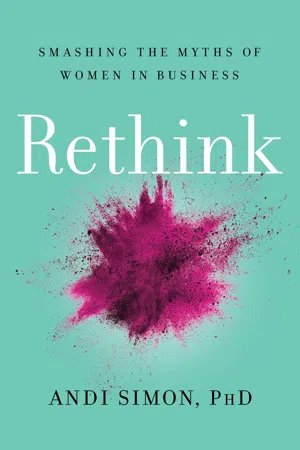
More and more, women today are challenging long-held beliefs about what they can and can’t do. They’re speaking up, stepping out, breaking through, and redefining what society has always told them was true about their capabilities. In Rethink: Smashing the Myths of Women in Business, Andi Simon tells the stories of 11 women from different industries who opened up the possibilities for their professional careers and personal lives by being authentic, taking risks, and pushing past the obstacles others placed before them. These are stories that tell of innovation, show how women rise, and ignite change.
Andi, a corporate anthropologist, an award-winning author, and a successful entrepreneur, debunks myth after myth as she profiles the women in the book and offers key wisdom, insights, and observations through her unique lens. Whether about entrepreneurs, innovators, scientists, academics, attorneys, or leaders in other fields, the stories demonstrate how all the women have broken down walls and paved the way to more.
But this book isn’t only about the 11 women who are pushing boundaries and transforming business, culture, and society; it’s about inspiring all women to achieve and showing them a way to launch forward. Rethink provides the tools and framework for questioning society's norms, challenging our own current thinking, and smashing the preconceived notions about women that can so often hold us back from realizing our goals and dreams. In this book, you'll learn how to take a hands-on approach to examining and rethinking your own personal and professional life in order to recognize your fuller potential.
- 256 pages
- English
- ePUB (mobile friendly)
- Available on iOS & Android
eBook - ePub
About this book
Information
PART ONE
The Reason for This Book
Introduction
This book emerged from the success of my first book, On the Brink: A Fresh Lens to Take Your Business to New Heights. On the Brink won an Axiom 2017 Bronze Best Business Book Award. The book sold well and brought in many great clients. However, much to my chagrin, as I reviewed what I had written, I realized that all but one of the case studies were about men—CEOs of companies that had stalled or gotten stuck, and my company had to help them start growing again.
My publisher, Tanya Hall, CEO of Greenleaf Book Group, is a successful businesswoman and writer in her own right. I asked her: “How did I, or we, do that?” We both laughed a bit and realized it was time to write the next book. This book was going to be about women and what I saw happening all around me. These women were literally smashing the myths of women in business, defying everything they were told about women in business. They were boldly leading the way forward in their industries, and their stories needed to be told. I soon realized that a new mythology was emerging, and these women were the ones who could frame it, live it, and change the way our society thought about women and their growing force in the world of business and society.
Today, women are driving a coevolution of previously unseen size and scope. Women are challenging long-held beliefs about what they can and cannot do. Despite the theories of evolutionary psychologists and others that women evolved to stay in the home to care for children so men could hunt, farm, trade, go to war, and protect their homes, these women are breaking out of these genetic determinants and showing how they can do everything men can do, albeit differently, and in some cases better. These myths are being rewritten by women who have capitalized on education, the demands of the marketplace, and new possibilities that have emerged. Reluctantly, men are realizing they don’t have all the solutions to societal or business problems, thereby creating an opening for women to rethink these long-held beliefs as they establish a new norm and lead the way forward for others.
Beyond Lean In
When I began to write this book, people asked me if I wanted to write about Sheryl Sandberg or Meg Whitman, or perhaps Mary Barra or Indra Nooyi, all well-known and highly successful women who have led major firms and helped develop vast wealth. They are, indeed, highly successful women in their own right. Their stories can and do inspire other women to want to achieve significant roles in large corporations, with the associated prestige and wealth that comes with it. But something else was taking place as women were moving into all levels of industry and business, and that was the story I wanted to share.
While some women have become billionaires, they are still a mini-minority. There were only 319 women billionaires in 2018. That was an impressive increase, since back in 2015, there were only 187. There is some progress at the top. However, that increase is less impressive when you realize that 2,433 men were also billionaires in 2018. While much more remains to be done, these women set a standard for others to reach for and a style to emulate.
The funnel, however, is not filling up as fast as we might like. Sheryl Sandberg’s Lean In was a push to increase the number of women in CEO roles in S&P 500 companies. In 2017, the momentum she was championing came to a hard stop. Only 5.4 percent of CEOs in S&P 500 firms were women. Despite Sheryl Sandberg’s urging women to “Lean In,” companies have not been opening up and moving women into leadership and senior management positions. As evident in LeanIn.org’s 2018 research conducted with McKinsey, the advancement of women in the large corporate workplace was not moving. As they wrote, “Progress isn’t just slow—it’s stalled.”
The largest companies did not seem to be moving in the right direction to open the gates to women. In fact, many of the women who were on the brink of moving into those senior C-suite positions jumped off the ladder because the obstacles were overwhelming, and the road was filled with men who seemed to be deliberately trying to stop their progress. As Susan Chiara wrote in 2017, “The impact of gender is hard to pin down decisively. But after years of biting their tongues, believing their ranks would swell if they simply worked hard, many senior women in business are concluding that the barriers are more deeply rooted and persistent than they wanted to believe.”
These myths about women are being manipulated to keep them out of leadership roles. Women are seen as dependable rather than visionary. They also tend to be uncomfortable with self-promotion and are more likely to be criticized when they do grab the spotlight. Men remain threatened by assertive women. Most women are not socialized to be unapologetically competitive. Those who thought they were on their way to somewhere important get discouraged. They begin to wonder what they are really trying to do—and why it is so hard to find purpose and meaning in the positions they thought were important to pursue.
It turns out the problem is far deeper than simply those women trying to enter the C-suite. Attorneys are finding that men often forget that female attorneys are their colleagues and think of them more as support staff, asking them to clean their plates or get their coffee. Women dentists complain they still get men telling them they are taking a spot in dental school that a man should have. And women in number two positions are being asked to be the back ups to the C-suite men, not their equals.
And, of course, there is that pay gap. Women still do not earn as much as men, and that wage gap remains a major challenge. In 2000, women earned 73 cents for every dollar a man earned. By 2016, the gender pay gap had shrunk to 80 cents to the dollar, which is an improvement, but we have a ways to go still.
There is another way of looking at the situation women are facing. While substantial progress has been made, something profound is taking place as women are moving into these jobs, and they are beginning to change the myths and norms that have kept them out. Perhaps Lean In wasn’t focused on the right companies. Maybe women are moving forward, taking on significant roles in smaller or middle-market companies, or starting their own businesses, entering and reaching parity in a wide array of fields and growing in numbers among all the professions. Perhaps they are succeeding to push through the proverbial glass ceiling, opening doors to power and profits, but in different ways.
What is success anyway? This is an important question to ask, particularly when women, me included, have had to leap over those walls that society keeps throwing up to keep us in “our place”—be it the home, kitchen, or nursery—and out of the C-suite or the boardroom.
As I stop to see what is happening through a fresh lens, I notice that something is taking place under the LeanIn.org radar. I have been watching it in the work I do and the women leaders I support. I see a little of it in the speaking engagements for CEOs that I have done. While most of the CEOs in the room are men, a few more women appear in each group each time I attend. Women are beginning to inherit family firms, start innovative new companies, and push through some of the barriers.
We were all excited to see the election of a record number of women into Congress, the expanded role of women in local and state government, and the power of the women’s soccer team successes in capturing the world’s attention. Even if they had to sue for equal compensation to that which men were getting, the worldwide excitement over the women’s soccer team became rightfully important.
These emerging women may not be moving into the largest of the firms, and they may not yet be the CEOs or the billionaires, but they are moving into areas that men did not believe women could perform in and where they were not wanted. Those industries still exist, from the executive and directorial levels of Hollywood to aerospace, where there are few women. The talented women are starting to emerge, but the walls are tall and the ceilings difficult to break through.
But their time is coming. What I am seeing is the rising place of women. As John Seely Brown once wrote, “The way forward is all around us, if only we can see it.” There is no single factor here. Instead, a convergence of forces are coming together to provide opportunities for women, and they are capitalizing on them. From their majority numbers in higher education, to those entrepreneurs opening and running their own businesses, to the rise of female support networks, women are taking advantage of the possibilities, finding the gaps, and seizing the moment.
The women in this book are redefining what our society believes to be “true” and in the process are challenging the walls that keep women in, the glass ceilings they have tried to break through, and the world as men and even women have long thought it was “supposed to be.” What is so exciting is to see the size and scope of these changes across a wide range of industries by so many talented women. Whether it is #MeToo or the sheer weight of women leading industry and culture, those walls are falling, faster and faster.
This doesn’t mean that men are not still putting up barriers and barricades. As Kim Elsesser wrote in 2018 in her Forbes.com article “Female Lawyers Face Widespread Gender Bias,” women attorneys continue being stereotyped as women, not as accomplished lawyers. This includes everything from being mistaken for janitors, administrators, or court personnel to having men ask them to clean their plates. A woman attorney shared, “I have frequently been assumed to be a court reporter. In my own firm, I’ve been asked if I am a legal administrative assistant on multiple occasions, even after making partner.” The biases are profound, and changing them is a persistent problem everywhere.
Smashing Myths
While interviewing these women and many others, I realized how they were changing me and my own story. I was getting pulled into their stories and was personally affected as a result. Stories change us as we listen to them, read them, or watch them. We become a part of the story. We get engaged with the storyteller. While I knew that intellectually, it wasn’t until I did the interviews that I began to see how my whole idea about the book was changing, and the women who were sharing their stories were, in fact, changing me.
Did these women know they were “smashing the myths” at the time? Not really. Most of them were realists, understanding that there were always going to be hurdles to leap over. In some ways they were simply pushing forward, and in the process they achieved results that amazed even them. They were in the labyrinth that Alice H. Eagly and Linda L. Carli write about in their book Through the Labyrinth: The Truth About How Women Become Leaders. As stated in the book, there is no single path to follow. It is a maze of twists and turns to tackle. And in the stories these women share, you will see how they defied the myths and created a new story where women are pushing down walls, breaking through glass ceilings, and launching new societal norms that are opening up and allowing their greatness to come through.
The women interviewed in this book are not alone or unique. As you read their stories, you will see how they are pushing through in innovative ways and smashing the following cultural myths they encountered along the way:
Myth 1: Women Can’t Be Great Entrepreneurs
Myth 2: Women Are Not Good Leaders
Myth 3: Women Cannot Run a Fashion Business
Myth 4: Women Shouldn’t Be Lawyers
Myth 5: Women Cannot Manage Money
Myth 6: Women Do Not Make Good College Presidents
Myth 7: Women Can’t Be Geoscientists
Myth 8: Women Aren’t Fit for Careers in Aerospace
Myth 9: Women Cannot Rise to Upper Management Roles
Myth 10: Women Don’t Belong in IT
Myth 11: Anthropologists Don’t Work in Business
As you take this journey, you will meet Jamie Candee, who has been leading others since she was in high school, when she first began helping people become their best selves. Celeste Ford will share how she created an award-winning company to help the aerospace industry develop high-tech solutions in highly innovative, impactful ways. You will also meet Stephanie Breedlove, a highly successful entrepreneur who had to disregard her parents when they didn’t think she and her husband could build a successful business. And then there’s Delora Tyler, who learned that as an African American woman, if she wanted to be heard in the workplace and have her ideas appreciated, she would need to start her own company. Today she can take any company from 0 to 60, despite all obstacles put in front of her. You will also meet Evelyn Medvin, a highly renowned geologist, who will tell you how she bucked all the resistors who never thought a woman could cut it in the field and uses her ability to “see” geology to find oil where others can’t. Maria Gallo will discuss how she turned a struggling university into a thriving institution. Babette Ballinger overcame all types of obstacles to create and grow a successful manufacturing business in the fashion industry. Andrea Kramer will tell you how she defied what others told her and became a successful attorney. Janine Firpo will relay how she helps women manage and grow their earnings and savings. You will also meet Sam Radocchia, who will show you how she is crushing it in the IT industry. And then there’s me, an anthropologist who found the perfect partnership in business and anthropology to help companies see themselves through a fresh lens and course-correct their way to success.
The Myths That Frame Your Own Story
Each of these women tell you their stories so you can rewrite your own, even better. As you read their stories, I invite you to ask yourself how your beliefs, and those of others around you—from family to friends to media and to teachers—have kept you thinking about what you can’t do as opposed to what is right there waiting for you to accomplish.
Before you get discouraged, I want you to know that each of these women faced the same or similar challenges and continue to do so today. Yet they are smashing the myths before them, and they want you to do so as well.
When people share their stories, they do so to give their wisdom. When this happens, we can activate our own story and change it. Each story shared in this book is the gift of each woman to help us see, feel, and think about our own lives through a fresh lens. The stories are also framing a new mythical reality where women are not who society once thought they were. Some of these women, at times, were slaying a metaphorical dragon. Others went from rags to riches. Several were on a quest. Typically, they were on a journey, often without a clear destination, with many hurdles to overcome, challenges to conquer, and rewards to amass. Their stories are as much about becoming who they wanted to be as they are about profits and success.
I hope their stories will help you see a pathway for you and others like you. It cannot be done alone. Women need others to learn from, model themselves after, and share their common stories. They need a culture that supports their achievements and helps them overcome the challenges. These women are part of this new community, one that you can also be a part of.
As you read these stories, think about yourself and where you are in your own life’s journey. Think about what you would like to create and how it feels to be where you are right now. Are you letting your heart lead you? Or is your brain hijacking your journey? Let go, if you can, of whatever it is that is keeping you back, and follow these women, one story at a time. As you do, think about the stories that have become the mythology you believe to be true. And know that you, too, can smash them to become the woman you know you are and can be.
After each story, you will find my thoughts as an anthropologist in the From the Observation Deck section. Anthropology is grounded in the assumption that people often don’t know what they are doing or why they are doing it. Only by observing them go through their stories and experiencing their journeys with them can we capture what we see happening. I c...
Table of contents
- Cover
- Title Page
- Copyright
- Dedication
- Contents
- Foreword
- Part One: The Reason for This Book
- Part Two: The Myths and the Women Who Smashed Them
- Part Three: Tools to Use to Smash Myths and Create New Successes
- Acknowledgments
- Index
- About the Author
Trusted by 375,005 students
Access to over 1.5 million titles for a fair monthly price.
Study more efficiently using our study tools.
Frequently asked questions
Yes, you can cancel anytime from the Subscription tab in your account settings on the Perlego website. Your subscription will stay active until the end of your current billing period. Learn how to cancel your subscription
No, books cannot be downloaded as external files, such as PDFs, for use outside of Perlego. However, you can download books within the Perlego app for offline reading on mobile or tablet. Learn how to download books offline
Perlego offers two plans: Essential and Complete
- Essential is ideal for learners and professionals who enjoy exploring a wide range of subjects. Access the Essential Library with 800,000+ trusted titles and best-sellers across business, personal growth, and the humanities. Includes unlimited reading time and Standard Read Aloud voice.
- Complete: Perfect for advanced learners and researchers needing full, unrestricted access. Unlock 1.5M+ books across hundreds of subjects, including academic and specialized titles. The Complete Plan also includes advanced features like Premium Read Aloud and Research Assistant.
We are an online textbook subscription service, where you can get access to an entire online library for less than the price of a single book per month. With over 1.5 million books across 990+ topics, we’ve got you covered! Learn about our mission
Look out for the read-aloud symbol on your next book to see if you can listen to it. The read-aloud tool reads text aloud for you, highlighting the text as it is being read. You can pause it, speed it up and slow it down. Learn more about Read Aloud
Yes! You can use the Perlego app on both iOS and Android devices to read anytime, anywhere — even offline. Perfect for commutes or when you’re on the go.
Please note we cannot support devices running on iOS 13 and Android 7 or earlier. Learn more about using the app
Please note we cannot support devices running on iOS 13 and Android 7 or earlier. Learn more about using the app
Yes, you can access Rethink by Andi Simon in PDF and/or ePUB format, as well as other popular books in Business & Women in Business. We have over 1.5 million books available in our catalogue for you to explore.