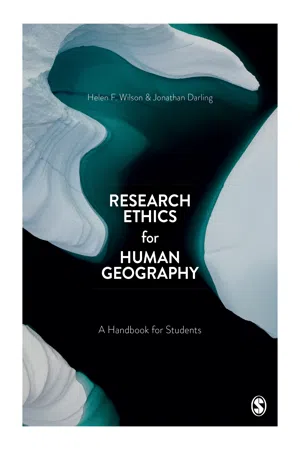
Research Ethics for Human Geography is a lively and engaging introduction to key ethical issues in geographical research by leading figures in the discipline. It addresses the wide range of ethical issues involved in collecting, analysing and writing up research across the social sciences, and explores and explains the more specific ethical issues associated with different forms of geographical inquiry.
Each chapter comprises detailed summaries and definitions, real-life case studies, student check-lists and annotated recommendations for reading, making the book a valuable toolkit for students undertaking all forms of geographical research, from local and overseas fieldwork, through to dissertation research, methods-training, and further research.
eBook - ePub
Research Ethics for Human Geography
A Handbook for Students
- 384 pages
- English
- ePUB (mobile friendly)
- Available on iOS & Android
eBook - ePub
Research Ethics for Human Geography
A Handbook for Students
About this book
Information
Table of contents
- Cover
- Half Title
- Title Page
- Copyright Page
- Acknowledgements
- Contents
- List of Figures
- List of Tables
- Notes on Contributors
- Acknowledgements
- Preface: A Student's Perspective
- 1 Introducing Ethics
- 2 Geography and Ethics
- Part 1Core Ethical Issues
- 3 Positionality
- 4 Consent
- 5 Anonymity
- 6 Sensitive Topics
- 7 Power and Empowerment
- 8 Emotions
- 9 Expectations
- 10 Statistics and Data
- 11 Data Management
- 12 Avoiding the Weaponization of Your Research
- Part 2 Approaches
- 13 Radical Geographies
- 14 Activist Geographies
- 15 Participatory Approaches
- 16 Indigenous Methods and Research with Indigenous Communities
- Part 3 Subjects
- 17 Vulnerable Subjects
- 18 Animals
- 19 Children and Young People
- 20 Historical Geographies and Archived Subjects
- 21 Powerful and Elite Subjects
- 22 The Environment
- Part 4 Spaces
- 23 Public Spaces
- 24 Private and Domestic Spaces
- 25 Spaces of Development
- 26 Voluntary Spaces
- 27 Virtual Spaces and Social Media
- 28 Spaces of Disaster
- Part 5 Writing
- 29 Writing Research
- Glossary
- References
- Index
Trusted by 375,005 students
Access to over 1.5 million titles for a fair monthly price.
Study more efficiently using our study tools.
Frequently asked questions
Yes, you can cancel anytime from the Subscription tab in your account settings on the Perlego website. Your subscription will stay active until the end of your current billing period. Learn how to cancel your subscription
No, books cannot be downloaded as external files, such as PDFs, for use outside of Perlego. However, you can download books within the Perlego app for offline reading on mobile or tablet. Learn how to download books offline
Perlego offers two plans: Essential and Complete
- Essential is ideal for learners and professionals who enjoy exploring a wide range of subjects. Access the Essential Library with 800,000+ trusted titles and best-sellers across business, personal growth, and the humanities. Includes unlimited reading time and Standard Read Aloud voice.
- Complete: Perfect for advanced learners and researchers needing full, unrestricted access. Unlock 1.5M+ books across hundreds of subjects, including academic and specialized titles. The Complete Plan also includes advanced features like Premium Read Aloud and Research Assistant.
We are an online textbook subscription service, where you can get access to an entire online library for less than the price of a single book per month. With over 1.5 million books across 990+ topics, we’ve got you covered! Learn about our mission
Look out for the read-aloud symbol on your next book to see if you can listen to it. The read-aloud tool reads text aloud for you, highlighting the text as it is being read. You can pause it, speed it up and slow it down. Learn more about Read Aloud
Yes! You can use the Perlego app on both iOS and Android devices to read anytime, anywhere — even offline. Perfect for commutes or when you’re on the go.
Please note we cannot support devices running on iOS 13 and Android 7 or earlier. Learn more about using the app
Please note we cannot support devices running on iOS 13 and Android 7 or earlier. Learn more about using the app
Yes, you can access Research Ethics for Human Geography by Helen F. Wilson, Jonathan Darling, Helen F. Wilson,Jonathan Darling,Author in PDF and/or ePUB format, as well as other popular books in Ciencias sociales & Geografía humana. We have over 1.5 million books available in our catalogue for you to explore.