Section 1: Network Fundamentals
This section introduces you to the world of networking, starting with how devices intercommunicate. It then discusses the various types of networking devices along with their functionality. This section also covers popular networking protocols and services that allow a network to share a resource with other devices. Additionally, you will learn about IPv4 and IPv6 addressing, and subnetting techniques.
This section contains the following chapters:
- Chapter 1, Introduction to Networking
- Chapter 2, Getting Started with Cisco IOS devices
- Chapter 3, IP Addressing and Subnetting
- Chapter 4, Detecting Physical Issues, Wireless Architectures, and Virtualization
Chapter 1: Introduction to Networking
Beginning a journey in the field of networking is an exciting one for everyone. I'm sure you are interested in learning about the operations of a computer and especially how the internet, the largest network, functions and grows. Networking is an ever-demanding field in Information Technology (IT); each day, organizations from healthcare providers, educational institutions, government agencies, and other industries are continuously expanding and improving their network infrastructure to support newer services and network traffic. Almost everyone is connected to the internet. Educators and businesses are using various online collaboration platforms to extend their reach to students and potential customers in a global market. All these amazing technologies are made possible by computer networks.
The Cisco Certified Network Associate (CCNA) 200-301 certification is designed to prepare you for associate-level networking roles in the IT industry. CCNA is one of the most popular certification requirements for almost every network engineering job, and there is a very good reason why. The CCNA certification is a foundational level certification with a lot of essential information; I know part of the name contains the word "associate", but that's just in the Cisco certification hierarchy structure since the next level is Cisco Certified Network Professional and so on. The CCNA is one of the most recommended certifications you can follow to begin your networking journey.
The CCNA will teach you how to design, implement, configure, and troubleshoot small- to medium-sized enterprise networks. You will learn to efficiently implement network access, IP connectivity, IP services, and security through an enterprise network. Additionally, gaining your CCNA certification will open up a whole new world of career opportunities as the certification itself is well-respected in the networking field.
Throughout this chapter, you will learn about the important history of how computer networks were developed and the era before the internet. Then, we will cover the early and current generation of the internet and explore how networking has become part of our daily lives. You will learn about communication technologies and networking protocols that are designed to help us connect with our loved ones, friends, and colleagues. You will also learn about the various sizes of networks and components such as routers and switches, which move messages from one device, across a network, to another person. Lastly, you'll learn about the various protocol suites that are built into each operating system and network device that sets the protocol for exchanging messages.
In this chapter, we will cover the following topics:
- Understanding the evolution of networking and the internet
- Understanding network sizes – SOHO, LAN, and WAN
- Learning about network protocol suites
- Understanding the functions of network devices
- Network topology architectures
Understanding the evolution of networking and the internet
In the pre-internet age, scientists, institutions, and other experts were working to create a network that could allow them to connect computers on a worldwide scale. Computer scientists began working on a model; the initial prototype was known as the Advanced Research Projects Agency Network (ARPANET).
ARPANET was developed in the 1960s. It was funded by the US Department of Defense (DoD) with the idea it would be used to connect universities and research centers. The network technology used on this prototype was packet switching. This allowed connected computers to send and receive data on a single network. However, ARPANET was not resilient enough to allow multiple channels of communication on the network.
The US Defense Advanced Research Projects Agency (DARPA) developed the Transmission Control Protocol/Internet Protocol (TCP/IP) suite, which was adopted by ARPANET in the early 1980s. The US DOD called it the official standard computer networking. With the adoption of TCP/IP, ARPANET began to evolve into much larger networks, allowing other organizations to be interconnected, and became what we commonly refer to as the internet today.
The internet is a worldwide collection of many interconnected networks, such as Wide Area Networks (WANs) and Local Area Networks (LANs). Each organization or person who connects a device to the internet simply extends the network (internet), so the internet is continuously growing as more devices are going online. Later in this chapter, we will take a deeper dive and discuss various types and sizes of network topologies.
The internet itself is not owned by any one person or organization in the world. However, there are many groups and organizations that help maintain the stability and set standards for intercommunicating on the internet and private networks.
As an upcoming network engineer, it's good to know a little about the following organizations and groups:
- Internet Engineering Task Force (IETF). Its mission is simply to make the internet work better for all. You can find more information about IETF on their website at www.ietf.org.
- Internet Assigned Numbers Authority (IANA) is responsible for the assignment, coordination, and management of internet protocol (IP) addressing, internet protocol resources, and the Domain Name System (DNS) Root Zone. You can find more information about IANA on their official website at www.iana.org.
- Internet Corporation for Assigned Names and Numbers (ICANN) contributes to the internet's sustainability by coordinating and managing the internet's numerical spaces and namespaces to ensure its stability. You can find more information about ICANN on their official website at www.icann.org.
Now that we have covered the history of the internet, we'll look at how various network sizes differ in the next section.
Understanding network sizes – SOHO, LAN, and WAN
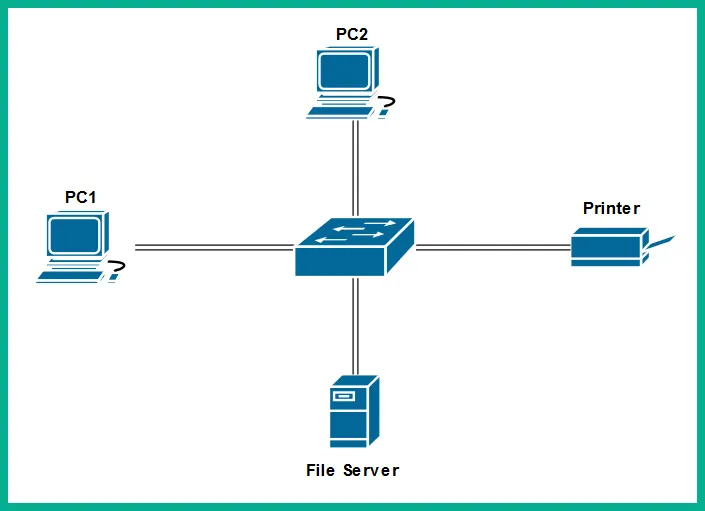
Let's imagine we have a few devices that are all interconnected in a single network, sharing files between themselves without having the user (human) physically walk around with a portable storage device such as a flash drive to copy and paste files. Users access a centralized file server within the company's network from their local computer.
The following diagram shows a small network with both a network-shared printer and file server:
Figure 1.1 – Devices interconnected to create a small LAN
This type of network is commonly referr...