Prepare to take the Cisco Certified Network Associate (200-301 CCNA) exam and get to grips with the essentials of networking, security, and automationKey Features• Secure your future in network engineering with this intensive boot camp-style certification guide• Gain knowledge of the latest trends in Cisco networking and security and boost your career prospects• Design and implement a wide range of networking technologies and services using Cisco solutionsBook DescriptionIn the dynamic technology landscape, staying on top of the latest technology trends is a must, especially if you want to build a career in network administration. Achieving CCNA 200-301 certification will validate your knowledge of networking concepts, and this book will help you to do just that. This exam guide focuses on the fundamentals to help you gain a high-level understanding of networking, security, IP connectivity, IP services, programmability, and automation. Starting with the functions of various networking components, you'll discover how they are used to build and improve an enterprise network. You'll then delve into configuring networking devices using a command-line interface (CLI) to provide network access, services, security, connectivity, and management. The book covers important aspects of network engineering using a variety of hands-on labs and real-world scenarios that will help you gain essential practical skills. As you make progress, this CCNA certification study guide will help you get to grips with the solutions and technologies that you need to implement and administer a broad range of modern networks and IT infrastructures. By the end of this book, you'll have gained the confidence to pass the Cisco CCNA 200-301 exam on the first attempt and be well-versed in a variety of network administration and security engineering solutions.What you will learn• Understand the benefits of creating an optimal network• Create and implement IP schemes in an enterprise network• Design and implement virtual local area networks (VLANs)• Administer dynamic routing protocols, network security, and automation• Get to grips with various IP services that are essential to every network• Discover how to troubleshoot networking devicesWho this book is forThis guide is for IT professionals looking to boost their network engineering and security administration career prospects. If you want to gain a Cisco CCNA certification and start a career as a network security professional, you'll find this book useful. Although no knowledge about Cisco technologies is expected, a basic understanding of industry-level network fundamentals will help you grasp the topics covered easily.
- 764 pages
- English
- ePUB (mobile friendly)
- Available on iOS & Android
eBook - ePub
Implementing and Administering Cisco Solutions: 200-301 CCNA Exam Guide
About this book
Trusted by 375,005 students
Access to over 1 million titles for a fair monthly price.
Study more efficiently using our study tools.
Information
Section 1: Network Fundamentals
This section introduces you to the world of networking, starting with how devices intercommunicate. It then discusses the various types of networking devices along with their functionality. This section also covers popular networking protocols and services that allow a network to share a resource with other devices. Additionally, you will learn about IPv4 and IPv6 addressing, and subnetting techniques.
This section contains the following chapters:
- Chapter 1, Introduction to Networking
- Chapter 2, Getting Started with Cisco IOS devices
- Chapter 3, IP Addressing and Subnetting
- Chapter 4, Detecting Physical Issues, Wireless Architectures, and Virtualization
Chapter 1: Introduction to Networking
Beginning a journey in the field of networking is an exciting one for everyone. I'm sure you are interested in learning about the operations of a computer and especially how the internet, the largest network, functions and grows. Networking is an ever-demanding field in Information Technology (IT); each day, organizations from healthcare providers, educational institutions, government agencies, and other industries are continuously expanding and improving their network infrastructure to support newer services and network traffic. Almost everyone is connected to the internet. Educators and businesses are using various online collaboration platforms to extend their reach to students and potential customers in a global market. All these amazing technologies are made possible by computer networks.
The Cisco Certified Network Associate (CCNA) 200-301 certification is designed to prepare you for associate-level networking roles in the IT industry. CCNA is one of the most popular certification requirements for almost every network engineering job, and there is a very good reason why. The CCNA certification is a foundational level certification with a lot of essential information; I know part of the name contains the word "associate", but that's just in the Cisco certification hierarchy structure since the next level is Cisco Certified Network Professional and so on. The CCNA is one of the most recommended certifications you can follow to begin your networking journey.
The CCNA will teach you how to design, implement, configure, and troubleshoot small- to medium-sized enterprise networks. You will learn to efficiently implement network access, IP connectivity, IP services, and security through an enterprise network. Additionally, gaining your CCNA certification will open up a whole new world of career opportunities as the certification itself is well-respected in the networking field.
Throughout this chapter, you will learn about the important history of how computer networks were developed and the era before the internet. Then, we will cover the early and current generation of the internet and explore how networking has become part of our daily lives. You will learn about communication technologies and networking protocols that are designed to help us connect with our loved ones, friends, and colleagues. You will also learn about the various sizes of networks and components such as routers and switches, which move messages from one device, across a network, to another person. Lastly, you'll learn about the various protocol suites that are built into each operating system and network device that sets the protocol for exchanging messages.
In this chapter, we will cover the following topics:
- Understanding the evolution of networking and the internet
- Understanding network sizes – SOHO, LAN, and WAN
- Learning about network protocol suites
- Understanding the functions of network devices
- Network topology architectures
Understanding the evolution of networking and the internet
In the pre-internet age, scientists, institutions, and other experts were working to create a network that could allow them to connect computers on a worldwide scale. Computer scientists began working on a model; the initial prototype was known as the Advanced Research Projects Agency Network (ARPANET).
ARPANET was developed in the 1960s. It was funded by the US Department of Defense (DoD) with the idea it would be used to connect universities and research centers. The network technology used on this prototype was packet switching. This allowed connected computers to send and receive data on a single network. However, ARPANET was not resilient enough to allow multiple channels of communication on the network.
The US Defense Advanced Research Projects Agency (DARPA) developed the Transmission Control Protocol/Internet Protocol (TCP/IP) suite, which was adopted by ARPANET in the early 1980s. The US DOD called it the official standard computer networking. With the adoption of TCP/IP, ARPANET began to evolve into much larger networks, allowing other organizations to be interconnected, and became what we commonly refer to as the internet today.
The internet is a worldwide collection of many interconnected networks, such as Wide Area Networks (WANs) and Local Area Networks (LANs). Each organization or person who connects a device to the internet simply extends the network (internet), so the internet is continuously growing as more devices are going online. Later in this chapter, we will take a deeper dive and discuss various types and sizes of network topologies.
The internet itself is not owned by any one person or organization in the world. However, there are many groups and organizations that help maintain the stability and set standards for intercommunicating on the internet and private networks.
As an upcoming network engineer, it's good to know a little about the following organizations and groups:
- Internet Engineering Task Force (IETF). Its mission is simply to make the internet work better for all. You can find more information about IETF on their website at www.ietf.org.
- Internet Assigned Numbers Authority (IANA) is responsible for the assignment, coordination, and management of internet protocol (IP) addressing, internet protocol resources, and the Domain Name System (DNS) Root Zone. You can find more information about IANA on their official website at www.iana.org.
- Internet Corporation for Assigned Names and Numbers (ICANN) contributes to the internet's sustainability by coordinating and managing the internet's numerical spaces and namespaces to ensure its stability. You can find more information about ICANN on their official website at www.icann.org.
Now that we have covered the history of the internet, we'll look at how various network sizes differ in the next section.
Understanding network sizes – SOHO, LAN, and WAN
Let's imagine we have a few devices that are all interconnected in a single network, sharing files between themselves without having the user (human) physically walk around with a portable storage device such as a flash drive to copy and paste files. Users access a centralized file server within the company's network from their local computer.
The following diagram shows a small network with both a network-shared printer and file server:
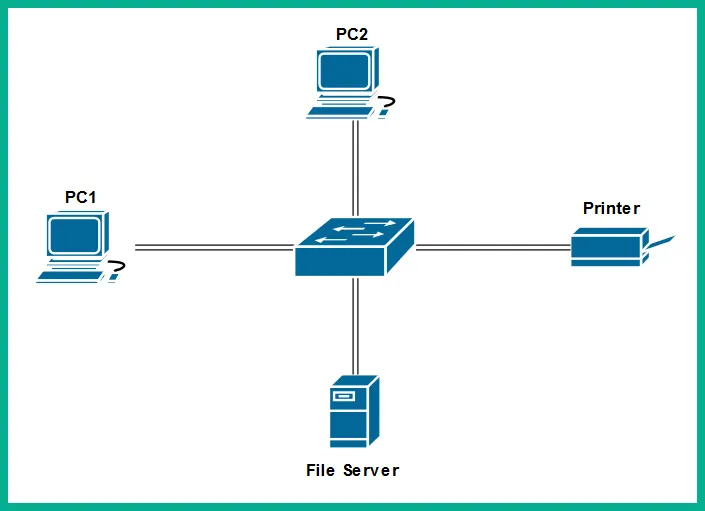
Figure 1.1 – Devices interconnected to create a small LAN
This type of network is commonly referr...
Table of contents
- Implementing and Administering Cisco Solutions: 200-301 CCNA Exam Guide
- Why subscribe?
- Preface
- Section 1: Network Fundamentals
- Chapter 1: Introduction to Networking
- Chapter 2: Getting Started with Cisco IOS Devices
- Chapter 3: IP Addressing and Subnetting
- Chapter 4: Detecting Physical Issues, Wireless Architectures, and Virtualization
- Section 2: Network Access
- Chapter 5: Implementing VLANs, Layer 2 Discovery Protocols, and EtherChannels
- Chapter 6: Understanding and Configuring Spanning-Tree
- Section 3: IP Connectivity
- Chapter 7: Interpreting Routing Components
- Chapter 8: Understanding First Hop Redundancy, Static and Dynamic Routing
- Section 4: IP Services
- Chapter 9: Configuring Network Address Translation (NAT)
- Chapter 10: Implementing Network Services and IP Operations
- Section 5: Security Fundamentals
- Chapter 11: Exploring Network Security
- Chapter 12: Configuring Device Access Control and VPNs
- Chapter 13: Implementing Access Control Lists
- Chapter 14: Implementing Layer 2 and Wireless Security
- Section 6: Automation and Programmability
- Chapter 15: Network Automation and Programmability Techniques
- Chapter 16: Mock Exam 1
- Chapter 17: Mock Exam 2
- Assessments
- Other Books You May Enjoy
Frequently asked questions
Yes, you can cancel anytime from the Subscription tab in your account settings on the Perlego website. Your subscription will stay active until the end of your current billing period. Learn how to cancel your subscription
No, books cannot be downloaded as external files, such as PDFs, for use outside of Perlego. However, you can download books within the Perlego app for offline reading on mobile or tablet. Learn how to download books offline
Perlego offers two plans: Essential and Complete
- Essential is ideal for learners and professionals who enjoy exploring a wide range of subjects. Access the Essential Library with 800,000+ trusted titles and best-sellers across business, personal growth, and the humanities. Includes unlimited reading time and Standard Read Aloud voice.
- Complete: Perfect for advanced learners and researchers needing full, unrestricted access. Unlock 1.4M+ books across hundreds of subjects, including academic and specialized titles. The Complete Plan also includes advanced features like Premium Read Aloud and Research Assistant.
We are an online textbook subscription service, where you can get access to an entire online library for less than the price of a single book per month. With over 1 million books across 990+ topics, we’ve got you covered! Learn about our mission
Look out for the read-aloud symbol on your next book to see if you can listen to it. The read-aloud tool reads text aloud for you, highlighting the text as it is being read. You can pause it, speed it up and slow it down. Learn more about Read Aloud
Yes! You can use the Perlego app on both iOS and Android devices to read anytime, anywhere — even offline. Perfect for commutes or when you’re on the go.
Please note we cannot support devices running on iOS 13 and Android 7 or earlier. Learn more about using the app
Please note we cannot support devices running on iOS 13 and Android 7 or earlier. Learn more about using the app
Yes, you can access Implementing and Administering Cisco Solutions: 200-301 CCNA Exam Guide by Glen D. Singh in PDF and/or ePUB format, as well as other popular books in Computer Science & Computer Networking. We have over one million books available in our catalogue for you to explore.