![]()
CHAPTER 1
The Entangled Bank
It is an afternoon of uncertain weather in early May. The clouds repeatedly thickening, promising rain, then breaking to reveal patches of blue – allowing the sun to briefly warm the ant hills on the grassy slope in front of me. I am sitting on a small fragment of chalk grassland on the side of the Cudham valley in Kent. This remnant of a previously much more diverse countryside is now just a thin sliver of open habitat on an otherwise wooded slope (Fig. 2). The valley bottom below me illustrates the twentieth-century fate of much of this species-rich vegetation – converted to bright green fertilised fields, species-poor and dominated by grass. Fields ‘improved’, in the language of modern agriculture, although that’s not how a plant conservationist would see it.
FIG 2. Downe Bank nature reserve in the Cudham Valley, Kent, in early May 2019. A short walk from Down House, and a favourite afternoon walk for Charles and Emma Darwin.
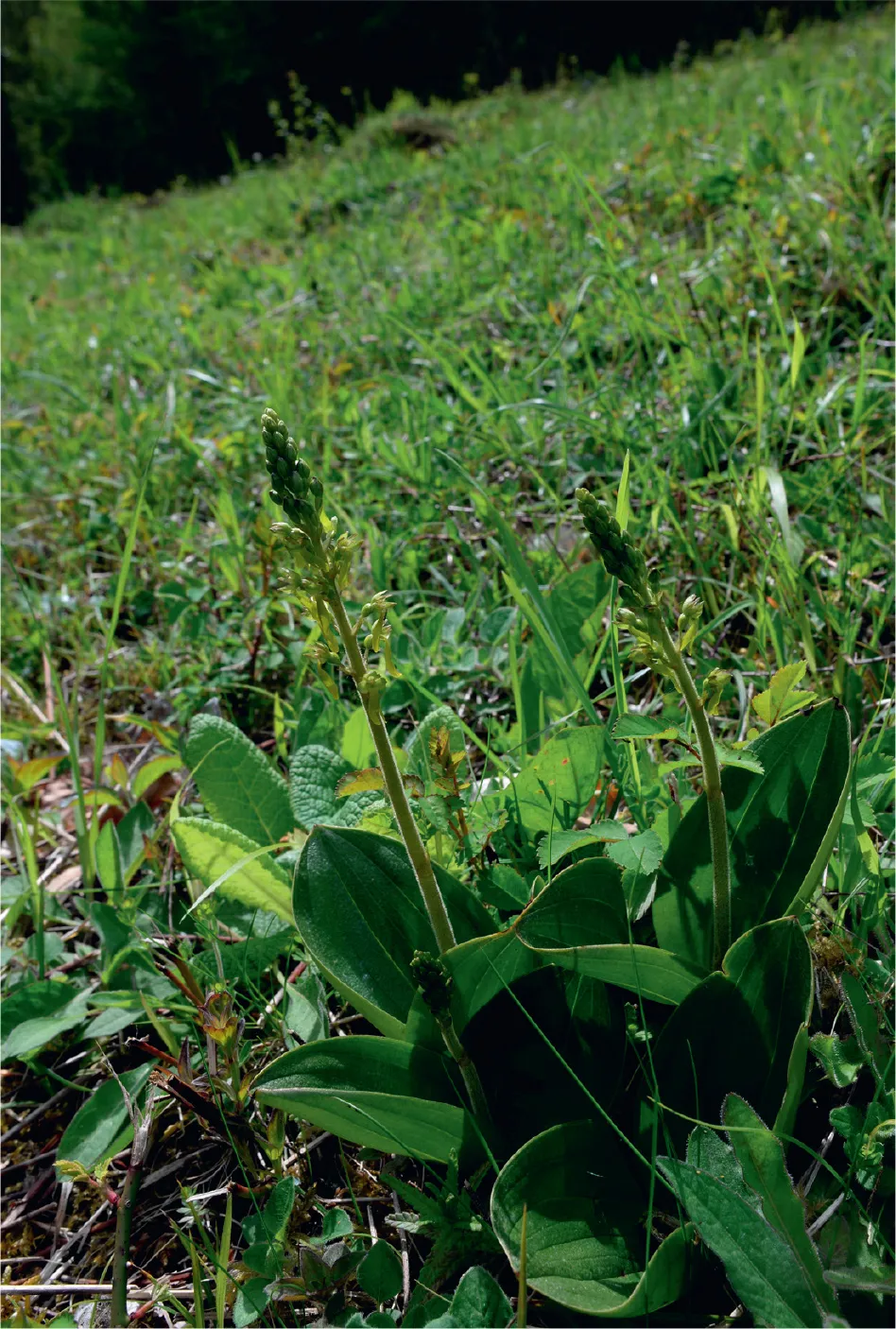
At first glance the vegetation on the bank looks simple, comprising grassland with a small path running between ant hills. Take a closer look, however, and it reveals itself as a complex tangle of mosses, grasses and a wide variety of herbs. There are nine species of orchid growing here, although this early in the year only Common Twayblade is flowering (Fig. 3). The orchid-rich character of this bank is not new – in the 1860s, obsessed by the complexities of orchid reproduction, Charles Darwin fondly referred to this site as his ‘orchis bank’. The name fitted the site well in the 1860s when many more British orchid species were placed in the genus Orchis than is the case today, and orchis was also used in the English name of several orchid species. The Darwins lived in Downe village only a short walk away, and the orchis bank was the objective of a favourite afternoon walk for Charles and his wife Emma, and possibly one of the inspirations for Darwin’s metaphor of an ‘entangled bank’ that famously appears in the final paragraph of On the Origin of Species. Today it’s still a quiet stroll from Downe along a footpath beside the Cudham Road to reach the reserve. As a classic description of the complexity of nature that ecologists strive to understand, Darwin’s entangled bank still works today. Indeed, this book is an introduction to the ideas that help us start to untangle the entangled bank, and understand the complexities of ecology.
FIG 3. Common Twayblade Neottia ovata flowering on Downe Bank, one of nine species of orchids that grow on Darwin’s orchis bank.
Darwin (1859) closed one of the most famous books in the history of science with this description of the English countryside he knew:
It is interesting to contemplate an entangled bank, clothed with many plants of many kinds, with birds singing on the bushes, with various insects flitting about, and with worms crawling through the damp earth, and to reflect that these elaborately constructed forms, so different from each other, and dependent on each other in so complex a manner, have all been produced by laws acting around us.
Many of the banks and field margins around Downe in the mid-nineteenth century would have matched this description, and while Downe Bank is often cited as the origin of the entangled bank (simplified to a ‘tangled bank’ in later editions of The Origin), Janet Brown (2002), one of Darwin’s most important biographers, rightly deploys the caution and scepticism of a good historian, writing that the orchis bank ‘may well have been the same sweetly tangled bank’. Whatever its role in inspiring Darwin’s classic image of biodiversity, the Darwin connection gives Downe Bank added importance in British natural history, and it was the first reserve acquired by the Kent Wildlife Trust, in 1962.
That day in May Brimstone butterflies Gonepteryx rhamni were ‘flitting about’, yellow against the bright green of the unfolding leaves on the coppice at the base of the bank, while overhead flew Ring-necked Parakeets Psittacula krameri. While much has not changed on the bank since Darwin’s time, the parakeets would have surprised him. It’s a bird he probably never saw in the wild – its native range is central Africa, India and nearby countries (places he never visited on the Beagle voyage). There were some escapes from captivity into the wild in Britain, including a population that survived for a few years in Norfolk around the time of Darwin’s death, but our current population appears to have originated from multiple escapes of captive birds during the twentieth century (Heald et al. 2020). This colourful intrusion of tropical diversity into the Kent countryside illustrates one of the many ways in which humans have changed the ecology of the planet – moving large numbers of organisms to locations far from their original home – a topic returned to in Chapter 12.
WHAT IS ECOLOGY?
Using Darwin’s metaphor of an entangled bank to introduce the science of ecology raises a basic question – what do we mean by ecology? The word ‘ecology’ gets used in multiple ways, several of which are compatible with using Darwin’s orchis bank as the opening example in this book. Say ‘ecology’ to many people and they will often think of nature conservation and attempts to address a whole host of environmental problems – from ‘saving the whales’ when I was growing up in the 1970s, to fears that the whole planet is potentially now in need of saving. This book doesn’t address ecology in this sense (except in the final chapter, which gives a necessarily selective brief overview of some aspects of ecology as applied to environmental problems). Instead it focuses on the science of ecology – especially the ecological concepts that attempt to explain the workings of Darwin’s entangled bank. Why is this bank (and the world at large) so diverse, and what are the relationships between the plants of many kinds, the birds singing on the bushes, and the various insects flitting about, not to mention the worms crawling through the damp earth and a host of other small and often overlooked organisms? The importance of microorganisms and fungi in ecological processes is one of the recurring themes in this book. Key ecological processes are often driven by obscure organisms that seldom feature in TV natural history documentaries or books and magazine articles written by, and for, naturalists (Fig. 4).
The term ‘ecology’ was coined (originally as ‘oecologie’) by Ernst Haeckel and popularised in a widely read book of 1866 where he defined ecology as ‘the whole science of the relations of the organism to the environment’ (Egerton 2012). Our modern definitions are still very similar – for example, ‘the scientific study of the abundance and distribution of organisms in relation to other organisms and environmental conditions’ (Ricklefs & Relyea 2014). Haeckel certainly didn’t singlehandedly invent ecology; as so often in the history of science, it is impossible to identify a clear starting date, and many people were starting to do what we would now consider ecological studies long before 1866 (one of many examples was Gilbert White; see Chapter 8). However, giving this area of science a name and a formal definition obviously helped focus people’s attention on this way of thinking about the world, although it was the end of the nineteenth century before ecology started to become a growing area of research.
FIG 4. Lichen-covered rock on Cadair Idris, Snowdonia. The large pale green lichen is Map Lichen Rhizocarpon geographicum (the grey patches are other species of lichens). The main body of a lichen is made up of fungus, but the ‘organism’ itself is a composite of fungus and a range of species of microbes (see Chapter 7).
In Britain, plant ecology developed more rapidly than animal ecology, with Arthur Tansley being a particularly influential figure in the early decades of the twentieth century. It would however be incorrect to assume that the key driver for ecological research has always been the sort of environmental concern that people would now often attribute to scientists working in this area. As the science historian Peter Bowler (1992) has pointed out, many early ecological studies were ‘often initiated by scientists who hoped to modify the natural balance in order to allow sustainable exploitation’. This was particularly the case for some of the early ecological researchers in the United States of America, and it is still important – for example in applying ecological ideas to try and formulate a more sustainable agriculture. Whatever the underlying reason for studying ecology, the science is underpinned by a number of basic ideas, and the aim of this book is to introduce some of these using examples drawn from British natural history. The rest of this opening chapter discusses a couple of very basic and fundamental concepts – with many more detailed ideas considered in the subsequent chapters.
ISLANDS OF ORDER IN A SEA OF CHAOS
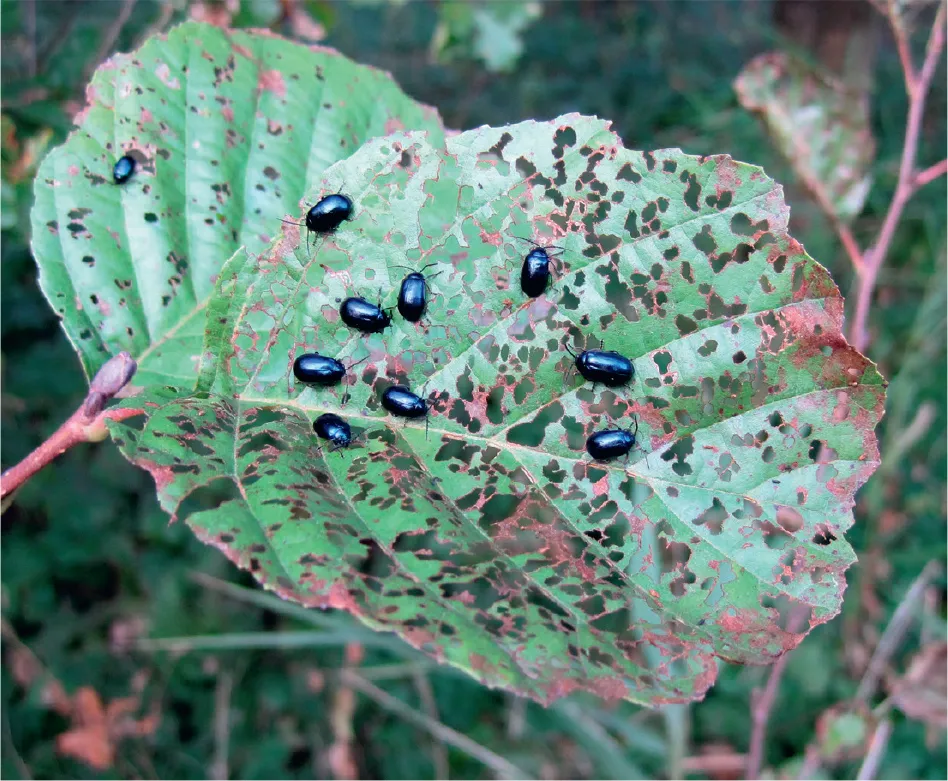
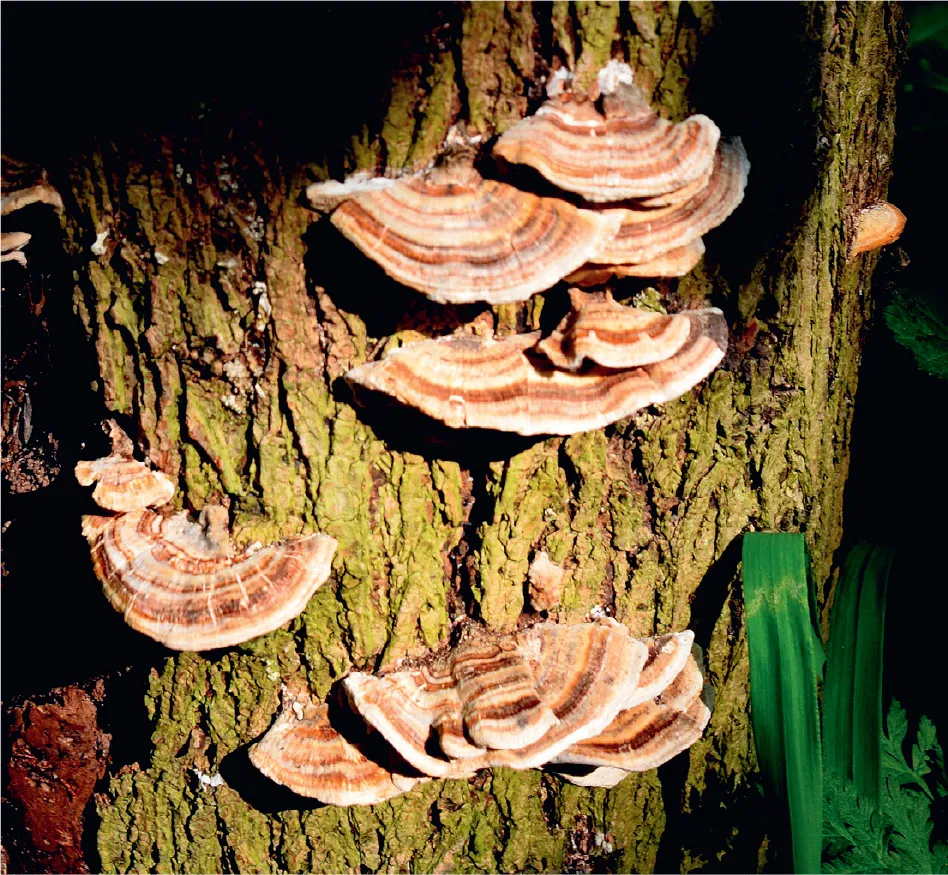
An obvious question in ecology is this – where does an organism get its energy from? Common answers are that the energy comes from photosynthesis, or that it comes from eating other organisms – be that as a herbivore eating plants (Fig. 5) or as a carnivore eating other animals. As discussed in more detail later in this book, however, other options are available, such as feeding on dead biological material (Fig. 6) or mixing photosynthesis with consuming other organisms.
To understand why the acquisition of energy is such a fundamental process in ecology requires a brief excursion into the ideas embodied in an area of science called thermodynamics. This sounds a long way from anything to do with natural history, but as a science that’s all about the movement of energy in the form of heat it’s very relevant to many ‘why’ questions in natural history. The early history of thermodynamics makes this obvious. It was developed as an area of theory applicable to steam engines – how they are fuelled (effectively, what they eat) and how efficiently they can use these sources of power. These are also questions we can ask about the plants, birds and worms in Darwin’s entangled bank.
Fundamental to understanding energy use by organisms (or steam engines) is the idea of the second law of thermodynamics. This ‘is of central importance in the whole of science, and hence in our rational understanding of the universe, because it provides a foundation for understanding why any change occurs’ (Atkins 2007). Peter Atkins, who wrote these words, is a distinguished physical chemist, but the second law is just as central to ecology as it is to chemistry. This should not be a surprise when you consider that metabolism (the processes in cells by which energy is stored or released) is a chemical process. This approach to thinking about thermodynamics and ecology, described below, is a brief summary of a somewhat more technical discussion in my earlier book Fundamental Processes in Ecology: an Earth Systems Approach (Wilkinson 2006).
FIG 5. Alder Leaf Beetles Agelastica alni feeding on Alder Alnus glutinosa leaves at Askham Bog on the outskirts of York in 2019. This beetle was thought to have become extinct in Britain in the 1940s, but it reappeared in 2004, and is now becoming common at some locations in northern England.
FIG 6. Turkeytail Trametes versicolor in Bunny Old Wood, Nottinghamshire. A very common fungus growing, and feeding, on dead wood. This is a very variably coloured species, and one of the commonest polypores in Europe (Kibby 2017).
Look in a physics text or popular science book (such as the one by Peter Atkins from which I have just quoted) and you will see that the second law is usually defined in relation to a concept called ‘entropy’. One way to think of entropy is that it is a measure of the disorder, or our lack of information, about the state of things – this is a horribly inexact way of describing entropy, but any attempt at anything more rigorous quickly becomes rather technical (Thorne & Blandford 2017). One brief way of stating the second law of thermodynamics is that ‘the entropy of the universe is always increasing’ – so we should expect things to become more disordered over time. This certainly seems true of my study as I am working on a book, and physics suggests it is true of the universe as a whole. However, as naturalists we can sidestep ideas of entropy and instead use a more intuitive concept called ‘free energy’. This is simply the amount of energy available for doing useful work – for example, walking to the bookshelves behind me as I write, to check physics textbooks in an attempt to make sure what I am writing is at least approximately correct (give or take the odd simplification).
Why should free energy matter to an ecologist? Think about the look of an organism such as the orchid in Figure 3 or the beetles (or the Alder leaf) in Figure 5, or look at yourself in a mirror – all these examples look ordered, and in many cases they are bilaterally symmetrical too (i.e. one side is a mirror image of the other). In a universe dominated by the second law, how do such organisms manage to stay so organised rather than falling apart? In a neat phrase, Lynn Margulis and Dorion Sagan (1995) encapsulated this idea as organisms representing ‘islands of order in an ocean of chaos’. The way organisms maintain this order – and temporarily save themselves from death and the ocean of chaos – is to use energy from their environment to maintain their ordered structure. As no organism, or machine, can be 100 per cent efficient (this follows from thermodynamics too), then all organisms must also be producing some waste. The ecological implications of these fundamental ideas from physics can be summarised as:
energ...