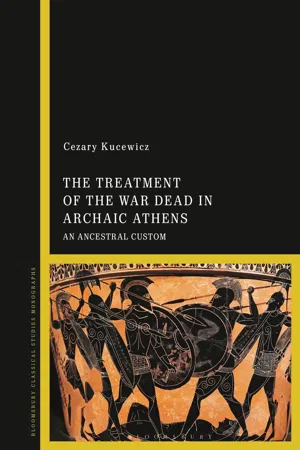
Exploring the representations of the war dead in early Greek mythology, particularly the Homeric poems and the Epic Cycle, alongside iconographic images on black-figure pottery and the evidence of funerary monuments adorning the graves of early Athenian elites, this book provides much-needed insight into the customs associated with the war dead in Archaic Athens. It is demonstrated that this period had remarkably little in common with the much-celebrated institutions of the Classical era, standing in fact much closer to the hierarchical ideals enshrined in the epics of Homer and early mythology.
While the public burial of the war dead in Classical Athens has traditionally been a subject of much scholarly interest, and the origins of the procedures described by Thucydides as patrios nomos are still a matter of some debate, far less attention has been devoted to the Athenian war dead of the preceding era. This book aims to redress the imbalance in modern scholarship and put the spotlight on the Athenian war dead of the Archaic period.
In addition, the book deepens our understanding of the processes which led to the establishment of first public burials and the Classical customs of patrios nomos, shedding significant light on the military, cultural and social history of Archaic Athens. Challenging previous assumptions and bringing new material to the table, the book proposes a number of new ways to investigate a period where many 'ancestral customs' were thought to have their roots.
- 296 pages
- English
- ePUB (mobile friendly)
- Available on iOS & Android
eBook - ePub
About this book
Information
1
The Homeric War Dead
The Iliad is littered with corpses and gory depictions of death in battle. Men die from fatal blows to nearly every part of the body, including the eyes, mouth and bladder. Warriors are decapitated and mutilated, heads and armless torsos are sent ‘spinning like a ball’ (13.204) or rolling ‘like a log down the battle’ (11.147).1 The Iliad, as Moses Finley summarized, ‘is saturated in blood’, whilst the ‘poet and his audience lingered lovingly over every act of slaughter’.2 According to one estimate, there are no fewer than 274 men killed in the Iliad. Some of the most famous and memorable scenes of the poem concern the deaths of the main heroes Sarpedon, Patroclus and Hector.3 The centrality of death and dying as the leading theme of Homer’s epic poem is undeniable, and would go on to provide a source of inspiration for all ancient Greek writers. ‘The Iliad’, as Emily Vermeule concluded, ‘put dying, though not death itself, in stage center and shaped the tradition of subsequent literatures, that death is not the enemy of achievement or creativity but its cause, since the contemplation of death is the single factor which makes us long for immortality’.4
For Homeric warriors, however, not all deaths were equal. The social status of elite heroes, or the aristoi, required them to receive lengthy and lavish funerals after their deaths in battle. Achilles’ obsequies, for instance, lasted for seventeen days; Hector’s funeral took nine and Patroclus’ two days, concluded with glorious funeral games.5 The fate of the dead bodies of the common warriors in the Iliad, on the other hand, is markedly different. Most end up unburied and exposed to scavengers. This contrast is especially evident when one compares the opening and closing lines of the poem:
Sing, goddess, the anger of Peleus’ son Achilles and its devastation, which put pains thousandfold upon the Achaeans, hurled in their multitude to the house of Hades strong souls of heroes, but gave their bodies to be the delicate feasting of dogs, of all birds, and the will of Zeus was accomplished…
1.1–5
They piled up the grave-barrow and went away, and thereafter assembled in a fair gathering and held a glorious feast within the house of Priam, king under God’s hand. Such was their burial of Hector, breaker of horses.
24.801–4
The radical difference in the treatment of the bodies of elite and non-elite warriors – the one exposed and mutilated, the other buried and glorified – seeps through a number of similar passages in the Iliad, which provide an important insight into the social world depicted in the poem. The double standard governing the retrieval and burial of the dead, however, has rarely been considered in the numerous studies of Homeric society, which usually tend to focus either on the political and economic status of the poem’s kings and nobles (basileis), or the historical authenticity of the communities portrayed in the Iliad and Odyssey.
In this chapter I will explore the ideals and norms surrounding the retrieval and treatment of the war dead, as depicted in the Homeric poems. I will analyse epic scenes involving fighting over corpses, mass and individual burials, as well as despoiling and mutilating the dead. What were the reasons behind the contrasting treatment of the bodies of elite and common warriors? Can they throw any meaningful light on the ideals and structure of Homeric society? Finally, did the Homeric poems reflect or provide an archetype for the Athenian standards governing the treatment of the war dead of the Classical period? The Homeric epics are our richest literary source for burial customs in the early Greek world, on the levels of practice, ideology and social and religious attitudes to death.6 This richness, as we will see in this chapter, also manifests itself in the way the poems depict the war dead, their recovery, treatment and commemoration. The historicity of the latter practices, firmly embedded within the poetic depictions of combat, belong to a wider debate on the relation of the fighting scenes from the epic to the realities of war in early Greece. Despite obvious difficulties in trying to assign a precise time frame to Homeric warfare, recent scholarly studies tend to highlight the similarities between battles depicted in the Iliad and the type of fighting portrayed in the poetry and art of the seventh century BC, in particular the songs of Callinus and Tyrtaeus.7 The poems, according to these interpretations, bore a clear resemblance to early Archaic warfare, while at the same time providing enduring military ideals for generations of Greek audiences. The relation of these ideals, especially those surrounding the treatment of the war dead, to the historical realities of Archaic battlefields will therefore be a common thread throughout the chapters of this book. Homer, as Plato remarks in the Republic (606E), was the ‘educator of Hellas’, and his influence was nowhere stronger than in the matters of the military ethos and war.8 Any study of Greek attitudes towards the war dead, therefore, has to begin with the Iliad.
Homeric society: Elite vs commoners
The traditional view that permeates most studies of Homeric society emphasizes the class boundary which separated the aristoi and basileis from the multitude of commoners.9 The iron curtain which divided the Homeric princes from the rest of the people was strictly adhered to and rarely crossed in both the battle narratives of the Iliad and the depictions of household and community life in the Odyssey.10 The most common example used to demonstrate the rigid class ideology of the poems is the famous episode of the Achaean assembly in Book 2 of the Iliad.11 After Agamemnon’s plan to order a mock retreat of his army to test the Achaean morale fails, Odysseus, prompted by Athena, restores order by speaking to both kings and common warriors:
Whatever king or man of note he met, to his side he would come and with gentle words seek to restrain him, saying: ‘It is not right, man, to try to frighten you as if you were a coward, but sit down yourself, and make the rest of your people sit’… But whatever man of the people he saw, and found brawling, him he would drive on with his staff, and rebuke with words, saying: ‘Sit still, man, and listen to the words of others who are better men than you; you are unwarlike and lacking in valour, to be counted neither in war nor in counsel. In no way will we Achaeans all be kings here.’12
2.188–203
Odysseus’ speech has an immediate effect and the Achaean army unites once more, with the exception of a commoner Thersites, who disrupts the assembly by abusing Agamemnon. Odysseus, however, immediately scorns him (‘you shall not lift up your mouth to argue with princes, cast reproaches into their teeth’ 2.250–1) and strikes him with a royal sceptre, much to the approval of the rest of the army.
The whole episode reveals a clear class-division between the Homeric nobles and commoners.13 The first were men of influence; respected and politely spoken to, leaders of men in combat and council. The others were cowards of no account in battle or assembly, kept in check with harsh words and, if necessary, violence. As such, the social world depicted in the Iliad and Odyssey, according to traditional interpretations, was rigidly stratified into classes and centred primarily on the actions of the basileis and aristoi, who held an unquestionable monopoly in war and politics. The lives and exploits of the common people, on the other hand, were consequently downplayed by the poet. ‘Throughout the poems’, as Ian Morris remarked, ‘the basileis are glorified, and the demos ignored to the point of total exclusion’.14 The poems, therefore, have been widely seen as products of an elite ideology, composed and informed by an elite perspective and written for an elite audience.15
The Homeric basileis stand out from the crowds on account of their wealth, noble birth, superior fighting skills and physical beauty.16 They occupy the highest political positions in their respective communities, while at the same time continually striving to enhance their social rank and reputation in the eyes of the fellow aristoi by performing outstanding deeds on the battlefield, in the assembly or, indeed, in any other competitive environment. In times of peace, the basileis act both as heads of their households (oikoi), which consist of a large estate in town and a sizeable amount of land in the countryside, and rulers of their communities.17 During war, they recruit men among their followers, retainers and dependants and lead them in battle. Altogether, the Homeric basileis form a cohesive and highly competitive group, defined by shared social norms and values, and led by the paramount basileus whose position is usually inherited and based on superior wealth and numbers of followers.18
Furthermore, the Homeric princes enjoy a number of privileges assigned to them by their communities. As Sarpedon, the paramount basileus of the Lykians, explains in his famous speech to Glaukos, the aristoi are honoured by all people with ‘pride of place, the choice meats and the filled wine cups in Lykia, and all men look on us as if we were immortals, and we are appointed a great piece of land by the banks of Xanthos, good land, orchard and vineyard, and ploughland for the planting of wheat’ (12.311–14).19 These honours, as Sarpedon adds, are given to them because of their military leadership and martial excellence:
‘Therefore it is our duty in the forefront of the Lykians to take our stand, and bear our part of the blazing of battle, so that a man of the close-armored Lykians may say of us: ‘Indeed, these are no ignoble men who are lords of Lykia, these kings [basilēes] of ours, who feed upon the fat sheep appointed and drink the exquisite sweet wine, since indeed there is strength of valor in them, since they fight in the forefront of the Lykians’.
12.315–21
The battle narratives of the Iliad confirm the supremacy of the Homeric basileis in combat, as the action focuses nearly exclusively on the individual exploits of a small number of leading heroes.20 The long episodes of the martial feats (aristeia) of Agamemnon, Diomedes or Achilles, lend further support to the class-division in the poem, as the nameless masses of warriors (laoi) appear to play no signific...
Table of contents
- Cover
- Half-Title Page
- Series Page
- Title Page
- Contents
- List of figures
- Acknowledgements
- Notes to the reader
- Introduction: The War Dead in Ancient Athens
- Part One
- 1 The Homeric War Dead
- 2 The War Dead in the Greek Mythological Tradition
- Part Two
- 3 The War Dead in the Early Greek Iconographic Tradition
- 4 Archaic Monuments for the War Dead
- 5 Ancestral Customs in the Classical City
- Part Three
- 6 War, State and Society in Archaic Athens
- Conclusion
- Notes
- Bibliography
- Index
- Copyright
Trusted by 375,005 students
Access to over 1.5 million titles for a fair monthly price.
Study more efficiently using our study tools.
Frequently asked questions
Yes, you can cancel anytime from the Subscription tab in your account settings on the Perlego website. Your subscription will stay active until the end of your current billing period. Learn how to cancel your subscription
No, books cannot be downloaded as external files, such as PDFs, for use outside of Perlego. However, you can download books within the Perlego app for offline reading on mobile or tablet. Learn how to download books offline
Perlego offers two plans: Essential and Complete
- Essential is ideal for learners and professionals who enjoy exploring a wide range of subjects. Access the Essential Library with 800,000+ trusted titles and best-sellers across business, personal growth, and the humanities. Includes unlimited reading time and Standard Read Aloud voice.
- Complete: Perfect for advanced learners and researchers needing full, unrestricted access. Unlock 1.5M+ books across hundreds of subjects, including academic and specialized titles. The Complete Plan also includes advanced features like Premium Read Aloud and Research Assistant.
We are an online textbook subscription service, where you can get access to an entire online library for less than the price of a single book per month. With over 1.5 million books across 990+ topics, we’ve got you covered! Learn about our mission
Look out for the read-aloud symbol on your next book to see if you can listen to it. The read-aloud tool reads text aloud for you, highlighting the text as it is being read. You can pause it, speed it up and slow it down. Learn more about Read Aloud
Yes! You can use the Perlego app on both iOS and Android devices to read anytime, anywhere — even offline. Perfect for commutes or when you’re on the go.
Please note we cannot support devices running on iOS 13 and Android 7 or earlier. Learn more about using the app
Please note we cannot support devices running on iOS 13 and Android 7 or earlier. Learn more about using the app
Yes, you can access The Treatment of the War Dead in Archaic Athens by Cezary Kucewicz in PDF and/or ePUB format, as well as other popular books in History & Greek Ancient History. We have over 1.5 million books available in our catalogue for you to explore.