First published Open Access under a Creative Commons license as What is Inclusive Research?, this title is now also available as part of the Bloomsbury Research Methods series.
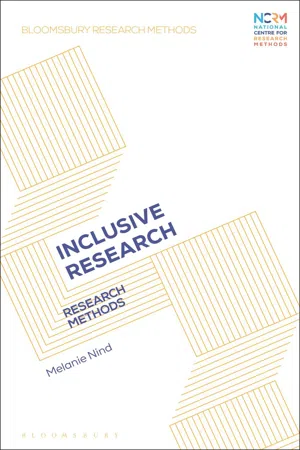
This book describes and defines inclusive research, outlining how to recognize it, understand it, do it, and know when it is done well. In doing so it addresses the areas of overlap and distinctiveness in relation to participatory, emancipatory, user-led and partnership research as well as exploring the various practices encompassed within each of these inclusive approaches.
The author, Melanie Nind, focuses on how and why more inclusive approaches to research have evolved. She positions inclusive research within the key debates and shifts in policy, defines key ideas and terms, discusses the contested nature of inclusive research and illustrates a range of approaches using exemplars. The aim is to discuss the range of challenges involved and to examine the degree to which these challenges have so far been met.
- 120 pages
- English
- ePUB (mobile friendly)
- Available on iOS & Android
eBook - ePub
About this book
Information
1 Inclusive research defined
Introduction
This book introduces readers to inclusive research including how to recognize it, understand it, conduct it and know when it is done well. I have a developing – rather than fully developed – stance on inclusive research myself. As I discuss further in Chapter 5, I have adopted a more inclusive approach at some times than at others and I have recently engaged in a study of what quality means in inclusive research. The quality study (Nind and Vinha, 2012) involved focus group dialogue with over 60 inclusive researchers/supporters and funders of inclusive research to co-create knowledge about this way of approaching research and supporting social inclusion. I am convinced by the argument (e.g. Walmsley and Johnson, 2003) that inclusive research requires critical scrutiny and I engage in this throughout the book.
Inclusive research encompasses a range of approaches and methods and these may be variously referred to in the literature as participatory, emancipatory, partnership and user-led research – even peer research, community research, activist scholarship, decolonizing or indigenous research – the list goes on. By way of illustration, the International Collaboration for Participatory Health Research (ICPHR, 2013) add to the list of research traditions in this camp: Participatory Rural Appraisal (PRA), Liberationist Research approaches, Action Research, Human/Cooperative/Appreciative Inquiry, Community-Based Participatory Research (CBPR), Constructivist Research, Feminist Research, Empowerment Evaluation and Democratic Dialogue. Many of these terms are in more frequent usage than the term ‘inclusive research’ that I have opted to use for this book. I use inclusive research deliberately as the most generic term, however, to embrace this whole family of approaches, all of which reflect a particular turn towards democratization of the research process.
It is worth noting at this juncture that alongside common threads and distinctive features among research approaches that might be considered inclusive, there is variation in terms and meanings that relate to international variations. I write from the United Kingdom where inclusive research is emerging as a term. It is used differently here from action research where the ideas of Kurt Lewin, Lawrence Stenhouse and John Elliott have been influential in a concept evolving to stress the personal, professional and political in educational action research in particular (Noffke, 2009). In the United States, collaborative research is a similar umbrella term, more commonly used to embrace research that actively engages communities and policy makers in conducting research, including framing the research problem and interpreting and acting on the findings. Minkler and Wallerstein (2008) regard CBPR also as an ‘overarching’ term: for action research, participatory action research (PAR), mutual inquiry and feminist action research, all of which stem from a reaction to a dominant research tradition and bring a new ‘orientation’ based on mutual respect and co-learning. They note the difference between the way that action research is understood in the United Kingdom and Australia compared to the United States, and the different geographical roots of PAR in work with oppressed peoples in Asia, Africa and Latin America. Wallerstein and Duran (2008) similarly note Northern and Southern traditions and variations. The Durham Community Research Team (2011) observes that while the concept of CBPR is most used in US health research it is used in the United Kingdom also.
In this first chapter some of these nuances are acknowledged and some, by necessity, are set aside as inclusive, collaborative, participatory, emancipatory, participatory action, and partnership/user-led/child-led research are defined and explained in relation to each other and to the fields and arguments from which they have evolved. Within each of the research approaches defined in this chapter there are elements of consensus, elements where there are differences of emphasis, and matters of greater contention. This includes discussion of the ways in which they overlap and what makes them distinctive. In later chapters the rationale for inclusive research in different fields and disciplines is explained (Chapter 2), different models of inclusive research are presented through illustrative examples (Chapter 3), the challenges and criticisms – together with responses to these – are discussed (Chapter 4), and the quality, status and future of inclusive research is explored (Chapter 5).
Inclusive research is a growing field and one in which researchers can be passionate, often arguing that inclusive research (or their particular variety of it) is superior in some way. Contested matters include who gets to participate in research (Cornwall and Jewkes, 1995; Holland et al., 2008), what constitutes active participation (Gallacher and Gallagher, 2008), whether it is the quality of the participation or the quality of the research that matters more (Freeman and Mathison, 2009; Greene, 2009), whether inclusive or participatory research is necessarily ‘ethically or morally superior’ or ‘more enabling’ (Holland et al., 2008; Frankham, 2009) and whether participation and emancipation can be decoupled (Danieli and Woodhams, 2005). There are also debates about the individuals, groups and topics for whom inclusive research is helpful or necessary, and about what is driving the push to make the research inclusive. To enter such debates it is first necessary to look at the various ways in which these kinds of research are conceptualized.
Defining inclusive research
The term inclusive research can be found prominently in the field of learning disability1 research and in the work of Walmsley and Johnson (2003). They use the term to embrace ‘a range of research approaches that traditionally have been termed “participatory”, “action” or “emancipatory”’ (p. 10). Importantly, they pinpoint the commonality between these: ‘Such research involves people who may otherwise be seen as subjects for the research as instigators of ideas, research designers, interviewers, data analysts, authors, disseminators and users’ (p. 10). In answer to why yet another term is needed for this kind of research, Walmsley and Johnson are clear: inclusive research as a term allows for the blurred and shifting boundaries between, for example, feminist, participatory and emancipatory research and it ‘has the advantage of being less cumbersome and more readily explained to people unfamiliar with the nuances of academic debate’ (p. 10). It is a term that can be used across fields and disciplines.
Inclusive research can be usefully thought of as research that changes the dynamic between research/researchers and the people who are usually researched: it is conceived as research with, by or sometimes for them (see Griffiths, 1998), and in contrast to research on them. Inclusive research shares common ground with qualitative research more widely, particularly the concern with grounding research in the experiences and views of respondents (Kiernan, 1999). Most qualitative research, though, retains the status quo of the researcher being the person who defines the questions, handles and controls the interpretation of the data, and makes and communicates the conclusions; it is this that is unsettled in inclusive research. Kiernan (1999) regarded such a turn as a new paradigm but with variations in how it was understood and enacted by traditional and new ‘co-researchers’. Fenge (2010) in the title of her paper about PAR with older lesbians and gay men, ‘Striving towards Inclusive Research’, reminds us that journeying towards being inclusive is at the heart of what the shift in paradigm is about.
Predictably, inclusive research cannot be translated into one particular way of doing things; the options or permutations for this are extensive (Walmsley, 2004). Nonetheless, it is possible to pinpoint the characteristics and principles underpinning inclusive research. Walmsley and Johnson (2003, p. 64) do this in relation to people with learning disabilities:
• The research problem must be one that is owned (not necessarily initiated) by disabled people.
• It should further the interests of disabled people; non-disabled researchers should be on the side of people with learning disabilities.
• It should be collaborative – people with learning disabilities should be involved in the process of doing the research.
• People with learning disabilities should be able to exert some control over process and outcomes.
• The research question, process and reports must be accessible to people with learning disabilities.
An alternative umbrella term to inclusive research might be CBPR, as discussed earlier, or collaborative research, as used for example by the University of California Center for Collaborative Research for an Equitable California (CCREC). They describe collaborative research as ‘engaged scholarship in action, in which university researchers, community members, and policy makers respect the knowledge that each partner brings to the discussion so that together they might know better how to understand the complex problems facing our communities and how to design and implement research-based responses to those problems’ (CCREC, n.d.). They also recognize the plethora of similar labels attached to such research, including community-based research, CBPR, engaged scholarship and PAR. The overlap with inclusive research is clear to see. While throughout this book I use inclusive research as my umbrella term, I acknowledge that collaborative research as a term might work equally well if it were not also used to refer to all kinds of collaborations, for example, between parties of equal status or between universities and business partners, which reflect a completely different agenda. Similarly action research terms are problematic in that not all action research has a participatory element and CBPR carries with it the concept of community that does not travel well across cultures and languages (Springett et al., 2011). While the nature of this book series and book theme necessitates using an overarching term, I also, at times, adapt choice of language to reflect political and other contexts as Springett et al. (2011) argue is necessary.
Defining participatory research
To see how the term inclusive research also allows for the overlap and reciprocity between participatory and emancipatory research these too need to be defined. Cancian (1989) sees participatory research as involving democratic relationships to produce knowledge which incorporates participants’ everyday knowledge, and to solve problems. Bourke (2009, p. 458) offers a definition of participatory research as ‘a research process which involves those being researched in the decision-making and conduct of the research, including project planning, research design, data collection and analysis, and/or the distribution and application of research findings’. This definition indicates that it is the people being researched who are participating and that the participation is comprehensively across the multiple stages of the research. It stresses involvement in the process of doing the research rather merely providing data for it, which is echoed by many. As with inclusive research, many writing specifically about participatory research tend to resist further delineation of what this involves in practice.
Byrne et al. (2009, pp. 67–8) address the inherent motivation for participatory research: ‘participatory researchers seek to engage in meaningful partnerships with the researched seeking meaningful data for social transformation.’ Thus, participatory research has an element of doing things in a more participatory way for a reason – to bring about change (Durham Community Research Team, 2011; ICPHR, 2013). At this point there are different emphases among the various advocates of this kind of research. The change might be about how knowledge is produced, including ‘a de-privileging of “researcher-only” expertise’ (Byrne et al., 2009, p. 68; ICPHR, 2013), or about what the knowledge is used for. For Fenge (2010, p. 880) this is about ‘lay researchers . . . setting the agenda for the research to be undertaken’, and for Browne et al. (2012) it is about influencing the agendas of those with power while empowering those without. The social change associated with participatory research is partly achieved by making research more of a dialogue; a crucial element is academic and lay researchers2 working closely together to benefit from each other’s perspectives.
In participatory research the contention is mostly about whether participatory research is a set of techniques or a political philosophy (Cleaver, 1999). Methods can be important. Dyslexic doctoral researcher Spires has explained to me the importance of her video methods in doing research with university students with dyslexia: providing alternatives to producing and reading written text, for all their benefit. Similarly, Ayrton (2012) sought fitting methods for her research with mothers in Southern Sudan where literacy is limited. By stringing beads on to a leather thong to make bracelets, she supported the women to tell their life stories without employing artefacts associated with education and literacy. This also provided them with a valued product of the reflections. Nonetheless, many would argue that methods are not the essence of participatory research.
ICPHR (2013) stress that participatory research, or participatory health research which is their particular concern, is a research paradigm rather than a research method. This means that it is the underlying assumptions that matter most, or as Cook (2012) argues, such research ‘inhabits different spaces and offers different ways of seeing’. Fals-Borda and Rahman (1991) even refer to participatory research approaches as a range of epistemological principles or paradigms. Cooke and Kothari (2001), Punch (2002), Kesby (2007) and Clark (2010) have all argued for participatory design rather than for participatory methods. Participatory methods for research with children are often devised and referred to as child friendly, but Todd (2012, p. 193) explains that ‘the adoption of methods as seemingly more “child friendly” misses the complexities of the research situation, as a contested and constructed site.’ Thomson (2007, p. 209) is also explicit about this, arguing that ‘participation is not inherent to the research methods themselves as some accounts of participatory methods seem to imply.’ She has an alternative concept of participatory research as ‘spatial practice’. Spaces for life experiences to be discussed may be ‘closed’ (or ‘invited’) spaces, directed by the researcher, or ‘claimed/created space’, in which participants can create new power and possibilities. Cornwall and Jewkes (1995, p. 667) similarly argue that ‘what is distinctive about participatory research is not the methods, but the methodological contexts of their application’ – the researchers’ attitudes on the various research problems leading them to adapt ordinary methods for use by and with ordinary people. Also contentious, they argue, is whether participatory research is ‘a universal panacea for the problems besetting conventional practice’ or ‘biased, impressionistic and unreliable’. This panacea question is discussed further in Chapter 4.
Defining emancipatory research
Emancipatory research is usually defined in more overtly political terms than participatory research. It ‘has been widely taken to mean only that sort of research which is controlled by those who are implicated by it, with the aim of the empowerment of those participants through the research process and outcomes’ (Frankham, 2009, p. 3, after Barnes, 2003). Oliver (1992, p. 110), a major proponent of emancipatory research for disabled people, describes it as being about confronting social oppression. This for him necessitates a fundamental change in ‘the social relations of research production’ such that researchers have to ‘learn how to put their knowledge and skills at the disposal of their research subjects, for them to use in whatever ways they choose’ (p. 111). Oliver’s criteria for emancipatory research include the following: it is disabled people who gain; the research combats social oppression; disabled people are in control of the resources (otherwise it is more like participatory research); and the research process is politicized. Disabled people’s groups offer guidance on this, thereby making clear, and in some ways policing, what is seen as acceptable. For Oliver, emancipatory research is the ideal and participatory or action research is what people settle for when this cannot be achieved; moreover, settling for less involves a ‘limited vision of the possible’ (1997, p. 26) and a reinforcement of the status quo in terms of power. A useful metaphor he uses to help make the distinction is that participatory/action research approaches ‘allow previously excluded groups to be included in the (research) game as it is, whereas emancipatory strategies are concerned about both conceptualising and creating a different game, where no one is excluded in the first place’ (p. 26).
Oliver is not alone in attempting to distinguish emancipatory research from other f...
Table of contents
- Cover
- Half-Title
- Series
- Title
- Contents
- Series foreword
- Tables and figures
- Acknowledgements
- 1 Inclusive research defined
- 2 Inclusive research as an evolving set of practices
- 3 Inclusive research: Stories from the field
- 4 Inclusive research under fire: Criticisms and defences
- 5 Summary and where next? The pursuit of quality in inclusive research
- Further reading and resources
- References
- Index
- Copyright
Trusted by 375,005 students
Access to over 1.5 million titles for a fair monthly price.
Study more efficiently using our study tools.
Frequently asked questions
Yes, you can cancel anytime from the Subscription tab in your account settings on the Perlego website. Your subscription will stay active until the end of your current billing period. Learn how to cancel your subscription
No, books cannot be downloaded as external files, such as PDFs, for use outside of Perlego. However, you can download books within the Perlego app for offline reading on mobile or tablet. Learn how to download books offline
Perlego offers two plans: Essential and Complete
- Essential is ideal for learners and professionals who enjoy exploring a wide range of subjects. Access the Essential Library with 800,000+ trusted titles and best-sellers across business, personal growth, and the humanities. Includes unlimited reading time and Standard Read Aloud voice.
- Complete: Perfect for advanced learners and researchers needing full, unrestricted access. Unlock 1.5M+ books across hundreds of subjects, including academic and specialized titles. The Complete Plan also includes advanced features like Premium Read Aloud and Research Assistant.
We are an online textbook subscription service, where you can get access to an entire online library for less than the price of a single book per month. With over 1.5 million books across 990+ topics, we’ve got you covered! Learn about our mission
Look out for the read-aloud symbol on your next book to see if you can listen to it. The read-aloud tool reads text aloud for you, highlighting the text as it is being read. You can pause it, speed it up and slow it down. Learn more about Read Aloud
Yes! You can use the Perlego app on both iOS and Android devices to read anytime, anywhere — even offline. Perfect for commutes or when you’re on the go.
Please note we cannot support devices running on iOS 13 and Android 7 or earlier. Learn more about using the app
Please note we cannot support devices running on iOS 13 and Android 7 or earlier. Learn more about using the app
Yes, you can access Inclusive Research by Melanie Nind in PDF and/or ePUB format, as well as other popular books in Social Sciences & Social Science Research & Methodology. We have over 1.5 million books available in our catalogue for you to explore.