Cycling is currently enjoying a boom in popularity. What are the reasons behind this phenomenon? How have perceptions and the popularity of cycling shifted?
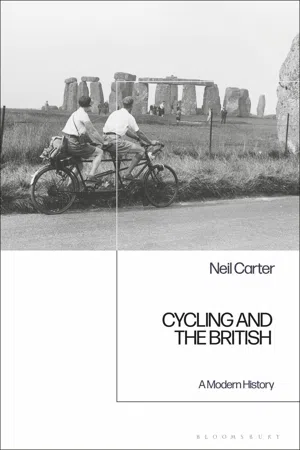
This book charts the historical development of cycling both as a leisure and sporting activity since the 19th century and explores the wider political and cultural context in which cycling in Britain emerged. In particular, it examines cycling's relationship with environmental politics and its place in popular culture. Neil Carter successfully traverses several historical sub-disciplines, including the history of transport, leisure, sport, medicine and politics, employing the analytical tools of class, gender, political culture, the role of the state and commercialism to demonstrate how British identity has shaped and been shaped by cycling.
At a time when it has become part of debates over transport and health, Cycling and the British: A Modern History provides a timely and clear analysis of the changes and continuities in attitudes towards cycling.
- 368 pages
- English
- ePUB (mobile friendly)
- Available on iOS & Android
eBook - ePub
About this book
Information
Chapter 1
Cycling and the rise of respectable recreation
In February 1869 the first London to Brighton bicycle journey took place. It was also the first long-distance bicycle road ride in Great Britain. Three pioneering velocipedes riders, Charles Spencer, J. Mayall and Rowley B. Turner, took the best part of a day to cover the 50 or so miles on machines weighing between 70 and 80 pounds. They set off in the morning, stopped off in Crawley for lunch before reaching Brighton in darkness. Spencer and Mayall were gymnasts from the German Gym Club in King’s Cross, and Spencer would later earn a living writing about cycling and as a bicycle instructor, teaching people how to ride these new modern machines. Spencer himself had been taught by Turner. It was Turner, then a student in Paris, who had been the first person to bring a Michaux velocipede – an iron-tired wooden boneshaker – to Britain in 1868. He then persuaded his uncle, Josiah Turner, the managing director of the European Sewing Machine Company (later Coventry Machinists Co. Ltd.), to accept an order to build 400 machines for the French market. However, with the outbreak of the Franco-Prussian War the machines were later put on the British market. The three riders were followed for part of their journey by a journalist from The Times in a horse-drawn carriage as the ride was, in essence, a commercial venture and an exercise in marketing, as it acted as a public demonstration of the machine’s capabilities and a test of its robustness. The completion of their ride proved that the new machine was practical and road worthy. The publicity it brought to cycling and its trade ushered in a craze for this new activity, and it became a marker of modernity among the middle classes in Britain, as at the time it was only they who could afford the price of £10 to £12 for each machine.1
The birth and then the startling growth in popularity of cycling both reflected and reinforced many of the characteristics of the Victorian age. Economic prosperity, entrepreneurship, national self-confidence and growing social divisions can all be found in the emergence of cycling as a mass activity. Cycling enjoyed an elevated place in social circles, which was both a cause and a product of a boom in sales of bicycles during the 1890s especially, and before the mass production of motor vehicles, cyclists enjoyed the relative freedom of the roads. The bicycle also offered a form of liberation and emancipation for women while organizations such as the Cyclists’ Touring Club (CTC) and the National Cyclists’ Union (NCU) established cycling as a sport and leisure activity on a national scale. While cycling eventually traversed both class and gender lines, it was initially a male, middle-class activity for participation and pleasure seeking. More generally, ‘[s]port became embroiled in the sophistication of a class society anxious to define its own position in a world of very raw newness’.2 In particular, the ideology of amateurism was present within cycling as it was in many other areas of middle-class society.
While cycling offered the Victorians a modern form of pleasure and thrill seeking, its appeal was also a response to a range of contemporary anxieties. One of these was health. Holt has argued that ‘[m]aterial and cultural forces came together in the second half of the nineteenth century to create a new culture of the body, ingeniously fusing together the values of a striving enterprising liberal elite with the refined and restrained world of upper-class good manners and style’.3 Summed up by the phrase mens sana in corpore sano, Bruce Haley has claimed that ‘[n]o topic more occupied the Victorian mind than Health – not religion, or politics, or Improvement, or Darwinism’. The dominant idea, reflecting new attitudes towards mental well-being, was ‘total health or wholeness’. New attitudes to bodily discipline found receptive audiences in all areas of Victorian society and its institutions.4 The birth of cycling coincided with the sports boom of the late nineteenth century. A cult of athleticism had been stimulated in the elite public schools, leading to a growth in the popularity of sports such as football and cricket, while for the middle classes in particular lawn tennis and golf took root in the bourgeoning suburbs. An increasing number of publications were devoted to physical culture and the importance of exercise in attaining a healthy mind in a healthy body.5
The cycling industry and the sport’s enthusiasts and promoters had been keen to point out the health benefits of cycling through its link to the ‘great outdoors’. The Victorian era had witnessed an exponential growth in office work, leading to the ‘great indoors’. Working conditions were unhealthy due to rising levels of pollution in cities, poor ventilation and a lack of lighting. As a result, it bred a need to escape into the country. One notable medical cycling enthusiast, Dr Richardson, declared,
I really know of nothing that has been so good for health. They [men and women] have learned how to ventilate their own bodies, how to imbibe an air free of injurious vapours and particles; while they have developed a freedom and a strength of limb, a mental pleasure and escape from care, which have been useful alike to mind and body. In addition, they have been gainers of many good and serviceable mental qualities.6
Arthur Balfour, the future prime minister, later noted that in light of rapid urbanization and the diminishing boundary between the rural and the urban, especially in London, previous generations had had fewer opportunities to get out of the capital ‘to enjoy by means of the cycle a breath of country air, a view of country scenery, a knowledge of the splendours of the magnificence, which English scenery presents to us’.7
On the flip side of its pleasures, riding a bicycle brought with it danger and the threat of injury. In 1876 one cyclist in Scotland had suffered a broken arm and other injuries after a boy threw his cap into the front wheel of his ordinary. It was noted that there had been many other serious accidents in Edinburgh due to this type of behaviour.8 Later, there were medical warnings over the dangers of cycling. These included damage to the spine due to a crouched riding style, ‘bicycle face’ caused by an aching neck as well a risk of a general decline in fertility. In 1896 a series of contradictory articles in the British Medical Journal on the relationship between health and cycling reflected this state of affairs.9 Much of the advice dispensed regarding exercise and its benefits for health was predicated on the notion of moderation. It was thought that excessive physical activity would lead to ill health and this also applied to cycling. Moreover, the promotion of moderation was also a reaction to the growing popularity of professional and commercial sport which contradicted the virtues of sport as seen through the eyes (and words) of an amateur elite.
Cycling, allied to its health benefits, also had a moral worth, it was argued. In 1884 E. R. Shipton, the editor of the Cycling Tourists’ Club’s CTC Gazette, proclaimed,
Cycling is daily becoming a strong moral force, not alone in that it has enlisted the sympathies of those who seek healthful recreation at a modicum of cost but because it has appealed successfully to those in high places, and because its utilitarian nature is daily bringing it into request in a hundred different ways, all of which must gain for it a position, in the estimation of an essentially practical people, which it would otherwise for many a day have been denied.10
In March 1899, Balfour, in a speech addressing the National Cyclists’ Union, in his capacity as its president, declared that ‘there has been no more civilising invention in the memory of the present generation than the invention of the cycle. (Cheers). Open to all classes, enjoyed by both sexes and by all ages, the cycle gives us health, it gives us variety.’11 Moreover, riding a bicycle was not only a healthy and pleasurable experience; it was a marker of Victorian middle-class status. Despite Balfour’s claim, at a time of rapid social change, cycling carried meanings of respectability and aspiration, which often made it a site of both social inclusion and exclusion. For Richardson, for example, cycling produced character-building qualities, such as perseverance and courage, which were important characteristics of the middle-class gentleman.12 It was in this social and cultural context that cycling emerged as a pastime.
Victorian cyclists and cycling organizations
In terms of the extent of cycling’s popularity, the period from 1870 to 1900 can be divided into two phases: before and after the craze of the 1890s. At its height from 1895 to 1897, it was estimated that there were 1.5 million cyclists in Britain.13 According to Rubenstein, ‘There is no doubt that almost everyone who could afford a bicycle and who was not physically incapacitated rode avidly during the “boom” of 1895-97.’14 Women in particular were to the fore during the boom. In 1890 a Ladies’ Cycling Club was briefly formed, before the years 1895 to 1898 witnessed the establishment of numerous female cycling clubs across the country with a national body, the Lady Cyclists’ Association, formed in 1895. Yet few of these clubs survived the boom and many disbanded, reflecting general trends within cycling.15
While much of the history of cycling has been written from the perspective of the 1890s, the ‘anti-diluvium period’ remains important as the pre-1890s established some of the social and cultural trends that shaped cycling deep in to the twentieth century. How many people actually rode bicycles and tricycles during this early period? In 1877 one estimate put the figure at 40,000. By 1888 it had grown to an estimate of 300,000 to 400,000 cyclists.16 As way of comparison, in 1884 there were only around 4,000 bicycles in France, but by 1893 this figure had increased to 132,276, rising in 1898 to 376,117.17 Early meets and parades had helped to popularize cycling, drawing large crowds and interest from the press. One of the first had been the Hampton Court meeting. It was first staged in 1874 with 40 cyclists; two years later there were over 400, most belonging to a club. In 1876 they rode two-by-two from Hampton to Teddington, then on to Bushey Park before returning to Hampton. Another indication of cycling’s bourgeoning popularity was the emergence of instructors. An early pioneer was the aforementioned Charles Spencer. Spencer was a journalist and president of the Middlesex Bicycle Club and his gymnasium was the first school for teaching bicycling. In 1870 he published a guide for beginners, The Bicycle: Its Use and Action.18 By the late 1880s there were cycling schools in most urban areas.19 In another social context, the early bicycle also drew comparisons with the horse as a ‘steed of steel’ or ‘iron steed’, for example. It reflected how now owning bicycle carried similar social and economic connotations to owning a horse, as the rider could look down on those, literally and metaphorically, who could not own one.20
Britain was still a localized and rural country during the nineteenth century.21 Yet like the railways, the bicycle was opening up the nation. The bicycle allowed a rider to discover new roads as well as new villages and towns. In June 1873 Spencer and three other members of his club rode for the first time from London to John O’Groats, a journey of about 800 miles, which took two weeks. In July 1880 Henry Blackwell and C. A. Harman, both of Canonbury CC, completed the first ‘End-to-End’ on bicycles, taking 13 days to ride 889 miles from Land’s End to John O’Groats.22 In 1878 two national cycling organizations had been formed: the Bicycle Union, later renamed the National Cyclists’ Union in 1883, and the Bicycle Touring Club, later renamed the Cyclists’ Touring Club also in 1883.23 By 1899 the membership of the CTC was over 60,000 and that of the NCU, based on its individual members and affiliated clubs, had exceeded 70,000.24 However, the vast majority of cyclists were unattached, because unlike members of team and many individual sports, they did not need to belong to a club; they instead could make their own fun due to the freedom cycling offered. Moreover, it was not compulsory for clubs to join these bodies.
Underpinning the early development of cycling was the growth of an increasingly affluent suburban middle class, comprised mainly of young men, who were eager to embrace modern technology. The late nineteenth century had witnessed a growth in the middle classes more generally. In 1880 it was estimated that the non-manual class accounted for 16.7 per cent of the working population, a figure that had increased to 26.6 per cent by 1913. While there was a modest increase in some professions such as the clergy and the law, there were exponential rises elsewhere. For example, the number of civil servants grew by nearly 170 per cent.25 Between 1881 and 1911, the number of commercial clerks in England and Wales – male and female – rose from 181,457 to 477,535.26 Male clerks and other members of the lower middle classes were at the forefront of the 1890s sporting mania. Places of work were used for organizing sporting activities, while clerks also had the requisite skills in running clubs.27
The middle-class cycling fraternity was not homogenous. In H. G. Wells’ comic novel The Wheels of Chance: A Bicycling Idyll, published at the height of the boom in 1896, the hero Hoopdriver, was a draper’s assistant. He represented a classic member of the socially aspiring lower middle classes. While he planned to spend his holidays on a cycling tour in the south of England, he was unable to afford a modern diamond-frame bicycle, and kept falling off his older model, which resulted in badly bruised legs. Despite the democratic nature of cycling, the novel highlights the stark class divisions between its main characters. While Hoopdriver aspires to respectability, he is looked down upon by the acquaintances of the novel’s upper-middle-class heroine. Wells was one of a number of literary figures who made cycling the subject of one of their novels. Another was J. K. Jerome and...
Table of contents
- Cover
- Half-Title
- Title
- Contents
- Acknowledgements
- Abbreviations
- Introduction
- 1 Cycling and the rise of respectable recreation
- 2 Cycling as Victorian spectacle
- 3 Cycling, Englishness and the politics of the road
- 4 Cycling and the people
- 5 The birth of British massed-start racing
- 6 Women, modernity and cycling
- 7 Cycling in the age of motoring
- 8 Cycling, politics and environmentalism
- 9 Cycling in post-industrial Britain
- 10 Elite cycling and British society
- Conclusion
- Notes
- Bibliography
- Index
- Copyright
Trusted by 375,005 students
Access to over 1.5 million titles for a fair monthly price.
Study more efficiently using our study tools.
Frequently asked questions
Yes, you can cancel anytime from the Subscription tab in your account settings on the Perlego website. Your subscription will stay active until the end of your current billing period. Learn how to cancel your subscription
No, books cannot be downloaded as external files, such as PDFs, for use outside of Perlego. However, you can download books within the Perlego app for offline reading on mobile or tablet. Learn how to download books offline
Perlego offers two plans: Essential and Complete
- Essential is ideal for learners and professionals who enjoy exploring a wide range of subjects. Access the Essential Library with 800,000+ trusted titles and best-sellers across business, personal growth, and the humanities. Includes unlimited reading time and Standard Read Aloud voice.
- Complete: Perfect for advanced learners and researchers needing full, unrestricted access. Unlock 1.5M+ books across hundreds of subjects, including academic and specialized titles. The Complete Plan also includes advanced features like Premium Read Aloud and Research Assistant.
We are an online textbook subscription service, where you can get access to an entire online library for less than the price of a single book per month. With over 1.5 million books across 990+ topics, we’ve got you covered! Learn about our mission
Look out for the read-aloud symbol on your next book to see if you can listen to it. The read-aloud tool reads text aloud for you, highlighting the text as it is being read. You can pause it, speed it up and slow it down. Learn more about Read Aloud
Yes! You can use the Perlego app on both iOS and Android devices to read anytime, anywhere — even offline. Perfect for commutes or when you’re on the go.
Please note we cannot support devices running on iOS 13 and Android 7 or earlier. Learn more about using the app
Please note we cannot support devices running on iOS 13 and Android 7 or earlier. Learn more about using the app
Yes, you can access Cycling and the British by Neil Carter in PDF and/or ePUB format, as well as other popular books in History & British History. We have over 1.5 million books available in our catalogue for you to explore.