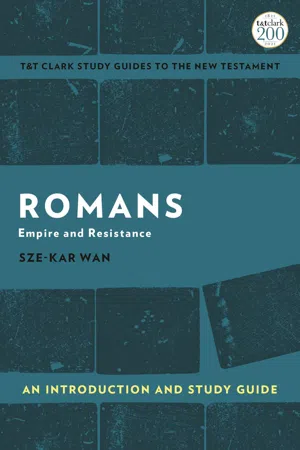
Sze-kar Wan examines the social and political ramifications of Paul's last and longest letter. By taking seriously Paul's faithfulness to his ancestral tradition, Wan argues that Paul is engaged in ethnic construction by incorporating non-Jews into Ideal Israel. With its claim of universality and the cosmic Son of God installed as king, Ideal Israel stands in pointed opposition to the Roman Empire.
Wan presents the Letter to the Romans as Paul's extended argument to his Gentile audience in defence of Ideal Israel and their place in it, without ignoring such prominent themes as good news, faith and belief, eschatology, and the collection for the poor. By also including a reading of Romans 13 as resistance against absolute authority, at variance with historical interpretations that defended American slavery and German Nazism, Wan gives readers a new perspective on a defiant message that can be marshalled to resist oppressive regimes.
- 128 pages
- English
- ePUB (mobile friendly)
- Available on iOS & Android
eBook - ePub
About this book
Information
1
How to Read Romans?
Paul, a slave of Christ Jesus, called to be an apostle, set aside for the good news of God that was promised beforehand through his prophets in holy scriptures concerning his son who came out of the seed of David according to the flesh, designated Son of God in power according to the spirit of holiness by resurrection from the dead, Jesus Christ our Lord, through whom we received grace and apostleship for the obedience of faith among all the Gentiles, for the sake of his name, among whom you yourselves are also called to belong to Christ; to all God’s beloved who are in Rome, called to be saints. Grace to you and peace from God our father and Lord Jesus Christ.
(Rom. 1.1–7)1
So begins Paul’s letter to the Romans, the last of Paul’s extant letters but also his longest, written in the last third of the fifties of the Common Era. The movement of which Paul was a part venerated a man executed by Roman authorities in Judea as a rebel agitator, one Jesus of Nazareth. But instead of staying in the backwaters of Judea, the movement made incursions into the Mediterranean world by establishing meeting cells in cities around the Empire. Such a transgressive move beyond its traditional borders had its challenges, not the least of which was how to deal with the incongruity of touting someone who had been crucified as the long-awaited messiah. Crucifixion was the ‘most extreme form of punishment’, typically reserved for enemies of the state and slaves;2 the Jewish messiah, at least in popular imagination, was expected to deliver his people from tyranny, and it was assumed that the deliverance would be executed through military or political means. This incongruity escalated infinitely when Paul, self-designated as an apostle on behalf of just such a messiah, now decided to write to the meeting cell in none other than Rome itself, the seat of the very empire that crucified Jesus. How he presented, then resolved, this incongruity underlies his Letter to the Romans.
At the outset, I want to emphasize that Paul was not a Christian but a Jew. It would be anachronistic to call him ‘Christian’, of course, for Christianity had not yet become a sociologically identifiable group separate from Judaism, and Christians did not begin adopting the title for themselves until the second century. More important, though, is evidence gleaned from Paul’s own statements that betray a robust confidence in his Jewish identity and upbringing in Judaism. He calls himself a Pharisee and claims to be a scrupulous follower of the Torah and its stipulations, so much so that he pronounces himself ‘blameless as to righteousness under the law’ (Phil. 3.4–6). He also tells us that he is ‘zealous for the traditions of [his] ancestors’ and that he is steeped in them far beyond his contemporaries (Gal. 1.14). There is no indication that he did not remain a faithful Jew throughout his life, even after his call to be an apostle to the Gentiles (Stendahl 1976; Eisenbaum 2009: 132–69).3 If that is the case, Paul’s purpose in writing Romans, or any of his letters for that matter, is not to start a new religious movement; he is much more concerned with an internal reform among his own kinsfolk than with creating a sectarian group. The starting point for that reform is what God has done in and through Jesus, who was appointed Christ and the cosmic Son of God at the moment of his resurrection (Rom. 1.4).
Reading Romans Politically
As is typical of his extant letters, Paul’s self-introduction hints at how he wishes to relate to his intended audience.4 In Romans, he introduces himself as a ‘slave of Christ Jesus’ (1.1). That is not necessarily a title of self-abnegation, however. In light of the destination of the letter and the theological-political overture of the prescript to be discussed below, it should probably be taken as a title modelled after the well-known ‘slave of Caesar’, who was a member of the imperial household serving as personal representative and occasional emissary of the emperor. Archaeological evidence and inscriptions paint a picture of someone whose direct access to the emperor gained him power and status denied to all but a select few (Jewett 2006: 100). A slave of Caesar spoke no words of his own but only on behalf of the emperor, though reality was different. ‘Given that his master was a son of a god and his word was backed by the full power of the Roman military establishment, the slave’s word would be a powerful medium indeed’ (Brown 2004: 733). In calling himself a ‘slave of Christ Jesus’, therefore, Paul presents himself as a representative of Christ, an emissary tasked with conveying not his own but the words of his master, ‘the good news of God’ (1.1).
The title ‘slave of Christ Jesus’ enables Paul to make a subtle claim for Jesus. In contrast to the Roman ruler who calls himself a ‘son of god’ (divi filius), Jesus is the Christ, the Son of the true God (1.3–4). ‘Christ’ has lost much of its political connotations through centuries of domestication, but it is the Greek translation of the Hebrew mashiach, ‘anointed’, a title commonly applied to kings and royal figures in biblical tradition. So King Saul is called the ‘anointed of the Lord’ (1 Sam. 12.3, 5, etc.) in biblical parlance, as are King David (2 Sam. 19.22; 23.1, etc.) and his successors (2 Sam. 22.51). True, Paul does not always attach full messianic significance to the title ‘Christ’; his writings betray no urgency to demonstrate Jesus is the Christ, and nowhere does he use the common expression ‘the anointed of the Lord’. Nevertheless, for Paul, ‘Christ’ applies uniquely to Jesus and is therefore defined by him and not the other way around. So for Marinus de Jonge, ‘The designation “Christ” receives its semantic content not through a previously fixed concept of messiahship but rather from the person and work of Jesus… When early Christians spoke about (the) “Christ”, they meant Jesus in whom they believed; they did not necessarily intend to convey the “messianic” connotations of the term’ (de Jonge 1994: 915). That said, Paul is well aware of the messianic significance of the title. He lists ‘the Christ coming in the flesh’ as one of the prerogatives of the Jewish people (Rom. 9.5) and calls Christ ‘a servant of the circumcised for God’s truth, in order to confirm the promises of the patriarchs’ (15.8), thereby connecting ‘Christ’ to messianic expectations of old. Here, in his self-introduction that opens the letter, he vests ‘Christ’ with full messianic force by juxtaposing it to ‘the seed of David’ (1.3), which is a royal title heralding the arrival of the Davidic messiah in the end time.
Paul gives himself a second title, ‘apostle’ (1.1). An apostolos was an ambassador representing an authority figure in communicating his or her wishes to other lands (Herodotus 1.21; 5.38, etc.). When Paul joined the Jesus-movement as a latecomer, apostolos had already developed into an exclusive title for leaders in the emerging hierarchy. In his polemical letter to the Galatians, he claims the apostolic office for himself, for he feels he is as entitled to it as the so-called ‘pillars’ because of the commission he received directly from the divine (Gal. 1.11–12, 15–16). In denying the Jerusalem leaders the exclusive right to the title, Paul in effect tried to return it to its original meaning as a representative of God. The related verb apostellein (‘to send’), after all, referred to being commissioned by a divine authority; Epictetus called a wise man ‘apostle’, because he was sent by Zeus (Epictetus, Diss. 3.22.23). In introducing himself to his audience as an apostle, therefore, Paul signals his intention to extend his position as member of the inner circle to that of a divine ambassador, ‘set aside for the good news of God’ (Rom. 1.1). This language is identical to his self-description in his polemical letter to the Galatians: ‘When [God] who had set me aside from my mother’s womb and called me through his grace was pleased to reveal his son in me, in order that I might proclaim the news of him among the Gentiles … ’ (Gal. 1.15–16). Then, as now, Paul highlights his divine commission to preach the good news to the Gentiles.
To modern ears, ‘good news’ (euangelion) is safely consigned to a piety divorced from the public arena. To first-century ears, however, euangelion was part of an extensive vocabulary associated with the emperor cult, which marshalled religious symbolism to facilitate governance of the empire. The cult depicted the emperor as an extraordinary man embodying good fortune, salvation, even divinity. His birth, accompanied by cosmic signs and power and portended by other astrological wonders, was proclaimed as ‘good news’.
When Paul says he is charged with preaching the ‘good news of God’ (Rom. 1.1), therefore, he has in mind the identity of Christ that stands in stark contrast to the imperial propaganda of Rome. (See Chapter 3 for a more thorough discussion of ‘good news’.)
This reading of euangelion is consistent with the political-theological intensity of the self-introduction (Taubes 2004: 13–16). The good news has to do with ‘[God’s] son who came out of the seed of David according to the flesh, designated Son of God in power according to the spirit of holiness by resurrection from the dead, Jesus Christ our Lord’ (Rom. 1.3–4). ‘Seed of David’ is of course a political term, but it should be understood in light of Paul’s apocalypticism. According to the Psalm of Solomon, the messiah will come out of the Davidic line and will restore Israel to its former glory: ‘See, O Lord, and raise up for them their king, the son of David, at the time which you chose, O God, to rule over Israel your servant’ (Ps. Sol. 17.21 Atkinson). Restoration of Israel’s fortunes would take place when the nations (read: Gentiles) are defeated and brought to justice: ‘The reign of our God is forever over the nations (Gentiles) in judgement’ (Ps. Sol. 17.3 Atkinson adapted). The expectation that the messiah will subjugate and judge the Gentiles finds a ready echo in Paul’s understanding of his own mission. He describes his apostolic responsibility as demanding ‘obedience of faith among all the Gentiles’ (Rom. 1.5). The meaning of ‘obedience of faith’, a phrase unique to Romans and repeated twice more (15.18; 16.26), will be discussed in the next chapter, but it refers to Gentile submission to Christ Jesus (Elliott 2008). A similar scene is depicted in Daniel’s dream, in which the human figure (Son of Man) is appointed to rule God’s elect with humaneness and justice, while foreign powers are defeated and held in judgement (Dan. 7.1–14). In other words, this messianic figure proclaimed by Paul is no mere human ruler; he is a king after the ancient Davidic line ‘according to the flesh’ (1.3) but is consecrated as the Son of God through the resurrection ‘according to the Spirit of holiness’ (1.4). It is this dualistic conception of Christ as flesh and spirit and his divine appointment that set him apart from all self-appointed emperors. The heart of Paul’s euangelion consists of ‘the affirmation of Jesus as the traditional Davidic Messiah, who was adopted and enthroned as the Son of God on the basis of his resurrection’ (Jewett 2006: 104).
‘Son of God’ as a royal title can be amply documented in biblical and extra-biblical sources (e.g., 2 Sam. 7.14; Ps. 2.7; 89.26–27). The coronation psalm, ‘You are my son; today I have begotten you’ (Ps. 2.7), was central to early Christian articulation of Jesus. The Gospel of Mark, for example, uses it to define Jesus’s messiahship (Mk. 1.11). The title is also found among the Dead Sea Scrolls: ‘This is the assembly of famous men, [those summoned to] the gathering of the community council, when [God] begets the Messiah with them’ (1QSa 2.11–12; see also 4QFlor 1.10). Less studied in modern times but far more prevalent than Jewish usage in the first-century Mediterranean world was the use of title by Roman emperors. Upon coaxing the Senate to declare his adopted father Julius divine (divus Iulius), Augustus declared himself divi filius, ‘son of god’. This title was proclaimed on diverse media around the capital, but none as popular and effective as coins struck with that title. Seen against the background of Roman political theology, Paul’s well-chosen titles for Jesus no longer look so innocent.
It has been suggested that Paul’s presentation of Christ is influenced by popular images of the emperor (White 1999: 130–2), but it might be more accurate to say that Paul intentionally marshalled symbols and titles from his own ancestral traditions to present a King Jesus who stood in direct opposition to Caesar. As Dieter Georgi concludes, ‘If the terms chosen by Paul for his Roman readers have associations with the slogans of Caesar-religion, then Paul’s gospel must be understood as competing with the gospel of the Caesars’ (Georgi 1991: 87). Proof can be found in Paul’s depiction of the sonship of Jesus that follows a Jewish apocalyptic pattern. Christ acquires his title Son of God not by self-acclamation but by divine demonstration of God’s power over life and death. Christ’s resurrection is a forerunner of the general resurrection when the hoped-for peaceable kingdom of God is about to be realized. The valley of dry bones in Ezekiel 37 played a significant role in shaping popular expectations for the end time, but it was the book of Daniel, composed under the dictatorship of Antiochus IV (167 bce), that explicitly raised the spectre of the resurrection:
There shall be a time of anguish, such as has never occurred since nations first came into existence. But at that time your people shall be delivered, everyone who is found written in the book. Many of those who sleep in the dust of the earth shall awake, some to everlasting life, and some to shame and everlasting contempt. Those who are wise shall shine like the brightness of the sky, and those who lead many to righteousness, like the stars forever and ever.
(Dan. 12.1–3 NRSV)
The assertion that a messiah would be installed through the resurrection had no precedence in Jewish literature (Collins 1995: 104). Paul had integrated the apocalyptic expectation of general resurrection into the Son of Man tradition of Daniel 7 in response to a pastoral issue in the Thessalonian congregation (1 Thess. 4.13–18), so in all likelihood, Paul himself, not some early creed, was responsible for making this breakthrough.5 Such an interpretation allows him to transform a local kingship into cosmic rulership. In the felicitous words of Anton Fridrichsen: ‘Through His resurrection from the dead, Jesus, formerly the Messiah of the Jews, has been enthroned as Lord and Saviour of the whole world’ (Fridrichsen 1947: 10).
Ever since the Reformation, Paul’s letter to the Romans has been read as a handbook of timeless doctrines. Philip Melanchthon famously called Romans a ‘compendium of the Christian religion’. Even today Romans is commonly read as Paul’s systematic theology that supposedly proceeds from universal sin to solution in Christ (one prominent example is found in Dunn 1998). Such a proposal accounts for the seemingly systematic appearance of the letter, its irenic tone missing in his other letters, and its pattern of developing earlier themes (e.g., body of Christ, ‘the strong and the weak’, Adam Christology, Abraham, circumcision, the law, etc.). Given the high concentration of political-theological terms used in the opening verses, however, and the multiple ways these terms stand in opposition to imperial propaganda, it becomes increasingly untenable to read Romans as an academic tractate detached from the capital’s political and theological agendas. It would be an anachronism to impose a post-Enlightenment separation between politics and religion on a reading of an ancient text – let alone one that was consciously composed to mimic, then oppose, the political and theological language used exclusively by the overlord of the very imperial seat of power to which the letter is being sent. Rome, after all, was well known for manipulating religious symbols to maintain pax Romana. In coins and such visual aids as dioramas, sculptures, triumphal arches, and so on, the Romans proclaimed themselves as the authors of peace and benevolence. In their own self-understanding, it was Rome’s divine mission to govern the peoples of the world and to impose upon them the rule of law – that is, Roman law. In Scipio’s Dream, General Scipio’s grandfather appears to him in a dream to foretell his decisive victory over Carthage that would establish Rome as the undisputed master of the Mediterranean world. In the dream, Scipio tours the heavens and is told that the Empire is founded and ruled by heroes whose true home is in the heavens:
Be assured of this, so that you may be even more eager to defend the republic. All who have protected, aided, or enlarged their fatherland have a reserved place prepared for them in the heavens, where they may enjoy a beatified existence forever. Nothing accomplished on earth is more pleasing to that supreme God who rules the whole universe than human associations and councils in justice being bound together, which are called states. Their rulers and protectors come from here and thither they return.
(Cicero, Rep. 6.13)
This pronouncement is presented as ‘prophecy’, disclosed to Cicero’s readers in an otherworldly journey identical to those found in Jewish apocalyptic writings, thus giving this political agenda eternal legitimacy. In accordance with this vision, it is Rome’s foreordained destiny to extend its borders to incorporate others and to impose its law, forms of government, civilization, and indeed its ‘peace’ (pax), upon the world.
In Book 6 of Virgil’s Aeneid, the rise of Rome is again presented as prophecy to be etched into the history of time. The dead Anchises takes his son Aeneas, Trojan hero and legendary founder of Rome, on a tour of the underworld and introduces him to all the ‘future’ heroes of the Empire. This prophecy thus establishes, in apocalyptic prophecy, Rome’s entitled domination of the whole earth and all its inhabitants:
Roman, r...
Table of contents
- Cover
- Halftitle Page
- Title Page
- Dedication Page
- Contents
- 1 How to Read Romans?
- 2 Reading Romans
- 3 Theological Themes in Romans
- 4 Church and State: Romans 13.1–7
- 5 Epilogue: Proceed with Caution …
- Works Cited
- Index
- Imprint
Trusted by 375,005 students
Access to over 1.5 million titles for a fair monthly price.
Study more efficiently using our study tools.
Frequently asked questions
Yes, you can cancel anytime from the Subscription tab in your account settings on the Perlego website. Your subscription will stay active until the end of your current billing period. Learn how to cancel your subscription
No, books cannot be downloaded as external files, such as PDFs, for use outside of Perlego. However, you can download books within the Perlego app for offline reading on mobile or tablet. Learn how to download books offline
Perlego offers two plans: Essential and Complete
- Essential is ideal for learners and professionals who enjoy exploring a wide range of subjects. Access the Essential Library with 800,000+ trusted titles and best-sellers across business, personal growth, and the humanities. Includes unlimited reading time and Standard Read Aloud voice.
- Complete: Perfect for advanced learners and researchers needing full, unrestricted access. Unlock 1.5M+ books across hundreds of subjects, including academic and specialized titles. The Complete Plan also includes advanced features like Premium Read Aloud and Research Assistant.
We are an online textbook subscription service, where you can get access to an entire online library for less than the price of a single book per month. With over 1.5 million books across 990+ topics, we’ve got you covered! Learn about our mission
Look out for the read-aloud symbol on your next book to see if you can listen to it. The read-aloud tool reads text aloud for you, highlighting the text as it is being read. You can pause it, speed it up and slow it down. Learn more about Read Aloud
Yes! You can use the Perlego app on both iOS and Android devices to read anytime, anywhere — even offline. Perfect for commutes or when you’re on the go.
Please note we cannot support devices running on iOS 13 and Android 7 or earlier. Learn more about using the app
Please note we cannot support devices running on iOS 13 and Android 7 or earlier. Learn more about using the app
Yes, you can access Romans: An Introduction and Study Guide by Sze-kar Wan in PDF and/or ePUB format, as well as other popular books in Théologie et religion & Critique et interprétation bibliques. We have over 1.5 million books available in our catalogue for you to explore.