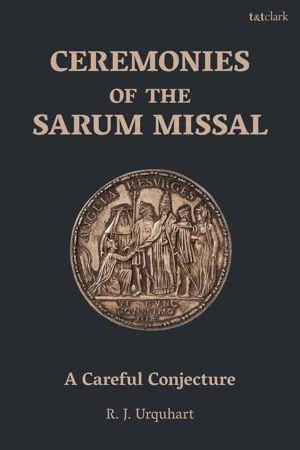
R.J. Urquhart provides the first systematic description of the ceremonial of the Sarum Mass in 500 years. Using a variety of sources, and tracing the Sarum rite and its occasional use from the Act of Supremacy through to modern times, Urquhart has compiled a volume that offers the best possible reconstruction and overview of these profoundly beautiful rites from the liturgical treasury of the Church.
Urquhart considers Sarum in the light of Pope Benedict XVI's groundbreaking apostolic constitution, Anglicanorum Coetibus, and how this has reopened the question of the catholicity of part of the Anglican patrimony. He also considers the impact of Pope Benedict's Summorum Pontificum and its proposition that what was sacred for earlier generations remains sacred now, arguing that this supremely pastoral teaching calls for a more profound and detailed study of the rite.
Urquhart covers all aspects of the ritual, beginning with an outline of the vessels, books and vestments and then moving on to outline both Low and High Mass, special forms, processions and blessings, and the ritual year. Appendices cover the role of the laity, and offer an Ordo Missae with simple rubrics.
- 304 pages
- English
- ePUB (mobile friendly)
- Available on iOS & Android
eBook - ePub
About this book
Information
BOOK VII
THE RITUAL YEAR
XXVIII
ADVENT AND CHRISTMAS
§1. THE SEASON OF ADVENT
At all Masses, whether of the season or not,1 the Gloria in excelsis is omitted, and Benedicamus Domino takes the place of Ite missa est.2 The acolyte leaves off his tunicle and vests in amice, alb and cincture.3 He uses the humeral veil in the usual fashion.4 At Masses of the season and votive Masses other than those of the Cross and Salus populi,5 the deacon and subdeacon wear chasubles instead of dalmatic and tunicle. On vigils now and throughout the year, unless otherwise specified, the ministers wear neither chasubles nor dalmatic and tunicle,6 but on Christmas Eve,7 if it falls on a Sunday, the ministers wear dalmatic and tunicle, and then the acolyte reads the prophecy from the pulpit and not from the choir step.8 Mid-Advent has no special colour or ceremonies.
§2. THE EMBER DAYS
The Ember Days are held in the third week of Advent, the first full week of Lent, Whit Week and in September.9 The Masses for these last may be found in the Missal after the last Sunday after Trinity. All are celebrated on the lines of those in Advent, with very few differences. Except in Whit Week, the ministers wear neither chasubles nor dalmatic and tunicle.10 Likewise, the acolyte does not use the tunicle.
On Wednesday and Friday, there are no significant variations from the usual ceremonial. Saturday is more complicated.11 The prayers are sung at the south corner of the altar, attended by the ministers as for the collect. They are not preceded by Dominus vobiscum. In Lent, Oremus is preceded by Flectamus genua and Levate. The deacon, as he sings Flectamus genua, kneels,12 followed at once by all except the celebrant.13 Likewise, the subdeacon rises as he sings Levate. All follow him, kissing the forms.14 For the prophecies and chants, the celebrant and ministers sit, returning to the altar for each prayer. The lessons are read in ordinary choir dress from the choir step,15 the first by an acolyte (who may be the acolyte of the Mass in his vestments)16 and the others by clerks in ascending order of rank.17 On Ember Saturdays, the lessons are read by readers taken alternately from the two sides of the choir.18 The first four chants are sung at the choir step by a single different surpliced cantor,19 the last by two of a higher rank in choir dress.20 The tract of the Mass is sung straight through by two second-form clerks in choir dress at the choir step. Meanwhile, the choir sits.21 At Low Mass, the celebrant remains at the missal after the Kyrie. He kneels whenever he says Flectamus genua.22 All kneel with the celebrant. The server replies Levate. The celebrant reads all the lessons and chants himself.
§3. CHRISTMAS AND EPIPHANY
The Processional makes Christmas the model for all processions on principal doubles. The Missal23 includes three Masses for Christmas: in gallicantu (with four rulers), in aurora (with two rulers) and in die (with four rulers).24 The usual rules concerning bination apply. The Missal presumes that the first Mass follows on immediately from Matins, the Officium being intoned as soon as Te Deum is finished.25 In this case, the celebrant, ministers and servers will leave the choir during Te Deum in order to vest.26 In this Mass, when it is sung, the prophecy is farsed by two clerks of the second form in copes from the pulpitum27 to a special tone.28 At Low Mass, the prophecy is said, without farsing, in the usual way.29 In the second and third Masses, the prophecy is sung in the usual manner from the pulpitum, if possible not by the acolyte of the Mass but by a surpliced clerk, chosen from the second form for the dawn Mass and from the upper form for the day Mass.30 At the end of the third Mass, if None is to follow immediately in the choir, before leaving the altar, the priest sings the verse Verbum caro factum est.31 On Epiphany Eve, the deacon and subdeacon wear dalmatic and tunicle.32 On the day itself, the verse Balaam, &c. in the sequence is sung thrice.33
1 Col 3; Col 659; Missal C.233.
2 Col 2.
3 The rule is that the acolyte wears the tunicle only when Gloria in excelsis is said Cons 55.
4 C 66.12 has the humeral veil worn in Advent.
5 For this Mass, see Coll 1, 19 and 740–741*. The rubrics at Coll 1 and 19 are probably merely ceremonial (see Defensorium Directorii [1]).
6 Coll 1 and 676.
7 Col 1.
8 Col 45.
9 The rule for determining the dates of the Ember Days is given at C 56.
10 Coll 1 and 676.
11 As usual, the Sarum rubrics are sparse. They are here supplemented from OP.1530–1 (which deal with Holy Saturday) and De Herdt, t. I. p. 2. n. 42. cap. II (for the ceremonial surrounding Flectamus genua). The Roman rite has the celebrant stand at the altar for the lessons, as it does for the epistle at Mass, though even he is allowed to sit on Holy Saturday after he has read each prophecy at the altar until the lector has finished chanting it (F.326).
12 De Herdt reports that some authorities prescribe kneeling on both knees, though he himself recommends genuflecting on one knee only. OP.775 prescribes kneeling.
13 OP.1281.
14 Col 135.
15 C 66.39. Col 543 (September) has the lessons and chants run thro...
Table of contents
- Cover
- Half-title Page
- Title Page
- Contents
- Preface
- Note on authorities
- List of abbreviations
- Key to the symbols used in the figures
- Book I The Treasurer’s Purview
- Book II Liturgical Gesture
- Book III Low Mass
- Book IV High Mass
- Book V Special Forms of Mass
- Book VI Processions and Blessings
- Book VII The Ritual Year
- Appendix I The Laity in Church
- Appendix II Form of Bidding of the Bedes
- Appendix III Ordo Missae with Simple Rubrics
- Bibliokaiallography
- Index
- Copyright Page
Trusted by 375,005 students
Access to over 1.5 million titles for a fair monthly price.
Study more efficiently using our study tools.
Frequently asked questions
Yes, you can cancel anytime from the Subscription tab in your account settings on the Perlego website. Your subscription will stay active until the end of your current billing period. Learn how to cancel your subscription
No, books cannot be downloaded as external files, such as PDFs, for use outside of Perlego. However, you can download books within the Perlego app for offline reading on mobile or tablet. Learn how to download books offline
Perlego offers two plans: Essential and Complete
- Essential is ideal for learners and professionals who enjoy exploring a wide range of subjects. Access the Essential Library with 800,000+ trusted titles and best-sellers across business, personal growth, and the humanities. Includes unlimited reading time and Standard Read Aloud voice.
- Complete: Perfect for advanced learners and researchers needing full, unrestricted access. Unlock 1.5M+ books across hundreds of subjects, including academic and specialized titles. The Complete Plan also includes advanced features like Premium Read Aloud and Research Assistant.
We are an online textbook subscription service, where you can get access to an entire online library for less than the price of a single book per month. With over 1.5 million books across 990+ topics, we’ve got you covered! Learn about our mission
Look out for the read-aloud symbol on your next book to see if you can listen to it. The read-aloud tool reads text aloud for you, highlighting the text as it is being read. You can pause it, speed it up and slow it down. Learn more about Read Aloud
Yes! You can use the Perlego app on both iOS and Android devices to read anytime, anywhere — even offline. Perfect for commutes or when you’re on the go.
Please note we cannot support devices running on iOS 13 and Android 7 or earlier. Learn more about using the app
Please note we cannot support devices running on iOS 13 and Android 7 or earlier. Learn more about using the app
Yes, you can access Ceremonies of the Sarum Missal by Richard Urquhart in PDF and/or ePUB format, as well as other popular books in Theology & Religion & Christian Rituals & Practice. We have over 1.5 million books available in our catalogue for you to explore.