Yoonjong Kim analyses the divine-human relationship in Paul's theology, focusing on Paul's portrayal of the relationship in Romans 1–8. Kim stresses that previous studies of this relationship have not paid sufficient attention to the fact that it is not static, but rather exhibits progression and development towards a goal. To address the significance of the human agent's role in the relationship, Kim employs a social psychological theory – interdependence theory – offering a consistent analytic framework for diagnosing the interactions in a dyadic relationship in terms of the dependency created by each partner's expectations of outcomes.
Kim explores several key stages of the divine-human relationship and the direction in which the relationship develops throughout Romans 1–8, in order to highlight the significance of the human partners in the course of the development. He focuses in particular on betrayal (1.18–3.20), restoration (3.21–26; 5.1–11), the oppressive relationship with Sin (5.12–8.11), and the investment for the future (8.12–39), and concludes that although the foundation of the relationship rests on God's initiative, the divine outworking guides the relationship so that it facilitates mutual participation of the human partners in the restoration and development of the relationship toward the ultimate goal.
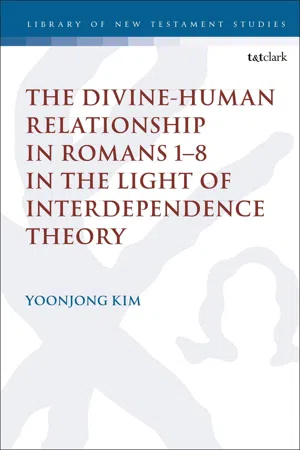
eBook - ePub
The Divine-Human Relationship in Romans 1–8 in the Light of Interdependence Theory
- 208 pages
- English
- ePUB (mobile friendly)
- Available on iOS & Android
eBook - ePub
The Divine-Human Relationship in Romans 1–8 in the Light of Interdependence Theory
About this book
Information
1
Introduction
1.1 Introduction
The issue of the divine-human relationship has long been a significant topic in studies of Paul’s theology, and scholars have reached various conclusions through different routes of interpretation. In particular, the differences in position derive from how important and influential one thinks the role of each party in the relationship is. Some scholars perceive human beings to be totally dependent upon God; therefore, the human role cannot make any significant difference in the relationship, particularly with regard to salvation. Other scholars, although acknowledging the special quality of the divine action, have attempted to give weight to the meaning of human action. Although a few Pauline studies discuss the issue of the divine-human relationship with various foci, a full-scale study on the question of how the relational dynamics can vary according to the development of the relationship has not been thoroughly attempted. The present study aims to map the geography of the relational dynamics between God and human beings in the course of the relationship’s development, examining to what extent both partners’ roles are significant in each situation and how the relationship is characterized in terms of dependence between the partners. As will be argued, although the divine-human relationship is fundamentally contingent upon God’s initiative, Paul indicates the importance of the mutual engagement of the human actors as the relationship progresses and develops in order to achieve a shared ultimate goal. For our study, we will deploy an analytic framework from social psychology that focuses on relational dynamics in a dyadic relationship, namely “interdependence theory.”
Before delving into discussion, it should be noted that we will limit our primary focus to Romans 1–8. Although we can find Paul’s description of the divine-human relationship in several places throughout his letters, Paul puts more effort into this topic in Romans 1–8 than in his other letters. Since Romans 1–8 contains rich information about the different stages of the divine-human relationship at a universal level, these chapters can be considered the most appropriate field for our discussion of Paul’s view on the divine-human relationship in general.1 Although Paul’s view on the issue of the divine-human relationship can be expressed variously throughout his letters, given the importance recognized by scholars of Romans in Paul’s theology, even called a “template,”2 what we observe in Romans 1–8 can provide grounds for further discussion later on. As will be shown, various stages of the divine-human relationship constitute the flow of Romans 1–8. For instance, the broken state (1:18–3:20), the restorative moments (3:21–26; 5:1–11) and a high degree of intimacy (8:12–39), along with the depiction of an antithetical type of relationship (5:12–8:11). Therefore, in Romans 1–8 our focus will primarily be on the passages related to the aforementioned key stages. Another crucial portion of Romans that also discusses the issue of the divine-human relationship, Romans 9–11, is not dealt with in our research. Although Paul speaks of the divine-human relationship at a universal level in Romans 9–11, because of the particular interest of Romans 9–11 in the relationship between Jews and Gentiles, these chapters will need independent treatment, though this is not to weaken the link between Romans 9–11 and other chapters in Romans. In a similar vein, Romans 12–15, which mainly concentrates on the relationship between believers, is not our main focus, though we will refer to several passages from these chapters that reflect how believers’ relationships with God can be related to their lifestyle in practical ways regarding the relationship with others.
In pursuing this aim, we will firstly review several seminal works of Pauline scholarship on the issue of the divine-human relationship mainly in Romans 1–8, elucidating the differences between perspectives as well as the areas for further development. In dealing with the scholars, we will classify them according to their primary orientation of approach to Paul.
1.2 Scholarship on the divine-human relationship in Romans 1–8
In this section, we will critically survey several crucial clusters of Pauline scholarship. The topics of “agency,” “apocalyptic” interpretation of Paul, the concept of χάρις (gift) and “covenantal relationship” provide entry points for our discussion on the divine-human relationship.3 As will be shown, one of the main points commonly considered is the possibility of human beings’ active involvement in the relationship.
1.2.1 Divine and human agency
A crucial aspect in discussions about the divine-human relationship is the issue of “agency.” John Barclay’s categorization of different perspectives on divine and human agency summarizes what is at issue among scholars. The three categories are as follows: 1) the “competitive relationship” model in which “the more that one is to be effective, the less can be attributed to the other,” while both agencies remain separated—thus “divine sovereignty and human freedom” would be treated as “mutually exclusive” from this viewpoint;4 2) the “kinship” model in which “the agency of one is shared with the other, rather than standing in competition”—thus, in this shared agency, what can make human agency “most effective” is what is “shared with God”;5 3) the “non-contrastive transcendence” model, which sees the transcendence of divine agency as not necessarily conflicting with human agency, while distinguishing one from the other—thus “created human agencies are founded in, and constituted by, the divine creative agency, while remaining distinctive from God.”6 Two questions are embedded in such categorization. On the one hand, it considers the matter of independence of agency; on the other, it considers the matter of competitiveness between agencies.
Francis Watson’s interpretation of Paul appears to fall into Barclay’s first category when he examines Paul’s interpretative work on the OT in light of the Christ-event. Watson argues that Paul, in contrast to other contemporary Jewish interpreters, prioritizes divine agency in his interpretation of the Torah:
Paul’s controversy with “Judaism” (Christian or otherwise) is in fact a conflict about the interpretation of the Torah.… [T]he question at issue is whether interpretative priority is to be given to a particular mode of divine agency (the making of an unconditional promise) or of human agency (the observance of the commandments).7
Watson argues that Paul, in his reading of Gen. 15:6, prioritizes and acknowledges divine agency in terms of salvation over the counter principle based on the reading of passages such as Lev. 18:5 (cf. 4 Maccabees; 4QMMT),8 which reflects Paul’s distinctive grammar of hermeneutics, i.e. “the hermeneutics of faith.”
However, Watson does not merely stress the passivity of human beings, but appears to acknowledge the importance of human response. Regarding the meaning of faith as human “acceptance,” Watson states that “ ‘faith’ is foundational to the divine-human relationship because faith alone is the human act that corresponds to the prior divine communicative action and is intended in it.”9 Responding to Hays’ critique that Watson’s interpretation of faith makes the divine-human relationship contingent upon the human act,10 Watson spells out the nature of faith as something intended in the divine promise. According to Watson, “if divine speech is to be effective, it must evoke a human response.”11 Therefore, as a human response, faith still points toward God’s initiative. In this sense, Watson argues that in Paul “gracious divine initiative and human activity are not mutually exclusive after all,”12 whi...
Table of contents
- Cover
- Series Page
- Title Page
- Contents
- List of Figures
- List of Abbreviations
- Abstract
- Acknowledgements
- 1 Introduction
- 2 Methodology
- 3 Diagnosing Human Corruption: Human Sinfulness as Betrayal (Rom. 1:18–3:20)
- 4 The Relational Significance of Jesus’ Death (1)—“Making Amends for Sins”: Jesus as ἱλαστήριον and the Process of Forgiveness (Rom. 3:21–26)
- 5 The Relational Significance of Jesus’ Death (2)—The Meaning of God’s Self-Sacrifice in Christ’s Death (Rom. 5:1–11)
- 6 History of Slavery and History of Salvation: An Investigation of the Sin-Human Relationship (Rom. 5:12–8:11)
- 7 Investment for the Future: The Meaning of Endurance throughout Suffering (Rom. 8:12–39)
- 8 Conclusion
- Bibliography
- Index of References
- Index of Authors
- Copyright
Trusted by 375,005 students
Access to over 1.5 million titles for a fair monthly price.
Study more efficiently using our study tools.
Frequently asked questions
Yes, you can cancel anytime from the Subscription tab in your account settings on the Perlego website. Your subscription will stay active until the end of your current billing period. Learn how to cancel your subscription
No, books cannot be downloaded as external files, such as PDFs, for use outside of Perlego. However, you can download books within the Perlego app for offline reading on mobile or tablet. Learn how to download books offline
Perlego offers two plans: Essential and Complete
- Essential is ideal for learners and professionals who enjoy exploring a wide range of subjects. Access the Essential Library with 800,000+ trusted titles and best-sellers across business, personal growth, and the humanities. Includes unlimited reading time and Standard Read Aloud voice.
- Complete: Perfect for advanced learners and researchers needing full, unrestricted access. Unlock 1.5M+ books across hundreds of subjects, including academic and specialized titles. The Complete Plan also includes advanced features like Premium Read Aloud and Research Assistant.
We are an online textbook subscription service, where you can get access to an entire online library for less than the price of a single book per month. With over 1.5 million books across 990+ topics, we’ve got you covered! Learn about our mission
Look out for the read-aloud symbol on your next book to see if you can listen to it. The read-aloud tool reads text aloud for you, highlighting the text as it is being read. You can pause it, speed it up and slow it down. Learn more about Read Aloud
Yes! You can use the Perlego app on both iOS and Android devices to read anytime, anywhere — even offline. Perfect for commutes or when you’re on the go.
Please note we cannot support devices running on iOS 13 and Android 7 or earlier. Learn more about using the app
Please note we cannot support devices running on iOS 13 and Android 7 or earlier. Learn more about using the app
Yes, you can access The Divine-Human Relationship in Romans 1–8 in the Light of Interdependence Theory by Yoonjong Kim in PDF and/or ePUB format, as well as other popular books in Theology & Religion & Biblical Studies. We have over 1.5 million books available in our catalogue for you to explore.