On 20th November 1979, the Salafi Group, led by a charismatic figure named Juhaiman al-Utaibi, seized control of the Sacred Mosque in Mecca, the holiest site in the Muslim World. The Salafi Group was not trying to establish an Islamic state. Instead, its members believed they were players in a prophetic script about the End of Time. After a two-week siege, the Saudi government recaptured the mosque, threw the survivors into prison, and had them publicly executed.
The Mecca Uprising offers an insider's account of the religious subculture that incubated the Mecca Uprising, written by a former member of the Salafi Group, Nasir al-Huzaimi. Huzaimi did not participate in the uprising, but he was arrested in a government sweep of Salafi Group members and spent six years in prison. In 2011, he published his memoir, Days with Juhaiman, offering the most detailed picture we have of the Salafi Group and Juhaiman. The Mecca Uprising had profound effects on Saudi Arabia and the Muslim world[DC1] [YG2] . The Saudi government headed off opposition from religious activists and made efforts to buttress the ruling family's legitimacy as the guardians of Islam. Huzaimi's memoir sheds light on the background of this religious and political landscape, and is the most detailed account we have of the Salafi Group and Juhaiman. The English edition is complete with an introduction and annotations prepared by expert David Commins to help readers understand the relevance of the Meccan Uprising [DC3] and how it fits into the history of the Islamic World.
[DC1]lower case? Muslim world
[YG2]changed to author's suggestion
[DC3]Mecca Uprising
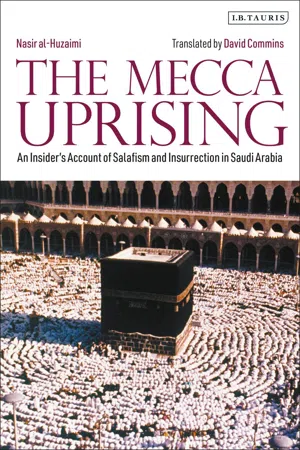
eBook - ePub
The Mecca Uprising
An Insider's Account of Salafism and Insurrection in Saudi Arabia
- 208 pages
- English
- ePUB (mobile friendly)
- Available on iOS & Android
eBook - ePub
The Mecca Uprising
An Insider's Account of Salafism and Insurrection in Saudi Arabia
About this book
Information
NOTES
Introduction to the English Edition
1An exact figure for the rebel band has not been established. Estimates range from three hundred to five hundred.
2“Salafi” refers to Muslims who believe that through the ages Muslims deviated from Islam in its original form and who seek its restoration.
3That has become the standard assessment of the uprising’s impact. Nabil Mouline, The Clerics of Islam: Religious Authority and Political Power in Saudi Arabia, translated by Ethan S. Rundell, Yale University Press, 2014, pp. 212–13. Madawi al-Rasheed, A Most Masculine State, Cambridge University Press, 2013, pp. 108–10. James Buchan, however, describes steps to restrict Western influence in 1978 and early 1979. “The Return of the Ikhwan,” in David Holden and Richard Johns, eds., The House of Saud: The Rise and Rule of the Most Powerful Dynasty in the Arab World, Holt, Rinehart, and Winston, 1982, p. 519.
4Joseph Kechichian provided the first meticulous study of Juhaiman’s writings: “Islamic Revivalism and Change in Saudi Arabia: Juhayman al-’Utaybi’s ‘Letters’ to the Saudi People,” Muslim World 80:1 (1990), 1–16. Stephane Lacroix and Thomas Hegghammer were the first scholars to use interviews with Huzaimi and other Saudis familiar with Juhaiman’s group. Their article places the Salafi Group and Juhaiman in the context of religious tendencies in Saudi Arabia by examining the Salafi Group’s brief history, its members’ social backgrounds, and the traces of Juhaiman’s movement in Saudi Arabia’s religious landscape up to the early 2000s. “Rejectionist Islamism in Saudi Arabia: The Story of Juhayman al-’Utaybi Revisited,” International Journal of Middle East Studies 39:1 (2007), 103–22. Yaroslav Trofimov offers the most complete account of the uprising based on interviews with Saudi government officials and Saudis familiar with the Salafi Group. The Siege of Mecca: The Forgotten Uprising in Islam’s Holiest Shrine and the Birth of Al-Qaeda, Doubleday, 2007. Compared to other accounts, Huzaimi’s memoir emphasizes religious factors more than politics in explaining tensions between Juhaiman’s faction and the Saudi authorities that led to the uprising.
5Ervand Abrahamian, A History of Modern Iran, Cambridge University Press, 2018, is an excellent introduction to the revolution and its historical background.
6James Bill, The Eagle and the Lion: The Tragedy of American-Iranian Relations, Yale University Press, 1989, p. 233. Bill’s book surveys relations between the United States and Iran from the early 1900s to the early years of the Islamic Republic.
7William B. Quandt, Peace Process: American Diplomacy and the Arab-Israeli Conflict since 1967, Brookings Institution, 2005, gives an expert’s first-person insights into the Camp David Accords and the Egyptian-Israeli peace treaty.
8One difference between the Salafi Group and other Islamic groups was the former’s indifference toward the Palestinian issue.
9Trofimov’s The Siege of Mecca provides the most detailed account of the uprising.
10Trofimov, The Siege of Mecca, pp. 104–16, 142–4, 202–6.
11Toby Craig Jones, “Rebellion on the Saudi Periphery: Modernity, Marginalization, and the Shi’a Uprising of 1979,” International Journal of Middle East Studies 38:2 (2006), 213–33.
12Some details about the precise role of the French advisers remain unclear, particularly whether they directed the assault from a nearby town outside the zone forbidden to non-Muslims or undertook a nominal conversion to Islam and entered Mecca.
13Trofimov, The Siege of Mecca, pp. 224–5. Some estimates of the death count run to a thousand or more. About 170 militants surrendered.
14Steve Coll, Ghost Wars: The Secret History of the CIA, Afghanistan, and Bin Laden, from the Soviet Invasion to September 10, 2001, Penguin, 2004.
15Two introductory texts on Islam that discuss the topics in this section are Frederick Denny, An Introduction to Islam, 4th ed., Pearson Hall, 2011, and Jonathan P. Berkey, The Formation of Islam: Religion and Society in the Near East, 600 to 1800, Cambridge University Press, 2003.
16Medina is short for Madinat al-Nabi, the City of the Prophet.
17The common English translation for jihad is holy war.
18The Quran, Surat al-Hijr, al-Hijr 15:1.
19The Quran, Surat al-Zukhruf, Ornaments of Gold, 43:2–3.
20On the early history of hadith literature and hadith scholars, J. Robson, “Hadith,” Encyclopaedia of Islam, 2nd ed., Brill, 2006.
21Technically, a hadith may originate with someone who knew the Prophet and not the Prophet himself.
22Wilferd Madelung, “’Abd Allah B. Al-Zubayr and the Mahdi,” Journal of Near Eastern Studies 40:4, Arabic and Islamic Studies in Honor of Nabia Abbott: Part Two (October 1981), 291–305; hadith cited from p. 294.
23J. Robson, “al-Bukhari, Muhammad b. Isma’il,” Encyclopaedia of Islam, 2nd ed., Brill, 2006; G. H. A. Juynboll, “Muslim b. al-Hadjdjadj,” Encyclopaedia of Islam, 2nd ed., Brill, 2006; A. J. Wensinck, “al-Nasa’i,” Encyclopaedia of Islam, 2nd ed., Brill, 2006; J. Robson, “Abu Da’ud al-Sidjistani,” Encyclopaedia of Islam, 2nd ed., Brill, 2006; G. H. A. Juynboll, “al-Tirmidhi,” Encyclopaedia of Islam, 2nd ed., Brill, 2006; J. W. Fück, “Ibn Madja,” Encyclopaedia of Islam, 2nd ed., Brill, 2006.
24For an overview of apocalyptic thought and Mahdist movements in Islam from early times to the present, Jean-Pierre Filiu, Apocalypse in Islam, University of California Press, 2011.
25Vernon O. Egger, A History of the Muslim World to 1750: The Making of a Civilization, 2nd ed., Routledge, 2017, pp. 65–71. The word “Shiism” comes from the Arabic phrase Shi’at Ali, or partisans of Ali.
26On the second civil war, Egger, A History of the Muslim World to 1750, pp. 73–4; Filiu, Apocalypse in Islam, pp. 8–10.
27Madelung, “’Abd Allah B. Al-Zubayr ...
Table of contents
- Cover
- Half-title Page
- Title Page
- Contents
- Acknowledgments
- Notes on the Arabic and English Editions
- Introduction to the English Edition
- The Memoir
- Appendix I The Dreaming Nation: The Role of the Dream in Sanctifying Salafi Islamic Discourse, by Nasir al-Huzaimi
- Appendix II The Grand Mosque Sermon
- Appendix III “Juhaiman’s Sin:” Nasir al-Huzaimi: This Is My Story with the Expected Mahdi
- Appendix IV Interview with Nasir al-Huzaimi, by Badr al-Rashid
- Notes
- Further Reading and Works Cited
- Glossary
- Index
- Copyright Page
Trusted by 375,005 students
Access to over 1.5 million titles for a fair monthly price.
Study more efficiently using our study tools.
Frequently asked questions
Yes, you can cancel anytime from the Subscription tab in your account settings on the Perlego website. Your subscription will stay active until the end of your current billing period. Learn how to cancel your subscription
No, books cannot be downloaded as external files, such as PDFs, for use outside of Perlego. However, you can download books within the Perlego app for offline reading on mobile or tablet. Learn how to download books offline
Perlego offers two plans: Essential and Complete
- Essential is ideal for learners and professionals who enjoy exploring a wide range of subjects. Access the Essential Library with 800,000+ trusted titles and best-sellers across business, personal growth, and the humanities. Includes unlimited reading time and Standard Read Aloud voice.
- Complete: Perfect for advanced learners and researchers needing full, unrestricted access. Unlock 1.5M+ books across hundreds of subjects, including academic and specialized titles. The Complete Plan also includes advanced features like Premium Read Aloud and Research Assistant.
We are an online textbook subscription service, where you can get access to an entire online library for less than the price of a single book per month. With over 1.5 million books across 990+ topics, we’ve got you covered! Learn about our mission
Look out for the read-aloud symbol on your next book to see if you can listen to it. The read-aloud tool reads text aloud for you, highlighting the text as it is being read. You can pause it, speed it up and slow it down. Learn more about Read Aloud
Yes! You can use the Perlego app on both iOS and Android devices to read anytime, anywhere — even offline. Perfect for commutes or when you’re on the go.
Please note we cannot support devices running on iOS 13 and Android 7 or earlier. Learn more about using the app
Please note we cannot support devices running on iOS 13 and Android 7 or earlier. Learn more about using the app
Yes, you can access The Mecca Uprising by Nasir al-Huzaimi in PDF and/or ePUB format, as well as other popular books in Politics & International Relations & Social Science Biographies. We have over 1.5 million books available in our catalogue for you to explore.