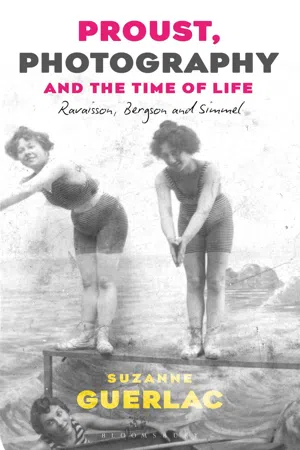
Through an engagement with the philosophies of Proust's contemporaries, Félix Ravaisson, Henri Bergson, and Georg Simmel, Suzanne Guerlac presents an original reading of Remembrance of Things Past (A la recherche du temps perdu). Challenging traditional interpretations, she argues that Proust's magnum opus is not a melancholic text, but one that records the dynamic time of change and the complex vitality of the real.
Situating Proust's novel within a modernism of money, and broadening the exploration through references to cultural events and visual technologies (commercial photography, photojournalism, pornography, the regulation of prostitution, the Panama Scandal, and the Dreyfus Affair), this study reveals that Proust's subject is not the esthetic recuperation of loss but rather the adventure of living in time, on both the individual and the social level, at a concrete historical moment.
- 256 pages
- English
- ePUB (mobile friendly)
- Available on iOS & Android
eBook - ePub
About this book
Information
PART ONE
Grandmother: Habit, Death, and Photography (Attachment and Detachment)
Chapter 1
The Double Work of Habit
The Grandmother is the character who dies in the Recherche. Unlike the many reported deaths in the novel—of Albertine, for example, and Swann, and all those whose passing Charlus intones in Finding Time Again, “Hannibal de Bréauté, dead! Antoine de Mouchy, dead! Charles Swann, dead! Adalbert de Montmorency, dead! Boson de Talleyrand, dead! Sosthène de Doudeauville, dead!” (FTA 171)—the Grandmother’s death is a major story event that falls smack in the middle of Proust’s novel (the first chapter of The Guermantes Way II). Her dying takes time. Proust draws out its telling over almost forty pages in one of the novel’s longest uninterrupted narrative sequences, one that bridges The Guermantes Way I and II with exceptional continuity on the level of story. The Grandmother dies slowly and, in a sense (as we shall see), more than once. Proust will turn to photography to write the long duration of her dying, which, as the reader eventually discerns, extends throughout most of the novel’s story time up to the point where the focus shifts definitively to Albertine in The Prisoner.
But what happens to our Narrator as the Grandmother dies? His voice becomes strangely muted. His sentences become noticeably shorter and his style turns icy. The tone is not so much grave (at moments it is darkly comic) as coldly precise. And what happens to our Hero, Marcel? He seems to fade into the background after the first paragraph of this chapter, when, trying to get his Grandmother home from the Champs-Élysées after her stroke, he experiences a deep and abstract loneliness:
I had always been accustomed to placing myself in her heart… but now she was a closed book for me, a part of the external world, and I was obliged to hide from her… what I thought about her state of health, and to betray no sign of my anxiety. I could not have mentioned it to her with any more confidence than to a stranger. She had suddenly restored to my keeping the thoughts, the sorrows that I had entrusted to her forever, since I was a child. She was not yet dead. But I was already alone. (GW 309, translation modified)
The chapter opens with this transitional moment—the Grandmother not yet dead, Marcel already alone. Mme Amédée will die some forty pages later. The next chapter opens on a quite different note: “Although it was simply a Sunday in autumn, I had just been reborn… a change in the weather is enough to create the world and ourselves afresh” (GWII 342). It is a new day. Marcel cheerfully turns his attention to the social world of the Guermantes. There will be no further mention of the Grandmother until an involuntary memory image brings her lively presence back to him many, many pages later, in Sodom and Gomorrah.
“There was only one love affair in the Recherche,” Roland Barthes famously declared, “that of Marcel and his Grandmother.”1 Marcel’s apparent detachment immediately following her death is puzzling, given his extravagant love for her. A background figure who walks in the garden in Combray and a traveling companion to Balbec (where she is also a source of minor embarrassment at the Grand-Hôtel), she provides indispensable comfort during Marcel’s nighttime anxieties and illnesses. Mme Amédée is simply there in Marcel’s world—like the weather:
But as for my grandmother, in all weathers, even in a downpour…, we would see her in the empty rain-lashed garden, pushing back her disordered gray locks so that her forehead could more freely drink in the salubriousness of the wind and rain. She would say: “At last, one can breathe!’ and would roam the soaked paths. (SW 11)
She is breath, rain, and wind to Marcel’s confinement and asthmatic suffering. Her gaze is without irony. If she remains a somewhat hazy character (her face usually half veiled), it is because Marcel has not quite distinguished himself from her—“I, for whom my grandmother was still myself—I who had only seen her with my soul” (GW 135). She serves as Marcel’s container: he places his thoughts and feelings in her. Unable to hold these any longer at the moment of her stroke, she releases them back to him as a gap opens up between life and death: “She was not yet dead. But I was already alone” (GW 309).
To understand Marcel’s reaction—or apparent lack of reaction—to his Grandmother’s death, we have to go all the way back to the first night Marcel spends in the Grand-Hôtel on his initial visit to Balbec in In the Shadow of Young Girls in Flower. He and his Grandmother have traveled together by train from Paris. Upon their arrival at the hotel, Marcel announces he is not feeling well and might need to return to Paris immediately. As his Grandmother heads out to do some errands (in case they have to head right back home), Marcel takes the elevator up to his room. Feverish and “feeling exhausted” (SYG 245), he is nevertheless unable to rest. He panics. Grandmother eventually arrives and comforts him; she unlaces his boots to help him get ready for bed and gazes up at him tenderly. This event will return as a powerful involuntary memory image in Sodom and Gomorrah, a memory that will prompt Marcel to finally accept the reality of his Grandmother’s death, almost a year after her passing, and enable him, belatedly, to mourn her.
The panic Marcel experienced in the hotel room that night was not simply an effect of his chronic asthma—his gasping for air—although that was part of it; it was also, the Narrator tells us, a response to the idea of death, a way of feeling it. The unfamiliar space of the hotel room makes Marcel anxious because its sheer newness implies separation. Marcel becomes aware that those we love will die one day, and, worse yet, we will eventually forget them and feel only indifference toward them.
Familiarity, Proust’s Narrator suggests here in a lengthy and complex digression, is not so much a question of knowing (connaître) one’s surroundings as it is a matter of feeling known (connu) by them. This occurs when things seem to let themselves become part of us by moving inside us. At home, the familiar objects of Marcel’s daily life had become “nothing but accessories of my own organs, extensions of myself” (SYG 246). In the unfamiliar setting of the hotel room, however, objects remain resolutely external. Our Hero’s whole being is reduced to a “vigilant body [corps conscient]” (SYG 245, translation modified) that struggles to absorb the impressions that bombard him from the outside. Our Hero imagines himself perceived by the objects in the room, as by a stranger. “In that room of mine at Balbec, ‘mine’ in name only, there was no space for me: it was crammed with things which did not know me” (SYG 245). In the unfamiliar hotel room he feels aggressively crowded out by the sensory impressions of things, but “[a]s our attention furnishes a room, so habit unfurnishes it, making space in it for us” (SYG 245). In other words, habit helps us interiorize the objects of the external world so we can make space for ourselves, peacefully, within it.
Marcel experiences a violence of unfamiliarity in that hotel room. Adapting to change becomes a matter of life or death: “Deprived of my universe, evicted from my room, I… wished I could die” (SYG 246). It is in connection with this anxiety about death (and desire for it) that Proust’s Narrator explains what he calls “the analgesia of habit” (SYG 250), its power to defend against the disconcerting impact of the new and the idea of death it carries. Habit engenders the comfort of familiarity that protects us from change by tying us to the past. As it does so, however, it erodes desire and flattens experience, inducing boredom or disappointment. As Beckett’s famous essay on Proust convincingly argued, this mechanistic understanding of habit supports a traditional interpretation of the Recherche according to which, because life dulls and disappoints, it needs art to redeem it.2
But the analgesia of habit works in two ways; habit, Proust’s Narrator explains, is a “double work [œuvre double]” (SYG 251, translation modified). Here Proust repeats the language of Félix Ravaisson (1813–1900), who theorizes a “double law” of habit from the perspective of a philosophy of life and an ontology of time. This “double law” of habit follows from the two moments of passing time: present time becoming past, and future time becoming present. It corresponds to what Ravaisson calls the “double influence simply of the duration of change.”3 In time, he writes (alluding to Kant’s transcendental esthetic), “everything passes, nothing remains [demeure].”4 Habit concerns “the force of impressions,” as they pertain to our receptivity, our action, and our desire, which is to say as they pertain to intensity, understood as “degree of reality.”5 As a dual operation, then, habit is specific to living beings, as distinct from inorganic things; it accords with the structure of intermittence that, as the physiologist Xavier Bichat affirmed, characterizes animal life.6
If habit is a “double work” (SYG 251, translation modified), then mechanical repetition is only one side of it, the one that sticks us to the past to defend familiarity. As a dual operation, it involves both holding on to the past (through a repetition of attachment) and breaking with the past, in order to embrace the new as it arrives from the future. This other side of habit, we could say, is affirmatively analgesic (affirmative in Nietzsche’s sense); it supports us in adapting to change by making us forget past attachments, wrenching memories from the heart.7 In adapting to the new, Proust writes, we undergo “a death of our self, albeit followed by a resurrection, but a resurrection in the form of a different self” (SYG 250). This modality of habit invites death to operate within us through involuntary forgetting, “stripping off bits of us at every moment, which have no sooner mortified than new cells begin to grow” (SYG 250). It involves a process of “fragmentary death [mort fragmentaire] which attends to us throughout the duration of our lives [durée]” (SYG 250, translation modified).
As an affirmative operation, then, habit alters the very structure of experience in Proust’s novel, rendering it fundamentally discontinuous. It produces its “analgesic effect” only through an automatic forgetting that leads to indifference. This explains Marcel’s apparent equanimity during the long episode that recounts the death of his Grandmother. It accounts for his cheerful energy immediately after her death, and the belatedness of his mourning. The self that had felt deeply attached to Grandmother (the self that still lived in the childlike modality of croyance—faith or trust) has died with her. Marcel is reborn as the social self we witness in The Guermantes Way II, which emerges with disconcerting suddenness after Mme Amédée’s death. To this new self, Grandmother’s death has very little meaning, because this Marcel comes into being with her death—we might even say this self is called into being by it. It is the affirmative modality of habit, then, that accounts for what Marcel will retrospectively refer to as the “forgetting of my grandmother” (SG 158, translation modified) that persists for over a thousand pages of Proust’s novel, that is, until the involuntary memory image of her tender presence breaks through the automatic forgetting imposed by habit and prompts an intense experience of mourning.
The law of habit announces that the death of those we love leads to indifference. Ravaisson had affirmed this view, as did Xavier Bichat. This is a fundamental axiom of Proust’s most unsentimental novel. It governs Marcel’s immediate response to his Grandmother’s death, and, eventually, his response to the death of Albertine, the next object of his fierce attachment. Habit, then, on Proust’s analysis, involves a double work of life and death, such that “first death, then a new life would have done their dual work at the behest of Habit” (SYG 251). Living includes dying. This is the structure of intermittences du cœur, which introduces a temporality of discontinuous series into Proust’s novel, one that dislocates chronological progress, proposing instead “different and parallel series in time—without any break in continuity” (SG 156). This is the temporality of Proust’s novel—the time of death in life, of anachronism, and of intermittences du cœur—and it will guide our reading. To focus exclusively on the repetitive side of habit (the one that glues us to the past) is to construe time as a fixed horizon of Baudelairean ennui, which triggers a yearning to escape into an ideal world of essences. It is to miss Proust’s investment in the vitality of time. If habit is important to Proust, it is because, as Félix Ravaisson made clear, it concerns strategies for coping with time as it happens. What becomes present arrives from the future and is already on its way to becoming past. Living in time is the principal subject of Proust’s novel, and its dynamics dictate the novel’s form. Both Ravaisson and Proust appreciate that the challenge we face is not to escape time (in the wake of Kantian philosophy) but to enter more fully into it.8 Negotiating the dynamics of lived time requires both attachment and detachment—this is the lesson of the double law of habit.
Chapter 2
Involuntary Memory and Involuntary Forgetting
The hotel room scene in In the Shadow of Young Girls in Flower does not end when the Grandmother comforts Marcel, gazing at him tenderly as she helps him remove his boots. As soon as she leaves, Marcel begins to suffer again. In a densely packed digression, Proust’s Narrator offers an acute analysis of this suffering, one that confirms that habit concerns the passing of time and reveals that Proust transposes the double law of habit into the novelistic narrative register of dynamics of attachment and detachment:
The trepidation that overwhelmed me at the prospect of sleeping in an unfamiliar bedroom… may be nothing more than the lowliest, most obscure, organic, and all-but-unconscious mode of the supreme and desperate refusal, by the things that make up the best of our present life, to countenance even our theoretical acceptance of a possible future without them: a refusal which was the core of the horror I had so often felt at the thought that my parents would one day be dead,… a refusal which lurked beneath the difficulty I found in trying to think about my own death or even the kind of afterlife promised by Bergotte in his books, in which there would be no place for my memories, my defects, my very character, all of which found unconscionable the idea of their own nonexistence and hoped on my behalf that I was fated neither to unbeing nor to an everlasting life that would abolish them. (SYG 249, my emphasis)
This is an extraordinary sentence. It speaks from the vantage point of things—things that have moved inside a subject and feel threatened with annihilation because of the passage of time. These things have moved inside our Narrator/Protagonist thanks to the work of habit (the habit of repetition), which has rendered them familiar to him. The familiar objects to which he has grown attached—memories, loved ones, even his own defects of character, and, indeed, all the concrete features of his lived experience—convey, through Marcel’s panic, their refusal to submit to becoming past. Proust’s complicated sentence suggests that when these things rebel against change—against a future that would dispense with them—we experience their rebellion as our suffering. This ...
Table of contents
- Cover
- Halftitle Page
- Title Page
- Contents
- List of Illustrations
- Acknowledgments
- Abbreviations
- Introduction
- Part One Grandmother: Habit, Death, and Photography (Attachment and Detachment)
- Part Two Albertine Breaks the Frame
- Part Three Odette (and Swann): Social Time, Photography, and Money
- Conclusion
- Notes
- Works Consulted
- Index
- Imprint
Trusted by 375,005 students
Access to over 1.5 million titles for a fair monthly price.
Study more efficiently using our study tools.
Frequently asked questions
Yes, you can cancel anytime from the Subscription tab in your account settings on the Perlego website. Your subscription will stay active until the end of your current billing period. Learn how to cancel your subscription
No, books cannot be downloaded as external files, such as PDFs, for use outside of Perlego. However, you can download books within the Perlego app for offline reading on mobile or tablet. Learn how to download books offline
Perlego offers two plans: Essential and Complete
- Essential is ideal for learners and professionals who enjoy exploring a wide range of subjects. Access the Essential Library with 800,000+ trusted titles and best-sellers across business, personal growth, and the humanities. Includes unlimited reading time and Standard Read Aloud voice.
- Complete: Perfect for advanced learners and researchers needing full, unrestricted access. Unlock 1.5M+ books across hundreds of subjects, including academic and specialized titles. The Complete Plan also includes advanced features like Premium Read Aloud and Research Assistant.
We are an online textbook subscription service, where you can get access to an entire online library for less than the price of a single book per month. With over 1.5 million books across 990+ topics, we’ve got you covered! Learn about our mission
Look out for the read-aloud symbol on your next book to see if you can listen to it. The read-aloud tool reads text aloud for you, highlighting the text as it is being read. You can pause it, speed it up and slow it down. Learn more about Read Aloud
Yes! You can use the Perlego app on both iOS and Android devices to read anytime, anywhere — even offline. Perfect for commutes or when you’re on the go.
Please note we cannot support devices running on iOS 13 and Android 7 or earlier. Learn more about using the app
Please note we cannot support devices running on iOS 13 and Android 7 or earlier. Learn more about using the app
Yes, you can access Proust, Photography, and the Time of Life by Suzanne Guerlac in PDF and/or ePUB format, as well as other popular books in Philosophy & Literary Criticism. We have over 1.5 million books available in our catalogue for you to explore.