Longlisted for the 2022 Runciman Award
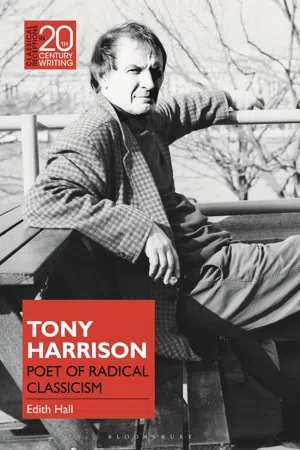
This is the first book-length study of the classicism of Tony Harrison, one of the most important contemporary poets in England and the world. It argues that his unique and politically radical classicism is inextricable from his core notion that poetry should be a public property in which communal problems are shared and crystallised, and that the poet has a responsibility to speak in a public voice about collective and political concerns. Enriched by Edith Hall's longstanding friendship with Harrison and involvement with his most recent drama, inspired by Euripides' Iphigenia in Tauris, it also asserts that his greatest innovations in both form and style have been direct results of his intense engagements with individual works of ancient literature and his belief that the ancient Greek poetic imagination was inherently radical.
Tony Harrison's large body of work, for which he has won several major and international prizes, and which features on the UK National Curriculum, ranges widely across long and short poems, plays, translations and film poems. Having studied Classics at Grammar School and University and having translated ancient poets from Aeschylus to Martial and Palladas, Harrison has been immersed in the myths, history, literary forms and authorial voices of Mediterranean antiquity for his entire working life and his classical interests are reflected in every poetic genre he has essayed, from epigrams and sonnets to original stage plays, translations of Greek drama and Racine, to his experimental and harrowing film poems, where he has pioneered the welding of tightly cut video materials to tightly phrased verse forms. This volume explores the full breadth of his oeuvre, offering an insightful new perspective on a writer who has played an important part in shaping our contemporary literary landscape.
- 248 pages
- English
- ePUB (mobile friendly)
- Available on iOS & Android
eBook - ePub
About this book
Information
1
‘Models of eloquence’: Radical Classicism
Idiosyncratic classicism
These are the extempore words with which Tony Harrison introduced some of his poems at an event organized by the campaign to save the Classics Department at Royal Holloway, University of London, in 2011:
I owe a huge debt to the Classics. Classics has been in my bloodstream since I was eleven. I absolutely absorbed it greedily. It gave me all kinds of models of eloquence I’ve been mining ever since, in my poetry, my theatre work, and in my films.1
He used four successive metaphors to describe his personal relationship with Classics: a financial one (debt), two physiological ones (bloodstream, greedily) and an industrial one (mining). These offer insights into his subjective feelings about classical literature, but also into the scope of his poetry, where economics, work, material production and corporeality are constant concerns. Classics gave him ‘models of eloquence’ – a carefully chosen phrase.
‘Eloquence’ has been one of Harrison’s signature nouns ever since his second book-length volume of poetry was published in 1978 under the title From ‘The School of Eloquence’ and Other Poems. ‘The School of Eloquence’ was one of the revolutionary London Corresponding Society’s euphemisms for their meetings, necessitated by the censorship laws of the 1790s. As members of the School of Eloquence they pretended to be assembling innocently to study rhetoric via classical authors, especially Cicero. But the real purpose was to plan republican constitutional reform.2 The word ‘eloquence’, in Harrison’s speech, is always suggestive of his identification with the history of democratic republicanism.
This book addresses the relationship between Harrison’s poetry and the ancient Graeco-Roman world, between the Bronze-Age backdrop to the myths enacted in Homer and ancient tragedy, and the triumph of Christianity around the end of the fourth century CE. The shorthand for that relationship in this book’s title is ‘radical classicism’. The uses to which Harrison puts the classical worlds are undoubtedly ‘radical’ in the special sub-sense of containing a commitment to ‘root-and-branch’ socio-political change of a left-wing rather than right-wing nature. By 1822 the term ‘radical’ was intuitively paired with ‘Jacobinical’;3 the 1841 autobiography of the Lancashire Chartist Samuel Bamford was entitled Passages in the Life of a Radical. But ‘classicism’ is ambiguous. It is not an ancient concept. Rival terms have been coined, such as Thomas Mann’s ‘classicity’ (Klassizität) in 1911.4 As Theodore Ziolkowski writes in his study of Modernism, every ‘classicism’ is embedded in its own era, and is ‘always a synthesis of past and present and never simply a restoration of antiquity’.5
Harrison’s idiosyncratic classicism eludes analysis according to many resonances of the term, such as the principles of proportion, moderation, simplicity, order and quiet dignity.6 The earliest instances, in the nineteenth century, emerged in response to the term ‘Romanticism’. In an 1826 review of an edition of Alberto Nota’s comedies, the author says that the Italians’ ‘national character and literature’ contains ‘classic elements’ (by which he means elements inherited from classical Latin literature), so that, for Italians, in what he calls ‘regular composition’, ‘Romanticism … will always be tempered by classicism’. He alludes to the Italians’ insistence that plays must have aesthetic unity, an inheritance of the Aristotelian tradition.7 Harrison certainly adheres to one of the formal tenets of ‘regular composition’ in his relishing of the constraints imposed on the poet by formal metre, as we shall see. He could loosely be accommodated by Sherard Vines’ definition of English classicism, which, despite its great ‘elasticity’, he says displays ‘correctness, good sense, grandeur and dignity’.8 Harrison’s ‘correctness’ does not extend beyond formal restrains, although his consistent outlook might well qualify as expressing ‘good sense’, and despite its earthiness, his poetry is often both grand and dignified. But he breaks all other rules ever invented by self-appointed policemen of literary form and content; he has no interest in nationalism or national literatures. His poetry is as informed by Romantic poets (Byron, Keats and Shelley; Hugo and Rimbaud; Goethe and Heine) as ‘Augustan’ or ‘classical’ ones.
His is not the impersonal, intellectual, morally didactic classicism associated with French authors of the later seventeenth century, however much he learned from translating Molière’s The Misanthrope and Racine’s Phèdre in the 1970s. Nor is it not the learned, crafted but critical and often satirical English classicism of Jonson, Dryden, Addison and Pope, however much he has absorbed from reading them immersively. Even less does Harrison’s classicism imply that he regards certain Greek or Roman artefacts ‘as the best of their category, often with the implication that their heyday is past’.9 He never glorifies classical antiquity, being aware, like the English radical Tom Paine, that idealizing it prevents living generations from conceiving a better future.10 Nor does he regard ancient texts as either qualitatively superior or ‘over and done with’; he treats ancient writers and figures as equals speaking to the contemporary public in vibrant living voices from the transhistorical community of authors with whom he interacts in diverse but never deferential ways. Harrison’s ancients speak to him in the present tense.
Nor is composer Wolfgang Rihm’s diagnosis of ‘classicism’ as the monopoly of the past relevant to Harrison. Rihm proposes that ‘something of the present can never be classic. Classicism always is when it has been.… Classicism becomes.’11 But Harrison’s poetry has oft...
Table of contents
- Cover
- Half-Title Page
- Series Page
- Title Page
- Contents
- Acknowledgements
- Timeline of Tony Harrison’s Classics-Informed Works
- Series’ Editor Preface
- 1 ‘Models of eloquence’: Radical Classicism
- 2 ‘Stone bodies’: Statuary and Classicism in The Loiners (1970) and Palladas (1975)
- 3 ‘Frontiers of appetite’: Phaedra Britannica (1975)
- 4 ‘Shaggermemnon’: Aeschylus’ Oresteia and Continuous (1981)
- 5 ‘All the versuses of life’: ‘v.’ and Medea: A Sex-War Opera (1985)
- 6 ‘Bookworm excreta’: The Trackers of Oxyrhynchus (1988) and Other Plays and Poems
- 7 ‘End to end in technicolour’: Prometheus (1998) and Other Films
- 8 ‘Witnessed horror’: Fram (2008) and Harrison’s Euripides
- 9 ‘Surviving the slopes of Parnassus’: ‘Polygons’ (2015) and Other Poems
- Notes
- Bibliography
- Index
- Copyright
Trusted by 375,005 students
Access to over 1.5 million titles for a fair monthly price.
Study more efficiently using our study tools.
Frequently asked questions
Yes, you can cancel anytime from the Subscription tab in your account settings on the Perlego website. Your subscription will stay active until the end of your current billing period. Learn how to cancel your subscription
No, books cannot be downloaded as external files, such as PDFs, for use outside of Perlego. However, you can download books within the Perlego app for offline reading on mobile or tablet. Learn how to download books offline
Perlego offers two plans: Essential and Complete
- Essential is ideal for learners and professionals who enjoy exploring a wide range of subjects. Access the Essential Library with 800,000+ trusted titles and best-sellers across business, personal growth, and the humanities. Includes unlimited reading time and Standard Read Aloud voice.
- Complete: Perfect for advanced learners and researchers needing full, unrestricted access. Unlock 1.5M+ books across hundreds of subjects, including academic and specialized titles. The Complete Plan also includes advanced features like Premium Read Aloud and Research Assistant.
We are an online textbook subscription service, where you can get access to an entire online library for less than the price of a single book per month. With over 1.5 million books across 990+ topics, we’ve got you covered! Learn about our mission
Look out for the read-aloud symbol on your next book to see if you can listen to it. The read-aloud tool reads text aloud for you, highlighting the text as it is being read. You can pause it, speed it up and slow it down. Learn more about Read Aloud
Yes! You can use the Perlego app on both iOS and Android devices to read anytime, anywhere — even offline. Perfect for commutes or when you’re on the go.
Please note we cannot support devices running on iOS 13 and Android 7 or earlier. Learn more about using the app
Please note we cannot support devices running on iOS 13 and Android 7 or earlier. Learn more about using the app
Yes, you can access Tony Harrison by Edith Hall in PDF and/or ePUB format, as well as other popular books in Literatur & Antike & klassische Literaturkritik. We have over 1.5 million books available in our catalogue for you to explore.