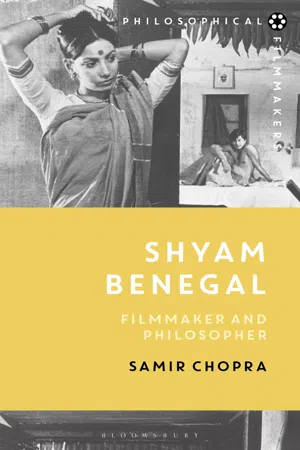
For over forty years, Shyam Benegal has been one the leading forces in Indian cinema. Informed by a rich political and philosophical sensibility and a mastery of the art and craft of filmmaking, Benegal is both of, and not of, Bollywood.
As a philosophical filmmaker Benegal brings to life the existential crisis of the downtrodden Indian, the 'subaltern' if you will-the serf, the peasant, the woman-and imposes a distinctive philosophical vision on his cinematic reworkings of literary products. To understand Benegal's cinema is to understand, through his lens, modern India's continued process of political and social becoming.
Focusing on the philosophical depth of Benegal's oueuvre, Samir Chopra identifies three key aspects of his work:
- A trio of films which signalled to middle-class India that a revolt was brewing in India's hinterlands
- Two sets of movies which make powerful feminist statements and bring viewers into the lives of Indian women by showcasing strong, interesting female characters
- Benegal the master storyteller, who possessed of a unique fabulist style in a reboot of the Indian epic Mahabharata, a Ruskin Bond novel set during the Indian Mutiny of 1857, and a Rashomon-like retelling of an Indian experimental novel, where three perspectives converge to form a unified whole
- 208 pages
- English
- ePUB (mobile friendly)
- Available on iOS & Android
eBook - ePub
About this book
Information
1
Poet of resistance
The ‘uprising trilogy’
Shyam Benegal’s moviemaking career began in the 1970s, as India emerged from the shadow of its first prime minister Jawaharlal Nehru’s reign, as populist revolts, armed uprisings – often suppressed by military action – and in a spectacular act of political self-mutilation, a government-imposed suspension of fundamental constitutional rights, the so-called Emergency, placed Indian democracy under a spell of existential questioning. The lenses Indian writers, poets, artists and filmmakers turned on India during these years enabled an acute stocktaking and reckoning of its continuing moral and political development. For these introspective efforts often offered an unflattering, searing counterpoint to the nationalist and patriotic self-congratulation that had greeted the first twenty-five years of Indian independence. Now, contrary to its earlier loftier assessments as an instrument of deliverance and harbinger of a new, qualitatively different polity, the Indian Constitution was broadly understood as a failed ‘social contract that did not . . . end the prevalent feudal order’ whose most pathological manifestations were ‘appalling poverty . . . rampant corruption’,1 and intractable conflicts arising out of ‘caste, linguistic, and communal hatreds and passions’.2
Benegal’s ‘uprising trilogy’ is framed by this post-independence ‘national disappointment’; it critiques the failure of the nascent Indian state to deliver on its lofty promises of a secular, classless republic distant from its older pathologies,3 as Indian classes and social formations, placed in conflict in an emerging and inarticulate political order, struggled to evolve ‘new values’.4 The uprising trilogy’s depiction of the painful, transitional development of social, moral and cultural values arising from these contestations placed Indian liberatory politics in concrete contexts, as India became ‘independent’ in a sense more actualized than having traded a colonial viceroy for another English-speaking, English-educated lawyer as the leader and architect of its emergent polity. India, as a postcolonial nation, acquired definition through such cinema – it became ‘visible’; its moral and political challenges were identified as the tasks of future Indian polities slowly hove into view.
By the end of the 1980s, Indian audiences of ‘new cinema’ had become painfully aware of post-independence peasant and serf struggles against feudalism and its associated social dysfunctions. In particular, nouveau riche urban Indian middle-class viewers most uncomfortably recognized the India portrayed in Benegal’s uprising trilogy. Their treatment of their indigent servants and ‘domestic help’ – those who cleaned their cars, washed their dishes and clothes, mopped their floors, cooked their food, the ones not allowed to eat and drink out of kitchen utensils used by the upper-caste bourgeois family, whose women were leered at, groped and raped by ‘the men of the house’ – did not differ significantly from how landlords treated their serfs; the feudal realities of the rural India were replicated in its urban, supposedly ‘modern’ precincts. As such, the rural rebellions depicted in the ‘uprising trilogy’ were visible warnings that these revolts could occur elsewhere, wherever tyranny, in whatever shape or form, was manifest. (Benegal does not, however, depict industrial actions, strikes or labour unrest in the ‘uprising trilogy’.)
By way of historical resonance, these movies invoke the Telangana People’s Struggle (1948–51), a defiant grassroots rebellion for autonomy and self-determination which followed on the heels of Indian independence and left its mark on a young, politically impressionable Benegal – and his nation. The Telangana People’s Struggle’s causes – feudal reform – and methods anticipated the late peasant Naxalite uprisings led by the Communist Party of India (Marxist),5 which were to become ‘famous’ or ‘notorious’ – depending on your political perspective – for their violent methods of resistance, and for the Indian government’s brutal, heavy-handed suppression and quelling of their rebellions. Variants of these uprisings continue in Maoist-Naxalite insurgencies in Indian states today; the transformation of Indian electoral politics to incorporate the voting energies of India’s ‘backward classes’ – untouchables, landless peasants, migrant workers – confirms an ‘electoral revolt’ is underway in contemporary India even as its current hijacking by the forces of reaction – as manifested in the rise to power of the Hindu nationalist Bharatiya Janata Party (BJP) – continues an unsurprising, if dispiriting, world-historical trend.
The ‘uprising trilogy’ depicts three different kinds of ‘uprisings’ with varying visions of change articulated within them; in none of them is the state resisted or overthrown. The state and its formal legal apparatus of governance, when not wholly invisible, appear powerless and ineffective, unable or unwilling to intervene in the microinteractions of the landlord and the peasant ‘away’ in the villages. These movies helped articulate a deep-rooted suspicion of electoral democracy and its associated politics in postcolonial contexts: that postcolonialism meant the nominal identity of the rulers in the metropole would change while the hinterlands, the frontiers, and the countryside would remain ruled by the owners of historically established material hierarchies who, as collaborators with dominant power, would retain their ‘offices’ by negotiating new terms of control with the new rulers. (Indeed, despite the expenditure of considerable reformist energies, the material power of entrenched landlords and the new industrialists and bourgeois classes was often ascendant in the newly independent India.6 ) The ‘subalterns’, in this dispensation, gained little to no power, saw no change in their material realities. Such an analysis suggested that the national exultation over relief from colonialism and imperialism needed to be tempered by an examination of the products of the historical intersections of caste, class and gender in the political contexts of the lands now left free to devise their own futures; there were ‘two nations’ visible now that colonialism had receded from Indian shores and a politics that was only tractable for one was rendered incoherent.
The ‘uprising trilogy’ suggests, plausibly, that the first assault on the state, postcolonial or otherwise, would begin with ‘minor’ acts of resistance that would topple established and entrenched local historical centres of power; from there, the questioning of political and social verities could radiate outwards. Benegal’s political vision is thus ‘restricted’ in its scope but is not lacking in clarity or insight. The ‘uprising trilogy’, too, by bringing women and their hitherto hidden world to light, struck telling blows for a programme of change directed upwards and outwards from the private hearth and home to the patriarchal public polis. If the state is not resisted in these works, it is because it is implicitly claimed such reform of the public is useless and without political and moral valence, without a more fundamental moral reckoning that must take place in the private. That reckoning would be led by those who, like Mack the Turtle, had been placed at the very bottom of the social order – women, the landless, the lowest castes – but whose ‘standing up’ could upend it all.7
Contra Madhav Prasad – who extends little credit to, or imagines little political sophistication on the part of, the many Indian viewers who flocked to the ‘uprising trilogy’ – their viewer is not a mere voyeur who gains ‘access to the fascination and power of spectacle of feudal oppression and rebellion without being reminded of its proximity in date and time’.8 If anything, Benegal’s work reminded the Indian viewer little had changed since the identity of the rulers of New Delhi passed from British to Indian: the ‘new India’ behaved and functioned a great deal like the ‘old India’, and those who left the cities to travel to its rural suburbs knew this well. Prasad’s critique disdains Benegal’s work as not uncompromising enough in its politics; it accuses him of being committed to upholding a naive political sincerity, a state-ideology-inspired national vision at odds with the pathology he depicts. These political critiques supplement an artistic one, noted earlier, which sees Benegal committed to older, ‘mainstream’ cinematic techniques. In these understandings Benegal is too conventional and safe a filmmaker, too modest and quiescent in his political claims, to be taken seriously as an activist, polemicist or artist. Benegal’s movies, in this view, become part of the state’s ideological apparatus, committed to propping up a national sincerity about nationalistic claims. They become claims made by the nation about itself but in a manner that distances itself from the pathology it displays, restricting itself to a removed judgement of disavowal.
The misunderstandings of politics and art in these critiques runs deep; they do not reckon with the manner in which the ‘uprising trilogy’ was received by its audiences, who saw in its movies an acute failure of the national project, one that implicated its viewers – forcing introspective examination about the nature of their nation and their citizenship – as well as those whose lives and acts it brought to the screen. Benegal’s political function is wholly misunderstood if he is viewed as a promulgator of a staid, sincere, naive conception of the Indian nation; the placing of the family and the village as a fundamental unit of Indian political life makes his ‘private cinema’ devastating and corrosive of established public political verities. If the nation is constructed and constituted by the innumerable private realities on display in Benegal’s cinema, then to submit a critical description of them is to do no less than to question the nation and its cultures itself.
The ‘uprising trilogy’ is often referred to as the ‘rural trilogy’ in extant critical writings on Benegal; the physical and moral geography of ‘the Indian village’ depicted in them is a far cry from the romanticized and idealized village of mainstream Indian cinema, which depicted idyllic refuges from urban life, or the blank canvases of reformist visions. If the nation of India was understood to be a largely rural one, then this highly particularized cinema of the village was no less than an identification of the ‘real India’ which was to be the subject of political theorizing and praxis. The true significance of the ‘uprising trilogy’ is that it was made in a postcolonial context, questioning the national project underway for its failure to be genuinely inclusive in a manner befitting its theoretical and rhetorical pretensions. This failure was most visible when the fundamental unit of Indian life, the rural weekday, received its dues on the screen.
Ankur
Benegal’s international award-winning debut Ankur (The Seedling, 1974) recounts the rise-and-fall tale of a young landlord Surya, who is forced by his father to move to the village from the city to manage his family’s ancestral property. There, on the feudal estate, he finds his own ‘heart of darkness’ as he alienates his tenant farmers and the local community in manifold fashion and sexually exploits a tenanted Dalit woman Lakshmi after humiliating and punishing her husband, Kishtya, who promptly exiles himself in disgrace. Finally, after callously abandoning a pregnant Lakshmi, as Surya subjects her now-returned husband to a guilt-stricken brutal assault, we see the feudal estate reach its proverbial tipping point and prepare to ‘shrug off’ the landlord; a ‘seedling’ of revolt has been planted, there to bring forth the fruit of defiance.
Ankur applied ‘psychological realism’ to select mainstream Indian film industry conventions,9 a stylistic marriage of craft and convenience that paid dividends at the Indian box office and introduced Benegal’s work and ‘message’ to a larger audience; it featured, in a stunning debut, Shabana Azmi, who would become one of India’s greatest screen performers, and two veterans of Bombay theater, Anant Nag and Sadhu Meher, in its leading roles.10 Ankur borrowed its conceptions of the lecherous, leering, exploitative landlord and the eternally oppressed feudal serf from older Indian realist cinema – especially the work of stalwarts like Bimal Roy – but by situating them in a particularized regional and intersectional aesthetic brought the true social dysfunction and brutality of their unequal relationship to the fore. In its frank exploration of the hitherto invisible and misunderstood sexuality of Indian women, it contributed, too, to a politically and socially significant informing of patriarchal Indian moviegoers. Ankur was shot on location, in specific regional settings, and eschewed conventional devices such as song and dance sequences, a distinctive signature of Indian mainstream cinema; its actors speak in Dakhni, a local dialect of Andhra Pradesh, and participate in regionally specific rites, rituals and practices, rendering a visible locution of their location in space and time and instantiating Benegal’s claim that ‘the more culturally specific you are, the more universal you will be’.11
Ankur depicts a bildungsroman of sorts for Surya, a member of an older feudal order, one corrupted by its landed power; ostensibly a secular and egalitarian visitor, an enlightened messenger bearing tidings of reform from the modern city to a backward village, he soon shows himself to be a retrograde reactionary. His father, the archetypal patriarchal landlord, subjugates his idler heir, committing him to manage the precious bounty of his landed properties; Surya, who has resentfully and unwillingly borne the brunt of this paternal power, does not hesitate to impress that power on others, to exercise the ‘rights’ his father has exercised in the past. Machiavelli would have disapproved of this ‘prince’ and his crude displays of power, his cruel expressions of a counterproductive and corroded moral and political sensibility, his corrupted virtu; they signal a moral and tactical failure to recognize, and empathize with, those who inhabit ‘inferior’ social orders of caste and class. His arrogance and resentment are ‘naturally’ and dangerously directed at his father’s erstwhile mistress and her son, his half-brother, his lower-caste serfs, the local villagers, and the village policeman. Surya professes not to believe in caste and older social forms for his own convenience – as in accepting a cup of tea brewed by his low-caste female serf – for he is not a reformer. He kicks the local priest’s animals off his land, refusing to let them graze as an informal courtesy, and does not let his father’s mistress and his half-brother access irrigation water in the neighbouring fields; there is a rhythm of life, an ecology, in the village, and Surya disrupts and destroys it. This disruption is expressed vividly in Surya’s attempts – bumbling and awkward, and arrogant, self-entitled and selfish – to sexually exploit Lakshmi and in his cruel, formal and informal, assaults on her deaf-mute alcoholic husband Kishtya. Crucially, Surya is resisted by the woman Lakshmi, whose manifold defiance clears the way for the seedling of revolt to be planted.
For Lakshmi, in cinematic and material terms alike, is the ‘real boss’. A diligent serf, Lakshmi is the de facto estate manager as she works on the fields, grinds spices, cleans, cooks and chases stray cattle away. Lakshmi is loyal to, and protective of, Kishtya, her friend and companion; her relationship with Kishtya is not circumscribed by its sexual bonds and has failed to produce a child – an absence that does not diminish their relationship’s emotional affects. Lakshmi grants Kishtya a measure of agency by seeking and procuring employment for him, by shielding him from the psychic abuse others would direct at him. Surya, enthralled by Lakshmi’s visible sexuality and agency, covets her and seizes an opportunity to publicly humiliate his ‘rival’, Kishtya, after he is caught stealing toddy liquor from the estate’s palm trees. An angry and mortified Kishtya flees the estate, and in his absence, Surya and Lakshmi’s relationship is sexually consummated. Lakshmi becomes pregnant; the cowardly, contemptible and callous Surya, worried about his local reputation and paternal wrath, ‘asks’ Lakshmi to get an abortion. Lakshmi, at her most defiant, rejects his attempts to purchase her silence and acquiescence. The appalled local villagers – as their leering speculations suggest – acknowledge Surya’s right to use the bodies of landless women but expect him to maintain a genteel propriety, to pay them a maintenance income and a grant of property like his father did; an older noblesse oblige had kept Surya’s father, and significantly, the villagers too, in line. Surya rejects this possibility for redemption within the feudal framework; his corruption by feudal power has induced a moral and strategic blindness. From his vantage position of caste, class and gender, Surya cannot discern the moral failure visible in his exploitation and abandonment of his ‘lover’.
These developments set up Ankur’s dramatic conclusion, a cluster of climactic scenes of philosophic brilliance: a sober Kishtya returns home and gives Lakshmi his hard-earned money, proud of this visible evidence of his personal, self-directed redemption; he is ecstatic to find she is pregnant, naively imagining her incipient ...
Table of contents
- Cover
- Half-Title
- Series
- Dedication
- Title
- Contents
- Acknowledgements
- Introduction
- 1 Poet of resistance: The ‘uprising trilogy’
- 2 Making women visible: An Indian feminist
- 3 ‘Bringing stories to life’: The storyteller
- Conclusion
- Notes
- Bibliography
- Index
- Copyright
Trusted by 375,005 students
Access to over 1.5 million titles for a fair monthly price.
Study more efficiently using our study tools.
Frequently asked questions
Yes, you can cancel anytime from the Subscription tab in your account settings on the Perlego website. Your subscription will stay active until the end of your current billing period. Learn how to cancel your subscription
No, books cannot be downloaded as external files, such as PDFs, for use outside of Perlego. However, you can download books within the Perlego app for offline reading on mobile or tablet. Learn how to download books offline
Perlego offers two plans: Essential and Complete
- Essential is ideal for learners and professionals who enjoy exploring a wide range of subjects. Access the Essential Library with 800,000+ trusted titles and best-sellers across business, personal growth, and the humanities. Includes unlimited reading time and Standard Read Aloud voice.
- Complete: Perfect for advanced learners and researchers needing full, unrestricted access. Unlock 1.5M+ books across hundreds of subjects, including academic and specialized titles. The Complete Plan also includes advanced features like Premium Read Aloud and Research Assistant.
We are an online textbook subscription service, where you can get access to an entire online library for less than the price of a single book per month. With over 1.5 million books across 990+ topics, we’ve got you covered! Learn about our mission
Look out for the read-aloud symbol on your next book to see if you can listen to it. The read-aloud tool reads text aloud for you, highlighting the text as it is being read. You can pause it, speed it up and slow it down. Learn more about Read Aloud
Yes! You can use the Perlego app on both iOS and Android devices to read anytime, anywhere — even offline. Perfect for commutes or when you’re on the go.
Please note we cannot support devices running on iOS 13 and Android 7 or earlier. Learn more about using the app
Please note we cannot support devices running on iOS 13 and Android 7 or earlier. Learn more about using the app
Yes, you can access Shyam Benegal by Samir Chopra in PDF and/or ePUB format, as well as other popular books in Media & Performing Arts & Art General. We have over 1.5 million books available in our catalogue for you to explore.