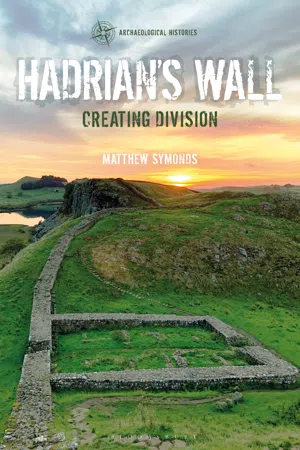
Over its venerable history, Hadrian's Wall has had an undeniable influence in shaping the British landscape, both literally and figuratively. Once thought to be a soft border, recent research has implicated it in the collapse of a farming civilisation centuries in the making, and in fuelling an insurgency characterised by violent upheaval. Examining the everyday impact of the Wall over the three centuries it was in operation, Matthew Symonds sheds new light on its underexplored human story by discussing how the evidence speaks of a hard border scything through a previously open landscape and bringing dramatic change in its wake. The Roman soldiers posted to Hadrian's Wall were overwhelmingly recruits from the empire's occupied territories, and for them the frontier could be a place of fear and magic where supernatural protection was invoked during spells of guard duty.
Since antiquity, the Wall has been exploited by powers craving the legitimacy that came with being accepted as the heirs of Rome: it helped forge notions of English and Scottish nationhood, and even provided a model of selfless cultural collaboration when the British Empire needed reassurance. It has also inspired creatives for centuries, appearing in a more or less recognisable guise in works ranging from Rudyard Kipling's Puck of Pook's Hill to George R. R. Martin's A Game of Thrones. Combining an archaeological analysis of the monument itself and an examination of its rich legacy and contemporary relevance, this volume presents a reliable, modern perspective on the Wall.
- 232 pages
- English
- ePUB (mobile friendly)
- Available on iOS & Android
eBook - ePub
About this book
Information
1
Introduction
Into Darkness
[Hadrian] was the first to build a wall, 80 miles in length, to separate the barbarians from the Romans.
– HISTORIA AUGUSTA, HADRIAN 11, 2
Hadrian’s Wall hardly fits the profile of a classic archaeological mystery. Even its current name offers answers rather than questions: Hadrian really was the emperor who ordered its construction, while a wall is something we can all relate to. The simplicity of this description is so timeless that its original Roman name seems to have been effectively the same: the vallum Aelium, or Aelian Wall,1 Aelius being Hadrian’s family name. As for why his Wall was needed, it is hard to visit the solemn chain of crags crowned by the curtain without sensing you are standing on an edge. This sentiment is borne out by the barrier belonging to a network of frontiers that girded the Roman Empire and, in Hadrian’s reign (117–138), stretched for over 10,000km through twenty modern countries on three continents (Map 1).2 Hadrian’s Wall accounts for a modest 117km, or 80 Roman miles, of that total (Map 3), but distinguishes itself by presenting a more formidable barrier than its peers. When it comes to the Wall’s purpose, our sole surviving Roman statement on the matter is a throwaway comment in the Historia Augusta. This scurrilous ancient document presents a racy and often unreliable exposé of various emperors’ lives, which was probably compiled over two centuries after Hadrian’s death. Despite this dubious pedigree, the text emphasises that the Wall served as a means to create division by distilling its essence into just four Latin words: qui barbaros Romanosque divideret, or ‘to separate the barbarians from the Romans’. So, even a rapid sketch of our knowledge seemingly rules out any real scope for mystery. We know what Hadrian’s Wall was, who built it, and why. Case closed.
But what did imposing this division on previously open country mean for its inhabitants? Modern visitors can be forgiven for imagining amid the serenity of the crags that Roman military planners indulged their frontier fantasies in an empty wilderness. But if you look closely, traces of more ancient activity can sometimes be made out in the vicinity of the Roman works. Faint blemishes, often no more than smudges on the landscape, mark the enclosures and roundhouses of scattered farmsteads, mouldering beside long untended fields. Follow the course of the Wall away from the picturesque uplands, through what is now gently undulating farmland or settlement, and the evidence for earlier activity rises sharply, even though the visible remnants diminish: levelled by agriculture or urban sprawl. These prehistoric sites testify to landscapes that were inhabited and worked for millennia before the Roman conquest. Our understanding of chronology is rarely all we would wish for, but it is clear enough that long stretches of the Wall split settled, sophisticated, and stable agricultural communities that were centuries in the making. It was once believed that such local groups prospered on the back of a durable peace dividend – the vaunted pax Romana – but new dating evidence is challenging this scenario by implicating the Wall in the collapse of some communities. Understanding how Hadrian’s Wall upset the rhythm of rural life, though, is hamstrung by our uncertainty concerning who was permitted to pass through it, and under what circumstances. To put it another way, we do not know what the Wall did. Here is our mystery. It hinges on the relationship between the Roman military and local population for almost 300 years while the Wall was operational, and its continuing impact down to today. To set the scene for this enquiry, we will begin by exploring some previous interpretations of the monument.
The writing on the Wall
The question of what Hadrian’s Wall did is far from being a new one. Many answers have been offered over the years, multiplying to keep pace with shifts in knowledge, or the foibles of scholarly fashion. These solutions shape our views of the world in which the Wall operated, and indeed the world it helped to create. After all, taking the statement in the Historia Augusta at face value presents the Wall as a social fault-line, screening unruly – and un-rulable – savages from cultured Romans; essentially, a bulwark between chaos and civilisation. This broad viewpoint continued to influence scholarship until well into the 19th century, but while the popular appeal of this image remains strong – as we will see when we examine some of the Wall’s fictional offshoots – more recent study of the monument has encouraged a nuanced take on its role. Back in 1732, the antiquarian John Horsley envisaged ‘defences against the enemy’ when he surveyed a barrier seemingly short on crossing points.3 A surprise followed in the 19th century, though, when a series of gateways through the frontier was discovered, built into small posts placed at sufficiently rigid intervals to coin the name ‘milecastles’ (Fig. 1). This demonstration that the Wall curtain was regularly pierced by access passages forced a reappraisal of just how formidable Rome’s foes really were.4 John Collingwood Bruce, then doyen of Wall studies, felt moved to remark that ‘the territory north of the Wall was not given up to the enemy’.5 As well as providing an early example of how knowledge won from digging could recast debate, it also created a headache for Wall scholars that remains acute: who were these gateways for? Were they intended to aid military manoeuvring, or a sop to inconvenienced local groups freshly divided from friends and relatives?

FIGURE 1 John Storey’s engraving of milecastle 42, after digging in 1848 revealed a pair of gateways. Courtesy of David J. Breeze.
Establishing whether the milecastle gateways eased passage for all is central to gauging the Wall’s purpose, but perceptions of this have differed markedly. In 1899, Robert Forster declared the Wall ‘a great stone portcullis, which cut off the southern tribes from their northern kinfolk, and so weakened both, depriving the north of the richer resources of the south, shielding the south from the fiery inspiration of northern freedom’.6 Twenty-two years later, R.G. Collingwood asserted a predominantly passive role for Hadrian’s Wall and concluded that it was primarily ‘designed to serve simply as a mark to show where Roman territory ended’.7 In 1976, David J. Breeze and Brian Dobson proposed that ‘the purpose of the barrier was to control movement, not to prevent it, as the liberal provision of gateways demonstrates. Civilians, whether merchants, local farmers moving their cattle and sheep or simply local people visiting relatives on the other side of the Wall, would be allowed through the gateways, though only presumably when they had satisfied the guards of their peaceable intentions and on payment of customs dues’.8 By 1990, John Mann could claim that the Wall was no more than ‘a rhetorical statement of Roman power’, and ‘in no way did the military defence of the occupied part of Britain’ depend upon it.9 These interpretations illustrate the intellectual journey initiated by the discovery of milecastle gateways, as a barrier once seen as effectively a cordon sanitaire morphed into one allowing life on both sides to continue with minimum hassle.
Despite the popularity of this model, not everyone has been persuaded. In 1999, Paul Bidwell reiterated the importance of deducing how the access arrangements worked: ‘if civilians could not use the milecastle gates, Hadrian’s Wall would be virtually a closed frontier’.10 More recently, the wheel has turned full circle with Nick Hodgson presenting a spirited case for the Wall making a more muscular contribution to provincial security. By this reading, the presence of regular gateways does not disqualify the barrier from being ‘designed along conventional lines as a defensible structure’,11 allowing an interpretation reminiscent of the ‘defences against the enemy’ hypothesised by Horsley. Today, opinion remains split. The two dominant scholarly views of the Wall’s purpose can be crudely characterised as either a military barrier capable of repulsing full-blown invasions, or a means to regulate the peaceful movement of people and goods. Although both camps accept the barrier could neutralise nuisances such as raiding, the former position envisions a largely closed frontier, and the latter a highly porous one, amounting to a radical difference in intent.
Scholarly debate about an ‘open’ or ‘closed’ barrier sounds eerily prescient in an age when the relative merits of ‘hard’ and ‘soft’ borders are once again high on the international political agenda. Such echoes of wider contemporary concerns crop up time and again in Wall studies, emphasising the monument’s currency during moments of national debate. Assessing this aspect aids appreciation of why successive generations saw the Wall as they did, and how interpretations of it continue to feed into, and be shaped by, current affairs. Breeze and Dobson’s case for it channelling rather than curtailing movement, for instance, was published just three years after Britain joined the European Community, with concomitant shifts to trading patterns and cross-border cooperation. In the 19th century, the Wall offered a model of cross-cultural cooperation when the British Empire needed reassurance, while the medieval period saw it helping to forge a sense of English nationhood. As early as the 6th century AD, Gildas, a preacher, was able to make a point by claiming Christian and British origins for the Wall (with a little help from the Romans). Together, these examples reflect the role of the zeitgeist when formulating archaeological theories and humanity’s genius for repackaging the past to suit present needs. That the Wall has been capable of sustaining so many conflicting readings speaks volumes about what the evidence for investigating it can and cannot tell us, making it essential to introduce the principal categories of information available.
A fragmented picture
Titbits from surviving copies of Roman-era literature typically underpin attempts to devise a crude chronology for activity in the frontier zone. While these ancient histories are invaluable for noting epochal events that befell Britain, they are typically short on detail. Few references are longer than a sentence, and even fewer mention the Wall directly. The Historia Augusta discloses, for instance, that upon Hadrian’s accession in 117 ‘the Britons could not be kept under control’,12 but nothing about the cause, duration, or geographical focus of this insurrection. Marcus Aurelius’ reign (161–180) furnishes another good example, when we learn simply that ‘war was threatening’. The emperor responded by appointing Calpurnius Agricola governor of Britain, and sending him ‘against the Britons’.13 Once again, though, the nature of the threat and whether it was focused within or without Roman territory is left ambiguous. A few extra words can make a massive dif...
Table of contents
- Cover
- Half-Title Page
- Dedication
- Series Page
- Title Page
- Contents
- List of Illustrations
- Acknowledgements
- 1 Introduction: Into Darkness
- 2 Rome and Britain: When Worlds Collide
- 3 Battling for Britain: Conflict and Collaboration
- 4 Drawing a Line: Hadrian and His Wall
- 5 A New Normal: War and Peace
- 6 The Long 4th Century: An End and a Beginning
- 7 The Mythmakers: From Limitanei to Legend
- 8 Wall Renaissance: Evidence from the Earth
- 9 Romancing the Stones: A Media Murus
- 10 Long Division: The Many Lives of the Wall
- Notes
- Bibliography
- Index
- Copyright
Trusted by 375,005 students
Access to over 1.5 million titles for a fair monthly price.
Study more efficiently using our study tools.
Frequently asked questions
Yes, you can cancel anytime from the Subscription tab in your account settings on the Perlego website. Your subscription will stay active until the end of your current billing period. Learn how to cancel your subscription
No, books cannot be downloaded as external files, such as PDFs, for use outside of Perlego. However, you can download books within the Perlego app for offline reading on mobile or tablet. Learn how to download books offline
Perlego offers two plans: Essential and Complete
- Essential is ideal for learners and professionals who enjoy exploring a wide range of subjects. Access the Essential Library with 800,000+ trusted titles and best-sellers across business, personal growth, and the humanities. Includes unlimited reading time and Standard Read Aloud voice.
- Complete: Perfect for advanced learners and researchers needing full, unrestricted access. Unlock 1.5M+ books across hundreds of subjects, including academic and specialized titles. The Complete Plan also includes advanced features like Premium Read Aloud and Research Assistant.
We are an online textbook subscription service, where you can get access to an entire online library for less than the price of a single book per month. With over 1.5 million books across 990+ topics, we’ve got you covered! Learn about our mission
Look out for the read-aloud symbol on your next book to see if you can listen to it. The read-aloud tool reads text aloud for you, highlighting the text as it is being read. You can pause it, speed it up and slow it down. Learn more about Read Aloud
Yes! You can use the Perlego app on both iOS and Android devices to read anytime, anywhere — even offline. Perfect for commutes or when you’re on the go.
Please note we cannot support devices running on iOS 13 and Android 7 or earlier. Learn more about using the app
Please note we cannot support devices running on iOS 13 and Android 7 or earlier. Learn more about using the app
Yes, you can access Hadrian's Wall by Matthew Symonds in PDF and/or ePUB format, as well as other popular books in Social Sciences & British History. We have over 1.5 million books available in our catalogue for you to explore.