Hair, or lack of it, is one the most significant identifiers of individuals in any society. In Antiquity, the power of hair to send a series of social messages was no different. This volume covers nearly a thousand years of history, from Archaic Greece to the end of the Roman Empire, concentrating on what is now Europe, North Africa, and the Near East. Among the key issues identified by its authors is the recognition that in any given society male and female hair tend to be opposites (when male hair is generally short, women's is long); that hair is a marker of age and stage of life (children and young people have longer, less confined hairstyles; adult hair is far more controlled); hair can be used to identify the 'other' in terms of race and ethnicity but also those who stand outside social norms such as witches and mad women.
The chapters in A Cultural History of Hair in Antiquity cover the following topics: religion and ritualized belief, self and society, fashion and adornment, production and practice, health and hygiene, gender and sexuality, race and ethnicity, class and social status, and cultural representations.
- 232 pages
- English
- ePUB (mobile friendly)
- Available on iOS & Android
eBook - ePub
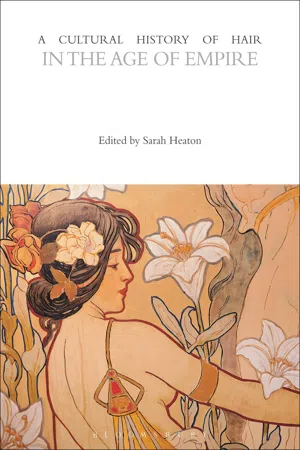
A Cultural History of Hair in the Age of Empire
About this book
Information
CHAPTER ONE

Religion and Ritualized Belief: Myth, Folklore, and Spiritualism in Victorian and Neo-Victorian Representations of Hair
Unweaving the Tangled Tresses of Influence and Obsession
INTRODUCTION: THE UNTAMED HAIR OF SPIRITUALISM AND THE SUPERNATURAL
The use and fashioning of hair in association with spiritualist practices is broad and far-reaching through history. In 1654, Emma Wilby writes, a “cunning-woman” claimed to have cured a headache by “boiling a lock of the client’s hair in wine and throwing it in the fire.”1 Cunning folk, those who practiced traditional magic and pagan witchcraft, were officially outlawed by the Vagrancy Act of 1824, yet the influence of their practices and rituals continued to be felt in the developing mythic and spiritualist beliefs of the period. Cunning folk continued to use hair both in the creation of their own appearance and in spells and magic. Ronald Hutton details how cunning folk fashioned their hair in order to heighten their mystique, and mark themselves as distinctly other. He notes Victorian cunning man Billy Brewer “promenaded Taunton in a long Inverness cape and sombrero hat, his hair falling in long dishevelled grey locks,” and another magic-practitioner nicknamed “Pigtail” Bridger, “who wore his hair as his nickname suggested.”2 Hair was a vital component in the performance of the spiritualist’s identity; it embellished their mystery and helped cultivate the detached position they occupied on the periphery of society.
The nineteenth-century fascination with the supernatural and spiritual has been widely discussed, with Richard Noakes establishing the “dilemma” of “the Victorian association of spiritualism with the supernatural” and the problematizing of that idea by “the Victorian quest for order behind phenomena purporting to come from the other world.”3 The instability of faith and belief during the early to mid-century created a social psyche that wanted to believe in something, yet wanted that something to be severely rational and physically tangible. Janet Oppenheim suggests British spiritualists valued its rituals and practices for the religious comfort that this belief offered, and how it “tended to emphasise the purportedly scientific foundations of their beliefs when they urged the claims of spiritualism to public attention and respect.”4 Hair was often presented as bridging this gap; it was ethereal in its materiality, and was taken as a representation of the whole individual. In this need for the rationalization of a supernatural other, we may witness the consolidating of the mythic and folkloric origins of the spiritual with the emergence of psychological understanding. Thomas Carlyle reflected on the blurring of these concepts in Sartor Resartus:
Notable enough too, here as elsewhere, wilt thou find the potency of Names, which indeed are but one kind of custom-woven, wonder-hiding Garments. Witchcraft and all manner of Spectre-work, and Demonology, we have now named Madness and Diseases of the Nerves.5
Classical notions of folkloric magic and spiritualism intertwined with rational scientific investigations. Hair occupied a unique space within these concepts. Representations of hair in art and literature often suggested the ongoing influence of pagan and mythological beliefs, while also reflecting the developing rationality and scientific faith of the nineteenth century.
The association of hair with the construction and performance of identity aligned to the suggestion that it can somehow represent or indicate the deviant or degenerate personality is apparent in Cesare Lombroso’s work on criminal type. Lombroso, in Criminal Man, acknowledges hair many times, often associating “thick hair,” or an “abundance” of hair as being an indicator of criminality.6 Interestingly, Lombroso embraced the supernatural later in his life, reappropriating his scientific rationality to spiritualist beliefs: hair remained an important means of conveying the image of the “other,” albeit now in a spiritual rather than criminal sense. In After Death—What?, he describes a photograph taken in the séance of a psychic named Randone, which he alleges shows “the form of a girl wrapped in a veil, with abundant hair falling to her knees.”7
The emphasis put on the unkemptness and abundance of hair by Lombroso, in both a criminal and a supernatural sense, suggest that it functions as a means of delineating non-socio-normative identities, or a sense of cultural unorthodoxy. This opposition between the untamed and restrained hair extended to hair length when, as Carolyn C. White notes, there was a “transition from large, extravagant hairstyles of the 18th century to the short, more restrained styles of the 19th century.”8 This shift in styles established a direct opposition between the popular, more restrained hairstyles and those that were wilder and less refined; hair, in both its styling and its use in ritual practices, became a symbol of the variable cultural dichotomy between what was deemed normal and other.
Hair’s heritage as an important facet in the representation of an individual in archaic spiritualist practices continued into the nineteenth century. As well as representing spiritualist identity, hair was also used in the mesmeric rituals of its practitioners. A series of séances that became known as the Cross-Correspondences focused on former British prime minister Arthur Balfour’s attempts to communicate with his deceased wife, Mary Lyttleton. Lyttleton was alleged to have attempted to contact her husband through a number of sessions of automatic writing conducted by various mediums over a thirty-year period following her death in 1875. Subsequent studies of the collection of correspondences have emphasized the importance of the fetishization of a lock of Mary’s hair, which Balfour originally cut from her head on her deathbed and kept in a silver casket, in his interpretation of the automatic writings as apparent recreations of her hair, the last bodily reminder of her life. Jill Galvan notes that Jean Balfour, a descendant of Arthur who became the lead archivist of the correspondences, dedicated a large section to the topic, “The ‘Lock of Hair’ References”: “These references in the scripts reportedly included a number of little drawings, along with those allusions to maidens’ hair and repetitions of the sigma, which because of its curved or bent-line shape, was interpreted as a pictorial rendering of the tress.”9 The need to interpret the curved lines as an image of Mary Lyttleton’s hair indicated Balfour’s desire for some kind of afterlife for his lover. The lock of hair as the physical signifier of her was, for him, witnessed in the automatic drawings of spirit mediums. Galvan elaborates on this idea when she writes:
The sustained attention to the scribblings—the wide, loose variety of drawings that got called a sigma—the strange equivalence of the sigma with the hair in the first place—all of this begins to seem like a desperate, endlessly frustrated, attempt to capture the hair itself. Lyttleton’s physical body, through the material form of the mediums’ handwriting—an attempt to lay claim to the body in the at best very limited way automatic handwriting will allow. In other words, in the quasi-virtual realm of the cross-correspondences, there arose a powerful, reactive craving for the material vestige of the self. Removed during Lyttleton’s last illness, the hair was desired as a sign of her vulnerable, mortal being and the true emotions this had experienced.
The highly material nature of the late Victorian era, following improvements in mass production, consumerism, and commodity capitalism, appears to have influenced the yearning for material signifiers of the body post-death. Hair provides a unique materiality that is in some senses evanescent even after death; its physicality and its psychical link to the deceased are reminiscent of pagan and folkloric visions of hair. David Pickering, in Cassell’s Dictionary of Witchcraft, summarizes this use: “Because the hair, like other body parts, is reputed to retain a mystic link with the body after it has been cut off, it has always been much valued by practitioners of witchcraft (particularly as the head is the seat of a person’s psychic power).”10 Pickering also highlights how strands of hair were used in “image magic” and “witches bottles” in order to represent the intended subject of a spell or concoction. As well as being able to convey a sense of identity to a living person, hair acted as a residual symbol of that identity in death. Representations of this phenomena in both Victorian and neo-Victorian art and literature extrapolate the notion of hair as being representative of personality, subjectivity, and the individual’s body, while also closely acknowledging the pervasive mythic, folkloric, and supernatural influences on representations of hair.
THE HAIR OF LITERARY SUPERNATURALISM
A number of prominent nineteenth-century writers were interested in some form of spiritualism or another. Sir Arthur Conan Doyle’s interest in supernatural beings, Charles Dickens’s belief in mesmerism, and even the influence of William James’s psychical research over his brother Henry’s ghost stories all indicate the ongoing influence of archaic supernatural beliefs in representations of hair in their common predilection to use it symbolically as a means of conveying or establishing this often inhuman “other.” Doyle’s portrayals of atavistic beastliness are often marked by lank hair, especially in the Holmes stories; Dickens circumscribed to what Galia Ofek terms the “Victorian Medusa-Rapunzel dichotomous paradigm” in his representations of female hair, again suggesting the ongoing influence of mythic and folkloric ideas; and Henry and William James’s involvement in the testing of hair in Psychical Research,11 as well as Peter Quint’s red-haired menace in The Turn of the Screw, are just some examples of the supernatural connotations of literary hair in the period. Thomas Hardy, in Return of the Native, also subscribes to this supernatural, pagan treatment of hair in his descriptions of Eustacia Vye:
To see her hair was to fancy that a whole winter did not contain darkness enough to form its shadow—it closed over her head like nightfall extinguishing the western glow.
Her nerves extended into those tresses, and her temper could always be softened by stroking them down. When her hair was brushed she would instantly sink into stillness and look like the Sphinx. If, in passing under one of the Egdon banks, any of its thick skeins were caught, as they sometimes were, by a prickly tuft of the large Ulex Europaeus—which will act as a sort of hairbrush—she would go back a few steps, and pass against it a second time.
She had pagan eyes, full of nocturnal mysteries, and their light, as it came and went, and came again, was partially hampered by their oppressive lids and lashes; and of these the under lid was much fuller than it usually is with English women.12
The description of Vye encapsulates a number of the dominant themes conveyed through representations of hair; she is othered in this depiction—her hair is described as being in tandem with her nerves, extending the metonymic connection between hair, the body, and self. The image of her nerves reaching into her hair is Medusan in its semiotics, as is the dark description of her “pagan eyes, full of nocturnal mysteries.” Representations of hair, particularly when influenced by spiritual or mythological ideas, suggest the division between body and identity, and how elements of the differentiated body, such as Vye’s hair, may be an indicator of interior spiritual characteristics. The Medusan connotations of Vye’s hair engage with ideas of entrancement through vision, and the sealing off of perceptions to solely focus on Gorgon-esque hair. As Deborah Lutz argues, “a dash of paganism, persisting into the nineteenth century, also added magic to hair’s religious aura.”13
In 1830, Scottish writer Walter Scott published his Letters on Demonology and Witchcraft, where he reflected on the nature of pagan, wiccan, and other classifications of spiritual belief. His recanting of anecdotes suggests the ongoing supernatural fascination with hair in the nineteenth century. He tells the alleged story of an encounter a “poor visionary” had with the “Restless People”—a crowd of men and women whom he had believed dead for years. Scott writes that after speaking in an unknown language, and roughly pushing him to and fro “all vanished but a female sprite, who, seizing him by the shoulder, obliged him to promise an assignation, at that very hour that day seven-night; that he then found his hair was all tied in double knots (well known by the name of elf-locks), and that he had almost lost his speech.”14 Elf-locks, an early western form of dreadlocked hair, were apocryphally viewed as being made by elves while children slept. However, they were later fashioned into an icon of otherness, as Abigail Bardi points out in her analysis of the disguised Rochester in Jane Eyre. Charlotte Brontë uses gypsy-based iconography, and depictions of these elf-locks to emphasize anxieties regarding both spiritual and social otherness. “The uses of the uncommon word ‘elf-locks’,” Bardi writes, “and of the homonym-like ‘grizzled’ and ‘bristled’, plus the red cloak, hint that Brontë’s Gypsy draws directly from the trope established by Scott [in his Waverley novels].”15 Scott’s awareness of the elf-lock hairstyle and its subsequent pervasiveness in his own tropic depictions of gypsies, as well as Brontë’s, again portray the supernatural levels of otherness that hair embodied within the nineteenth century.
FETISHIZATION AND TRANSACTION: CONTENDING SPIRITUALISM IN THE ROSSETTIS’ NARRATIVES OF HAIR
Dante Gabriel Rossetti was possessed by a fetishistic interest in hair. Many of his paintings—Lady Lilith, The Blessed Damozel, Beata Beatrix, and others—all depict golden-haired women, and he is alleged to have become obsessed with the hair of his sitters. Interestingly, William Rossetti acknowledged the importance of hair in the creation of the Rossetti name. In his biography of his brother, William wrote of how the “Rossetti race” were so called in Italy due to their “florid complexion and reddish hair.”16 Hair was fundamental in creating the Rossetti identity, and the origin of the family name establishes the discourse of patriarchal aestheticism that Dante Gabriel colluded with and Christina criticized.
Dante Gabriel Rossetti is recorded as having attended up to twenty...
Table of contents
- Cover
- Halftitle Page
- Title Page
- Contents
- List of Figures
- General Editor’s Preface
- Introduction: Empires of Hair and their Afterlives
- 1. Religion and Ritualized Belief: Myth, Folklore, and Spiritualism in Victorian and Neo-Victorian Representations of Hair
- 2. Self and Society: Hair Consciousness in the Age of Empire
- 3. Fashion and Adornment: African American Women in the United States, 1800 to 1920
- 4. Production and Practice: Hair Harvest, Hairpieces, and Hairwork
- 5. Health and Hygiene: “Monster top-knots and balloon chignons”
- 6. Gender and Sexuality: Tresses Adorned and Adored, Locks Coiled and Cut
- 7. Race and Ethnicity: Strands of the Diaspora
- 8. Class and Social Status: “The more you have the better”
- 9. Cultural Representations: Hair as the Abundant Signifier
- Notes
- Bibliography
- Contributors
- Index
- Imprint
Trusted by 375,005 students
Access to over 1.5 million titles for a fair monthly price.
Study more efficiently using our study tools.
Frequently asked questions
Yes, you can cancel anytime from the Subscription tab in your account settings on the Perlego website. Your subscription will stay active until the end of your current billing period. Learn how to cancel your subscription
No, books cannot be downloaded as external files, such as PDFs, for use outside of Perlego. However, you can download books within the Perlego app for offline reading on mobile or tablet. Learn how to download books offline
Perlego offers two plans: Essential and Complete
- Essential is ideal for learners and professionals who enjoy exploring a wide range of subjects. Access the Essential Library with 800,000+ trusted titles and best-sellers across business, personal growth, and the humanities. Includes unlimited reading time and Standard Read Aloud voice.
- Complete: Perfect for advanced learners and researchers needing full, unrestricted access. Unlock 1.5M+ books across hundreds of subjects, including academic and specialized titles. The Complete Plan also includes advanced features like Premium Read Aloud and Research Assistant.
We are an online textbook subscription service, where you can get access to an entire online library for less than the price of a single book per month. With over 1.5 million books across 990+ topics, we’ve got you covered! Learn about our mission
Look out for the read-aloud symbol on your next book to see if you can listen to it. The read-aloud tool reads text aloud for you, highlighting the text as it is being read. You can pause it, speed it up and slow it down. Learn more about Read Aloud
Yes! You can use the Perlego app on both iOS and Android devices to read anytime, anywhere — even offline. Perfect for commutes or when you’re on the go.
Please note we cannot support devices running on iOS 13 and Android 7 or earlier. Learn more about using the app
Please note we cannot support devices running on iOS 13 and Android 7 or earlier. Learn more about using the app
Yes, you can access A Cultural History of Hair in the Age of Empire by Sarah Heaton in PDF and/or ePUB format, as well as other popular books in History & Fashion Design. We have over 1.5 million books available in our catalogue for you to explore.