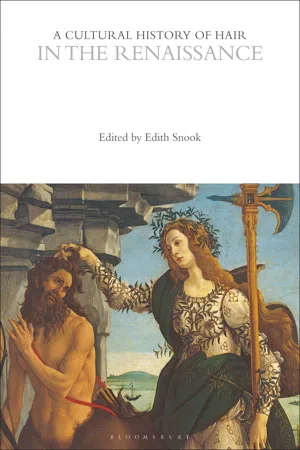
In the period 1450 to 1650 in Europe, hair was braided, curled, shaped, cut, colored, covered, decorated, supplemented, removed, and reused in magic, courtship, and art, amongst other things. On the body, Renaissance men and women often considered hair a signifier of order and civility. Hair style and the head coverings worn by many throughout the period marked not only the wearer's engagement with fashion, but also moral, religious, social, and political beliefs. Hair established individuals' positions in the period's social hierarchy and signified class, gender, and racial identities, as well as distinctions of age and marital and professional status. Such a meaningful part of the body, however, could also be disorderly, when it grew where it wasn't supposed to or transgressed the body's boundaries by being wild, uncovered, unpinned, or uncut. A natural material with cultural import, hair weaves together the Renaissance histories of fashion, politics, religion, gender, science, medicine, art, literature, and material culture.
A necessarily interdisciplinary study, A Cultural History of Hair in the Renaissance explores the multiple meanings of hair, as well as the ideas and practices it inspired. Separate chapters contemplate Religion and Ritualized Belief, Self and Society, Fashion and Adornment, Production and Practice, Health and Hygiene, Sexuality and Gender, Race and Ethnicity, Class and Social Status, and Cultural Representations.
- 232 pages
- English
- ePUB (mobile friendly)
- Available on iOS & Android
eBook - ePub
A Cultural History of Hair in the Renaissance
About this book
Information
CHAPTER ONE

Religion and Ritualized Belief
Hair has always held a range of religious and cultural meanings, and this is particularly true of the early modern period, a period of diverse approaches to religious reform and intense sectarian conflict. It was also the era of the notorious witch hunts. Hair played a role in all of these events, but given the vast array of authors and sources, we will be able to highlight merely a few examples drawn from prominent Reformation-era writers (Lutheran, Calvinist, and Anabaptist) and works relating to magic and witchcraft. It will become clear that hair was regarded as more than a symbol of the era’s gendered hierarchy; in popular culture it remained a marker of sexual wildness, demonic affiliation, and witchcraft. Before turning to these aspects, however, we will need to examine the biblical statements about hair since these were viewed as programmatic by both Renaissance humanists and sixteenth-century Reformers.
RELIGIOUS TEACHING AND MORALITY
Attitudes toward hair in the western tradition were shaped by both ancient culture and holy writ as well as by custom. Hair in the Hebrew scriptures had deeply religious significance. For example, in the description in Numbers 6 of the regulations for those Jewish men wishing to take a Nazirite oath to “separate himself to the Lord,” the growing of the hair is absolutely essential, along with abstinence from wine and avoidance of dead bodies, and it is only on the completion of the time of separation that the Nazirite must then “shave his consecrated head at the door of the tent of meeting, and shall take the hair from his consecrated head and put it on the fire” which is consuming the other peace offerings. The Hebrew hero Samson was a Nazirite from birth and it was in his long hair where his great strength lay. When Delilah cut off his seven locks, he lost his enormous strength because “the Lord had left him” (Judges 16: 20). Hair, then, could be a ritual sacrifice to Yahweh and a site of divine power or manliness.
In the Christian scriptures the emphasis was twofold. First, the writers cautioned against excessive attention on fashion, and second, they saw proper hair covering as a sign of the hierarchy inherent in Creation. The writer of 1 Peter warns women Christians to be chaste, and “let not yours be the outward adorning with braiding of hair” (1 Peter 3:3). They instead should focus on submission to their husbands rather than on beautification, a common enough sentiment in antiquity. Distinguishing sharply between male and female hair, the New Testament writers no longer identified long hair as a symbol of spiritual purity or holiness for men but as an essential sign of a woman’s submission to her husband. This is reinforced by Paul’s affirmation that women needed to cover their head while engaged in public worship:
But I want you to understand that the head of every man is Christ, the head of a woman is her husband, and the head of Christ is God. Any man who prays or prophesies with his head covered dishonours his head, but any woman who prays or prophesies with her head unveiled dishonours her head—it is the same as if her head were shaven. For if a woman will not veil herself, then she should cut off her hair; but if it is disgraceful for a woman to be shorn or shaven, let her wear a veil. For a man ought not to cover his head, since he is the image and glory of God; but woman is the glory of man … That is why a woman ought to have a veil on her head, because of the angels … is it proper for a woman to pray to God with her head uncovered? Does not nature itself teach you that for a man to wear long hair is degrading to him, but if a woman has long hair, it is her pride? For her hair is given to her for a covering. (1 Cor.11:3–15, RSV)
The apostle therefore affirms that proper hair length and veiling are requirements for Christians, and this became a general standard in the Christian West. This was epitomized in the requirement of religious women to be veiled, typically wearing a wimple that surrounded the face, while monks had the center of their heads shaved in a tonsure. Married women were expected to wear a head covering as a signal of their status, while prostitutes were forbidden in many communities from doing so.1 While Christians did not carry over the Hebrew injunction for men not to touch the corner of their beards (Leviticus 19:27), beards were often considered as signs of manhood or virility.
THE REFORMERS: MARTIN LUTHER AND JOHN CALVIN
The New Testament injunctions about hair and beard therefore remained normative in the early modern era, especially as Protestant Reformers sought to reshape religious and social customs along biblical precepts. None sought to overturn the traditional gendered hierarchy.2 Here we will survey the perspective of only four major figures: the German Martin Luther, the French-Genevan John Calvin, and the Dutch Anabaptist leaders Menno Simons and David Joris. Catholics did not alter the medieval norms on hair covering, as the Council of Trent increased the claustration of nuns and made no alterations to the wimple and veil as symbols of the nuns’ marriage to Christ.
On the subject of hair and hair covering for women, Luther was remarkably restrained. When interpreting Paul’s comments in 1 Timothy and 1 Corinthians, Luther moderates what he viewed as extreme applications of the apostle’s injunctions about hair. Women, Luther affirms, should dress appropriately, so that what they wear for church would not be the same as for a dance.3 Certainly “young unmarried women ought not to wear their locks braided but have a veil when they participate in the Sacrament.” Yet, he then comments, “I find no fault in our women. I could bear that young women come with their hair veiled, but this is contrary to custom. There should be modesty in dress.” He suggests that German women already follow Paul’s command, while others do not:
Paul wants women to veil their braids. Here there is no need to prohibit this practice. In France they wear their hair unbound and with open braids so that no one knows who is married or unmarried. Perhaps this is how Greek women wore their hair. Among our people married women veil their hair and braids. When they do this, they veil their locks chastely and modestly, so that it may not become material for watchers to think shameful thoughts.4
The expectation that married women would cover their hair to avoid sexually arousing their male neighbors is thus a commonplace that the Reformer believes needed little reinforcement. As to hair coverings in church services, Luther both affirms yet moderates Paul’s strictures, noting that, according to Paul’s statement in 1 Corinthians 11:5, women could still fulfill the office of prophet, as long as they covered their heads while doing so and kept silent when men spoke, “but if no man were to preach, then it would be necessary for the women to preach.”5
Elsewhere Luther reflected some aspects of popular culture with respect to hair. For example, in his commentary on the Song of Solomon, Luther pondered the biblical poet’s sexual wooing of his beloved. When the poet wrote “Your eyes are the eyes of doves behind your locks,” Luther took this to refer to hair hanging down to the eyes, something that “is singularly praiseworthy in a girl.”6 As with most commentators, Luther also pursues a metaphorical meaning, hence “the hair signifies the adornment of the priesthood, for in the church everything must be done decently and in order.” As for those who interpreted black hair “to imply a vile outward appearance,” Luther points to the positive reference in Song of Solomon 5:11 to show that “black hair was highly praised among them [the Jewish priesthood].” He also quotes Horace as saying a woman is, “worth looking at with dark eyes and black hair.”7 Following his allegorical vein, Luther interprets the long hair of women in Song of Solomon 7:5 to signify the Levite priesthood and government magistracy, the latter “flow from the high priest and king like hair from the top of the head, flowing down the back to the lower parts of the body.”8
All of this reveals that particular hairstyles for women were not a major concern for Luther, so long as married women wore hair covering in general and all women did so in church. John Calvin’s approach was not greatly different from Luther’s. In his commentary on 1 Timothy, Calvin advocates modesty and sobriety in dress and style. While “dress is an indifferent matter,” Calvin censures superfluity “such as curled hair, jewels, and golden rings.” The goal of any virtuous woman should be to distinguish herself from the style “of a strumpet.”9 As for Paul’s command about women in 1 Corinthians 11, Calvin agrees with St. Paul that when women pray or prophesy they must cover their heads as a sign of the subjugation of women to men. “Hence, on the other hand, if the woman uncovers her head, she shakes off subjection—involving contempt of her husband.” For a married woman to go about with head bare was therefore a form of rebellion against the patriarchal family.10 It was as if she had a shaven head, something that Calvin found abhorrent to nature, for “to see a woman shaven is a spectacle that is disgusting and monstrous.” Hair is certainly a natural covering for women but as a sign of beauty it should be hidden in public out of modesty.11 Just as a woman covers her head to show her subservience to her husband, he must not cover his head to proclaim that he is the master of the home and his wife. Turning this gender order upside down is what Paul meant about offending the angels: “if women uncover their heads, not only Christ, but all the angels too, will be witnesses of the outrage.” For Calvin, then, covering the hair was absolutely essential for pious women.
HAIR IN THE ANABAPTIST TRADITION
While the jury may still be out on the question of whether or not women experienced more freedom to play leading roles in the radical reformation after the early phase of the Anabaptist movement (ca. 1525–1535), which witnessed some women prophets and teachers, male leaders clamped down on further expressions of religious leadership on the part of their women colleagues and reasserted a traditional gender hierarchy.12 Even so, hair covering was not a major issue in the writings of Menno Simons (ca. 1496–1561), who, after the fall of the infamous Anabaptist kingdom of Münster in June 1535, eventually gained leadership over the peaceable remnant in the Low Countries. For both Joris and Menno, women were to be subservient to their husbands, but neither seemed deeply concerned about hair covering as a symbol of this subservience. Instead, Menno’s only published reference to hair referred back to the Samson and Delilah story as part of his argument with the Reformed preacher Martin Micron:
Dear me, if we poor folk were to abuse the Scriptures one-twentieth part as much as they do … and would pull the wool over the eyes of simple people as does Micron by his glosses, then (help, Lord) how they would turn up their noses at us … Nevertheless, however they teach and do; it is a welcome gospel to the poor, deceived world, as was commonly the case from the beginning with all false prophets and their followers. Let him break the bones of the Passover lamp and cut off Samson’s hair until the time comes that it is ended with him and he has to give an account before the Lord of his seducing.13
Here, then, Menno obliquely compares Micron to Delilah and the cutting of Samson’s hair to the persecution of Menno and his followers.
The Samson analogy was far more significant for Menno’s spiritualistic competitor David Joris (ca. 1501–1556) who between 1536 and the early 1540s was the major leader of the Dutch Anabaptists until his flight to Antwerp in 1539 and Basel (as Johann van Brugge) in 1544. In exile, Joris moved away from a sectarian identity and developed a spiritualism that depreciated all confessional distinctions in favor of an interiorized religion of the heart. A hunted heretic, Joris wrote dozens of tracts, treatises, and letters to interested parties across Europe. Unconstrained by formal education or theological orthodoxy...
Table of contents
- Cover
- Halftitle Page
- Title Page
- Contents
- List of Figures
- General Editor’s Preface
- Introduction
- 1. Religion and Ritualized Belief
- 2. Self and Society
- 3. Fashion and Adornment
- 4. Production and Practice
- 5. Health and Hygiene
- 6. Gender and Sexuality
- 7. Race and Ethnicity
- 8. Class and Social Status
- 9. Cultural Representations
- Notes
- Further Reading
- Contributors
- Index
- Imprint
Trusted by 375,005 students
Access to over 1.5 million titles for a fair monthly price.
Study more efficiently using our study tools.
Frequently asked questions
Yes, you can cancel anytime from the Subscription tab in your account settings on the Perlego website. Your subscription will stay active until the end of your current billing period. Learn how to cancel your subscription
No, books cannot be downloaded as external files, such as PDFs, for use outside of Perlego. However, you can download books within the Perlego app for offline reading on mobile or tablet. Learn how to download books offline
Perlego offers two plans: Essential and Complete
- Essential is ideal for learners and professionals who enjoy exploring a wide range of subjects. Access the Essential Library with 800,000+ trusted titles and best-sellers across business, personal growth, and the humanities. Includes unlimited reading time and Standard Read Aloud voice.
- Complete: Perfect for advanced learners and researchers needing full, unrestricted access. Unlock 1.5M+ books across hundreds of subjects, including academic and specialized titles. The Complete Plan also includes advanced features like Premium Read Aloud and Research Assistant.
We are an online textbook subscription service, where you can get access to an entire online library for less than the price of a single book per month. With over 1.5 million books across 990+ topics, we’ve got you covered! Learn about our mission
Look out for the read-aloud symbol on your next book to see if you can listen to it. The read-aloud tool reads text aloud for you, highlighting the text as it is being read. You can pause it, speed it up and slow it down. Learn more about Read Aloud
Yes! You can use the Perlego app on both iOS and Android devices to read anytime, anywhere — even offline. Perfect for commutes or when you’re on the go.
Please note we cannot support devices running on iOS 13 and Android 7 or earlier. Learn more about using the app
Please note we cannot support devices running on iOS 13 and Android 7 or earlier. Learn more about using the app
Yes, you can access A Cultural History of Hair in the Renaissance by Edith Snook in PDF and/or ePUB format, as well as other popular books in History & Fashion Design. We have over 1.5 million books available in our catalogue for you to explore.