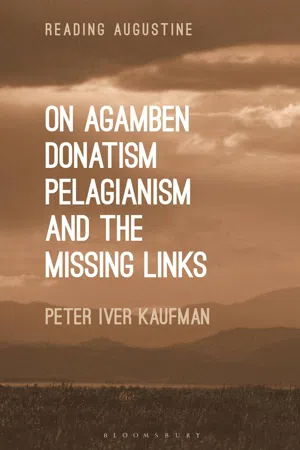
Peter Iver Kaufman shows that, although Giorgio Agamben represents Augustine as an admired pioneer of an alternative form of life, he also considers Augustine an obstacle keeping readers from discovering their potential. Kaufman develops a compelling, radical alternative to progressive politics by continuing the line of thought he introduced in On Agamben, Arendt, Christianity, and the Dark Arts of Civilization.
Kaufman starts with a comparison of Agamben and Augustine's projects, both of which challenge reigning concepts of citizenship. He argues that Agamben, troubled by Augustine's opposition to Donatists and Pelagians, failed to forge links between his own redefinitions of authenticity and "the coming community" and the bishop's understandings of grace, community, and compassion. On Agamben, Donatism, Pelagianism, and the Missing Links sheds new light on Augustine's "political theology," introducing ways it can be used as a resource for alternative polities while supplementing Agamben's scholarship and scholarship on Agamben.
- 160 pages
- English
- ePUB (mobile friendly)
- Available on iOS & Android
eBook - ePub
On Agamben, Donatism, Pelagianism, and the Missing Links
About this book
Information
1
Alternative Poleis: Touring with Giorgio Agamben
Come, my friends,
Tis not too late to seek a newer world.1
Our Way/Weigh In
Carl Schmitt’s time as an apologist for fascism takes a rather heavy toll on his reputation (Giorgio Agamben refers to him as famigerato: infamous or notorious), yet Schmitt could hardly be relegated to the back benches.2 From the wreckage of the Third Reich and from Schmitt’s reflections on law and sovereignty, political theorists for some time have been retrieving and underscoring his observation that sovereignty is necessarily linked with the power to suspend law and declare “a state of exception” or emergency. And, Agamben remarks, as the emergencies come to seem interminable, exceptions become rules empowering a sovereign—person, party, or elite—to exclude purportedly inferior or powerless others.3 Schmitt acknowledged as much; “the world,” he insisted, “will not be depoliticized.”4 Moreover, he prophesied, politics could not be “de-theologized.” Would-be omnicompetent statists invariably adapt theological formula to prompt and perpetuate awe among citizens and to ensure their obedience. Schmitt refers to such adaptations as “superficial secularization,” suspecting they were intended also to counter rivals to power who claimed to interpret impeccably the will of alternative, usually opposing deities.5 We will often refer to the issues of sovereignty, law, exception, and exclusion. They are central to Agamben’s analysis of current political practice, his gesturing toward a new politics, and this study’s sifting and reimagining poleis in which an innovative politics might thrive without discouraging what Agamben highly prized: singularity and potentiality. But some further consideration of “superficial secularization” (the sacralization of political theory and practice) seems timely. For one thing, Nicolas Howe only slightly exaggerates Schmitt’s influence when he docks him alongside Nietzsche and Durkheim, touting the three for having advanced a “time-honored tradition” that drops “political theology” into many religious studies curricula.6 And for another, religious rubrics and texts abound in Agamben’s recent work, characterized by critics and admirers alike as “secular messianism.”
The preternatural often authorized political protocols, and in many cultures still does. Schmitt judges that they gave sovereignty extra leverage. He derided political romanticists for the dreadful celebrations of billowing subjectivity attached to what he called their “fantasies of power,” of which the pretentions of The Tempest’s Prospero seemed emblematic.7 Nonetheless, Schmitt’s “superficial secularization,” as Roberto Esposito points out, relies on daunting mystifications to do as Prospero did: they enable sovereign powers to manufacture and then manipulate crises to their advantage, creating or declaring and sustaining states of exception while representing themselves as the mainstays of order. It is difficult to deny this strategy’s effectiveness, mapping the mainstream and defining the deviant. The purveyors of alternative protocols may not be overawed by the “superficial secularization,” but savvy sovereign powers tend to identify competing analyses of political practice with the crisis or emergency incumbent statists were providentially put in place to resolve—or at least keep at bay. As for the swarms of ordinary subjects or citizens, Esposito suggests that they generally see no option to obedience. But, on at least one count, Esposito seems overawed, allowing that the mystifications Schmitt identified were and are dramatic departures from previous practice.8
Unctions and anthems long endowed political ambitions with divine authority. Those who possessed power—or who obeyed them—were reassured for millennia by their priests’ rituals and prophets’ rhetoric. In the Christian traditions political practices that sometimes tilted toward the sordid were “redeemed” by theorists who, preferring political coherence to political conflict—and, arguably, to political morality—identified the standing order and those responsible for managing it with divine will. And apologists strained to cover over misfortune; less than a century after encomiast Eusebius of Caesarea rejoiced at Emperor Constantine’s conversion to the faith of his Christian subjects and awarded him quasi-divine status, Orosius, as the western parts of the empire disintegrated, revised subsequent emperors’ mission. A refugee from Spain, he put current adversities in the context of previous misfortunes and repackaged the idea in the Gospel of Luke that God had synchronized Jesus’s birth and Emperor Augustus’s order for a census (in which Mary and Joseph registered) to signal, notwithstanding setbacks, divine approval of the census, citizenship, and empire.9
As talk of—and nostalgia for—a “‘universal empire’ came to be eclipsed by talk of—and hopes for—a universal church in some circles, prelatical consecration of some secular sovereign powers came at a price, specifically, the increase of Church officials” prerogatives and privileges. From the eleventh century, bishops of Rome more insistently claimed the authority to referee the political disputes among secular princes. In the early fourteenth century, Dante Alighieri, poet and Florentine political operative, grew intensely angry about papal interference in Tuscan and Lombard politics. He hoped Emperor Henry VII’s descent from Aachen into Italy would bring some stability to the region by neutralizing the church’s influence. He confided that, as he first glimpsed Henry in Milan, he heard the line scripted for John the Baptist in the Gospel of John, receiving a revelation of sorts. Looking upon the emperor, Dante heard a mysterious voice whisper: “Behold the lamb of God who takes away the sin of the world.”10
To be sure, Dante’s bit of blasphemy hardly qualifies as “superficial secularization” but illustrates that theologically wired investments in political redemption have been made without (and as a protest against) established churches. Another Italian littérateur-turned-theologian-and-political-theorist, Giorgio Agamben, to whom you have already been introduced, shares Dante’s dismay. Christianity’s churches, as a rule, he complains, are implicated in their political cultures’ efforts to keep subjects from appreciating the extent of their captivity to sovereign powers and to keep them from discovering their uniqueness (or singularity) and potential as well as to dissuade them from innovating politically. He takes the polis as Schmitt described it, and he takes it as a problem. He adds that previous critics failed to recognize statists’ ruses, most notably a blood-stained mystification of the apparatuses and protocols (sanguinosa mistifacizione) over which sovereign powers presided. Marxists and anarchists alike were shipwrecked (naufragio); they failed to allow for the religious reefs beneath the secular surface of their orders.11 Agamben is sure that something messianic will be required to best the statists. But this messianic, though inspired by religious texts, will not originate with religious institutions, he says; the protests against spectacles that distract, protocols that dehumanize, and mystifications that beguile or intimidate cannot count on churches, mosques, or synagogues for backup.12
So Agamben casts off, much as Dante’s Ulysses does in the twenty-sixth canto of Inferno and as Ulysses leaves Ithaca a second time in Tennyson’s poem. And we shall eventually cast off from Agamben pages from now. But, touring with him for a time, we shall see why he was contemptuous of contemporary religious assemblies—thinking them closely associated with sovereign powers’ protocols. Religious piety had become part of the administrative strategies, networks, and discourses Agamben (borrowing from Gilles Deleuze and Michel Foucault) identifies as sovereignty’s oppressive apparatuses.13
Romano Guardini thought differently. He believed the “transcendental elements” Schmitt perceived in sovereign powers’ self-presentations gave Roman Catholicism purchase to counsel public officials and to plane the rougher edges of political practice. That possibility attracted leading prelates to Guardini’s work, including Popes Benedict XVI and Francis I.14 Schmitt, however, was having none of that late in his career. Catholicism sprung no surprises during the twentieth century, he protested; prelates accommodated every political order, offering few and muted protests. He predicted Christianity would continue on that trajectory unless economic upheaval undermined statist policies.15 On that count Agamben agrees; religion would neither insinuate itself as a rigorously moral monitor into the prevailing juridico-political systems and reform conventional political practices, nor promote a new politics. Protagonists of Agamben’s new politics would come from the rank of refugees (Flüchtlinge und Staatenlose). They would resemble the powerless about whom Jesus ostensibly preached in his Sermon on the Mount.16 But because sovereign powers’ “state[s] of exception” became the rule—a permanent, global “state of exception” (ha raggiunto oggi il suo massimo dispiegamento planetario)—Agamben sometimes writes despairingly and appears close to adopting the spirit of resignation that he took to be characteristic of the fatalism of the most despondent inmates of internment camps. Still, he writes to sound an alarm; sovereign powers’ protocols and apparatuses, he professes, will be as lethal as the murderous machines devised by fascists (una macchina letale).17
Alarmism? Agamben’s warning may seem overwrought, yet he accepts Schmitt’s analysis that enmity animated every political practice and that constitutional principles only look liberating. In reality, he suspects, they bundle phobias into articles, which express a thinly veiled desire to exclude vulnerable others. Sovereign powers, on Schmitt’s watch, were persuaded that homogeneity and conformity were preconditions for solidarity. And law in the service of order ventilated hostilities by grabbing or expropriating what belonged to the excluded, be they conquered tribes or ethnic others within. There was no upside for the excluded. They were marginalized, kenneled, deported, or exterminated—and always dehumanized. For humanity was reserved for obedient citizens, who trusted sovereign powers’ decisions and the juridico-political apparatuses.18
Following Foucault, Agamben refers to this take on citizenship, which “inscribes life” into the state, as part of biopolitics, the capture and captivity of life by and in sovereign powers’ juridical protocols. Agamben’s could be construed as a deluxe version of such criticism, which excoriates Schmitt’s apotheosis of sovereignty and associates divinization and dehumanization with current political practice or, as Foucault would have had it, with “biopower” fostering life, though, to Agamben’s mind, subtly channeling life into prescribed “forms of li...
Table of contents
- Cover
- Halftitle Page
- Title Page
- Contents
- Preface
- Acknowledgments
- 1 Alternative Poleis: Touring with Giorgio Agamben
- 2 Agamben, Augustine, and Compassion
- 3 Agamben, Augustine, and Grace
- Conclusion
- Further Reading
- Index
- Imprint
Trusted by 375,005 students
Access to over 1.5 million titles for a fair monthly price.
Study more efficiently using our study tools.
Frequently asked questions
Yes, you can cancel anytime from the Subscription tab in your account settings on the Perlego website. Your subscription will stay active until the end of your current billing period. Learn how to cancel your subscription
No, books cannot be downloaded as external files, such as PDFs, for use outside of Perlego. However, you can download books within the Perlego app for offline reading on mobile or tablet. Learn how to download books offline
Perlego offers two plans: Essential and Complete
- Essential is ideal for learners and professionals who enjoy exploring a wide range of subjects. Access the Essential Library with 800,000+ trusted titles and best-sellers across business, personal growth, and the humanities. Includes unlimited reading time and Standard Read Aloud voice.
- Complete: Perfect for advanced learners and researchers needing full, unrestricted access. Unlock 1.5M+ books across hundreds of subjects, including academic and specialized titles. The Complete Plan also includes advanced features like Premium Read Aloud and Research Assistant.
We are an online textbook subscription service, where you can get access to an entire online library for less than the price of a single book per month. With over 1.5 million books across 990+ topics, we’ve got you covered! Learn about our mission
Look out for the read-aloud symbol on your next book to see if you can listen to it. The read-aloud tool reads text aloud for you, highlighting the text as it is being read. You can pause it, speed it up and slow it down. Learn more about Read Aloud
Yes! You can use the Perlego app on both iOS and Android devices to read anytime, anywhere — even offline. Perfect for commutes or when you’re on the go.
Please note we cannot support devices running on iOS 13 and Android 7 or earlier. Learn more about using the app
Please note we cannot support devices running on iOS 13 and Android 7 or earlier. Learn more about using the app
Yes, you can access On Agamben, Donatism, Pelagianism, and the Missing Links by Peter Iver Kaufman in PDF and/or ePUB format, as well as other popular books in Philosophy & Ethics & Moral Philosophy. We have over 1.5 million books available in our catalogue for you to explore.