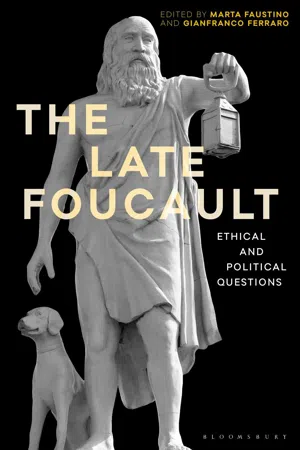
Michel Foucault is one of the most important and controversial thinkers of the twentieth century and one of the leading figures in contemporary Western intellectual life and debate. The recent publication of his last lecture courses at the Collège de France (1981-1984), together with the short texts, essays, and interviews from the same period, have sparked new interest in his work, allowing for a new understanding of his philosophical trajectory and challenging several interpretations produced over the last few decades.
In this later phase of his thinking, Foucault deepens and expands the course of his preceding works on the genealogy of subjectivity, while at the same time adding a significant ethical and political dimension to it. His focus on the ancient ethics of care of the self and technologies of self-constitution during this period adds important nuances to his previous positions on power, truth, and subjectivity, shedding new light on his philosophical endeavour as a whole and situating his reflections at the centre of current moral debates.
Focusing on the last stage of Foucault's thought, this book brings together international scholars to relaunch the critical debate on the significance of Foucault's so-called "ethical turn" and to discuss the ways in which the perspectives offered by Foucault in this period might help us to unravel modernity, giving us the tools to understand and transform our present, ethically and politically.
- 296 pages
- English
- ePUB (mobile friendly)
- Available on iOS & Android
eBook - ePub
About this book
Information
Part One
Philosophical Practices, Philosophy as Practice
1
Foucault’s Reinvention of Philosophy as a Way of Life:
Genealogy as a Spiritual Exercise
Michael Ure
This chapter examines Michel Foucault’s research on Greco-Roman philosophy. What is the significance of his “trip” to antiquity for modern ethics? The first section surveys his itinerary. It shows how he challenges conventional histories of philosophy by conceiving ancient philosophies as practices of the self or ways of life rather than simply as theoretical doctrines. Like Ilsetraut and Pierre Hadot, Foucault contributes to modern ethical reflection by rediscovering this ancient philosophy as an ethical work of the self on itself. Ancient philosophy is meant to form rather than merely inform the subject.1 Foucault adds an important qualification to this claim. Ancient philosophy, he suggests, also invented a new cultural type: viz., the philosophical hero. In doing so, he implies, it sublimated the archaic ideal of a beautiful existence exemplified by Greek heroes like Achilles and Odysseus. Cynicism, he claims, epitomized this ancient philosophical heroism. Foucault shows how ancient Cynics aimed to realize the beauty of invulnerability or sovereignty, but through the new means of living the truth. Cynics, as he conceives them, linked together the beautiful existence and the true life by publically displaying and boldly proclaiming their total sovereignty. Living the truth made the Cynic the true sovereign.
In the second section, I briefly examine why Foucault aims to reinvent philosophy as a way of life. Foucault argues that from roughly the sixteenth century onward, this model of ancient philosophy was practiced only on the margins of academic philosophy. Despite its marginality, he nevertheless claims that ancient philosophy, especially Cynicism and Roman Stoicism, constitutes a decisive moment in the history of thought that is “still significant for our modern mode of being” (Foucault 2005: 9). One of Foucault’s central claims about the significance of ancient philosophy is that it may help us address what he sees as a contemporary problem: the absence of a principle of ethics in the context of skepticism about founding our actions on religious decrees or allegedly scientific notions of normality.2 Foucault, we might say, looks to antiquity to develop a contemporary ethics without absolute obligations or sanctions. This a relatively uncontroversial description of Foucault’s late work, even if his ambition of reconstituting the ancient philosophical model remains deeply controversial.3
In the final section, however, I question whether Foucault’s own philosophical ethos reclaims, as he implies, “the living substance of ancient philosophy” (Foucault 1986: 9). It shows that he conceives Nietzschean genealogy as his own philosophy’s “spiritual exercise.” Genealogy, as he puts it, aims to introduce discontinuity into our being. This section demonstrates that Foucault’s genealogical practice of self-dissolution necessarily opposes the basic goal of ancient ethics: self-sufficiency or sovereignty. Taking this Nietzschean slant on Foucault’s philosophical ethos suggests that it does not refashion the ancient practices of the self. Rather, I argue that Foucault’s trip to antiquity unintentionally brings to light how contemporary subjectivity is partly constituted by a “chiastic” crossing of the ancient ethics of self-completion and the modern ethics of self-dissolution.
Philosophical Heroism
Foucault’s intellectual histories apply what he calls a genealogical knowledge or effective history, which, as he defines it, “is not made for understanding, but for cutting” (Foucault 1984: 88). “Knowledge,” as he explains, “even under the banner of history, does not depend on ‘rediscovery’, and it emphatically excludes the ‘rediscovery of ourselves’. History becomes ‘effective’ to the degree that it introduces discontinuity into our very being … ‘Effective’ history deprives the self of the reassuring stability of life and nature … It will uproot its traditional foundations and relentlessly disrupt its pretended continuity” (Foucault 1984: 88). Foucault’s genealogy lacerates our subjectivity by exposing these ontological discontinuities. In his late works, Foucault applies this genealogical method specifically to the history of ancient philosophy.
In contrast with other major interpretive traditions, by adopting a genealogical approach to the history of philosophy, Foucault aims to show that what counts as “philosophy” is historically variable. In the early 1980s Foucault characterized his overarching research program as the history of “ ‘the games of truth’ ,” through which “being is historically constituted as experience” (Foucault 1986: 6–7). Foucault distinguishes among different philosophical practices in terms of the different relationships they established between truth and subjectivity. Foucault therefore rejects the idea we can treat ancient philosophies as early stages in the progressive development of universal reason, or analyze their arguments as answers to perennial philosophical questions. He eschews what we might broadly call these Hegelian-Marxist and contemporary “analytic” approaches to the history of philosophy. Foucault’s goal is to circumscribe the historically specific forms and practices of ancient philosophies rather than seeing them through the lens of these modern models of philosophy.
Following Pierre Hadot, Foucault distinguishes ancient philosophies as practices of the self or as ways of life.4 Hadot had sought to recapture ancient philosophy “in its original aspect: not as a theoretical construct, but as a method for training people to live and look at the world in a new way. It is an attempt to transform mankind” (Hadot 1995: 107). Foucault affirms Hadot’s central claim that “philosophy in antiquity was a spiritual exercise” (Hadot 1995: 104).5 In his lectures during the 1980s at the Collège de France, he brings into sharp relief how the schools deployed both philosophical doctrines and spiritual exercises as means of giving form to life. Foucault identifies ancient philosophy itself as a kind of bio-technique, or a work ancient philosophers undertook on themselves to transform their own mode of being. As he conceives it, ancient philosophy is a voluntary and deliberate form of self-cultivation; the goal of the ancient philosophical schools is not theoretical knowledge alone, but the transformation or conversion of the self to realize a higher or “other” mode of existence (e.g. Foucault 2011: 244–5, 287). For this reason, he does not formulate a history of philosophical theories or doctrines, nor does he focus on analyzing the validity of the arguments of ancient logic, physics or ethics. Rather, as he declares, he seeks to sketch “a history of forms, modes, and styles of life, a history of the philosophical life … as a mode of being and as a form both of ethics and heroism” (Foucault 2011: 210).
We can begin to unpack the significance Foucault attributes to his research for modern ethics by briefly sketching his account of the genesis of this ancient model of philosophy as technology of the self or spiritual exercise. To understand ancient philosophy on its own terms and distinguish it from later models of philosophical practice, he argues, we need to recognize how it recast fundamental aspects of archaic, pre-philosophical culture. Let us briefly consider his account of how ancient philosophy transmuted archaic cultural practices. In The Hermeneutics of the Subject (1981–2) lecture series, Foucault argues that we can conceive ancient philosophy as a synthesis of the philosophical goal of delimiting what makes it possible for the subject to access the truth and what he identifies as the “pre-philosophic theme” of “spirituality” (Foucault 2005: 15). How is “spirituality” woven into the fabric of ancient philosophy? Foucault identifies two distinct elements of pre-philosophic “spirituality”: (a) the conditions of access to truth and (b) the effects of obtaining truth.
In the first case, he defines spirituality as “the search, practice and experience through which the subject carries out the necessary transformations on himself in order to have access to the truth” (Foucault 2005: 46). Spirituality establishes a particular relationship between truth and subjectivity: viz., “there can be no truth without a conversion or transformation of the subject” (Foucault 2005: 15). “Spirituality,” he explains, “postulates that the truth is never given to the subject by right … [or] by a simple act of knowledge … that for the subject to have the right of access to the truth he must be changed, transformed, shifted, and become … other than himself” (Foucault 2005: 15). Ancient philosophy, he claims, took up the archaic practice of “spirituality” by assuming “that a subject could not have access to the truth if he first did not operate upon himself a certain work which would make him susceptible to knowing the truth—a work of purification, conversion of the soul by contemplation of the soul itself” (Foucault 1984: 371). Here Foucault embroiders on Pierre and Ilsetraut Hadot’s account of ancient philosophy and its “spiritual exercises.”
Both take the view that spiritual exercises or technologies of the self make possible “a profound transformation of the individual’s mode of see...
Table of contents
- Cover
- Half-Title Page
- Series Page
- Title Page
- Contents
- Acknowledgments
- Introduction: Another Word on Foucault’s Final Words
- Part 1 Philosophical Practices, Philosophy as Practice
- 1 Foucault’s Reinvention of Philosophy as a Way of Life: Genealogy as a Spiritual Exercise
- 2 Self or Cosmos: Foucault versus Hadot
- 3 The Great Cycle of the World: Foucault and Hadot on the Cosmic Perspective and the Care of the Self
- Part 2 Care of the Self, Care of Others
- 4 Foucault According to Stiegler: Technics of the Self
- 5 Notes Towards a Critical History of Musicalities: Philodemus on the Use of Musical Pleasures and the Care of the Self
- 6 Foucault’s Ultimate Technology
- Part 3 Ontology of the Present, Politics of Truth
- 7 The Care of the Present: On Foucault’s Ontological Machine
- 8 Agonistic Truth: The Issue of Power Between the Will to Knowledge and Government by Truth
- 9 From Jurisdiction to Veridiction: The Late Foucault’s Shift to Subjectivity
- Part 4 Government of Self, Government of Others
- 10 Understanding Power Through Governmentality
- 11 On Authority: A Discussion Between Michel Foucault and Hannah Arendt
- 12 Neoliberal Subjectivity at the Political Frontier
- Part 5 Truth-Telling, Truth-Living
- 13 Rethinking Confession
- 14 Truth-Telling as Therapeutic Practice: On the Tension Between Psychiatric Subjectivation and Parrhesiastic Self-Cultivation
- 15 Foucault, the Politics of Ourselves, and the Subversive Truth-Telling of Trauma: Survivors as Parrhesiasts
- List of Contributors
- Index
- Copyright
Trusted by 375,005 students
Access to over 1.5 million titles for a fair monthly price.
Study more efficiently using our study tools.
Frequently asked questions
Yes, you can cancel anytime from the Subscription tab in your account settings on the Perlego website. Your subscription will stay active until the end of your current billing period. Learn how to cancel your subscription
No, books cannot be downloaded as external files, such as PDFs, for use outside of Perlego. However, you can download books within the Perlego app for offline reading on mobile or tablet. Learn how to download books offline
Perlego offers two plans: Essential and Complete
- Essential is ideal for learners and professionals who enjoy exploring a wide range of subjects. Access the Essential Library with 800,000+ trusted titles and best-sellers across business, personal growth, and the humanities. Includes unlimited reading time and Standard Read Aloud voice.
- Complete: Perfect for advanced learners and researchers needing full, unrestricted access. Unlock 1.5M+ books across hundreds of subjects, including academic and specialized titles. The Complete Plan also includes advanced features like Premium Read Aloud and Research Assistant.
We are an online textbook subscription service, where you can get access to an entire online library for less than the price of a single book per month. With over 1.5 million books across 990+ topics, we’ve got you covered! Learn about our mission
Look out for the read-aloud symbol on your next book to see if you can listen to it. The read-aloud tool reads text aloud for you, highlighting the text as it is being read. You can pause it, speed it up and slow it down. Learn more about Read Aloud
Yes! You can use the Perlego app on both iOS and Android devices to read anytime, anywhere — even offline. Perfect for commutes or when you’re on the go.
Please note we cannot support devices running on iOS 13 and Android 7 or earlier. Learn more about using the app
Please note we cannot support devices running on iOS 13 and Android 7 or earlier. Learn more about using the app
Yes, you can access The Late Foucault by Marta Faustino,Gianfranco Ferraro in PDF and/or ePUB format, as well as other popular books in Philosophy & Ethics & Moral Philosophy. We have over 1.5 million books available in our catalogue for you to explore.